

If you are asking how to start your own ABA practice, do not begin with a logo or a rented office. Begin with a service model, a legal and credentialing plan, a clinical-quality system, and enough cash runway to survive the delay between setup and reliable payment. A BCBA may understand behavior analysis very well and still need separate help with business formation, state rules, payer credentialing, billing, privacy, employment, and taxes.
Table of Contents
- How to Start Your Own ABA Practice: Is It Ready?
- What Service Model Should You Choose?
- What Business and Credentialing Foundation Do You Need?
- What Clinical Systems Must Exist Before the First Client?
- How Do You Model Startup Cash Flow?
- When Should You Launch or Pause?
- What Startup Mistakes Should You Avoid?
- Frequently Asked Questions
- Sources for Further Study
- Take the Free BCBA Mock Exam
There is no single national startup checklist that makes an ABA practice ready in every state. The BACB provides certification and ethics resources, but state boards, payers, employers, and local authorities may impose additional requirements. This roadmap helps you sequence the work and identify what to verify; it is not legal, tax, billing, or financial advice.
Short answer: define what you will provide, verify whether and where you may provide it, build the business and payer foundation, install clinical and privacy systems, and launch only when quality and cash-flow safeguards are ready. A small practice can start with one BCBA and a narrow scope. It still needs a real system for consent, documentation, supervision, data, emergencies, and billing.
How to Start Your Own ABA Practice: Is It Ready?
Starting an ABA practice is a professional-service decision, not only a business-registration decision. Before spending on branding or software, write one page that answers five questions:
- Who will you serve? Define age range, referral profile, geography, language access, and the populations you are competent to support.
- What will you provide? Decide whether the initial offer is assessment, BCBA consultation, parent training, supervision, direct services, telehealth, staff training, or a carefully limited combination.
- Where will services occur? Home, clinic, school, community, telehealth, or a hybrid model each creates different consent, privacy, travel, staffing, and emergency questions.
- Who will perform each role? A solo BCBA, contractors, RBT employees, administrative staff, billers, and clinical supervisors create different responsibilities and risks.
- How will quality be measured? Choose the client outcomes, treatment-integrity checks, documentation reviews, supervision contacts, and complaint or incident process you will use.
If the answer is “everyone, everywhere, and every service,” the scope is not ready. A narrow first model is easier to credential, explain to referral sources, staff, document, and audit. It can expand after the clinical and administrative systems work reliably.
What Service Model Should You Choose?
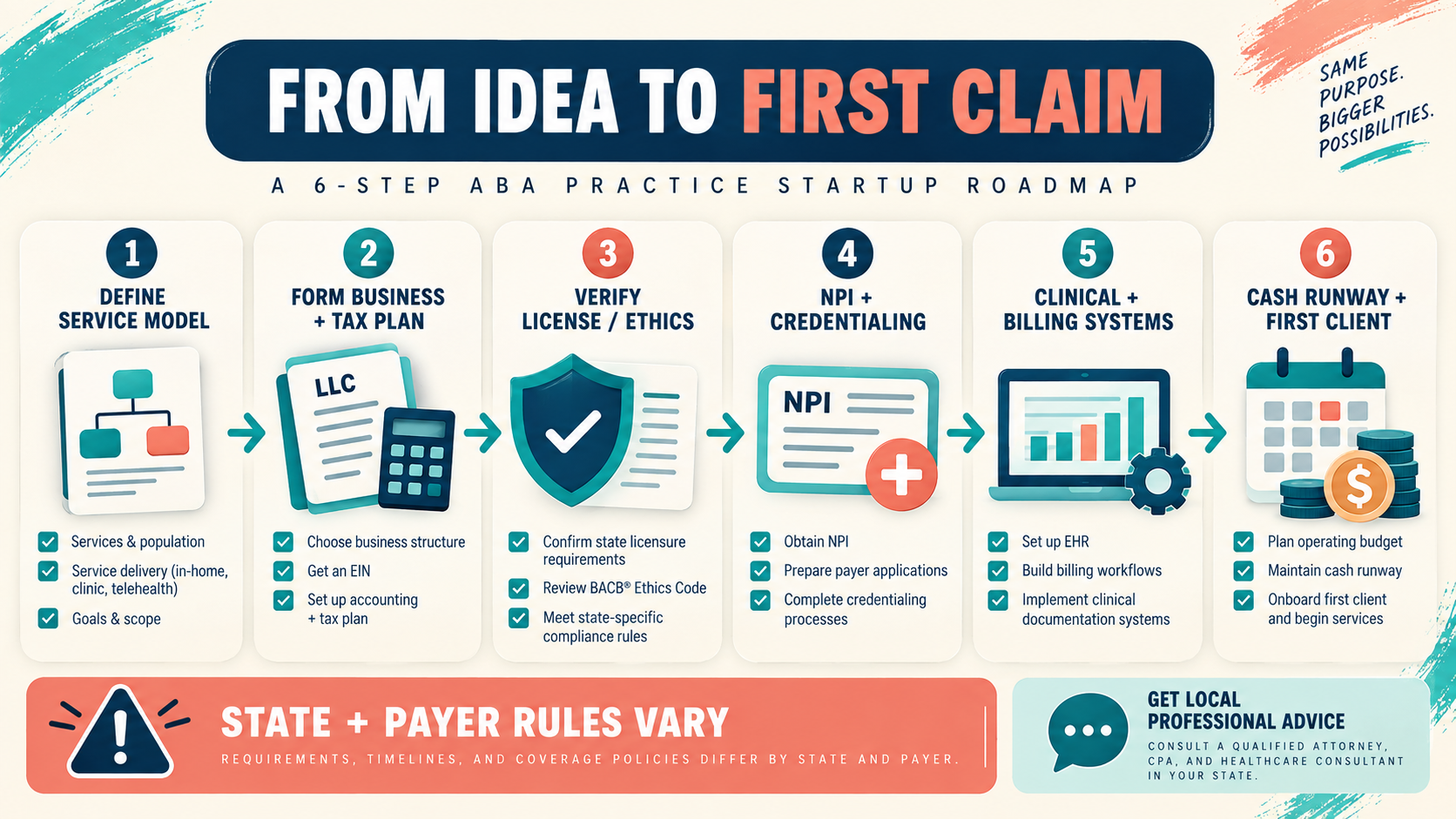
Your service model determines much of the startup workload. A solo private-pay consultation practice is not the same business as an insurance-funded clinic with RBT employees. Neither model is automatically better; the right choice depends on competence, demand, resources, payer access, and the level of responsibility you are prepared to carry.
| Model | Early advantage | System you must solve first |
|---|---|---|
| Solo consultation or parent training | Small scope and fewer staffing layers | Consent, scheduling, documentation, payment, and scope-of-practice boundaries |
| In-home or community services | Natural-environment service option and local referral fit | Travel, safety, incident response, staff coverage, and data access outside an office |
| Clinic or center | Shared space and concentrated operational routines | Lease, staffing, safety, utilization, privacy, maintenance, and emergency procedures |
| Insurance-funded group practice | Potential referral and reimbursement channel | Credentialing, authorizations, claims, audits, payroll, and payer-specific rules |
| Telehealth or hybrid | Geographic flexibility and lower physical-space needs | Jurisdiction, consent, technology, privacy, client fit, and emergency-location procedures |
Choose the smallest model that can deliver the outcomes you promise. “Small” does not mean informal. Even a solo practice needs written policies and a reliable record system.
What Business and Credentialing Foundation Do You Need?
Work on the business and credentialing tracks in parallel. A typical sequence looks like this, but the correct order can change by state and payer:
- Get local professional advice. Ask a business attorney and tax professional about entity choice, ownership, contracts, employment, independent-contractor classification, taxes, and record retention. Do not copy another practice’s LLC or contract language without review.
- Verify state and local rules. Check the state behavior-analyst board, health department, business-registration office, local zoning authority, and any telehealth or facility requirements. A BCBA certification is not the same thing as a state license or permission to operate every service model.
- Clarify the NPI structure. CMS distinguishes Type 1 individual NPIs from Type 2 organization NPIs. The correct structure depends on the provider and organization arrangement. CMS also warns that an NPI does not prove that a provider is licensed or credentialed and does not guarantee payment.
- Build the credentialing file. Collect certification records, state licenses, malpractice coverage, education, work history, disclosures, taxonomy information, ownership information, and practice locations. Keep one controlled version of the information so applications do not contradict one another.
- Decide how you will bill. Private pay, employer contracts, Medicaid, commercial insurance, and school or agency contracts have different documentation and payment rules. If you use a clearinghouse, billing service, or practice-management platform, define who owns claim corrections and access to the source record.
- Set up secure administration. Use role-based access, strong authentication, a written privacy process, a business email, a secure record system, and a documented backup plan. Avoid mixing client information with personal devices and informal messaging.
CAQH’s provider data portal is used by participating organizations to collect practice and professional information for credentialing, claims administration, directory services, and related workflows. It can reduce repeated paperwork, but a complete profile is not the same as acceptance by a payer. Each payer still controls its own enrollment and contracting process. The BACB’s Ethics Code resources should stay visible while you build the business. Ownership does not remove professional duties around competence, client welfare, confidentiality, conflicts, documentation, supervision, or truthful representation.
What Clinical Systems Must Exist Before the First Client?
A practice is not ready because it has a provider number or a website. Before services begin, create a minimum viable clinical system that a second professional could understand and audit:
- Intake and consent: referral screening, informed consent, assent when applicable, releases of information, service limits, and a process for declining a poor-fit referral.
- Assessment and treatment planning: assessment selection, operational definitions, socially meaningful goals, baseline, medical-necessity or payer documentation when applicable, and review dates.
- Data and progress review: measurement definitions, source data, graphing, treatment-integrity checks, clinical decision rules, and a way to correct errors without hiding the original record.
- Supervision and competency: role definitions, supervisor availability, feedback, staff competency checks, escalation, and a schedule for reviewing whether the plan is working.
- Safety and emergency response: who receives urgent calls, what happens if a client is at risk, how the practice handles a crisis outside service hours, and how incidents are documented.
- Privacy and technology: secure communication, access controls, record retention, device management, and a clear response to a breach or lost device.
- Closing or transferring care: notice, record transfer, referrals, outstanding claims, family communication, and continuity planning.
These systems are part of the product you are selling. Families and referral sources are not only buying hours; they are trusting your practice to make careful decisions, communicate clearly, protect information, and respond when the plan needs to change.
How Do You Model Startup Cash Flow?
Do not use a single “startup cost” number copied from another clinic. Build a simple model with three layers:
- One-time setup: formation, professional advice, licenses, deposits, equipment, initial software, credentialing support, and policy development.
- Monthly fixed overhead: payroll or owner draw, rent, software, insurance, bookkeeping, billing, phone, internet, supervision, and administrative support.
- Variable delivery costs: staff hours, travel, materials, subcontractors, payment processing, and services that rise with client volume.
A useful runway estimate is:
Cash runway target = one-time setup + (monthly fixed overhead × months until dependable receipts) + contingency
Use conservative assumptions. Credentialing can take time, claims may be delayed or denied, and a new caseload rarely fills on the day a practice opens. Model a slow first month, a delayed payer payment, a staff vacancy, and a client who pauses services. Then ask an accountant or financial adviser to review the assumptions.
Separate clinical capacity from billable capacity. A full calendar does not guarantee a healthy practice if documentation, supervision, authorization, or collections are falling behind. Track leading indicators such as referral-to-intake time, authorization status, completed notes, claim acceptance, days in accounts receivable, staff turnover, and client outcomes.
When Should You Launch or Pause?
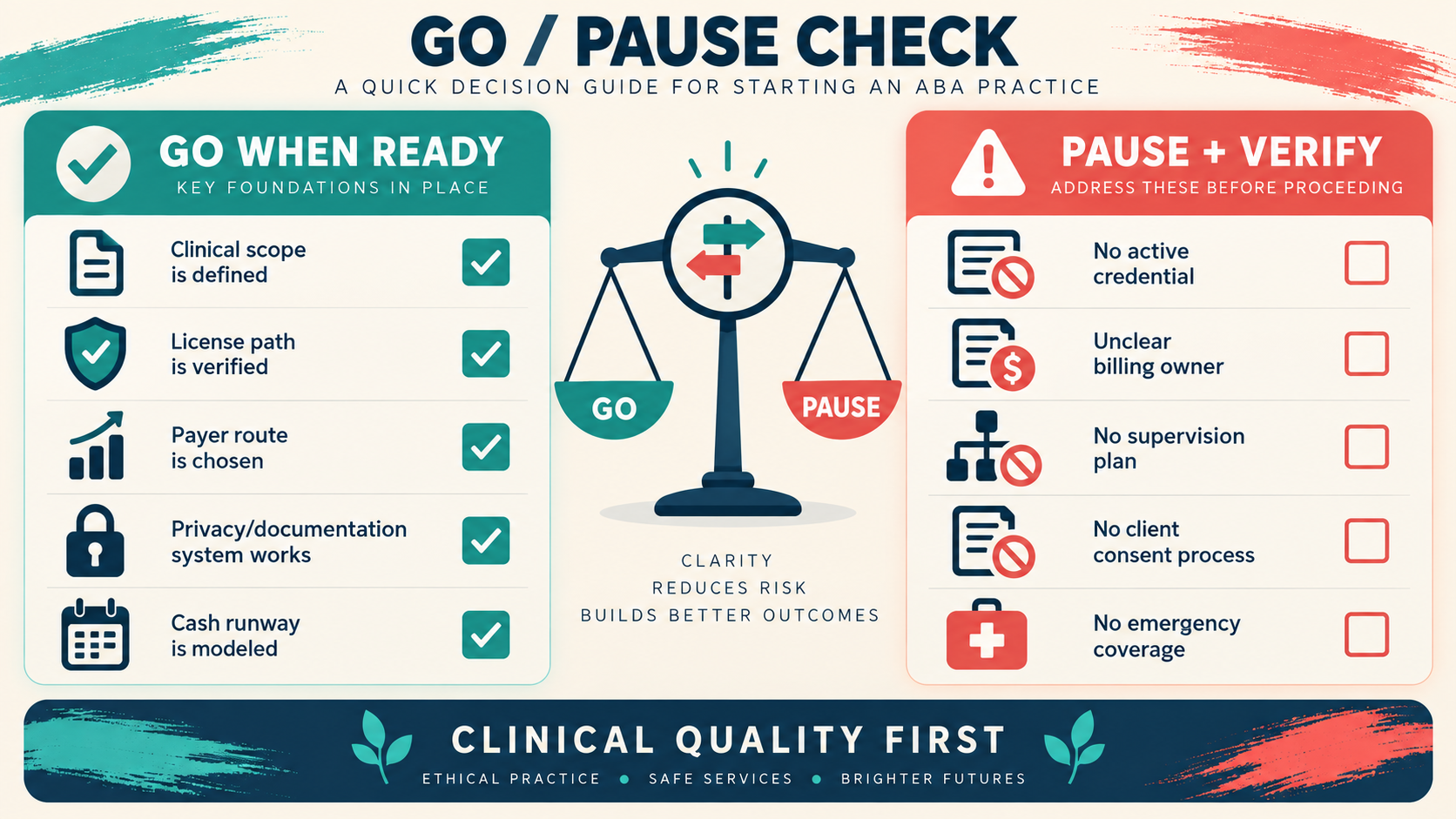
Use a go or pause decision before accepting the first client. You can launch a narrow service line when the following are verified:
- Your service scope matches your competence, license path, and available supervision.
- The entity, contracts, insurance, privacy process, and record system are ready for the services offered.
- You know who can provide each service and who covers an absence or emergency.
- Your intake, consent, assessment, treatment-plan, data, and discharge workflows are usable.
- You can explain the payer or private-pay process, expected timing of receipts, and client financial responsibility.
- You have enough runway to protect clinical decisions from short-term cash pressure.
Pause when the practice would need to serve clients before a credential, contract, consent process, emergency plan, or secure documentation system is in place. A delayed launch is easier to recover from than an avoidable privacy incident, unsupported treatment plan, denied claim, or abrupt service interruption.
What Startup Mistakes Should You Avoid?
- Starting with branding instead of scope. A polished website cannot resolve unclear services, populations, or clinical responsibility.
- Treating an NPI as permission to practice. CMS states that an NPI does not prove licensure or credentialing and does not guarantee payment.
- Using a copied policy manual. Policies must match your state, service model, staff, technology, and actual workflow.
- Hiring before modeling supervision and payroll. Employees create obligations even when referrals or reimbursements are slower than expected.
- Accepting every referral. A poor clinical fit can damage client outcomes, staff capacity, trust, and finances.
- Leaving billing until after service begins. Confirm authorization, coding, documentation, claim ownership, and denial follow-up before the first billable session.
- Confusing independence with isolation. A business owner still needs consultation, peer review, legal advice, accounting support, and a plan for clinical escalation.
Frequently Asked Questions
Can any BCBA start an ABA practice?: A BCBA may have a pathway to independent practice, but the ability to operate a specific business or service model depends on certification, state or local rules, payer requirements, competence, and the services offered. Verify the exact plan with the relevant authorities and qualified professionals.
Do I need an LLC to start an ABA practice?: Not necessarily. Entity choice is a legal and tax decision that depends on ownership, liability, tax treatment, contracts, and state rules. Ask an attorney and tax professional before forming or changing an entity.
Do I need an NPI for an ABA practice?: Covered health care providers use NPIs in HIPAA standard transactions, but the correct individual or organization structure depends on the provider arrangement. An NPI is not a license, credential, payer contract, or payment guarantee.
Can I run a private-pay ABA practice without insurance credentialing?: Some practices choose a private-pay model, but the rules, disclosures, contracts, and client financial responsibilities still need review. Private pay also does not remove clinical, privacy, state, or ethical obligations.
How long does it take to open an ABA practice?: There is no universal timeline. Entity setup, state permissions, credentialing, payer enrollment, hiring, space, technology, referrals, and cash flow can each become the slowest step. Build a dependency-based timeline instead of promising a fixed number of days.
Is opening an ABA practice part of the BCBA exam?: Practice ownership is not a substitute for BCBA exam preparation, and a business roadmap should not be presented as official exam content. Prepare for the exam with the current BACB materials and use business planning as a separate professional-development project.
Sources for Further Study
- BACB BCBA Ethics Resources — current BCBA certification and ethics resource hub.
- BACB Ethics Codes — ethics standards for applicants and certificants.
- CMS: National Provider Identifiers — NPI purpose and HIPAA transaction context.
- CMS NPI FAQs — individual versus organization provider categories and limitations.
- CAQH Provider Data Portal User Guide — provider and practice information used by participating organizations.
- ABA Practice Services: Credentialing Roadmap — competitor example focused on NPI, CAQH, and payer sequencing.
- CentralReach: ABA Practice Roadmap — competitor example covering service-model and business-planning questions.
Once the practice plan is separated from certification study, use the free BCBA mock exam to practice applying exam concepts. It is a study tool, not a substitute for legal, tax, payer, or clinical consultation.
Take the Free BCBA Mock Exam
If you want a low-pressure way to check your recall, use the free practice resource below. Take the Free BCBA Mock Exam



