
Professional boundaries in ABA are not a single rule about being distant. They are an ongoing system for keeping roles clear, protecting privacy, reducing conflicts of interest, and making sure client welfare—not personal convenience—drives decisions. Maintenance means checking the small choices before they become a pattern.
Table of Contents
- What Professional Boundaries Protect in ABA
- How to maintain professional boundaries ABA: Start With the Role, Not the Feeling
- Use a Boundary Maintenance Loop
- Control the Small Decisions That Create Boundary Drift
- Document, Consult, and Review the Boundary
- What to Do When the Boundary Starts to Drift
- Maintain Boundaries in Home, Community, and Telehealth Settings
- Common Exam and Practice Traps
- Frequently Asked Questions
- Sources and Verification Notes
- Take the Free BCBA Mock Exam
People searching for how to maintain professional boundaries ABA often want examples about gifts, social media, home sessions, or personal conversations. Those examples are useful, but the durable skill is a repeatable process: define the role, use approved channels, check for drift, consult early, document the decision, and review what happened.
This guide is an educational workflow for ABA teams. The current BACB ethics-code index and the current Ethics Code for Behavior Analysts remain the authority. Employer policies, licensure rules, funder requirements, and role-specific codes may add requirements. This article is not legal advice or case-specific ethics consultation.
What Professional Boundaries Protect in ABA
A professional boundary separates the service role from personal, financial, familial, social, or other roles that could influence judgment. It does not require a BCBA or RBT to be cold. Warmth, cultural responsiveness, clear explanations, collaboration, and respectful rapport can all fit inside a professional relationship.
The boundary becomes a concern when another role creates divided loyalty, unequal influence, privacy risk, pressure to provide special treatment, or difficulty ending or changing services. The current BACB Code addresses these concerns through connected standards rather than one isolated “boundary rule.” Multiple relationships, gifts, communication, confidentiality, competence, informed consent, and documentation can all matter in the same scenario.
Think of a boundary as a decision-support structure. It answers practical questions: Who is receiving the service? Who is a stakeholder? Which channel should be used? Who controls the schedule or evaluation? What information should remain private? Who reviews an exception? When will the decision be revisited? A clear answer makes ethical action easier for the whole team.
How to maintain professional boundaries ABA: Start With the Role, Not the Feeling
Before deciding whether a request is harmless or uncomfortable, name the role you are performing and the role the other person is asking you to add. Feelings are useful signals, but they are not the complete analysis. A boundary may be at risk even when everyone feels friendly, and a culturally unfamiliar interaction is not automatically a problem.
- Define the professional role: State whether you are providing direct service, consultation, supervision, training, assessment, management, or another defined function.
- Identify the affected people: Include the client, caregivers, stakeholders, supervisees, trainees, colleagues, and anyone closely connected to the service.
- Name the possible added role: It might be friend, babysitter, employer, landlord, business partner, family contact, social-media connection, or private adviser.
- Check the power: Ask who controls access, money, evaluations, recommendations, schedules, confidential information, or future opportunities.
- Check the risk: Consider objectivity, confidentiality, client welfare, exploitation, coercion, and the person’s ability to say no without losing services.
This role map keeps the discussion concrete. “The family is very nice” does not answer whether a personal relationship is forming. “The caregiver asked the RBT to provide paid childcare on weekends” identifies a second role, a financial exchange, and a possible change in expectations that deserves consultation.
Use a Boundary Maintenance Loop
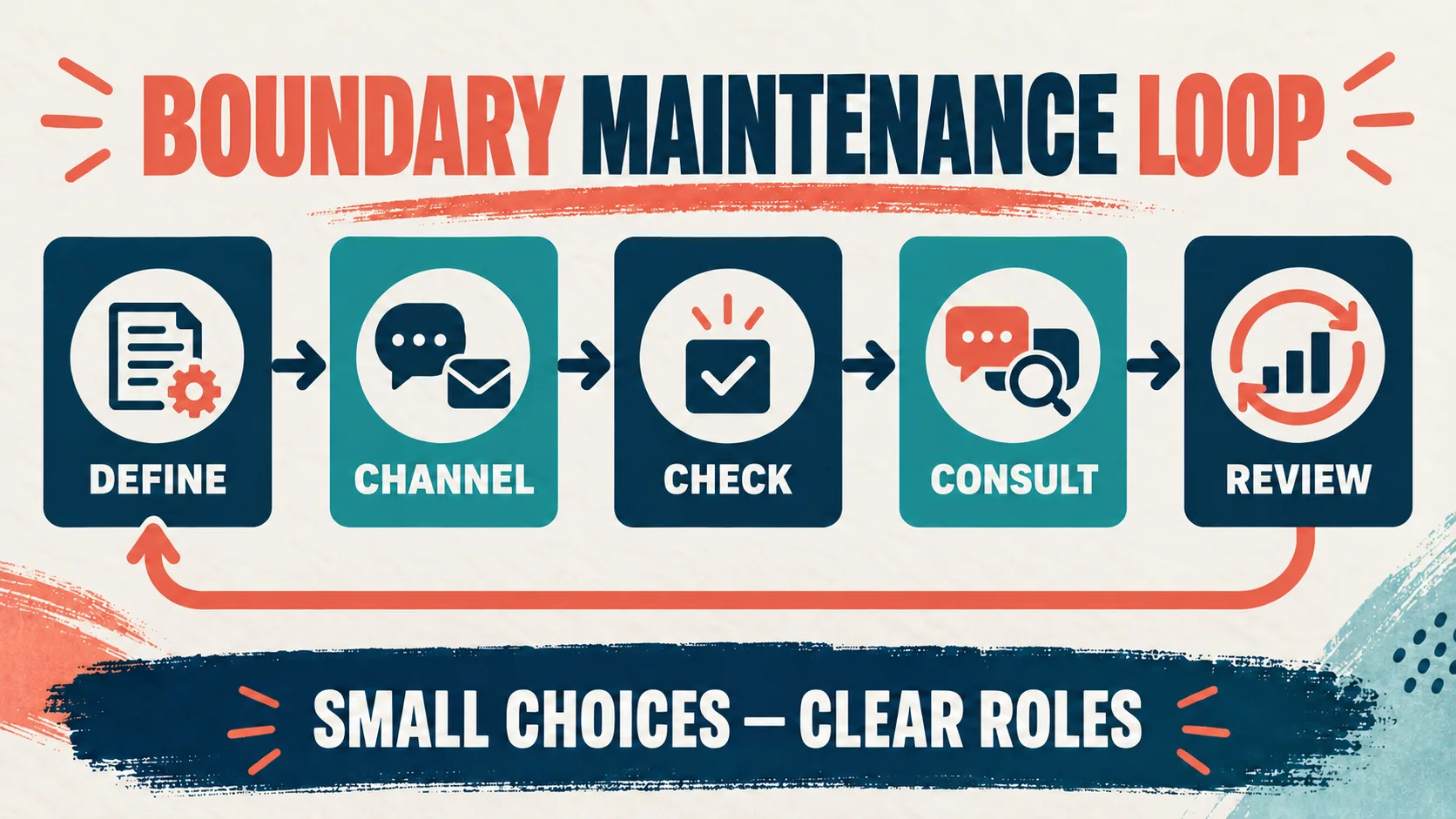
Boundaries are easier to maintain when the team checks them at predictable points rather than waiting for a crisis. Use this loop at onboarding, when the setting changes, after a difficult interaction, during supervision, and whenever a new request appears.
| Loop step | What to do | Record or check |
|---|---|---|
| Define | Explain the service role, communication expectations, privacy limits, and who makes which decisions. | Intake, consent, supervision, or team-policy record. |
| Channel | Use approved work accounts, scheduling tools, phone numbers, and hours; keep personal channels separate when policy requires. | Approved contact method and response expectations. |
| Check | Review gifts, self-disclosure, social media, favors, transportation, money, and changes in conversation or access. | Specific signal, affected role, and foreseeable risk. |
| Consult | Bring facts to the supervisor, clinical director, ethics contact, or other qualified reviewer before accepting an uncertain exception. | Date, person consulted, source reviewed, and decision. |
| Review | Check whether the role stayed clear, the safeguard worked, and a new decision is needed. | Follow-up date, outcome, remaining risk, and next action. |
The loop is preventive, not punitive. A routine check gives team members a low-drama way to ask for help before an interaction becomes a conflict. It also makes supervision more useful: a supervisor can review a specific signal and response instead of trying to infer a boundary problem from a vague feeling.
Control the Small Decisions That Create Boundary Drift
Boundary drift often begins with a series of small decisions. A single informal text, favor, or personal disclosure may not look significant, but repeated exceptions can create a new expectation. Use the current Code and organizational policy to decide what applies, then make the rationale understandable to the person receiving the limit.
- Communication: Redirect clinical questions from a personal account to an approved work channel. State when you respond and who handles urgent concerns.
- Social media: Follow the organization’s policy for friend, follow, direct-message, and public-post requests. Do not use a personal connection to share confidential service details.
- Gifts: Apply the current gift standard and employer rule. A small expression of gratitude still deserves a consistent response when accepting it could create pressure or expectation.
- Favors and transportation: Avoid side arrangements that add a caregiving, financial, or transportation role unless the appropriate authority has determined how the risk is managed.
- Self-disclosure: Share only what serves a clear professional purpose. Do not make the client, caregiver, or supervisee responsible for your emotional support.
- Home and community behavior: Dress, language, space, and conduct should remain consistent with policy even when the setting feels informal.
A useful script is short and role-based: “I want to keep our service relationship clear, so I use the work channel for case questions and cannot take on a private paid role. I can help you find the correct person to contact.” The script does not accuse the other person; it explains the boundary and offers a next step.
Document, Consult, and Review the Boundary
Documentation turns a boundary decision into a reviewable professional action. Follow the correct record system and privacy policy. Do not place sensitive case details in a personal phone note or casual group chat simply because it is convenient.
| Boundary record | Why it matters | Example prompt |
|---|---|---|
| Signal | Shows what happened without assigning motives. | What was requested, offered, shared, or changed? |
| Role analysis | Makes the professional role, added role, power, privacy, and welfare risks visible. | Who is affected, and what decision could the overlap influence? |
| Consultation | Shows that uncertainty was addressed through the correct support route. | Who was consulted, when, and which current policy or Code section was reviewed? |
| Boundary action | Connects the identified risk to a decline, referral, channel change, safeguard, or transfer. | What will happen now, who owns it, and what is the time frame? |
| Follow-up | Prevents a temporary safeguard from becoming an invisible permanent exception. | Did the risk reduce, remain, or change, and what is the next review date? |
Use neutral language. “The caregiver asked for private transportation on May 8” is more useful than “the caregiver crossed a line.” If a boundary concern involves a supervisor, a complaint, or a possible safety issue, follow the organization’s escalation and reporting process. Do not investigate beyond your authority or promise that a review will end in a particular outcome.
What to Do When the Boundary Starts to Drift
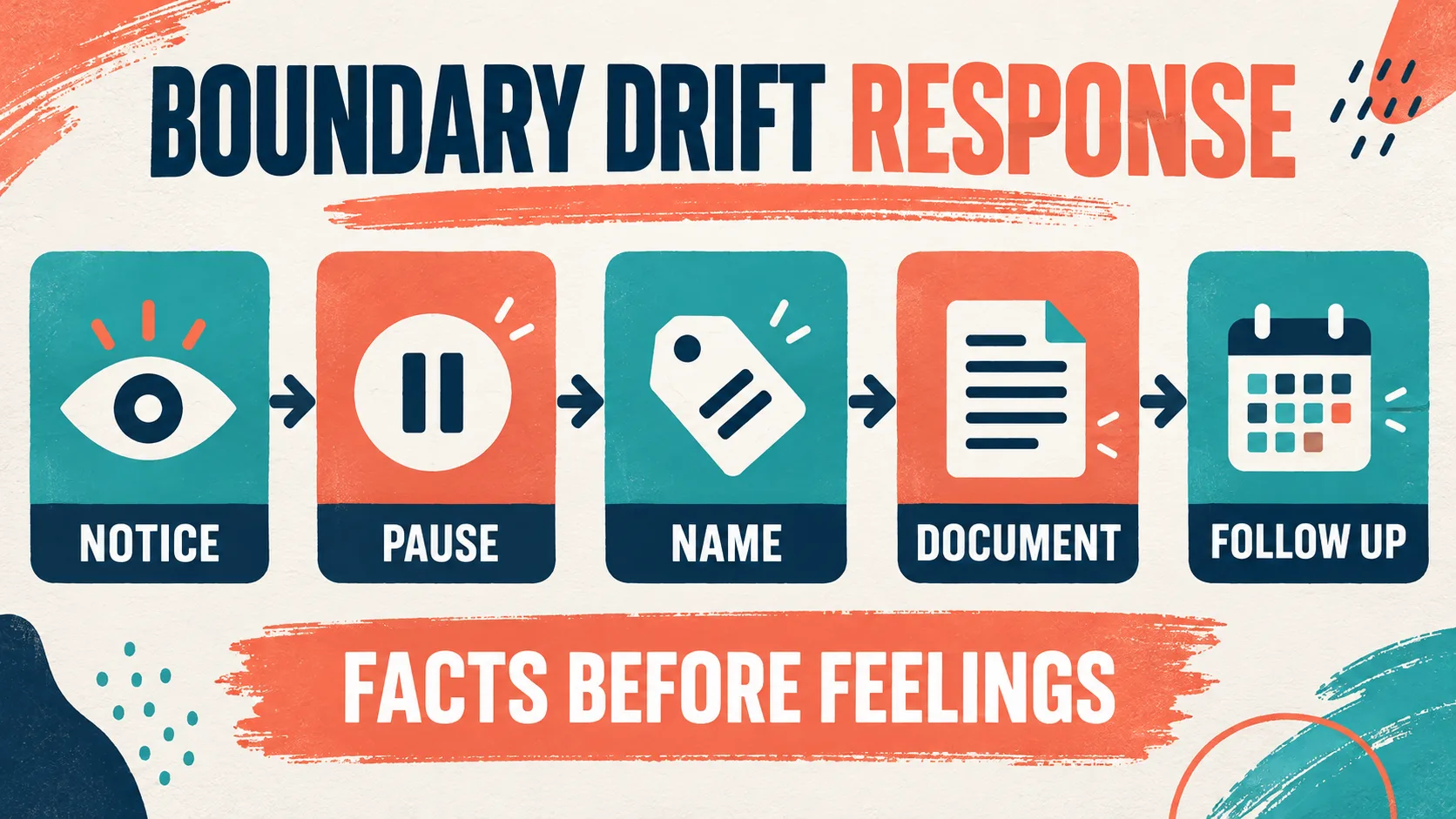
When a pattern is forming, use a pause-and-plan sequence:
- Pause the new role: Do not accept the gift, money, private service, or personal channel while the question is being reviewed.
- Name the facts: Write what happened, who was involved, and which professional decision or boundary could be affected.
- Consult early: Ask the relevant supervisor, clinical director, ethics contact, or manager for guidance. If that person is part of the issue, use the next appropriate route.
- Choose a response: Decline, redirect, refer, separate roles, add a safeguard, or begin a transition plan based on the risk and your authority.
- Review the outcome: Confirm that the person understands the boundary, the service remains accessible, and the record contains the action and follow-up.
Safeguards should be specific. “Be careful” is not a safeguard. “All case communication will move to the company platform; the clinical director will review the schedule monthly; the role arrangement will be reconsidered on June 30” is specific enough to monitor. If the overlap cannot be resolved promptly, the current BACB standard on multiple relationships points toward appropriate safeguards, a plan to eventually resolve the relationship, and documentation of actions and outcomes.
Maintain Boundaries in Home, Community, and Telehealth Settings
Informal settings remove some of the visual cues that normally reinforce a professional role. A home session may include family routines, pets, meals, or unexpected visitors. A community session may involve neighbors, school staff, or shared activities. Telehealth may blur the line between a work account and a personal device. The setting changes the risks, but it does not eliminate the need for role clarity.
- Before the session: Confirm the location, participants, communication channel, session purpose, privacy expectations, and who can authorize a change.
- During the session: Redirect personal requests, protect private information, stay within the defined role, and note a boundary signal that needs supervision.
- After the session: Close the approved channel, complete the required record, and avoid turning a warm interaction into an ongoing private relationship.
- When technology changes: Check whether a personal phone, social account, recording device, or platform creates a new privacy or access issue. Use approved tools and document exceptions.
Cultural responsiveness and professional boundaries can coexist. Ask what a gift, invitation, form of address, or communication style means in context, then apply the current Code and policy consistently. A respectful explanation is part of maintaining the relationship; it is not a reason to ignore a conflict.
Common Exam and Practice Traps
- “Boundaries mean no rapport”: Professional warmth and collaboration are compatible with a clear role.
- “One rule fits every setting”: Home, community, school, and telehealth contexts require different safeguards, but the same risk questions still apply.
- “Consent fixes the problem”: Agreement does not automatically remove power, dependency, confidentiality, or exploitation risk.
- “A small exception cannot matter”: Repeated small exceptions can create an expectation and a second role.
- “Document only after a complaint”: A timely, objective record helps supervision and follow-up before a concern escalates.
- “The old code is enough”: Verify the current BACB code and the role-specific resource before quoting a standard or deadline.
For BCBA exam preparation, practice explaining the reason behind a boundary response rather than memorizing a list of forbidden words. The free BCBA Mock Exam can help you rehearse scenario reasoning and identify study gaps; it is not a substitute for the current BACB Code, supervision, or professional consultation.
Frequently Asked Questions
How do you maintain professional boundaries in ABA?: Define the professional role, use approved channels, check gifts and personal requests, consult early when a second role could form, document the decision, and review whether the boundary remains effective. Apply the current BACB Code and the policies governing your setting.
Are professional boundaries the same as avoiding all personal conversation?: No. Rapport and respectful conversation can support services. The concern is whether personal conversation, self-disclosure, or contact creates pressure, privacy risk, divided loyalty, or a new role that affects professional judgment.
What should I do if a family asks for a favor outside ABA services?: Pause before agreeing, identify the added role and possible power or financial effects, explain the professional boundary, and consult the appropriate supervisor or policy. Offer a safe referral when possible and document the response in the correct system.
How often should boundaries be reviewed?: Review them at onboarding, supervision, setting or technology changes, after a boundary signal, and at the follow-up date for any safeguard. A fixed cadence can help, but a new request should trigger an immediate check rather than waiting for the next meeting.
What if the supervisor is the person creating the boundary concern?: Use the next appropriate organizational, ethics, human-resources, or regulatory route and preserve objective records. Role-specific codes, such as the current RBT ethics resources, may describe additional escalation expectations.
Sources and Verification Notes
The BACB ethics-code index and current Ethics Code for Behavior Analysts are the primary sources for this article. Requirements and policy language can change, and organizations or jurisdictions may impose stricter rules. Verify the current source before making a case decision, documenting a boundary exception, or answering an exam question.
- BACB Ethics Codes.
- BACB Ethics Code for Behavior Analysts.
- BACB RBT Ethics resources.
- BACB RBT Competency Assessment, for competency context; verify the current form before use.
Take the Free BCBA Mock Exam
A useful next step is to apply this idea in a fresh set of BCBA-style practice questions and review the feedback. Take the Free BCBA Mock Exam



