

EAB ABA usually refers to the relationship between the Experimental Analysis of Behavior and Applied Behavior Analysis. EAB asks basic-science questions about behavioral processes under controlled conditions; ABA applies behavioral principles to socially significant change. The two are connected, but they are not interchangeable labels.
Table of Contents
- What EAB ABA Means
- EAB and ABA Ask Different Questions
- Compare EAB and ABA by the Clues in the Scenario
- How Basic Research Informs Applied Work
- Classify the Scenario Before Choosing the Answer
- Examples That Separate EAB, ABA, and Professional Practice
- Common EAB ABA Exam Traps
- How to Study A.4 Efficiently
- Frequently Asked Questions
- Sources and Verification Notes
- Take the Free BCBA Mock Exam
People searching for eab aba are often trying to solve a BCBA exam question, define an acronym, or understand how behavior analysis moves from research to practice. The fastest way to get the distinction right is to ask what the investigator or practitioner is trying to learn, where the work occurs, how variables are arranged, and what outcome matters.
The current BACB BCBA Test Content Outline (6th ed.) explicitly includes A.4: distinguish among behaviorism, the experimental analysis of behavior, applied behavior analysis, and professional practice guided by the science of behavior analysis. This guide supports that study task. The BACB outline and current BACB materials remain the authority; this article is an educational explanation, not a substitute for a course, supervision, or professional consultation.
What EAB ABA Means
EAB means Experimental Analysis of Behavior. It is the basic-science branch of behavior analysis. The central question is often how a behavioral process works: how reinforcement schedules affect responding, how stimulus control develops, how consequences alter response patterns, or how an environmental variable relates functionally to behavior. EAB uses systematic experimentation and careful measurement to isolate relations and refine principles.
ABA means Applied Behavior Analysis. It applies behavioral principles and methods to behavior that matters to people in a particular context. The work may involve assessment, teaching, behavior change, prevention, health, education, organizational performance, communication, or other socially significant outcomes. ABA still uses data and experimental logic, but the question includes social importance, the individual’s context, and whether the change is meaningful and useful.
It helps to place both terms inside a larger map. Behaviorism is a philosophy or set of assumptions about behavior and science. EAB is a basic research branch. ABA is an applied branch. Professional practice guided by the science of behavior analysis is the service or decision layer in which a qualified practitioner selects, implements, evaluates, and communicates work responsibly. A scenario can move across layers, so classify the main purpose rather than reacting to one isolated word.
- EAB: discover, test, and refine behavioral processes or principles.
- ABA: apply those principles to socially significant behavior and evaluate meaningful change.
- Professional practice: deliver or supervise services using scientific, ethical, legal, and contextual judgment.
- Behaviorism: describe the philosophical assumptions that guide a science of behavior.
EAB and ABA Ask Different Questions
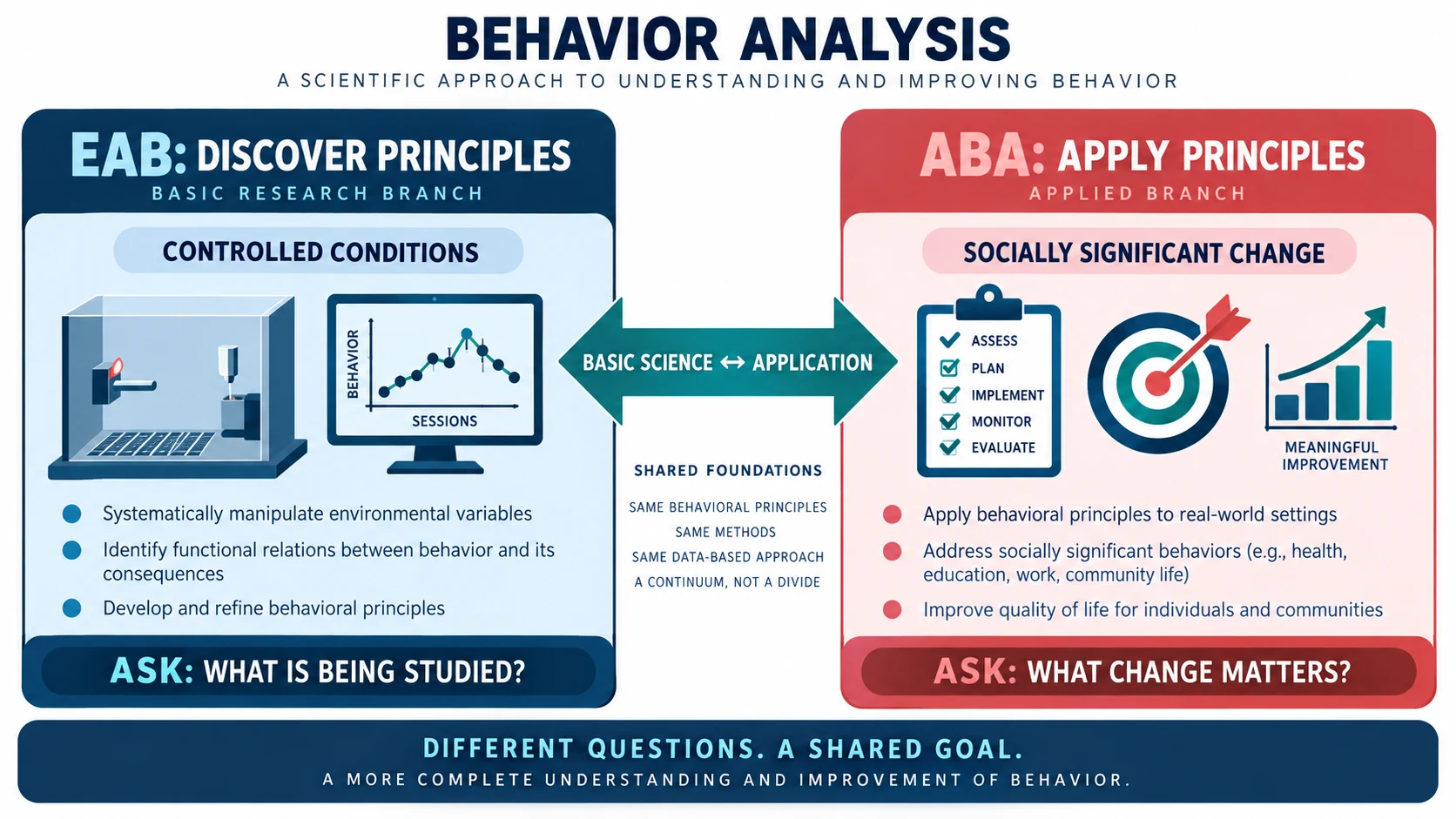
The cleanest EAB versus ABA distinction is not “laboratory versus clinic.” Setting can be a clue, but it is not the definition. The stronger question is the purpose of the analysis. EAB generally asks what behavioral relation can be demonstrated under controlled conditions. ABA generally asks whether a behavior change is important to the person or group, whether a behavioral procedure produces that change, and whether the effect generalizes and maintains in relevant environments.
For example, an EAB study might arrange different reinforcement schedules and measure response patterns to understand behavioral persistence. An ABA project might use a reinforcement-based teaching procedure to increase functional communication for a learner, then measure whether communication improves across people and settings. Both projects can use repeated measures, experimental control, and graphs. Their defining difference is the basic-versus-applied question and the role of social significance.
Compare EAB and ABA by the Clues in the Scenario
When a question gives you a dense scenario, sort the clues into four columns: purpose, context, method, and outcome. Do not decide from the presence of a rat, a clinic, a graph, or the word “intervention” alone. Those details can occur in more than one branch.
| Clue | EAB signal | ABA signal |
|---|---|---|
| Purpose | Isolate or explain a behavioral process. | Change behavior that has practical or social importance. |
| Context | Controlled arrangement designed to reduce competing variables. | Naturalistic or service context where fit, access, and generalization matter. |
| Participant or client | A participant contributes data to a basic research question. | A person, group, or organization receives an applied assessment or intervention. |
| Outcome | A replicated functional relation or refined principle. | A meaningful improvement that is effective, acceptable, and useful beyond one narrow test. |
The table is a reasoning aid, not a replacement for the full BACB outline. EAB can study human behavior, ABA can use highly controlled designs, and professional practice can occur in a laboratory or community setting. The question is which layer and purpose the item emphasizes.
How Basic Research Informs Applied Work
EAB and ABA are not competing teams. Basic research can identify behavioral processes that applied researchers and practitioners use as starting points. Applied work can also reveal limits, boundary conditions, and socially important questions that make basic researchers refine how a principle is described. The relationship is a feedback loop rather than a one-way pipeline.
Consider a generic reinforcement example. Basic research may show how a particular schedule changes response persistence under defined conditions. An applied team does not copy the schedule blindly. It asks whether the behavior is important, whether the reinforcer is available and acceptable, whether the plan respects the person’s preferences, what competing contingencies are present, and whether the change maintains in daily life. The applied decision preserves the behavioral principle while adapting the procedure to the individual and context.
- Principle: identify the behavioral process supported by research.
- Assessment: define the target behavior and relevant environmental variables.
- Design: select a procedure that fits the person, goal, resources, and ethical requirements.
- Measurement: collect data that represent the important dimension of behavior.
- Evaluation: examine effectiveness, social validity, generalization, maintenance, and unintended effects.
Classify the Scenario Before Choosing the Answer
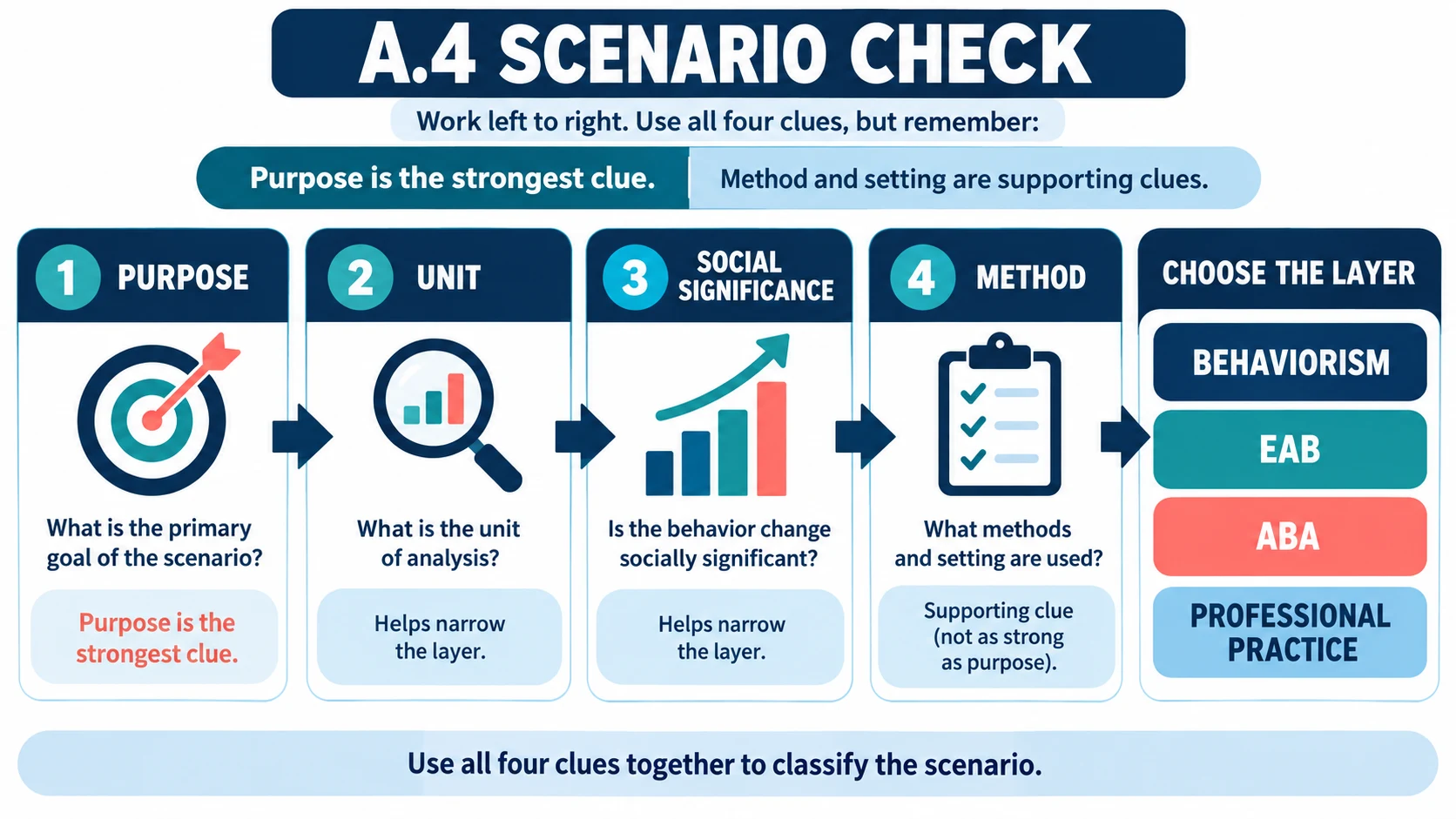
Use this five-step process for A.4 questions and for your own notes:
- Underline the goal: Is the writer discovering a relation, applying a procedure, explaining philosophical assumptions, or delivering a professional service?
- Identify the unit of analysis: Is the focus a behavioral process across controlled conditions, an applied target in a person’s life, or a practitioner’s decision?
- Find the social-significance clue: Does the scenario emphasize quality of life, communication, education, health, work, safety, or another outcome that matters to the consumer?
- Separate method from purpose: A single-case design, graph, reversal, or reinforcement schedule does not automatically make a scenario EAB or ABA.
- Choose the narrowest accurate label: If the question is about a service decision, professional practice may be the best answer even when the service is based on ABA principles.
A helpful sentence stem is: “This is primarily ___ because the main question is ___.” For EAB, fill the first blank with “experimental analysis of behavior” and the second with “which environmental variables produce a reliable behavioral relation.” For ABA, use “applied behavior analysis” and “whether a behaviorally based procedure produces meaningful change in the target context.”
Examples That Separate EAB, ABA, and Professional Practice
These examples are intentionally short. The classification depends on the purpose stated in the item, not on a single object or location:
- EAB: A researcher compares fixed-ratio and variable-ratio schedules to study response patterns under controlled conditions. The outcome is a refined account of schedule effects.
- ABA: A team evaluates a communication intervention selected to reduce a learner’s reliance on unsafe behavior and measures use across caregivers and routines. The outcome is socially significant change.
- Professional practice: A BCBA reviews assessment data, obtains consent, coordinates with a teacher, and adapts a plan to fit the client’s priorities and setting. The focus is responsible service delivery.
- Not automatically EAB: A laboratory study with a human participant can still be basic research, because the purpose may be to isolate a behavioral process rather than deliver an applied service.
- Not automatically ABA: A clinic location or the word “intervention” does not prove that an item is ABA. The question may instead be about supervision, ethics, measurement, or professional practice.
Common EAB ABA Exam Traps
- “EAB means animals.” Organism type is not the defining feature. Purpose and research question matter more.
- “ABA means autism therapy.” ABA addresses socially significant behavior across many populations and settings; autism services are one application.
- “Any experiment is EAB.” Applied single-case research can be experimental while still targeting a socially significant outcome.
- “Any intervention is ABA.” A service plan can involve professional practice guided by behavioral science; read the task being tested.
- “A graph identifies the branch.” Both basic and applied behavior analysis rely on measurement and data display.
- “Basic means less rigorous.” EAB and ABA both require systematic measurement and analysis; they differ in purpose and context.
For targeted review, use the free BCBA Mock Exam to practice classifying the question before comparing answer choices. Treat it as study practice, not as an official BACB resource or a substitute for the current outline.
How to Study A.4 Efficiently
Build a four-row note rather than memorizing four isolated definitions. For each row, write the goal, typical question, strongest clue, and one example:
| Term | Memory question | Fast distinction |
|---|---|---|
| Behaviorism | What assumptions guide the science? | Philosophy. |
| EAB | What behavioral process can be demonstrated? | Basic research. |
| ABA | Can a behavioral procedure improve an important outcome? | Applied science. |
| Professional practice | How should a qualified practitioner deliver the work responsibly? | Service and decision layer. |
Then create mixed practice items. Change the setting while keeping the purpose constant, or change the purpose while keeping the setting constant. This prevents a shortcut such as “lab equals EAB” from replacing actual analysis.
Frequently Asked Questions
Is EAB part of ABA?: EAB and ABA are distinct branches within behavior analysis. EAB contributes basic research and behavioral principles; ABA applies those principles to socially significant behavior. They inform one another but should not be used as synonyms.
What is the simplest EAB versus ABA distinction?: EAB primarily studies how behavioral processes work under systematic experimental conditions. ABA primarily evaluates behaviorally based change in a context where the outcome is socially important. Method clues help, but purpose is the strongest discriminator.
Can ABA use experimental designs?: Yes. Applied behavior analysis can use single-case experimental designs and repeated measurement to evaluate whether a procedure caused meaningful change. Experimental control does not automatically turn an applied project into EAB.
Why does the BCBA exam test EAB and ABA together?: The distinction helps future practitioners understand the science that supports behavior-analytic services and avoid confusing a basic research question with an applied or professional-practice question. The BACB BCBA Test Content Outline places this distinction in Domain A, task A.4.
What source should I verify before studying this distinction?: Start with the current BACB BCBA Test Content Outline and confirm that you are using the current edition. Course materials and study guides can add examples, but the official outline controls the exam content description.
Sources and Verification Notes
The BACB Test Content Outline is the primary authority for the exam distinction in this article. The European Association for Behaviour Analysis and professional or scholarly overviews are explanatory context, not substitutes for the BACB outline. Check the official source again if the BACB updates its outline or terminology.
- BACB BCBA Test Content Outline (6th ed.).
- BACB Test Content Outlines for BACB Certifications.
- BACB BCBA Handbook.
- European Association for Behaviour Analysis: What Is Behaviour Analysis?.
- Virginia Association for Behavior Analysis: Experimental Analysis of Behavior.
Take the Free BCBA Mock Exam
A useful next step is to apply this idea in a fresh set of BCBA-style practice questions and review the feedback. Take the Free BCBA Mock Exam



