

A date-aware BCBA planning guide for choosing your education path, verifying supervised fieldwork, preparing the application, and deciding what to check before the 2026–2027 transition. How to become a board certified behavior analyst is not a one-form process. The usual sequence is graduate-level education and approved behavior-analytic coursework, supervised fieldwork, an application to the Behavior Analyst Certification Board (BACB), and the BCBA examination. The exact route depends on your education, coursework, fieldwork documentation, application date, and any state-practice rules that apply where you work.
Table of Contents
- How to Become a Board Certified Behavior Analyst: The Decision Checklist
- Start With the Date, Not an Old Checklist
- Verify Your Degree and Coursework
- Plan Supervised Fieldwork and Documentation
- Complete the Application, Exam, and State-Practice Checks
- Turn Eligibility Work Into an Exam Study Plan
- Common Planning Mistakes to Avoid
- Frequently Asked Questions
- Quick Review Checklist
- Take the Free BCBA Mock Exam
The safest way to plan is to treat the current BACB Handbook and official 2027 requirements page as your source of truth. Use this article as a decision checklist, not as a promise that every applicant will qualify on the same timeline. If your application date crosses a policy transition, an older blog post or spreadsheet can be incomplete even when its general sequence is correct. Important: Certification eligibility, forms, deadlines, and transition rules can change. Verify your pathway and submission date directly with the official BACB BCBA resources and the current BACB 2027 requirements page.
How to Become a Board Certified Behavior Analyst: The Decision Checklist
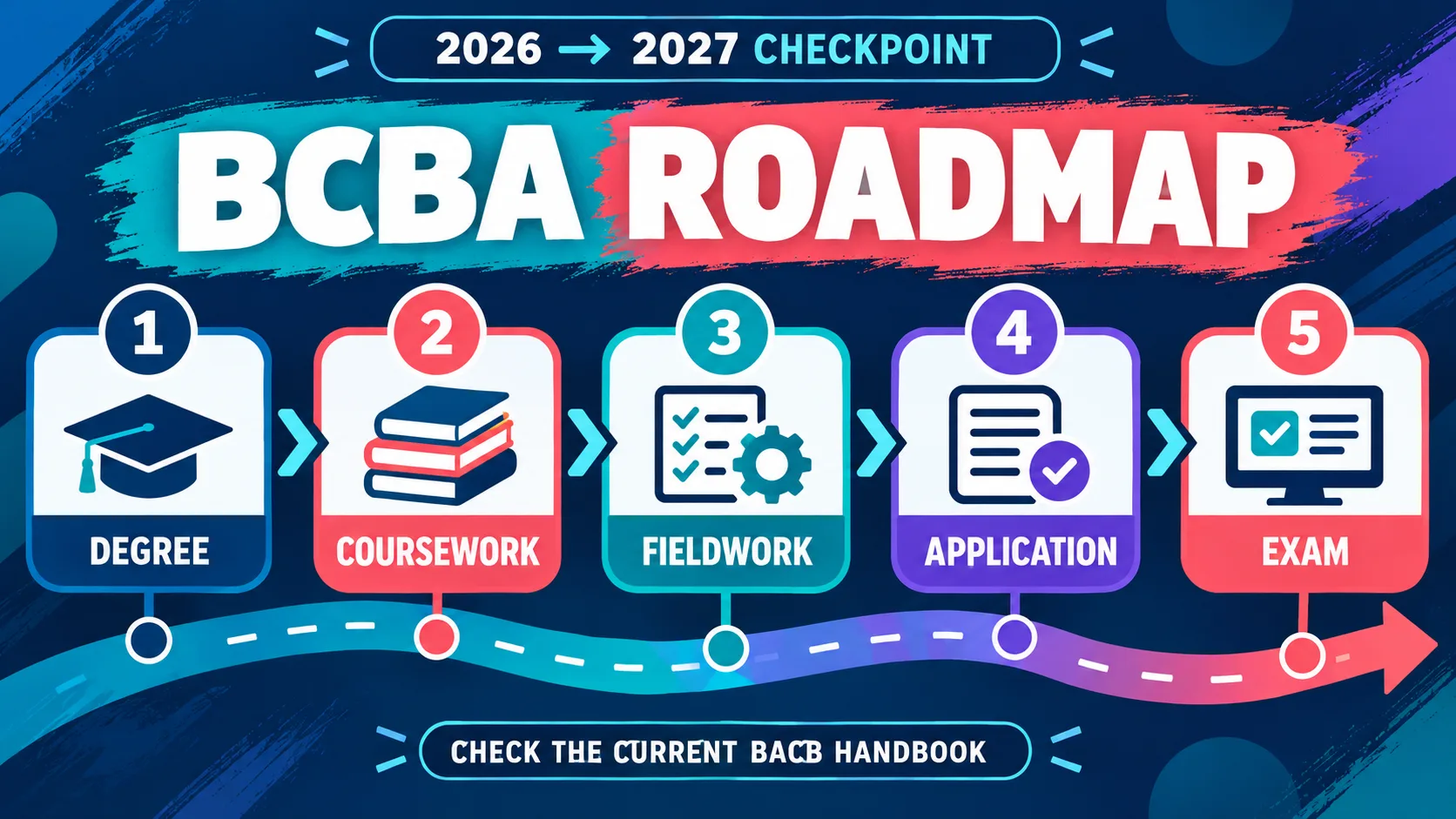
Think of the pathway as five checkpoints rather than one giant application. You do not need to memorize every administrative detail before taking the first step, but you do need to know which questions must be answered before you spend money or count hours.
- Choose the education route. Confirm that your degree level and field fit one of the current BACB pathways. Do not assume that a related psychology or education degree automatically supplies the required behavior-analytic coursework.
- Verify the coursework. Compare the courses on your transcript or program plan with the current BACB requirements. Save syllabi, transcripts, completion records, and any documentation your pathway requires.
- Arrange supervised fieldwork. Work with a qualified supervisor and clarify what counts, how supervision is documented, and which forms must be current for your application date.
- Submit the application correctly. Before applying, confirm that your education, coursework, fieldwork records, identity information, and supporting documents are complete and internally consistent.
- Prepare for the exam and local practice. Use the current examination information and task-content guidance, then check whether your state has a separate license or practice requirement.
This sequence is useful because it prevents a common planning error: studying intensely for the exam before confirming that the underlying education and fieldwork documentation can support an application. Exam preparation matters, but it should sit on top of a verified eligibility plan.
Start With the Date, Not an Old Checklist
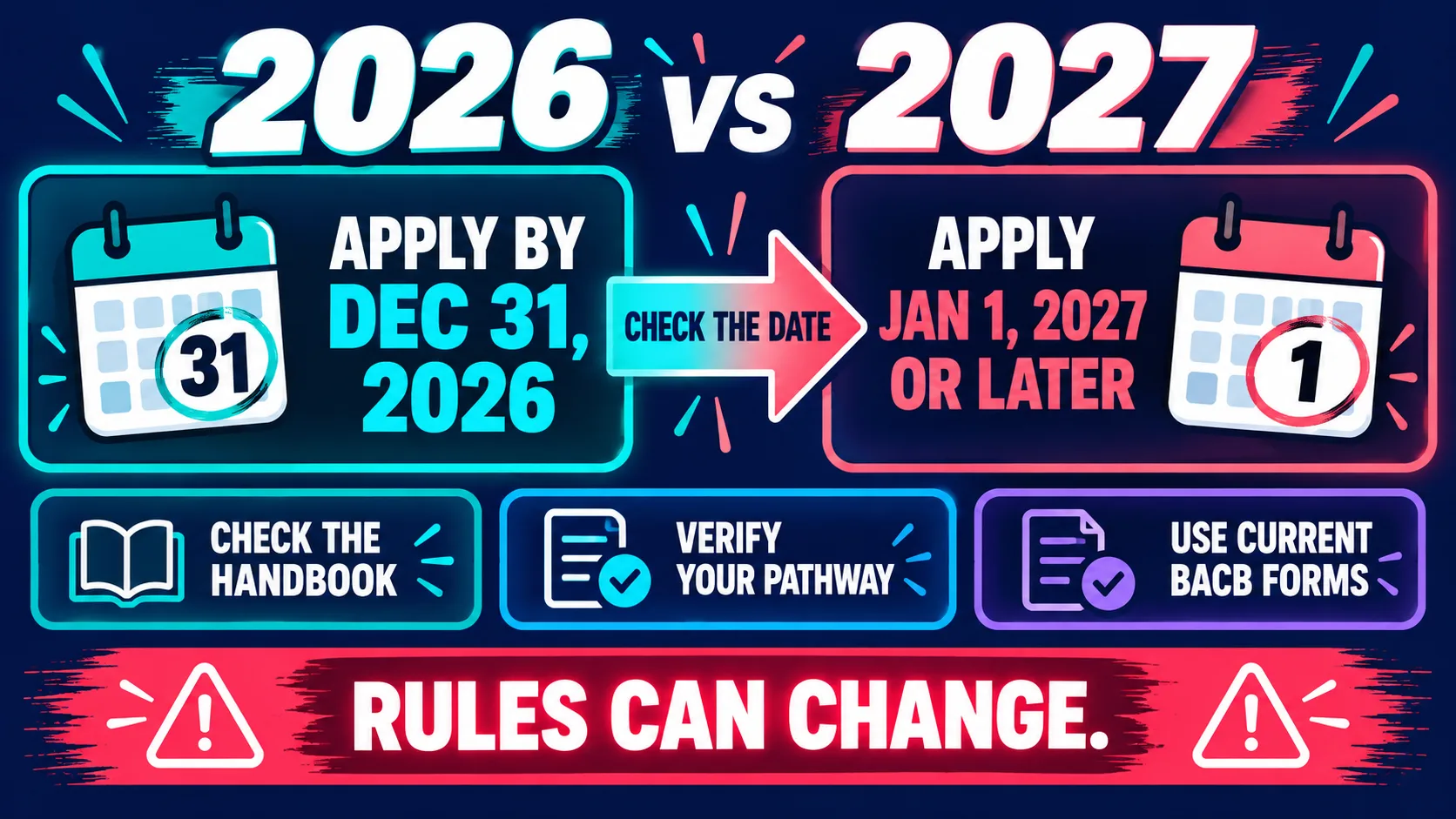
The most important 2026–2027 question is not simply “Which pathway sounds easiest?” It is “Which rules and forms apply to the date I expect to submit my application?” The BACB publishes transition information because eligibility and documentation standards can change. That makes the application date a planning variable, not a footnote.
| Planning question | Why it matters | What to verify |
|---|---|---|
| When will I submit? | A transition may be tied to an application or documentation date, not to the day you start studying. | The current BACB requirements page, Handbook, forms, and stated transition instructions. |
| Which pathway applies? | Different education and coursework routes can have different evidence requirements. | Your degree, coursework evidence, fieldwork arrangement, and the official pathway description. |
| Are my forms current? | A completed form from an older cycle may not be the right document for a later application. | The form version, signature requirements, dates, and retention instructions. |
Do not treat the phrase “2027 requirements” as a reason to rush or delay without checking the official language. Your best next action may be to contact the BACB, your program, or your supervisor with a specific date-and-pathway question. A source with a publication date is helpful, but the current official instruction controls.
Verify Your Degree and Coursework
A degree is only one part of the education checkpoint. The practical question is whether your degree, behavior-analytic coursework, and supporting records fit the current BACB pathway you intend to use. Start with an evidence folder rather than a list of assumptions.
| Evidence folder | Check before moving on | Do not assume |
|---|---|---|
| Degree record | The credential and conferral details match the pathway you are evaluating. | A degree title alone proves the required coursework. |
| Coursework record | Course names, credits, dates, and documentation can be mapped to the current requirements. | A course with “behavior” in its name automatically counts. |
| Program contact | Someone can explain which pathway and documents the program supports. | A marketing page replaces official eligibility instructions. |
If you are comparing programs, ask for the exact course sequence, fieldwork support, supervisor qualifications, documentation process, total cost, and what happens if the BACB changes a requirement. Those questions are more useful than asking only whether a program is “BCBA-friendly.” Save the answer and compare it with the official Handbook.
Plan Supervised Fieldwork and Documentation
Supervised fieldwork is where an otherwise tidy education plan can become difficult to document. Before you begin, clarify the supervisor relationship, the activities that will be observed or reviewed, the required supervision records, and the process for correcting missing or inconsistent entries. Keep your own organized copies while also following the approved system.
A useful monthly review asks four questions: Did I record the hours promptly? Are activities categorized correctly? Did supervision occur as required for the applicable pathway? Do the signatures, dates, and totals agree across records? Finding a discrepancy early is much easier than reconstructing months of fieldwork after the fact.
Never inflate, backdate, or “fill in” a record because you are close to a target. If an entry is unclear, pause and ask the supervisor how it should be corrected. The goal is not merely to accumulate a number; it is to maintain credible evidence of training and supervision.
Complete the Application, Exam, and State-Practice Checks
Once the education and fieldwork evidence are organized, move through the application in a controlled order:
- Re-read the current Handbook. Look for the instructions that apply to your pathway, application date, documentation, and examination.
- Run a document audit. Check names, dates, signatures, transcripts, course records, fieldwork forms, and any required attestations for consistency.
- Submit through the official process. Keep confirmation records and note any response deadline or request for additional information.
- Plan exam preparation around the current content outline. Study definitions, measurement, assessment, intervention, ethics, supervision, and application—not just vocabulary.
- Check local practice rules separately. BACB certification and state licensure or employer requirements are related but not identical questions.
Be careful with third-party claims such as “guaranteed approval,” “fastest BCBA route,” or “all-inclusive hours.” They may describe a service, not a universal rule. Use them as questions to investigate, then confirm the answer with the official source and your qualified supervisor or program contact.
Turn Eligibility Work Into an Exam Study Plan
After the pathway is verified, study for the exam with a feedback loop. A good first practice session is diagnostic: answer a mixed set under a time limit, mark each response as correct, guessed, or unknown, and record the content area behind the mistake. This tells you whether the problem is vocabulary, discrimination between similar concepts, data interpretation, or decision-making. Use the result to build three lists:
- Must learn: concepts you cannot explain or apply without notes.
- Must discriminate: pairs you confuse, such as similar measurement systems, assessment terms, or reinforcement procedures.
- Must practice: questions where you know the definition but choose poorly in a scenario.
When you are ready, use the Free BCBA Mock Exam as a diagnostic checkpoint. Review the explanation for every missed or guessed item; the value is in finding the next study action, not in chasing a flattering score.
Common Planning Mistakes to Avoid
| Mistake | Better move |
|---|---|
| Using a 2024 or 2025 checklist without checking the date. | Open the current BACB Handbook and transition page before making a pathway decision. |
| Counting fieldwork from memory. | Update records promptly and reconcile totals with your supervisor. |
| Studying only flashcards. | Mix definition recall with data, scenario, ethics, and application questions. |
| Confusing BACB certification with a state license. | Check both the BACB requirements and the rules of the state where you will practice. |
Frequently Asked Questions
How long does it take to become a board certified behavior analyst?: There is no single guaranteed timeline. Your degree status, coursework, fieldwork pace, supervision arrangement, application review, exam preparation, and the requirements in force for your application date all matter. Build a timeline from verified milestones rather than a marketing promise.
Can I become a BCBA with any master's degree?: Do not assume that any master’s degree automatically qualifies you. The degree, behavior-analytic coursework, and current pathway evidence must be evaluated together. Compare your records with the current BACB instructions before enrolling or counting a course.
Do I need supervised fieldwork before taking the BCBA exam?: Fieldwork and eligibility requirements are pathway- and date-sensitive. Review the current Handbook and 2027 transition information, then confirm your plan with an appropriately qualified supervisor or program contact. This article does not replace that review.
Is passing a mock exam the same as being ready to apply?: No. A mock exam measures study readiness; it does not verify your degree, coursework, fieldwork, application documents, or state-practice requirements. Use the two checklists separately.
What should I do first?: Write down your intended application date, identify the BACB pathway you are considering, and open the current official Handbook and 2027 requirements page. Then compare your degree, coursework, and fieldwork evidence against that pathway before spending more time or money.
Bottom line: The most reliable answer to how to become a board certified behavior analyst is a verified sequence: choose the pathway, check current rules by application date, document education and fieldwork, complete the application, prepare for the exam, and confirm local practice requirements. Use official BACB sources for eligibility decisions and use practice questions to turn your study gaps into a plan.
Quick Review Checklist
Use this final checklist to turn how to become a board certified behavior analyst into exam-ready reasoning. The goal is not to memorize a label in isolation; it is to identify the relevant evidence and explain why the best answer fits the scenario. Key ideas to review:
- State the central definition or decision point for how to become a board certified behavior analyst in your own words.
- Identify the detail that makes how to become a board certified behavior analyst different from its closest related ABA term.
- Separate the observable facts in a scenario from assumptions that are not supported by the facts.
- Write one example and one nonexample so you can recognize the concept in a new setting.
Exam application checks:
- Ask what the question is actually requesting before comparing the answer choices.
- Mark the antecedent, response, consequence, or other evidence that supports the selected answer.
- Look for a distractor that describes a related process but does not answer the specific question.
Final self-check:
- Explain how you would verify the interpretation with clear observations or data.
- Change one detail in the scenario and decide whether your answer should change.
- Give a one-sentence rationale that a supervisor or study partner could evaluate.
Take the Free BCBA Mock Exam
When you are ready to apply the idea, use the free practice resource below for additional feedback. Take the Free BCBA Mock Exam



