

A practical BCBA guide to planning high-probability request sequences, measuring the response, troubleshooting a stalled sequence, and keeping behavior momentum separate from broad compliance promises. Behavior momentum ABA usually refers to the tendency for behavior to persist after it has begun, especially when the surrounding conditions change. In applied behavior analysis, the phrase is often connected to a high-probability request sequence: present a few tasks that are likely to produce responding, then present a task that is less likely to produce responding. The purpose is not to “make” a person comply. The purpose is to arrange a testable, respectful sequence and evaluate what the data show.
Table of Contents
- Behavior Momentum ABA: The Practical Meaning
- The High-P to Low-P Sequence
- Plan the Sequence Before You Deliver It
- Measure the Effect Without Overclaiming
- When Behavioral Momentum Stalls
- Momentum, Reinforcement, and Premack Are Not Synonyms
- Frequently Asked Questions
- Quick Review Checklist
- Take the Free BCBA Mock Exam
The distinction matters for BCBA exam questions and practice. A high-p sequence can be an antecedent strategy, but it is not a substitute for functional assessment, reinforcement planning, skill analysis, communication support, or attention to assent. A sequence that works in one context may not work with a different task, learner, reinforcer, timing arrangement, or history of instruction.
Scope note: This is an educational explanation with fictional examples. Do not use it as a stand-alone client protocol. Follow current BACB ethics requirements, qualified supervision, approved assessment procedures, client rights, privacy safeguards, and the behavior analyst’s clinical judgment.
Behavior Momentum ABA: The Practical Meaning
In the original behavior-analytic literature, behavioral momentum is a metaphor for persistence: once responding is established, it may continue in the presence of a challenge or a change in environmental conditions. Applied research on high-probability requests examined whether a sequence of easy or likely-to-be-followed requests could increase responding to a more difficult request that followed.
That research background is important because the everyday phrase “build momentum” can sound more certain than the evidence supports. The classic Mace and colleagues study and later work provide a research basis for the concept, but no single sequence guarantees compliance. A recent meta-analysis of high-probability request sequences also describes the procedure as an intervention to increase compliance, not as proof that a clinician can skip individualized assessment.
A careful working definition is: an arrangement in which responding that is already likely is used to establish a pattern of responding before a less likely response is requested, with the result evaluated through data. The definition includes a sequence, a response measure, and an evaluation plan. It does not include a promise about a person’s motivation, character, or willingness.
The High-P to Low-P Sequence
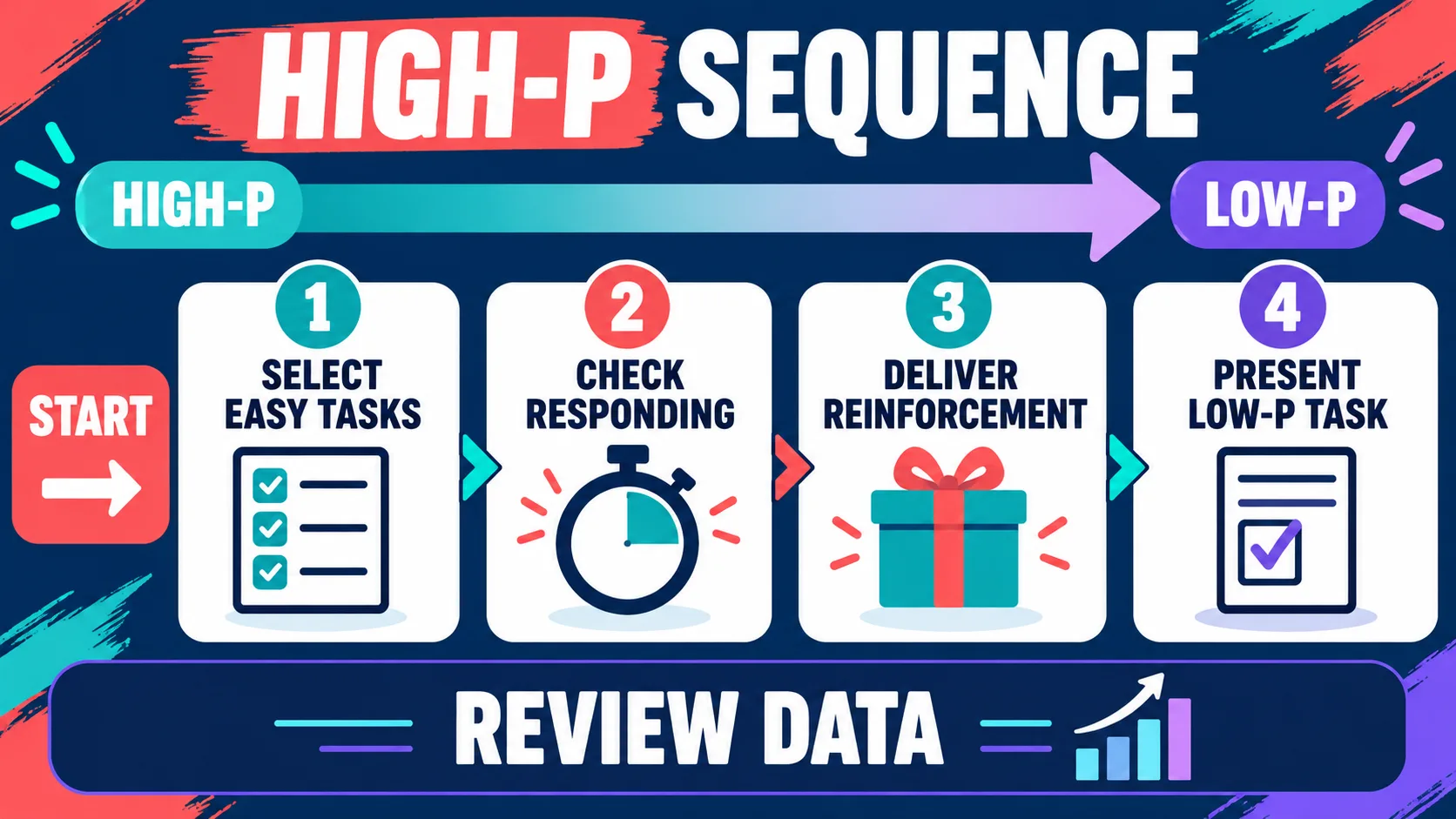
The sequence is easier to understand when each step has a job. High-probability requests should be genuinely likely to produce a response in the relevant context. The low-probability request should be defined clearly enough that an observer can tell whether it occurred. The transition should be planned rather than improvised after frustration appears.
- Select the low-p target. Define the response, materials, instruction, and what counts as an opportunity to respond.
- Identify candidate high-p requests. Use tasks the learner can perform and has recently performed in a comparable context. Do not call a task high-p simply because an adult believes it is easy.
- Check the sequence. Present the high-p requests in a predictable, low-pressure way and observe whether responding actually occurs.
- Deliver the planned consequence. Reinforcement, praise, access, or task progression should be defined ahead of time and consistent with the approved plan.
- Present the low-p request. Use the same operational definition and timing rule across opportunities so the data remain interpretable.
- Review the data. Look at responding to the high-p requests, the low-p request, latency, errors, refusal, and any signs that the sequence is creating an unwanted interaction.
Plan the Sequence Before You Deliver It
The most common planning error is choosing a catchy sequence without defining the variables that make it meaningful. Before implementation, write down the task, the response, the high-p criteria, the transition rule, the consequence, and the measurement. This turns “try momentum” into a small, reviewable decision.
| Planning variable | Decision to record | Warning sign |
|---|---|---|
| Task fit | Which high-p requests are fluent and likely in this setting? | The “easy” requests are actually new, effortful, or rarely reinforced. |
| Response effort | How much effort separates the high-p requests from the low-p task? | The jump is so large that the sequence becomes a demand burst. |
| Consequence | What happens after responding, and is it useful to the learner? | The adult assumes praise is reinforcing without checking its effect. |
| Timing | When does the low-p request follow the high-p sequence? | Long delays or extra demands make the sequence impossible to interpret. |
| Choice and assent | How can the person communicate pause, help, refusal, or a different option? | “Momentum” is used to override communication or distress. |
High-p requests are not a license to present a rapid stream of demands. A learner may respond to an easy motor imitation task but not to a language task, academic task, or social demand. The relevant probability is contextual. Check recent performance in the same environment and with similar materials.
Measure the Effect Without Overclaiming
Suppose a fictional learner receives three high-p requests before a worksheet task. The low-p response is “begin the first problem within 10 seconds.” Across ten opportunities, the learner begins within 10 seconds after the sequence on seven trials and without the sequence on four trials. That difference is worth reviewing, but it is not enough to conclude that momentum alone caused the change.
| Condition | Starts within 10 seconds | Opportunities | Descriptive rate |
|---|---|---|---|
| After high-p sequence | 7 | 10 | 70% |
| Without sequence | 4 | 10 | 40% |
The difference is a useful descriptive signal, not a causal guarantee. Check whether the worksheet changed, whether the adult provided extra prompts, whether the learner had different motivation, and whether the sequence itself included reinforcement. Also track errors, latency, refusal, and generalization. If the only “success” measure is immediate compliance, you may miss skill quality, maintenance, or the learner’s communication.
When Behavioral Momentum Stalls
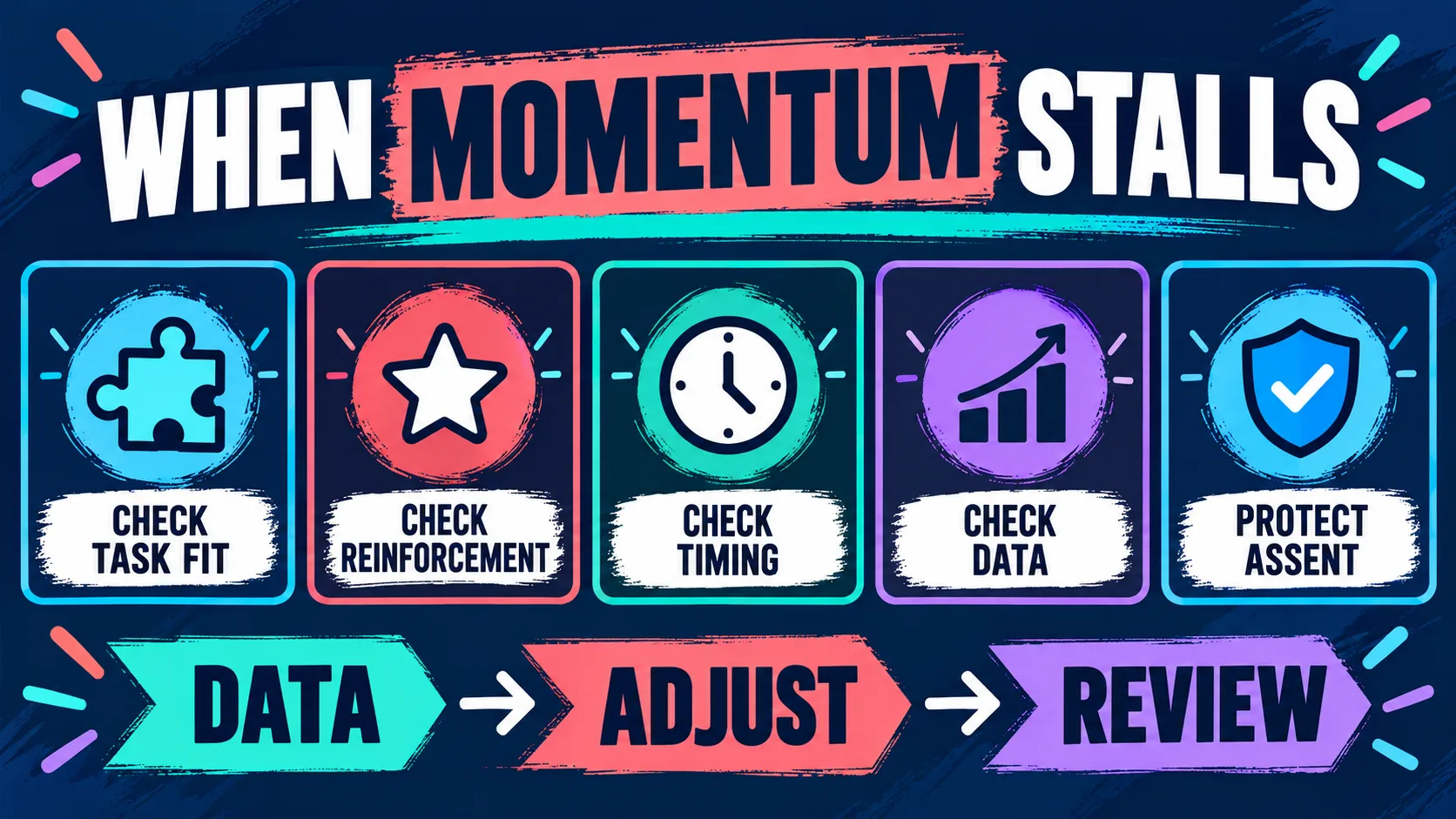
When a sequence stops helping, repeat the decision loop instead of simply adding more high-p requests. A long chain can increase response effort, create escape opportunities, or make the low-p task feel like an unpredictable trap. The first troubleshooting question is whether the target task and measurement are still clear.
- Check task fit. Were the high-p responses actually fluent today? Was the low-p task too difficult, too long, or missing a prerequisite skill?
- Check reinforcement. Did responding produce a consequence that matters, or did the sequence become a series of demands with no useful payoff?
- Check timing. Did the delay between high-p and low-p requests change? Did extra instructions appear in the transition?
- Check data quality. Are opportunities, latency, prompts, errors, refusal, and context recorded consistently?
- Protect assent and dignity. Does the person have a reliable way to pause, request help, or communicate a boundary? Stop and consult the supervising clinician if distress or risk increases.
Sometimes the correct adjustment is not a different request sequence. It may be task analysis, errorless teaching, choice, a functional communication response, an environmental change, or a more direct assessment. The procedure should serve the learner’s goal; the learner should not be treated as a test of whether a popular technique works.
Momentum, Reinforcement, and Premack Are Not Synonyms
These concepts can appear in the same intervention, but they answer different questions. Behavioral momentum describes persistence or a pattern of responding. Reinforcement describes a consequence that increases future behavior under specified conditions. Premack involves making access to a higher-probability behavior contingent on a lower-probability behavior. A high-p request sequence may use reinforcement and may resemble a Premack arrangement, but those labels are not interchangeable.
| Concept | Core question | Exam caution |
|---|---|---|
| Behavior momentum | Does responding persist when conditions or task demands change? | Do not turn a metaphor into a guarantee of compliance. |
| Reinforcement | Does a consequence increase future responding under the relevant conditions? | Preference is not the same as demonstrated reinforcing effect. |
| Premack principle | Can a higher-probability behavior be made contingent on a lower-probability behavior? | Do not label every easy-to-hard sequence as Premack. |
For a BCBA exam question, first identify whether the stem is asking about a behavioral principle, an antecedent procedure, a consequence, or an outcome measure. Then look for the evidence: what changed, what was measured, and whether the data support the stated conclusion.
When you want to practice that distinction, use the Free BCBA Mock Exam as a diagnostic. Tag missed items as antecedent strategy, reinforcement, measurement, intervention evaluation, or ethics instead of only recording a total score.
Frequently Asked Questions
What is an example of behavior momentum in ABA?: A fictional example is presenting a small series of tasks that a learner reliably completes, then presenting a clearly defined harder task and measuring whether responding changes. The example illustrates a sequence; it does not prove that the sequence will work for every learner or task.
Is behavior momentum the same as a high-probability request sequence?: They are closely related but not identical. Behavioral momentum is the persistence concept; a high-probability request sequence is an applied arrangement that may be used to influence responding before a lower-probability request.
How many high-p requests should be used?: There is no universal number that can be safely copied into every plan. Select requests based on actual performance, context, response effort, reinforcement, learner assent, and the data plan. Follow the supervising clinician’s protocol and the relevant research rather than a fixed internet rule.
What if the learner refuses the high-p requests?: Do not simply increase pressure. Treat the refusal as data, check task fit and motivation, honor communication, review the plan with the supervising clinician, and consider whether a different teaching or assessment strategy is needed.
Bottom line: Behavior momentum in ABA is best handled as a measured decision process: define the high-p and low-p responses, plan the sequence, evaluate data, adjust thoughtfully, and protect assent. A colorful procedure name never replaces individualized assessment or professional judgment.
Quick Review Checklist
Use this final checklist to turn behavior momentum aba into exam-ready reasoning. The goal is not to memorize a label in isolation; it is to identify the relevant evidence and explain why the best answer fits the scenario. Key ideas to review:
- State the central definition or decision point for behavior momentum aba in your own words.
- Identify the detail that makes behavior momentum aba different from its closest related ABA term.
- Separate the observable facts in a scenario from assumptions that are not supported by the facts.
- Write one example and one nonexample so you can recognize the concept in a new setting.
Exam application checks:
- Ask what the question is actually requesting before comparing the answer choices.
- Mark the antecedent, response, consequence, or other evidence that supports the selected answer.
- Look for a distractor that describes a related process but does not answer the specific question.
Final self-check:
- Explain how you would verify the interpretation with clear observations or data.
- Change one detail in the scenario and decide whether your answer should change.
- Give a one-sentence rationale that a supervisor or study partner could evaluate.
Take the Free BCBA Mock Exam
When you are ready to apply the idea, use the free practice resource below for additional feedback. Take the Free BCBA Mock Exam



