
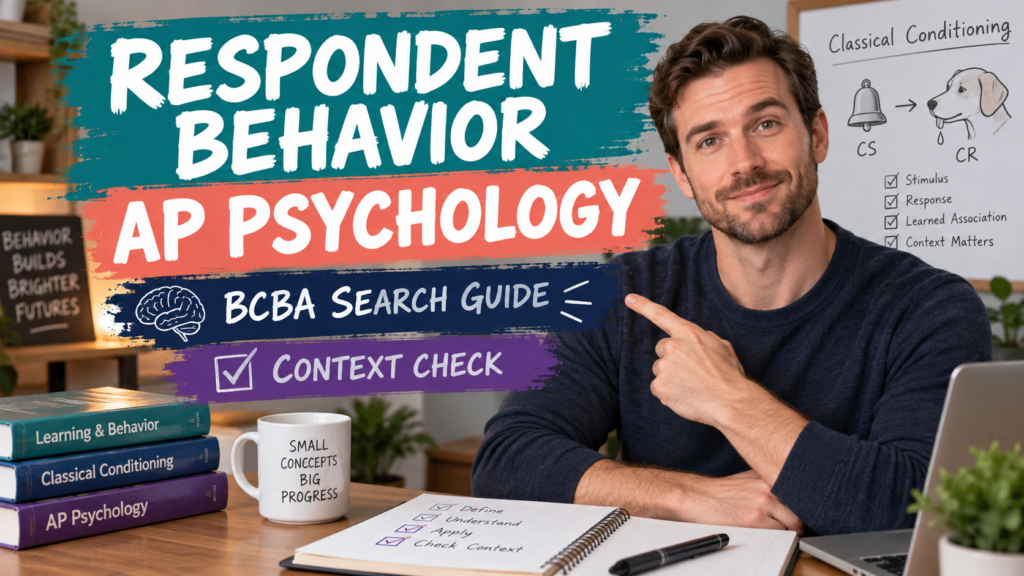
A context-first BCBA study guide for defining the phrase, separating ABA from look-alike meanings, and checking the current source before acting. The exact search phrase respondent behavior ap psychology definition needs context before it needs a definition. A short keyword can describe an applied behavior-analysis concept, a professional credential, a research method, a company symbol, a game, a legal organization, or an incomplete exam question. This guide turns the phrase into a precise reader task instead of guessing what the searcher meant.
Table of Contents
- respondent behavior ap psychology definition: the short answer
- Define the search intent before defining the term
- Connect the phrase to ABA carefully
- Use an evidence-first workflow
- Compare the likely meanings instead of collapsing them
- Avoid common interpretation mistakes
- When to use the current BACB source
- Turn respondent behavior ap psychology definition into BCBA study practice
- respondent behavior ap psychology definition FAQ
- The bottom line
- Take the Free BCBA Mock Exam
- References
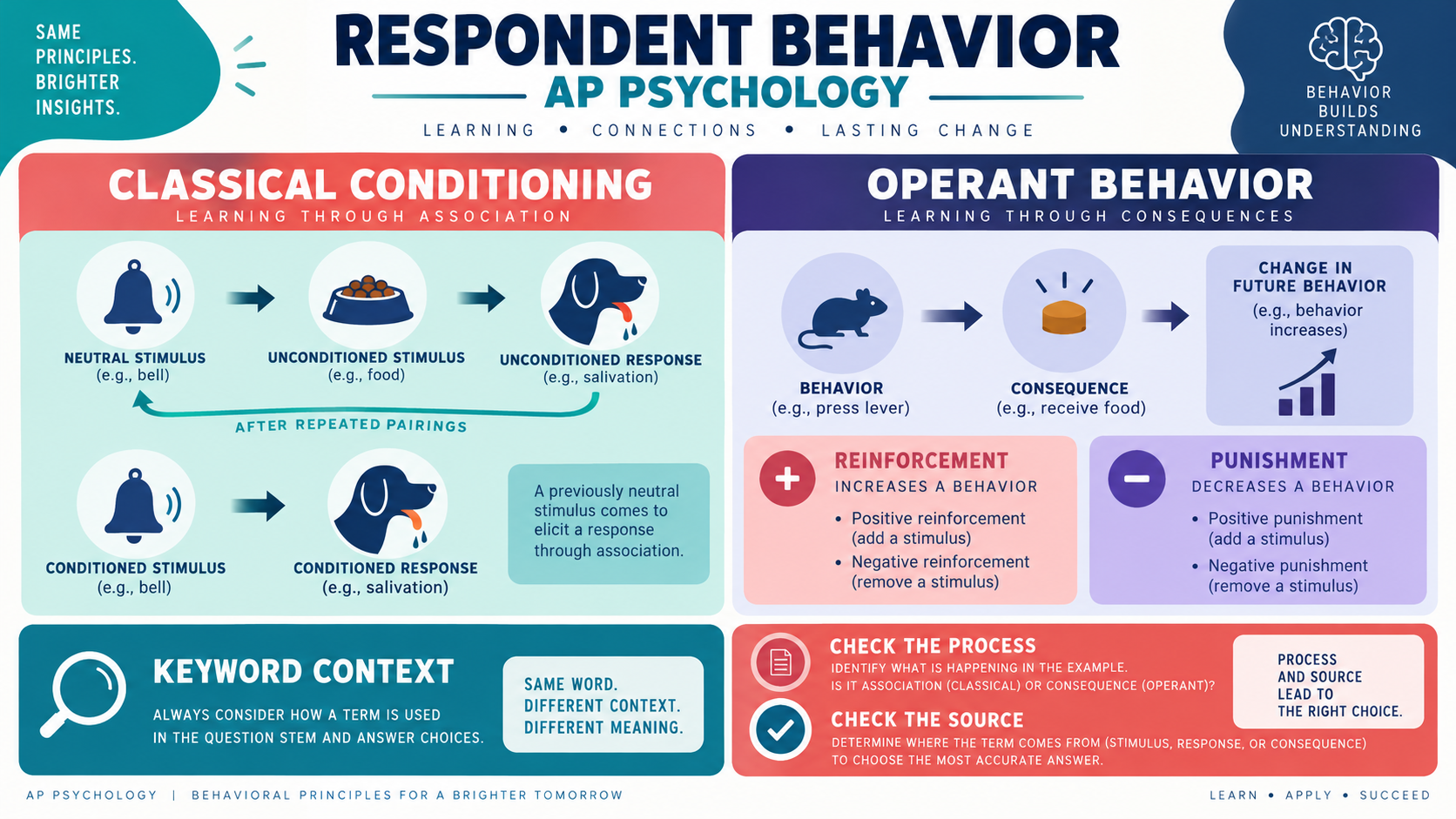
For this page, the working topic is respondent behavior across AP Psychology and ABA. The phrase is an AP Psychology definition query. The article explains respondent behavior and classical conditioning, then carefully distinguishes that learning process from operant behavior-analysis terms. The goal is not to force every search into ABA. It is to explain the supported interpretation, name the boundary, and direct the reader to the current BACB or other authoritative source when a live decision is involved.
Scope note: This is educational and exam-preparation content. It is not medical, legal, financial, diagnostic, billing, or individualized treatment advice. When the phrase concerns a learner, client, credential, application, or professional conduct matter, use the responsible supervisor or official agency for a case-specific determination.
respondent behavior ap psychology definition: the short answer
Start by asking what the searcher is trying to accomplish. If the query is asking for an ABA definition, answer with observable terms, examples, and the nearest contrast. If it is navigational, point to the official page rather than recreating a login, application, or provider directory. If it is a fragment from a practice question, complete the stem only after identifying the behavior, condition, consequence, measurement, or credential rule that controls the answer.
For respondent behavior ap psychology definition, the safest answer is therefore a bounded one: define the supported meaning, explain the closest competing meaning, and show what evidence would confirm the choice. A good BCBA study page does not turn an acronym into a diagnosis, a course label into certification, a search result into proof, or a single example into a treatment plan.
| Question | What to check | Why it matters |
|---|---|---|
| What does the exact phrase ask? | Identify whether it is a definition, comparison, navigation, exam stem, or acronym-disambiguation task. | The same letters can point to different fields. |
| What is the ABA meaning? | Name the observable behavior-analytic concept, role, or measurement procedure only when the context supports it. | A precise definition prevents a search snippet from becoming a false claim. |
| What evidence supports the answer? | Use the current BACB source, a clear example, and the relevant measurement or credential boundary. | A source and an example make the reasoning reviewable. |
| What should the reader do next? | Choose the correct official page, study concept, supervisor question, or professional route. | The next action should match the reader's real task. |
Define the search intent before defining the term
Search intent is the reader’s job, not simply the words typed into a search box. Two queries can share “ABA” and still require completely different answers. One reader may want the meaning of applied behavior analysis. Another may be trying to find the BACB exam route. A third may be searching for a stock symbol or an entertainment title. The page should make that distinction visible in its opening paragraphs. Use the following filter when the result page is mixed or the phrase is incomplete. It takes less time than writing a confident answer to the wrong question.
- Name the field suggested by the surrounding words: behavior analysis, psychology, finance, law, education, health care, or entertainment.
- Classify the task as learn, compare, navigate, calculate, verify, troubleshoot, or prepare for an exam.
- Look for the actor and object: learner, BCBA candidate, certificant, provider, company, game, journal, or agency.
- Write down the smallest answer that solves the task without adding unsupported assumptions.
- Check whether the user needs an official policy page rather than a general explainer.
- If two meanings remain plausible, label both and give a next-click test for each one.
Connect the phrase to ABA carefully
Applied behavior analysis uses observable behavior, environmental context, data, and socially meaningful goals. That does not mean every phrase containing “ABA” belongs to the field. A behavior-analytic interpretation becomes stronger when the query includes a learner, skill, response, consequence, assessment, intervention, supervision, fieldwork, BCBA, RBT, or measurement term. It becomes weaker when the surrounding results are stocks, brands, legal rules, games, or unrelated organizations.
When the ABA interpretation is supported, make the boundaries explicit. A teaching technique is not a complete treatment plan. A BCBA credential is not a medical degree. An exam answer is not a clinical recommendation. A graph or percentage is not meaningful without a clear operational definition and denominator. Those boundaries protect the reader and make the article more useful to a serious student.
- Define the target response or credential in plain language before using an abbreviation.
- Give one example and one nonexample so the learner can discriminate the concept.
- State which part is observable and which part still requires professional judgment.
- Keep learner communication, preferences, assent, dignity, and safety visible in applied examples.
- Separate a general study explanation from an individualized clinical or professional decision.
- Use the field’s current official source when requirements, ethics, testing, or certification are involved.
Use an evidence-first workflow
- Parse the words: mark the noun, action, population, setting, and any time or measurement term.
- Locate the source: use the current BACB handbook, requirements, ethics, or examination page when the topic is credential-related.
- Test the contrast: write what would make the nearest alternative meaning more likely.
- Anchor the example: describe an observable scenario, not a slogan or promise.
- Choose the next step: study the concept, verify the credential, ask the supervisor, or follow the official process.
Evidence means that important claims are traceable. If you say a procedure is discontinuous, show the observation rule. If a schedule is variable, name what varies. If a course leads to a credential, verify the current BACB pathway instead of relying on marketing language.
Compare the likely meanings instead of collapsing them
| Question | What to check | Why it matters |
|---|---|---|
| Behavior-analysis context | A learner, response, environment, data, intervention, BCBA, RBT, or supervision term appears. | Use ABA definitions, the current BACB source, and an observable example. |
| Research-method context | The phrase includes design, validity, sampling, measurement, reliability, or generalization language. | Define the method and identify what it can and cannot support. |
| Credential or exam context | The phrase includes BACB, Pearson VUE, certification, handbook, fieldwork, or eligibility. | Use the official current handbook or requirements page. |
| Other acronym or entity context | The results include finance, law, games, brands, or organizations outside ABA. | Do not force a clinical meaning; confirm the entity and redirect if needed. |
Avoid common interpretation mistakes
Ambiguous keywords often produce low-quality pages because the writer chooses the most familiar meaning and never checks the evidence. That can be especially harmful in behavior analysis, where a casual label may be mistaken for a credential, an intervention, or a conclusion about a learner. Screen for these mistakes before accepting an answer as exam-ready.
- Treating the acronym itself as proof that the query means applied behavior analysis.
- Repeating a fragmentary flashcard answer without naming the missing scenario facts.
- Using a course or provider label as proof of BACB eligibility or certification.
- Describing a technique as universally appropriate without considering function, preference, communication, and data.
- Confusing a schedule of reinforcement with an interval data-recording procedure.
- Confusing respondent behavior with operant behavior because both involve learning.
- Publishing private client, candidate, or certificant information to make an example sound credible.
- Giving legal, financial, medical, or diagnostic advice simply because the keyword is ambiguous.
- Linking to a stale handbook, unofficial form, or copied exam-content page.
- Failing to tell the reader exactly what to verify next.
When to use the current BACB source
Use the Behavior Analyst Certification Board as the controlling source for BCBA certification, examination, ethics, and current pathway requirements. The site changes its handbook, forms, deadlines, and examination guidance over time. A search result, university page, employer checklist, or old study note can be useful orientation, but it should not replace the current official document.
Turn respondent behavior ap psychology definition into BCBA study practice
To study respondent behavior ap psychology definition, write a one-sentence definition, one example, one nonexample, one closest contrast, and one source you would recheck. Then change one detail in the scenario. If the answer changes, you have identified the controlling variable. If it does not, explain why. This five-part routine builds discrimination instead of memorizing a phrase in isolation.
- State the reader task in one verb: define, compare, verify, navigate, calculate, or apply.
- Underline the facts that make the ABA interpretation stronger or weaker.
- Explain the nearest distractor in one sentence.
- Keep the example de-identified and behaviorally observable.
- Check the current official source before treating a rule as final.
For additional scenario practice, use the respondent behavior ap psychology definition practice questions and the Free BCBA Mock Exam. Treat the feedback as a study diagnostic, not as a BACB decision, clinical plan, or passing-score guarantee.
respondent behavior ap psychology definition FAQ
How do I know which meaning the phrase has?: Read the surrounding words and the result types. A learner, response, consequence, measurement, BCBA, or fieldwork term supports an ABA interpretation. Stocks, games, legal rules, newspapers, and other organizations point elsewhere. If the evidence stays mixed, label the ambiguity.
Can I use this page for an individualized client decision?: No. The page provides education and exam-oriented reasoning. A qualified team must assess the individual, include communication and preferences, review data, and determine an appropriate plan within its scope and applicable rules.
Which source controls when a summary conflicts with a website?: Use the current authority for the subject. For certification, examination, ethics, and BACB requirements, start with the official BACB materials and confirm the document date. For another field, use that field’s responsible authority.
What is the best next step after reading an ambiguous definition?: Write the exact task you need to complete, identify the actor and setting, and choose the source or supervisor who can confirm it. Do not solve an uncertain question by adding more confident wording.
The bottom line
respondent behavior ap psychology definition is most useful when treated as a starting point for context, not as a complete conclusion. Define the reader’s task, separate ABA from other meanings, use an observable example, protect scope and privacy, and check the current official source before acting. That process produces a more accurate study answer and a safer professional next step.
Take the Free BCBA Mock Exam
If you want a low-pressure way to check your recall, use the free practice resource below. Take the Free BCBA Mock Exam
References
- Behavior Analyst Certification Board
- BACB BCBA Handbook entry point
- BACB behavior-analysis and autism overview
- Free BCBA Mock Exam



