

A data-first guide to the analytic dimension, functional relations, visual analysis, and BCBA exam decision points. If you are studying analytic ABA, start with one correction: analytic does not simply mean that a behavior analyst collected data. It means the analyst uses measurement and experimental logic to evaluate whether the intervention, rather than an unrelated event, produced the behavior change. The word points to a functional relation, not to a graph by itself.
Table of Contents
- Analytic ABA in one sentence
- What “analytic” means in the seven dimensions
- Use the analytic logic: measure, compare, replicate
- Build the data before interpreting the relation
- Match the design to the causal question
- Read the graph: level, trend, and variability
- Keep analytic distinct from the other dimensions
- Use a five-question analytic worksheet
- Avoid the most common analytic ABA exam traps
- Practice the analytic decision, not just the definition
- Analytic ABA FAQ
- The bottom line
- Sources to study and recheck
- Quick Review Checklist
- Take the Free BCBA Mock Exam
The original Baer, Wolf, and Risley article described analytic application as a self-evaluating way to study whether observed change is attributable to the application and, if so, to which parts of that application. The current BACB Test Content Outline (TCO) expresses the exam version through measurement, experimental design, data interpretation, and intervention decisions. This article turns that idea into a practical exam routine without replacing the official TCO or your coursework.
Analytic ABA in one sentence
Analytic ABA asks whether there is credible evidence that the intervention caused a meaningful change in the target behavior. That question requires an operational definition, repeated measurement, a design that supports comparison, and a disciplined interpretation of the data. A dramatic improvement can be clinically encouraging while still leaving the causal explanation weak if the measurement or design cannot rule out plausible alternatives.
| Analytic question | What the analyst needs | Common weak substitute |
|---|---|---|
| Did behavior change? | A valid operational definition and repeated measurement. | A general impression such as “the client is doing better.” |
| When did it change? | A time series with a clear phase or condition boundary. | One pre-treatment and one post-treatment observation. |
| Why might it have changed? | A design and comparison that address alternative explanations. | Assuming the newest intervention caused every later improvement. |
| Will the change matter? | Effectiveness, social importance, and generalization checks. | A statistically or visually noticeable change with no practical context. |
What “analytic” means in the seven dimensions
In the seven dimensions described by Baer, Wolf, and Risley, the analytic dimension is connected to the field’s experimental side. An applied behavior-analytic intervention should not only target behavior that matters; it should also evaluate the relation between the procedures and the outcome. That is why analytic is closely related to behavioral measurement, experimental design, prediction, verification, and replication.
Analytic is not the same as “having a data sheet.” Data can be unreliable, too sparse, poorly defined, or collected without a comparison that supports interpretation. Conversely, a small single-case design can be analytically useful when the target is clearly defined, the measurement is repeated, the conditions are distinguishable, and the pattern of change supports a reasonable causal interpretation.
For the BCBA exam, connect the historical definition to the current exam boundary. The BCBA TCO 6th edition includes tasks about dependent and independent variables, internal validity, threats to internal validity, single-case designs, graph interpretation, and applying those designs. The TCO is the study map; the original article supplies the conceptual history.
Use the analytic logic: measure, compare, replicate
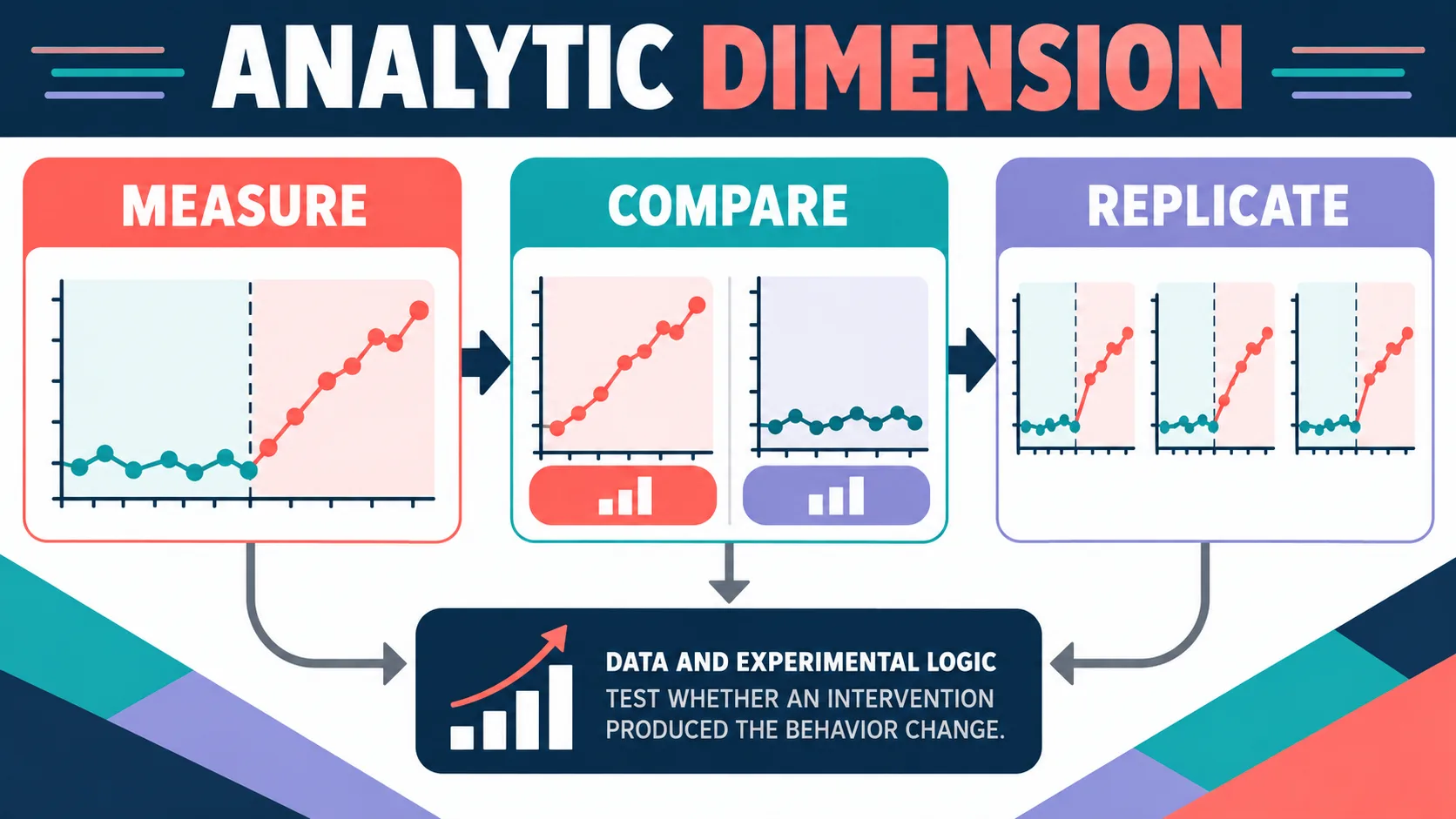
The three-step map is a compact way to remember the logic. Measure the target repeatedly and consistently. Compare behavior across meaningful conditions or phases. Replicate the relation across participants, settings, behaviors, materials, or repeated demonstrations when the design and clinical context call for it.
Replication does not mean copying a graph without thinking. It means asking whether the pattern is dependable enough to support a functional claim and useful enough to guide practice. In an exam vignette, look for the design feature that creates the relevant comparison. A reversal may show repeated changes when treatment is introduced and withdrawn; a multiple-baseline design may show staggered change across tiers; a changing-criterion design may show behavior tracking planned criterion shifts.
Build the data before interpreting the relation
Analytic reasoning fails early when the dependent variable is vague. “Cooperation,” “attention,” or “aggression” may be meaningful clinical topics, but they are not yet measurement definitions. Specify what counts as an instance, the measurement dimension, the observation context, and the conditions under which observers will record.
| Data checkpoint | Analytic question | Exam trap |
|---|---|---|
| Operational definition | Would two trained observers identify the same event? | Using a label or inferred state instead of observable behavior. |
| Measurement dimension | Does frequency, duration, latency, rate, or another dimension fit the question? | Choosing the easiest measure rather than the critical dimension. |
| Reliability and validity | Are the data consistent and representative of the behavior? | Treating agreement alone as proof that the measure is valid. |
| Procedural integrity | Was the independent variable implemented as planned? | Interpreting an outcome without checking treatment fidelity. |
Match the design to the causal question
The analytic dimension is not a contest to choose the most complicated design. Choose a design that answers the question while respecting ethics, safety, feasibility, and the need to keep treatment available. The current TCO asks candidates to identify and apply single-case experimental designs, so know what comparison each design makes and what threat it helps address.
| Design | Core comparison | What to look for |
|---|---|---|
| Reversal | Behavior across repeated treatment and comparison phases. | A change that follows each systematic introduction or removal, when withdrawal is ethical and feasible. |
| Multiple baseline | Staggered intervention across behaviors, settings, or participants. | Untreated tiers remain stable until the intervention is introduced. |
| Multielement | Rapid alternation of conditions. | Conditions are distinguishable and order or carryover effects are considered. |
| Changing criterion | Behavior follows successive planned criteria. | The criterion shifts systematically and the behavior tracks each step. |
An analytic claim is stronger when the design creates multiple demonstrations of the relation. It is weaker when the intervention, observer, setting, and unrelated life event all change at once. On an exam, do not let a large visual improvement distract you from the design logic.
Read the graph: level, trend, and variability
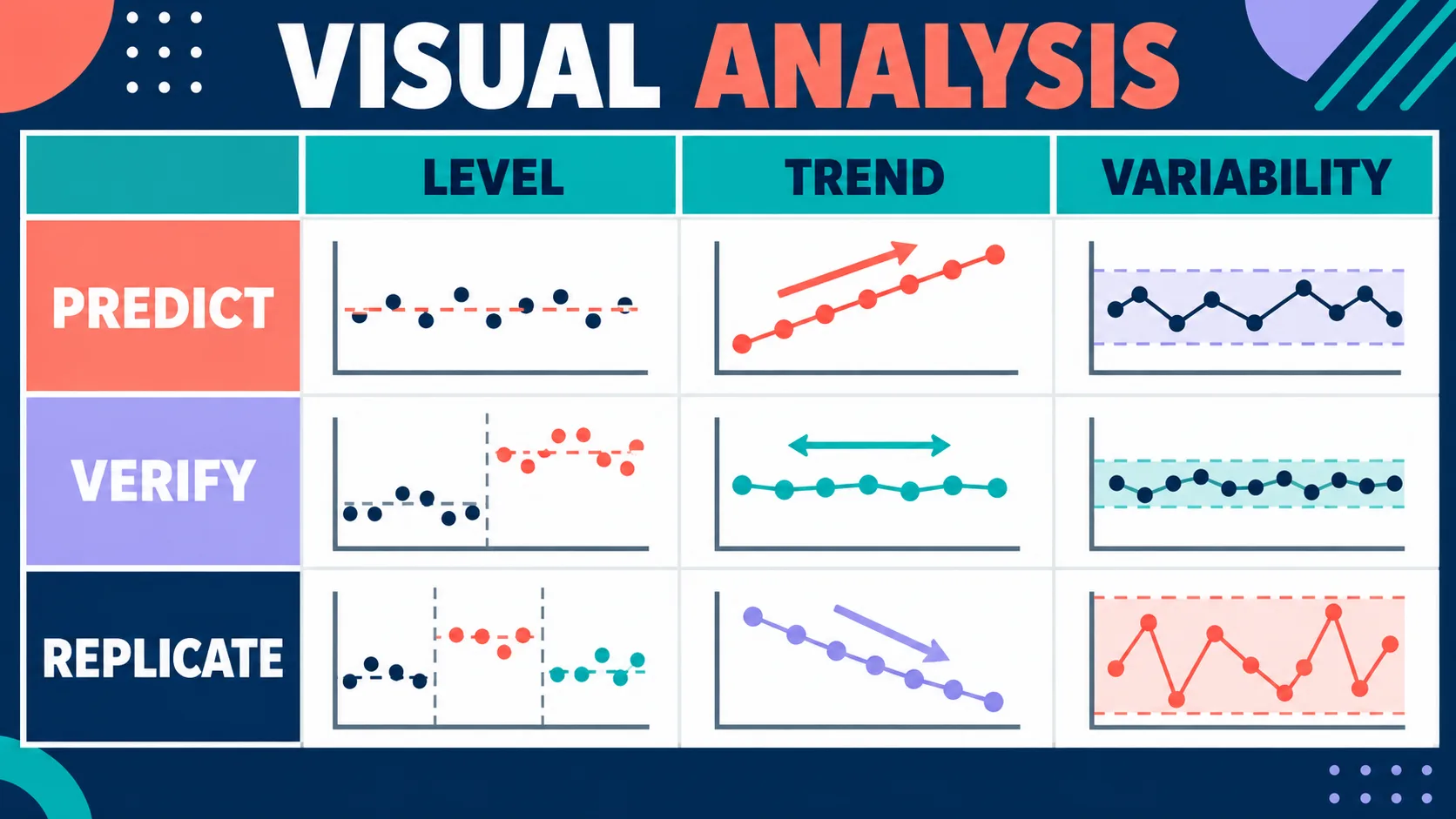
Visual analysis is the decision checkpoint between “I have data” and “I can defend an interpretation.” Start with level: where are the data points located within a phase? Check trend: are they moving upward, downward, or staying flat? Then check variability: how spread out are the points? Finally inspect immediacy of change, overlap, and consistency across phases or tiers.
| Graph feature | Question to ask | Interpretation caution |
|---|---|---|
| Level | Is there a meaningful change in the typical value after the phase shift? | One extreme point can exaggerate the apparent difference. |
| Trend | Was the direction already changing before intervention? | A preexisting trend may make the intervention effect ambiguous. |
| Variability | Are the phases stable enough to compare? | Large overlap or scatter can weaken a simple visual conclusion. |
| Replication | Does the pattern repeat when the design creates another demonstration? | A single phase change is not the same as repeated experimental control. |
Keep analytic distinct from the other dimensions
Analytic interacts with the other dimensions but does not replace them. Applied asks whether the target matters socially. Behavioral requires the target to be behavior, not an inferred trait. Technological means the procedures are described well enough to replicate. Conceptually systematic connects procedures to behavioral principles. Effective asks whether the change is meaningful. Generality asks whether the effects extend across time, settings, behaviors, or people.
A helpful exam distinction is: analytic is about demonstrating the relation; effective is about the importance or size of the outcome. An intervention can show a credible functional relation and still produce a change too small to matter. It can also produce a large change with weak analytic evidence if the design does not support attribution.
Use a five-question analytic worksheet
- What is the target behavior? Rewrite it as an observable, measurable definition.
- What is the dependent variable? Name the dimension and explain why it represents the clinical question.
- What is the independent variable? Identify the procedure, condition, or criterion that changes.
- What comparison supports the claim? Identify the phase, tier, condition, or criterion that creates the demonstration.
- What alternative explanation remains? Check history, maturation, measurement drift, carryover, integrity, and social-context changes.
When you miss an analytic ABA question, write the answer to these five prompts before reading another definition. This turns an exam error into a design-reading skill instead of a vocabulary card.
Avoid the most common analytic ABA exam traps
Trap one: data equals proof. Data are necessary but not sufficient. Trap two: correlation equals control. A behavior may improve alongside treatment without a design that demonstrates attribution. Trap three: a graph’s slope is the whole answer. Analyze phase boundaries, level, trend, variability, overlap, immediacy, and replication. Trap four: reliability equals validity. Observers can agree consistently on a poor definition. Trap five: analytic means effective. The causal question and the social-importance question are related but different.
Practice the analytic decision, not just the definition
After reviewing the concept, use a short case or mock item that forces you to identify the design, the dependent variable, and the strongest interpretation. For each miss, record the exact error: definition, measurement, design, graph reading, or alternative explanation. Then retest with a new scenario so you know whether the rule transferred.
Use the Free BCBA Mock Exam as a diagnostic, not as an official BACB result. A useful next action is to choose one TCO domain—often measurement or experimental design—review the rationale, and take a fresh mixed set after a delay.
Analytic ABA FAQ
What is analytic ABA?: Analytic ABA is the use of measurement and experimental logic to evaluate whether an intervention produced a behavior change. It is more than collecting data; it requires a defensible functional relation or a clearly bounded interpretation of the evidence. Does analytic mean the intervention worked?: Not automatically. Analytic addresses the evidence for the intervention-behavior relation. Effectiveness asks whether the change is meaningful. A study can support one conclusion more strongly than the other.
Why is visual analysis important in ABA?: Visual analysis helps the analyst inspect level, trend, variability, immediacy, overlap, and replication across phases or tiers. It supports a reasoned interpretation of the data rather than a reaction to one high or low point.
What designs are associated with analytic behavior analysis?: Single-case designs such as reversal, multiple-baseline, multielement, and changing-criterion designs can create repeated comparisons that support analytic reasoning. The right choice depends on the behavior, ethical constraints, feasibility, and causal question.
Is analytic the same as the analytic dimension in the seven dimensions of ABA?: The phrase is commonly used for that dimension, which emphasizes evaluating whether an application produced the observed change. Study the historical definition with the current BACB TCO so you can connect the concept to present measurement and experimental-design tasks.
The bottom line
Analytic ABA is the discipline of asking what the data and design allow you to claim. Define the behavior, measure the right dimension, create a meaningful comparison, inspect the graph, check treatment integrity, and look for replication. For exam questions, remember the core distinction: data describe change, while experimental logic helps evaluate whether the intervention produced it.
Sources to study and recheck
- Baer, Wolf, and Risley (1968), Some Current Dimensions of Applied Behavior Analysis
- Full text of the original article in PubMed Central
- BACB BCBA Test Content Outline, 6th edition
- BACB test content outline index
- Existing seven-dimensions overview
- Existing applied, behavioral, and analytic characteristics page
For targeted review, use our analytic aba practice questions to apply the concept in exam-style scenarios.
Quick Review Checklist
Use this final checklist to turn analytic aba into exam-ready reasoning. The goal is not to memorize a label in isolation; it is to identify the relevant evidence and explain why the best answer fits the scenario. Key ideas to review:
- State the central definition or decision point for analytic aba in your own words.
- Identify the detail that makes analytic aba different from its closest related ABA term.
- Separate the observable facts in a scenario from assumptions that are not supported by the facts.
- Write one example and one nonexample so you can recognize the concept in a new setting.
Exam application checks:
- Ask what the question is actually requesting before comparing the answer choices.
- Mark the antecedent, response, consequence, or other evidence that supports the selected answer.
- Look for a distractor that describes a related process but does not answer the specific question.
Final self-check:
- Explain how you would verify the interpretation with clear observations or data.
- Change one detail in the scenario and decide whether your answer should change.
- Give a one-sentence rationale that a supervisor or study partner could evaluate.
Take the Free BCBA Mock Exam
A useful next step is to apply this idea in a fresh set of BCBA-style practice questions and review the feedback. Take the Free BCBA Mock Exam



