
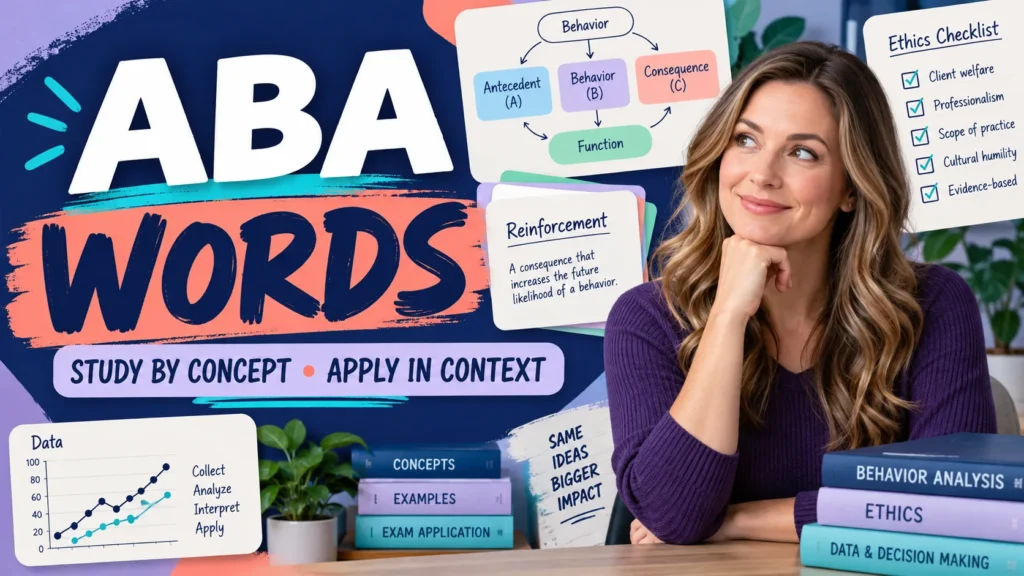
ABA words are easiest to learn when they describe a relationship, not when they sit alone on a flashcard. A strong study word tells you what happened, what evidence matters, what procedure is being used, or what professional decision follows. That is why “define the term” is only the first step.
Table of Contents
- What “ABA Words” Should Help You Do
- Build a Five-Category ABA Word Map
- Measurement Words: What Changed?
- Assessment and Intervention Words: Why and How?
- Ethics and Supervision Words: Who Is Protected?
- Term Triage: Definition, Example, Decision
- How to Study ABA Words Without Building a Word Pile
- FAQ: Glossaries, Exam Terms, and Practice
- Sources for Further Study
- Quick Review Checklist
This guide is a concept-based map for broad ABA vocabulary searches. It does not replace the current BCBA Test Content Outline, Ethics Code, handbook, supervision contract, or your supervisor’s definitions. Use the official source that applies to your credential and application date when a rule or requirement is involved.
What “ABA Words” Should Help You Do
Use a glossary when you need a quick definition. Use a study map when you need to tell similar concepts apart in a scenario. The broad phrase “ABA words” can include concepts and principles, measurement, assessment, behavior-change procedures, ethics, and supervision. A useful resource should tell you which family a word belongs to and what question it answers.
| Word family | Examples | Question it answers |
|---|---|---|
| Measurement | Frequency, duration, latency, rate, percentage, reliability | What changed, and how do we know? |
| Assessment | Preference assessment, skill assessment, functional assessment, social validity | What information should guide the next decision? |
| Intervention | Prompting, shaping, chaining, differential reinforcement, extinction, generalization | What procedure changes the conditions or teaches the skill? |
| Ethics | Competence, confidentiality, assent, cultural humility, multiple relationships | How do we protect clients, learners, and the profession? |
| Supervision | Feedback, performance monitoring, delegation, training, fieldwork documentation | Who is responsible, and what support is needed? |
The BCBA Test Content Outline 6th ed. groups exam tasks into domains rather than a single alphabetized “ABA words” list. That organization is useful: it reminds you that a word such as reinforcement may appear in a concepts question, a measurement question, an intervention scenario, or an ethics discussion, and the surrounding facts determine its meaning.
Build a Five-Category ABA Word Map
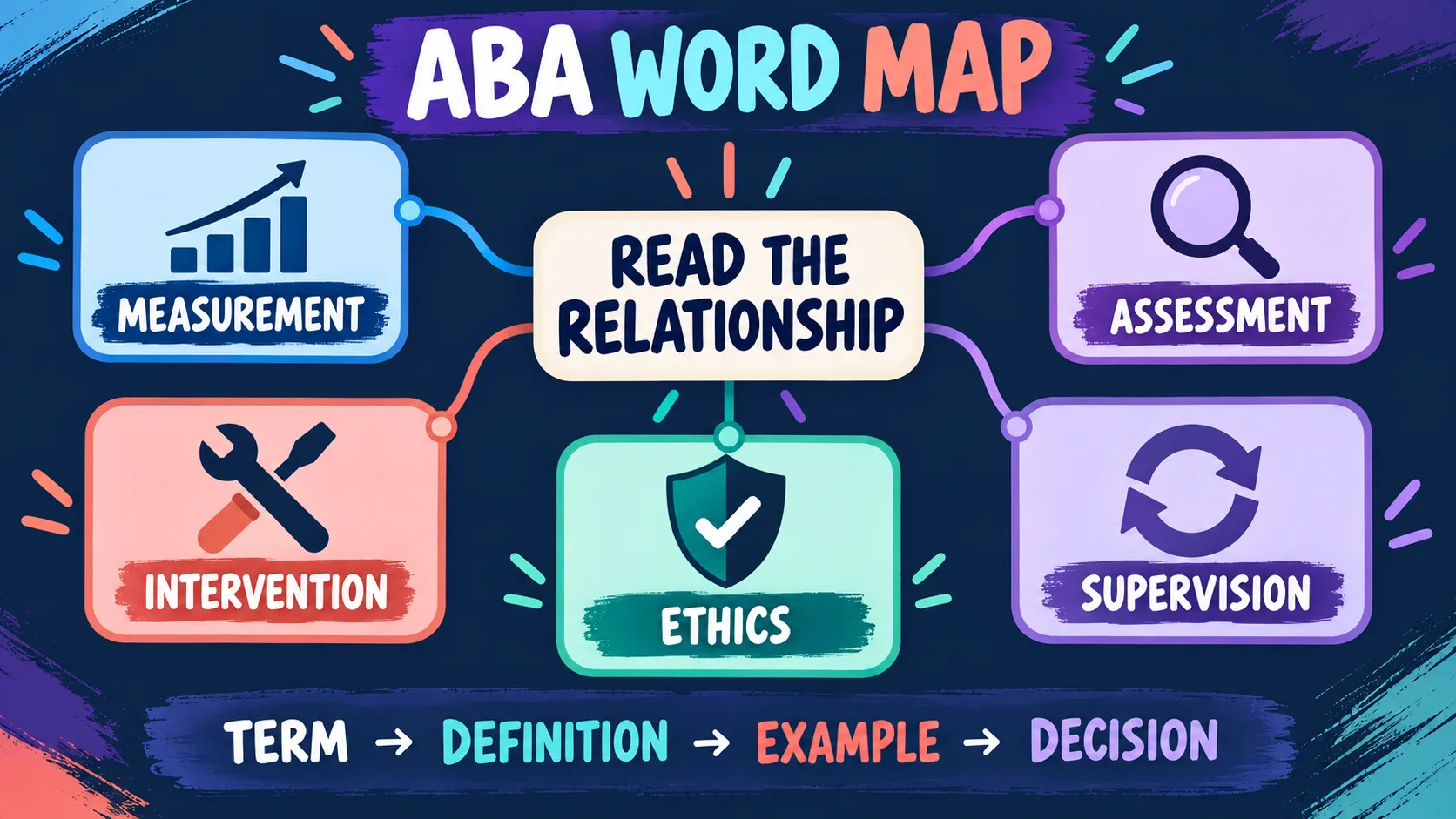
Start each vocabulary session by placing the new term into a category. Then connect it to a definition, a short example, and the decision it changes. The category is not a substitute for learning the term; it is a retrieval cue that helps you avoid mixing concepts with procedures or ethics boundaries.
- Measurement: identify the dimension of behavior and the data system.
- Assessment: identify what information is being gathered and why.
- Intervention: identify the environmental or teaching procedure and its target.
- Ethics: identify the client, learner, public, or profession that needs protection.
- Supervision: identify the role, feedback, training, and documentation responsibility.
Measurement Words: What Changed?
Measurement vocabulary is about translating behavior into a record that can be compared. Frequency is a count of responses in a defined period; rate adjusts a count for time; duration describes how long the response lasts; and latency describes the time between an event or instruction and the response. Percentage is meaningful only when the numerator and denominator are defined.
When a question uses the word measurement, ask three things: What is the dimension of the behavior? What is the observation window? What collection system can capture it reliably? A count may be useful for discrete requests, while duration may better describe an episode with a clear beginning and end. Do not choose a measure because it sounds more clinical. Also separate validity from reliability. Validity asks whether the measure represents what you intended to measure. Reliability asks whether the measurement is consistent enough to trust. A precise-looking number is not automatically valid.
Assessment and Intervention Words: Why and How?
Assessment terms describe how information is gathered before or during a decision. A preference assessment helps identify items or activities a learner may select; a reinforcer assessment evaluates whether a consequence changes future responding. A functional assessment examines variables related to behavior, but the exact method—indirect, descriptive, or experimental—matters. Social validity asks whether the goals, procedures, and outcomes matter to the people affected.
Intervention terms describe what the practitioner does. Prompting adds assistance to evoke a response. Shaping differentially reinforces closer approximations to a final response. Chaining links steps in a task analysis. Generalization concerns responding across people, settings, materials, or examples. Maintenance concerns responding over time after teaching conditions change.
The common trap is treating an intervention name as evidence that the intervention worked. A scenario still needs a target, context, procedure, measurement, and outcome. “Used prompting” is not enough; ask what prompt, for which response, with what change in independence.
Ethics and Supervision Words: Who Is Protected?
Ethics vocabulary is not a decorative list at the end of a study guide. It changes what action is acceptable. Competence asks whether the practitioner has the education, training, and experience for the task. Confidentiality asks how information is collected, protected, used, and disclosed. Assent concerns a person’s willingness to participate when assent is relevant to the service context. Cultural humility requires ongoing openness and responsiveness rather than a one-time claim of cultural expertise.
Supervision words identify responsibility and support. Feedback should be specific enough to guide performance. Performance monitoring uses data or direct observation to evaluate implementation. Delegation requires attention to role, competence, training, and oversight. Documentation should show what happened and who was responsible; it cannot turn an unperformed activity into a completed one.
When a question includes a conflict, a public statement, a client transition, or a supervisor relationship, stop treating it like a definition question. Look for the protected interest, the applicable code or policy, the person’s role, and the action that reduces risk.
Term Triage: Definition, Example, Decision
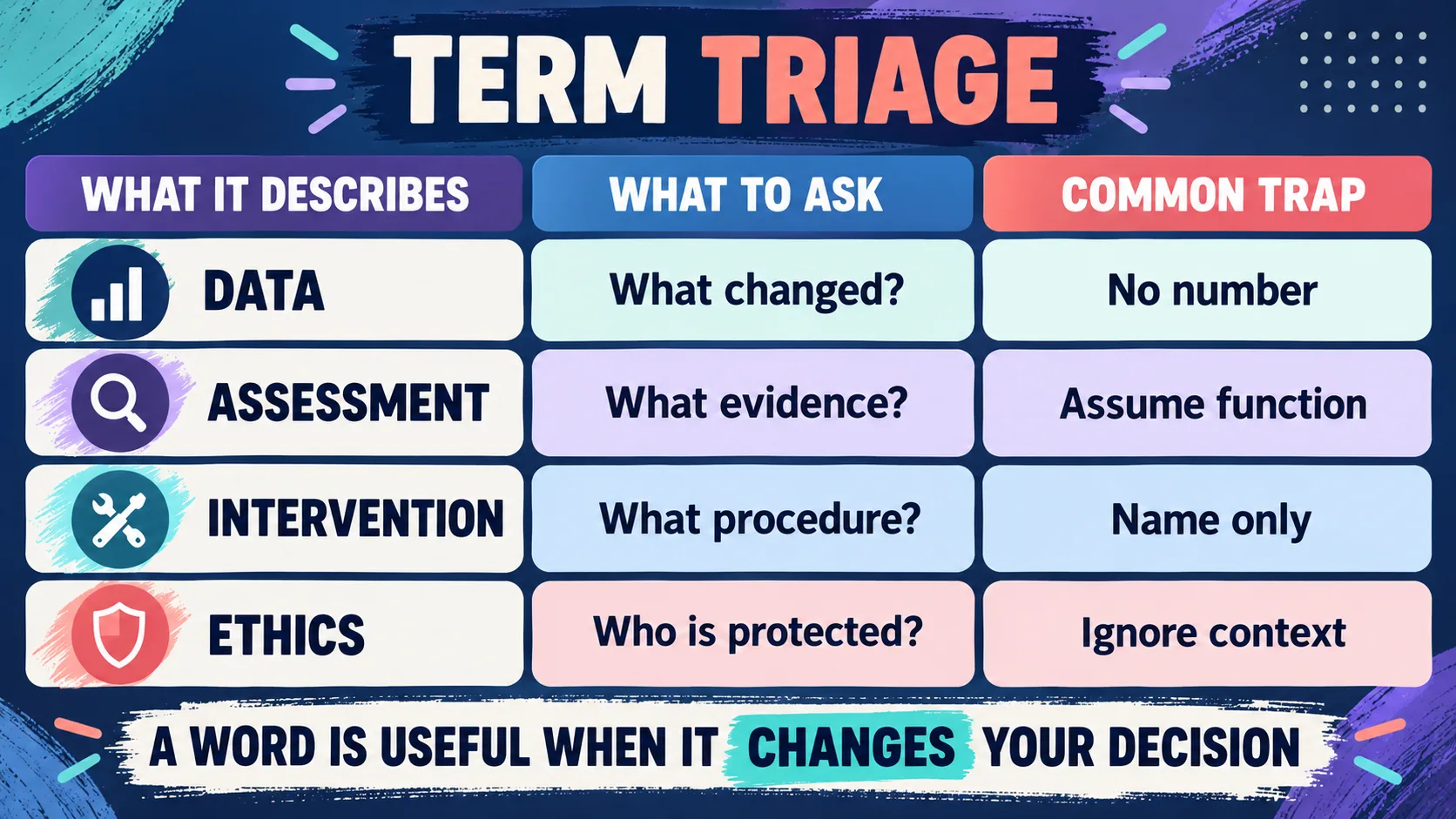
Use a three-part review for every high-value word:
- Definition: Can you state the concept without hiding behind a synonym?
- Example: Can you identify a clear scenario and a nonexample?
- Decision: Can you explain what the practitioner should measure, change, protect, or ask next?
| Term family | Ask yourself | Common trap |
|---|---|---|
| Data | What changed, and over what period? | Using “improved” with no number or comparison. |
| Assessment | What evidence is being gathered, and for what decision? | Assuming a function before assessment supports it. |
| Intervention | What procedure changed the antecedent, response, or consequence? | Naming a procedure without a target or fidelity check. |
| Ethics | Who is protected, and what obligation applies? | Ignoring confidentiality, competence, or context. |
| Supervision | Who observes, trains, gives feedback, and documents? | Treating a meeting or title as proof of effective supervision. |
How to Study ABA Words Without Building a Word Pile
Use a small, repeatable loop rather than adding hundreds of disconnected definitions:
- Collect: take the term from the current BACB outline, a practice question, or a supervisor-approved source.
- Contrast: pair it with a term that is easy to confuse, such as frequency versus rate or preference assessment versus reinforcer assessment.
- Apply: write one example, one nonexample, and one question-stem clue.
- Retrieve: close the notes and explain what the practitioner should measure, do, or protect.
- Audit: check the definition against the current official outline, ethics code, handbook, or supervisor guidance.
For broad vocabulary, organization beats volume. Keep a source column and a “last checked” date for rules or credential requirements. Use the existing ABA terms guide for lookup, then return to this page’s map to practice the relationship and decision.
FAQ: Glossaries, Exam Terms, and Practice
Are ABA words the same as BCBA exam terms?: There is overlap, but “ABA words” is a broad search phrase. The BCBA exam follows the official Test Content Outline, which organizes tasks into domains. Use that outline as the authority and use vocabulary resources as study aids.
Should I memorize a long list of ABA definitions?: Memorization can help with first exposure, but scenario questions require discrimination and application. Pair every definition with an example, a nonexample, and the decision it changes.
Why do the same words appear in measurement and intervention questions?: Because a term’s role depends on the scenario. “Reinforcement” can be a concept to identify, a consequence to arrange, or a relation to evaluate with data. Read the surrounding facts before choosing the answer.
Where should I verify ethics vocabulary?: Use the current BACB Ethics Code and applicable employer, payer, and state requirements. Ethics terms are not frozen forever, so check the official source instead of relying on an undated screenshot or flashcard.
When you are ready to test application rather than recognition, Take the Free BCBA Mock Exam and note which word family caused the mistake. It is a practice resource, not a substitute for the official outline, ethics code, coursework, or supervision.
Sources for Further Study
- BACB: BCBA Test Content Outline (6th ed.)
- BACB: Test Content Outlines for BACB Certifications
- BACB: Ethics Codes
- BACB: BCBA fieldwork resources
- BCBA Mock Exam: Applied Behavior Analysis Terms
This article is educational and is not an official BACB glossary. Confirm current certification, ethics, and examination information in the official sources before relying on it.
Quick Review Checklist
Use this final checklist to turn aba words into exam-ready reasoning. The goal is not to memorize a label in isolation; it is to identify the relevant evidence and explain why the best answer fits the scenario. Key ideas to review:
- State the central definition or decision point for aba words in your own words.
- Identify the detail that makes aba words different from its closest related ABA term.
- Separate the observable facts in a scenario from assumptions that are not supported by the facts.
- Write one example and one nonexample so you can recognize the concept in a new setting.
Exam application checks:
- Ask what the question is actually requesting before comparing the answer choices.
- Mark the antecedent, response, consequence, or other evidence that supports the selected answer.
- Look for a distractor that describes a related process but does not answer the specific question.
Final self-check:
- Explain how you would verify the interpretation with clear observations or data.
- Change one detail in the scenario and decide whether your answer should change.
- Give a one-sentence rationale that a supervisor or study partner could evaluate.



