
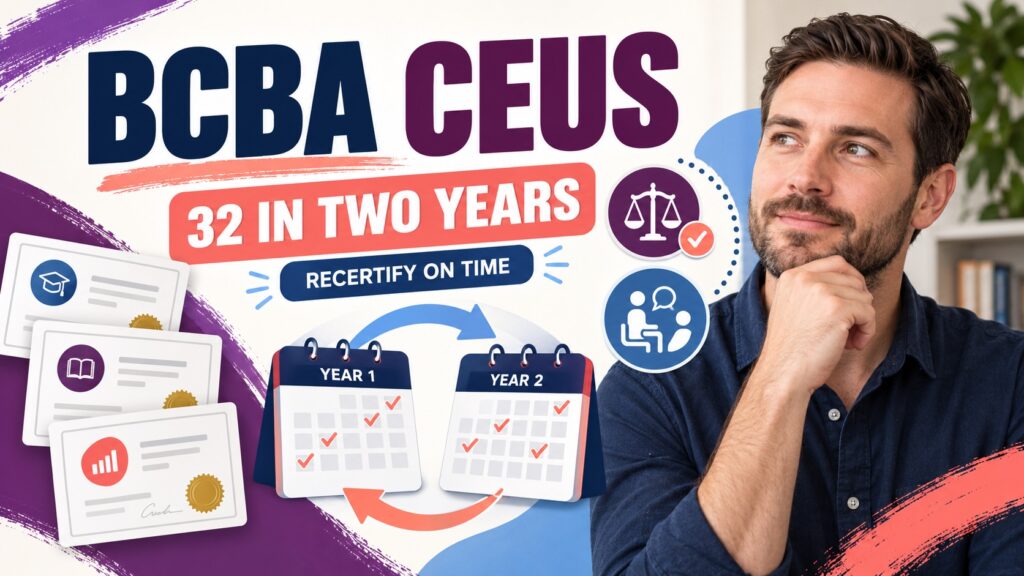
If you are asking how many ceus does a bcba need for recertification, the current BCBA Handbook answer is 32 continuing education units (CEUs) within each two-year recertification cycle. That total is not the whole planning rule. The current handbook also requires 4 CEUs in ethics and 3 CEUs in supervision for supervisors, when the supervision requirement applies. Beginning with the 2027 maintenance requirements, the supervision category changes to 4 CEUs for supervisors.
Table of Contents
- How Many CEUs Does A BCBA Need For Recertification?
- How Should You Calculate The 32 CEUs?
- Which CEU Categories Matter?
- What Counts Toward The Right Cycle?
- How Should You Track CEU Proof?
- What Changes In 2027?
- Which CEU Mistakes Create Recertification Problems?
- BCBA CEU FAQ
- What Should You Do This Week?
- Take the Free BCBA Mock Exam
The safest way to plan is to identify the rule that applies to your current recertification cycle, record every CE activity with supporting documentation, and recheck the BACB source before the next cycle begins. Do not use an older article that says “32 CEUs” without checking the ethics and supervision categories underneath the total. This guide separates the current 2026 rule from the announced 2027 change, explains what the numbers mean, and gives you a simple tracking method that keeps a certificate, category, date, and cycle together. Table of Contents
How Many CEUs Does A BCBA Need For Recertification?
Under the current BCBA Handbook, a BCBA needs 32 CEUs during each two-year recertification cycle. The current category checkpoints are 4 ethics CEUs and 3 supervision CEUs for supervisors, with the remainder coming from eligible continuing education. If you are not subject to the supervision requirement, you still need the total and ethics category; you should not invent a supervision category simply because another BCBA has one.
The BACB also requires certificants to follow ethics and self-reporting requirements and submit the recertification application and associated fees before the recertification date. CEUs alone do not renew the certification. The activity must be eligible, fall inside the correct cycle, be entered as required, and be supported by documentation.
One rule is more important than a generic annual average: CEUs belong to a defined two-year cycle. The BACB says excess CEUs cannot be moved to the next cycle, and missed CEUs cannot be made up after the recertification date during reinstatement. Plan from your own dates, not from January-to-December assumptions.
How Should You Calculate The 32 CEUs?
Use the total as a ceiling check and the categories as separate minimums. For a current BCBA who supervises and therefore needs the supervision category, a simple plan looks like this:
| Current-cycle bucket | Minimum to plan | Planning question |
|---|---|---|
| Total continuing education | 32 CEUs | Will all activities be inside the two-year cycle and eligible for the BCBA? |
| Ethics | 4 CEUs | Does most of the event focus on ethics or qualifying cultural/contextual responsiveness? |
| Supervision, if applicable | 3 CEUs under the current rule | Are you supervising people who trigger the BCBA supervision CE requirement? |
| Remaining eligible education | The balance needed to reach 32 | Does the activity fit an acceptable CE type and have proof? |
The table is a planning model, not permission to label any convenient webinar as ethics or supervision. If an activity is only briefly mentioning the ethics code while mostly teaching an unrelated topic, the BACB’s guidance says it should not be offered as ethics continuing education. Read the activity description, provider information, and category evidence before counting it.
Which CEU Categories Matter?
Start with the category shown in your BACB account and the supporting certificate. The current BCBA Handbook describes different CE activity types and asks certificants to enter the activity information and upload documentation. A certificate with a date and number of hours is useful, but it may not answer every category question by itself.
Ethics deserves special attention. The current and 2027 BACB materials explain that ethics continuing education can include ethics requirements and qualifying cultural or contextual responsiveness content. The event still needs to relate to behavior-analytic practice or applied research and be meaningfully focused on the qualifying subject. A general professional-development course is not automatically an ethics CEU because the presenter used the word “ethical” once.
Supervision is conditional. If you supervise and the applicable rule requires supervision CEUs, keep that category separate from general education. If your role changes during the cycle, reopen the current handbook and confirm the requirement instead of relying on last year’s tracking sheet.
What Counts Toward The Right Cycle?
Your recertification cycle is based on your original certification or recertification date, not necessarily the calendar year. A CE activity completed before the cycle opens normally belongs to an earlier period, and an activity completed after the cycle closes cannot repair a missed requirement. The BACB’s handbook gives the same basic warning: CEUs must occur within the cycle to which they are applied. Put the start and end dates at the top of a tracker. Before you register for an event, ask three questions:
- Will the event date fall inside my current two-year recertification cycle?
- Does the provider or activity description identify the CE type I plan to enter?
- Will I receive a certificate or other documentation showing the date, credit, and activity details?
Do not wait until the 45-day recertification window to discover that half your certificates are missing. Enter or organize the evidence while the event is still easy to verify. A small monthly update is more reliable than a large end-of-cycle search through old email.
How Should You Track CEU Proof?
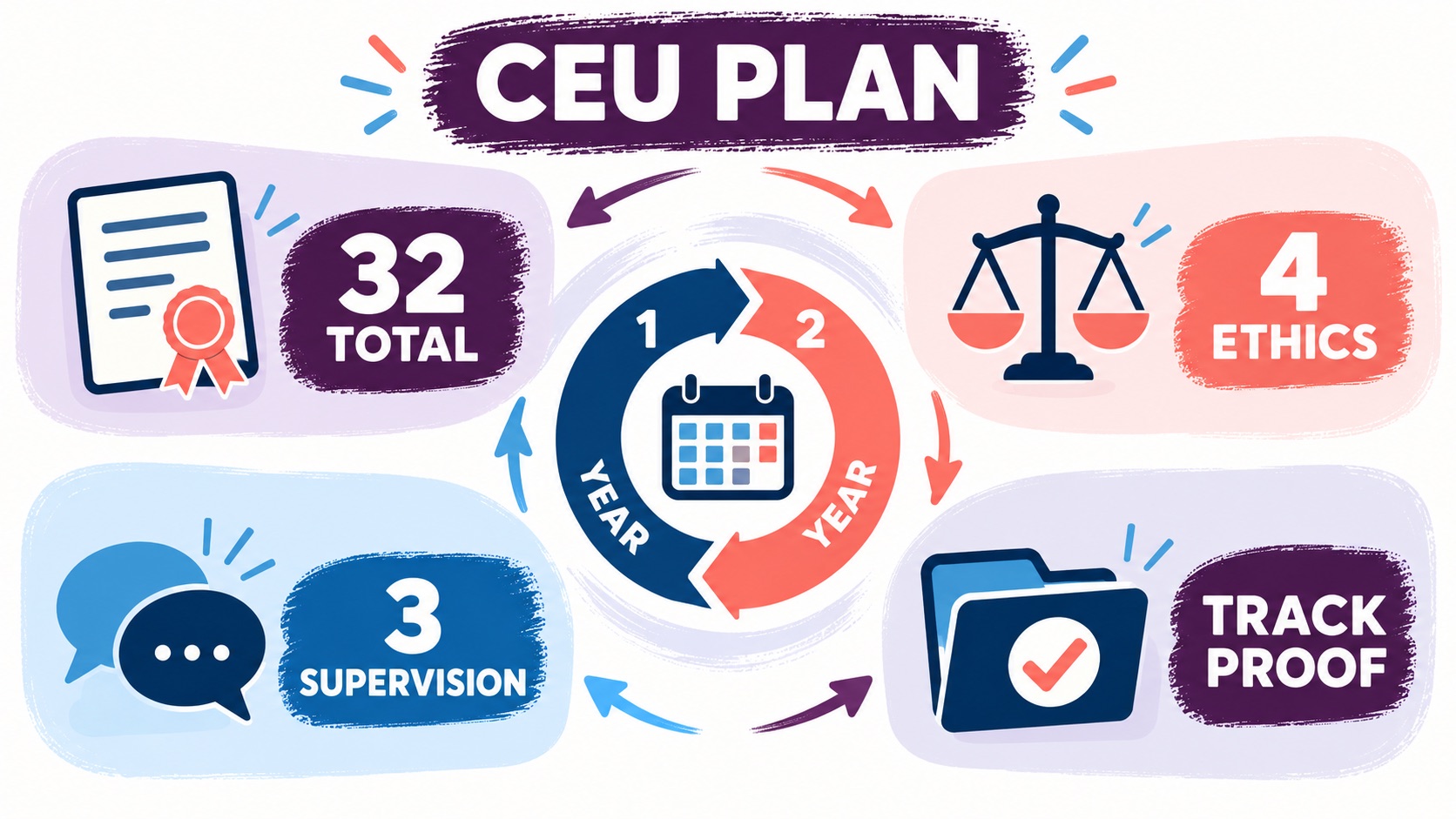
Create one row per activity and keep the original certificate in a matching folder. A practical tracker includes the event title, provider, date, CEU amount, category, cycle, upload status, and file name. If a single event contains multiple categories, record the category allocation separately so you do not accidentally count the same credit twice. Use this routine:
- Save the certificate immediately with an ISO-style date in the file name.
- Enter the activity in your BACB account when the documentation is available.
- Update separate totals for all CEUs, ethics, supervision, and any category that your current rule requires.
- At the end of each quarter, compare the tracker with the cycle end date and schedule the missing categories.
- Before recertifying, check the live handbook and confirm that the account entries and files agree.
Keep the tracker factual. It is not a place to guess that a course “should probably count.” Put uncertain items in a review column until you can confirm the category through the provider or BACB instructions.
What Changes In 2027?
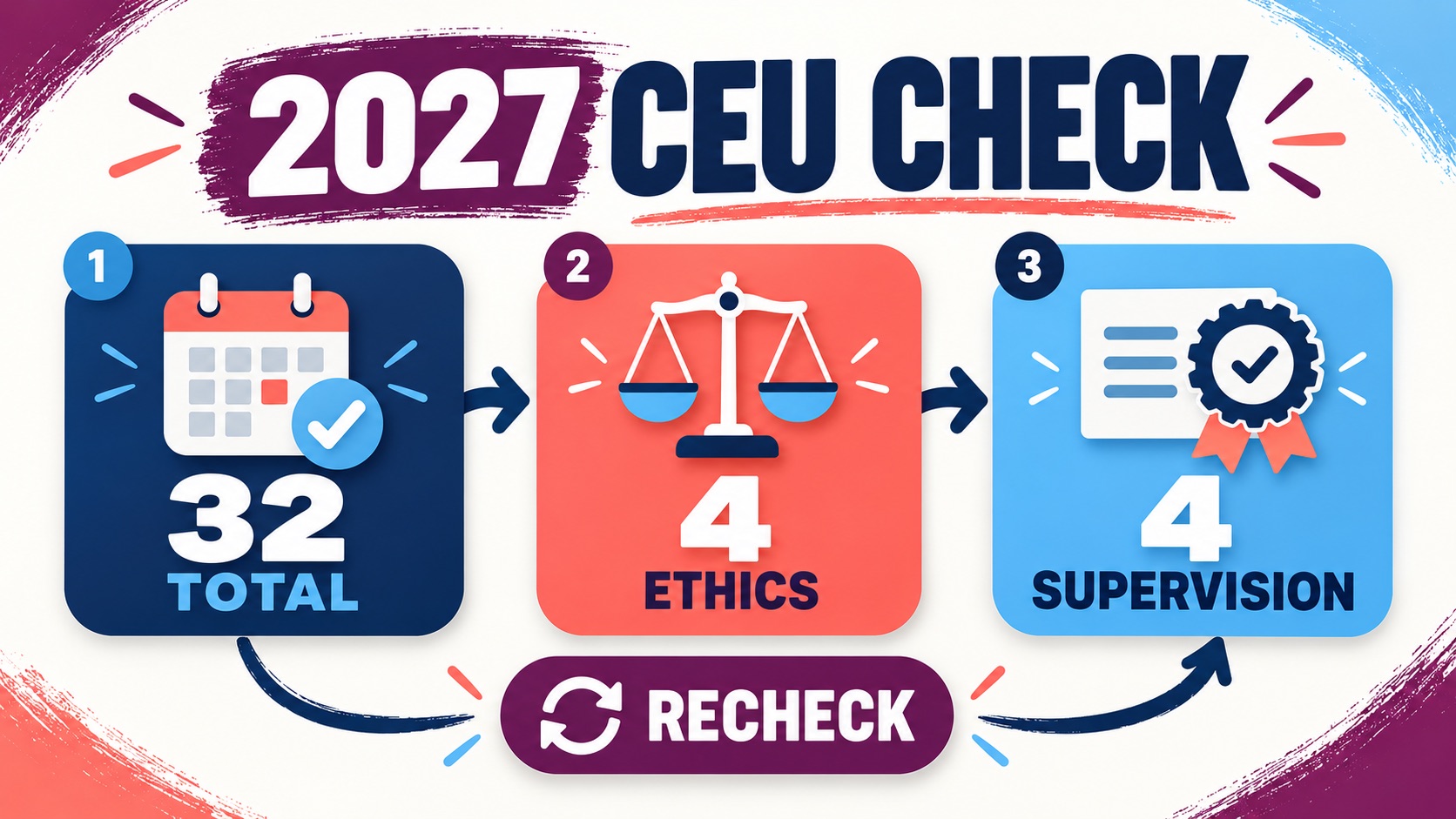
The BACB’s 2027 BCBA Requirements document says the total remains 32 CEUs within each two-year cycle, but the maintenance category for supervisors changes to 4 CEUs in supervision. The same document explains that the ethics category includes ethics requirements and qualifying cultural/contextual responsiveness content. The Recent & Upcoming Changes page lists January 1, 2027 as the effective date for revisions to BCBA eligibility and maintenance requirements.
That means the right answer to “How many CEUs?” is not just “32.” You also need to ask which maintenance rule controls your cycle and whether you supervise. If your recertification date or current cycle crosses the transition, do not assume that a certificate labeled “supervision” satisfies either the current or future category. Check the effective-date guidance and retain the course description that supports your classification.
Use a 2027 recheck before buying a large bundle of credits. Confirm the total, ethics definition, supervision category, acceptable activities, and submission procedure in the current handbook. A provider’s marketing page can explain a course, but the BACB source controls the certification requirement.
Which CEU Mistakes Create Recertification Problems?
The most common errors are tracking errors rather than arithmetic errors. Watch for these traps:
- Counting 32 credits without separately meeting the ethics and applicable supervision minimums.
- Putting an activity in the wrong two-year cycle because its certificate was downloaded later than its event date.
- Assuming a course is an ethics CEU because it briefly mentions the code of ethics.
- Counting a mock exam, study session, or informal reading as BACB continuing education without an eligible activity and documentation.
- Double-counting the same credit in general education and a special category.
- Waiting until after the recertification date to make up a shortfall.
If your tracker is short, take action before the cycle closes. If the cycle has already ended, read the current reinstatement and recertification instructions rather than assuming that a late webinar will repair the record.
BCBA CEU FAQ
Does every BCBA need 32 CEUs?: The current BCBA maintenance rule requires 32 CEUs in each two-year recertification cycle. The applicable category requirements, activity types, documentation, ethics and self-reporting obligations, and submission timing also matter. Treat 32 as the total requirement, not the complete checklist.
How many ethics CEUs does a BCBA need?: The current handbook requires 4 ethics CEUs within the cycle. Ethics activities should be meaningfully focused on ethics requirements or qualifying cultural/contextual responsiveness content related to behavior-analytic practice or applied research. Recheck the current handbook before you classify a course.
How many supervision CEUs does a BCBA need?: Under the current rule, a BCBA who is subject to the supervision requirement plans for 3 supervision CEUs. The 2027 BCBA Requirements document changes that supervision amount to 4 CEUs for supervisors beginning with the 2027 maintenance requirements. Confirm which rule controls your cycle.
Can a BCBA carry extra CEUs into the next cycle?: No assumption of carryover is safe. The BACB states that CEUs exceeding the required amount cannot be applied to the next cycle. Keep extra learning for professional development, but do not subtract it from the next cycle’s required plan unless the current BACB rule expressly allows it.
What Should You Do This Week?
Open your BACB account and write down the current recertification date. Then create four totals: all CEUs, ethics, supervision if applicable, and remaining eligible education. Add a link or saved copy of the current BCBA Handbook next to the tracker and set a quarterly review reminder. This turns “How many do I need?” into a number you can check before the deadline.
When you want a timed exam-preparation checkpoint alongside your CEU planning, use our free BCBA mock exam practice for how many ceus does a bcba need for recertification study planning. It is independent exam-preparation support; it does not award BACB CEUs or complete a recertification application.
Finally, recheck the current BACB handbook whenever your role, supervisor status, recertification cycle, or the effective date of a new requirement changes. The total may be easy to remember, but the category and cycle details are what protect the renewal.
Take the Free BCBA Mock Exam
When you are ready to apply the idea, use the free practice resource below for additional feedback. Take the Free BCBA Mock Exam



