
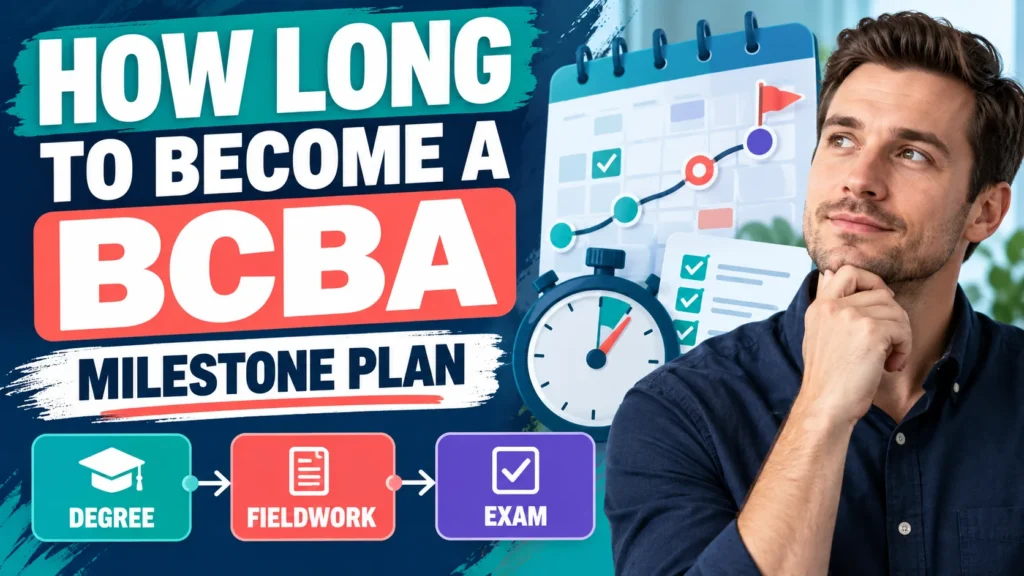
A practical BCBA timeline planner for students, supervisees, and career changers who need to separate fixed milestones from steps that can overlap. How long does it take to become a BCBA? There is no single number that applies to every applicant. Your timeline depends on where you start, which degree and coursework requirements you have already completed, how quickly you can accumulate qualifying fieldwork, when your application is complete, and which BACB requirements govern your application date.
Table of Contents
- How Long Does It Take to Become a BCBA? The Short Answer
- The Five Milestones That Control Your Timeline
- Why the 2026–2027 Transition Matters
- What Can Overlap—and What Cannot?
- Build Your Personal BCBA Timeline
- Where Applicants Lose Time
- Frequently Asked Questions
- Quick Review Checklist
- Take the Free BCBA Mock Exam
A useful estimate is therefore a milestone plan, not a promise. Someone who already has the appropriate graduate degree, behavior-analytic coursework, documented fieldwork, and an application-ready file may be close to the exam stage. Someone starting before graduate school has several sequential gates before an exam application is realistic. Fieldwork may overlap with coursework in some plans, but it does not erase the need for qualifying supervision, documentation, or a complete application.
Important scope note: This is an educational planning guide, not an eligibility determination. BACB rules, handbooks, forms, and transition guidance control. Verify your pathway and dates with the current official BACB resources before enrolling, changing supervision, submitting an application, or relying on a deadline.
How Long Does It Take to Become a BCBA? The Short Answer
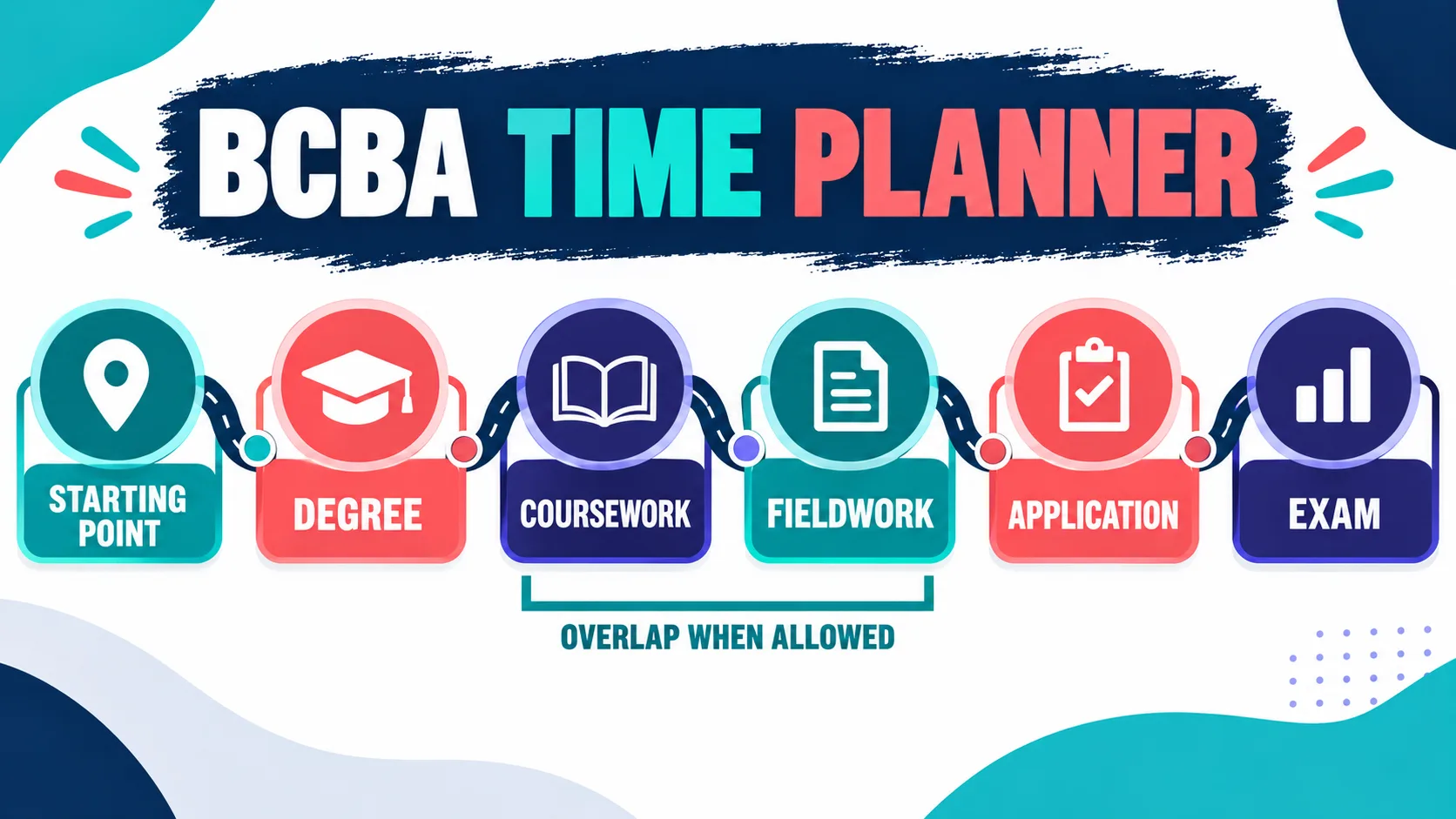
The shortest honest answer is: it depends on your starting point and the requirements attached to your application date. A person who has finished the degree, coursework, and fieldwork gates is planning for application review and exam preparation. A person without a qualifying graduate degree is planning for an education pathway first. Between those two points, the largest variable is usually not the number of study hours for the exam; it is the time needed to complete qualifying fieldwork while maintaining accurate supervision records.
| Your current starting point | Main time driver | First planning question |
|---|---|---|
| No graduate degree | Admission, graduate study, coursework, and fieldwork | Which current BACB pathway can the program support? |
| Graduate degree, coursework unclear | Coursework evaluation plus any remaining education and fieldwork | Can the coursework be documented under the applicable requirements? |
| Coursework complete, fieldwork in progress | Qualifying fieldwork pace, supervision, and monthly documentation | Are every month and supervision activity being recorded correctly? |
| Fieldwork complete | Application completeness, review, scheduling, and exam readiness | Is the file complete under the handbook that applies to my date? |
| Application-ready | Review, authorization, scheduling, and preparation quality | What is my readiness evidence beyond a calendar date? |
Use the table to locate the bottleneck, then plan from that bottleneck. Do not add the maximum duration of every step automatically: some education and fieldwork activities may overlap. Do not subtract time merely because two tasks occur in the same month: overlap is useful only when both activities remain compliant and well documented.
The Five Milestones That Control Your Timeline
1. Confirm the pathway and degree. Start with the official BACB pathway that matches your situation, not with an online estimate. A degree title alone does not answer every eligibility question. The program, coursework, fieldwork, documentation, and application rules must be considered together.
2. Map the behavior-analytic coursework. Obtain a transcript and a course-by-course review. Mark what is complete, what is in progress, and what still needs official documentation. This prevents a late discovery that a course assumed to count does not satisfy the pathway being used.
3. Establish qualifying fieldwork. Fieldwork is not simply time spent working in a behavior-analytic setting. It involves an approved arrangement, supervision, experience activities, records, and the limits that apply to the relevant requirements. The current BCBA Handbook is the controlling reference for the details that apply to your application.
4. Assemble the application file. Treat transcripts, fieldwork forms, supervisor information, payment, and any required documents as a project with a checklist. “I finished my hours” and “my application file is complete” are different milestones. A missing signature or inconsistent record can turn a planned submission date into a correction cycle.
5. Prepare for and schedule the exam. Exam preparation belongs near the end of the eligibility plan, but not only at the end. Use study checkpoints while you complete the earlier milestones so that you can identify weak domains without assuming that a high practice score equals eligibility or a guaranteed pass.
| Milestone | Evidence to collect | Do not assume |
|---|---|---|
| Pathway and degree | Program information, degree record, official BACB pathway guidance | That a similar-sounding degree automatically answers eligibility. |
| Coursework | Transcript, course review, completion dates, required documentation | That a course title or informal training is sufficient evidence. |
| Fieldwork | Supervision records, experience forms, monthly totals, supervisor confirmation | That paid work hours automatically equal qualifying fieldwork. |
| Application | Complete form, payment, transcripts, forms, and required supporting records | That submission and a complete, reviewable file are the same thing. |
Why the 2026–2027 Transition Matters
The BACB has published that significant BCBA and BCaBA requirement changes take effect on January 1, 2027. The official BCBA 2027 Requirements page describes two pathways starting in 2027, while the transition announcement explains how application timing matters. The transition resource says applications that include payment and all required documents and are received by December 31, 2026 can be reviewed under the current 2022 requirements; verify the current official wording before relying on that date.
That means a calendar estimate can be wrong even when the arithmetic is correct. If your plan crosses the transition date, create two checkpoints: the requirements you are currently pursuing and the requirements that would apply if you submit later. The BACB transition resource recommends using the official forms and guidance when you are unsure which set applies. Do not make a rushed submission solely to beat a date if the file is incomplete.
| Planning date | Planning action | Verification step |
|---|---|---|
| Before January 1, 2027 | List the current pathway, open requirements, and target application date. | Confirm the current handbook, forms, and receipt rules on BACB. |
| At the transition boundary | Recheck which requirements and forms govern an incomplete or later application. | Use the transition resource rather than a third-party summary. |
| After January 1, 2027 | Plan against the applicable 2027 pathway and the current handbook. | Document why your pathway, coursework, and fieldwork evidence fit. |
What Can Overlap—and What Cannot?
Overlap is the most useful way to make a timeline realistic. A graduate student may complete coursework while beginning qualifying fieldwork, if the program and supervision arrangement permit it. Exam study can also begin before every administrative step is complete. But overlap must be checked against the applicable BACB rules; it cannot be invented to make a spreadsheet look shorter. Think in three categories:
- Potentially parallel: coursework and approved fieldwork, exam-domain review and fieldwork, application organization and final supervision documentation.
- Usually dependent: an exam application cannot be treated as complete before the required education, fieldwork, and supporting records are ready under the applicable pathway.
- Always verify: monthly fieldwork limits, observation and supervision rules, forms, deadlines, pathway changes, and any requirement that has been updated since your plan was created.
The practical question is not “Can I do two things in the same month?” It is “Can I do both in a way that remains eligible, supervised, documented, and sustainable?” If speeding up one activity causes missing records or poor supervision, the apparent time saved can become a longer correction delay.
Build Your Personal BCBA Timeline
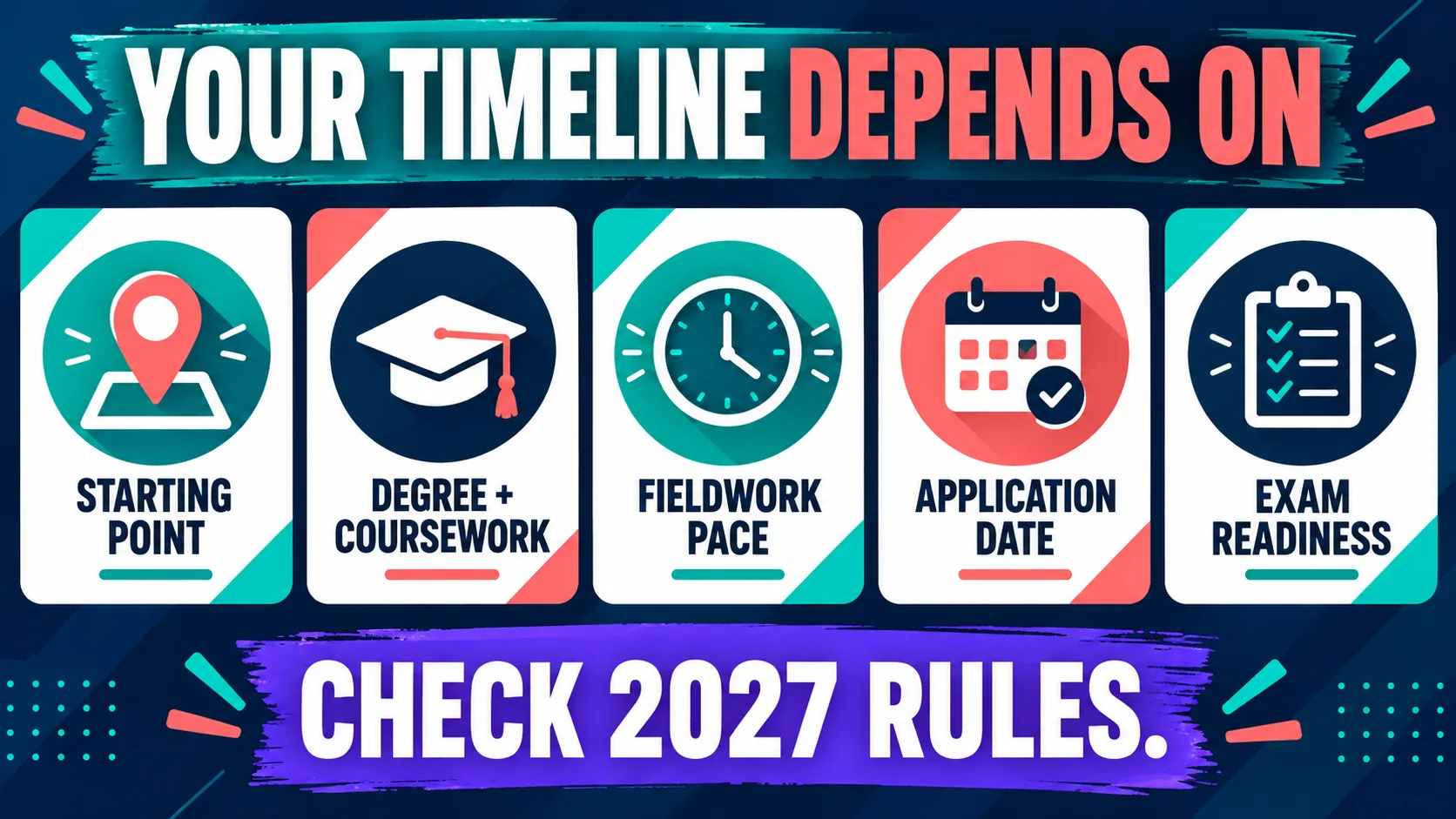
Build a one-page timeline from your actual evidence. Put the date of the last completed milestone at the top, then work forward to the next decision gate. Label every date as confirmed, estimated, or blocked by verification. This makes the plan useful when a transcript, supervisor, program, or BACB resource changes the assumption.
| Timeline field | Write this down | Why it matters |
|---|---|---|
| Starting point | Degree, transcript status, coursework, fieldwork, and application status | Prevents a generic estimate from hiding your real bottleneck. |
| Next proof | The next document, verified month, or supervisor confirmation you need | Turns an abstract goal into a controllable action. |
| Transition check | Which BACB resource and date rule you are using | Keeps the plan from relying on an expired summary. |
| Readiness evidence | Practice-domain results, error log, and review schedule | Separates “I have a date” from “I am preparing deliberately.” |
Here are three fictional planning patterns:
- Applicant A: graduate degree and coursework are documented, but fieldwork has not started. The fieldwork arrangement is the controlling milestone; exam preparation can begin gradually, but the exam date should not be treated as fixed.
- Applicant B: fieldwork is complete and the forms are being checked. The next work is application completeness, transition verification, and a targeted study plan based on practice errors.
- Applicant C: coursework and fieldwork are occurring in parallel. The plan tracks each month separately so that a busy month does not hide a supervision or documentation gap.
Where Applicants Lose Time
Most delays are not caused by the idea that the BCBA exam is impossible. They come from planning with an unverified assumption. Common examples include counting work hours without checking whether they qualify, waiting until the end to review transcripts, using old forms after a rule change, assuming a supervisor can retroactively repair missing records, or studying from practice questions without tracking which content areas repeatedly fail.
Use a weekly five-minute audit: What milestone did I advance? What evidence did I create? What assumption is still unverified? What official source changed? What is the smallest next action that prevents a larger delay? This habit is more valuable than repeatedly searching for a single universal answer to “how long.”
For exam preparation, take a diagnostic rather than guessing. The Free BCBA Mock Exam can help you identify content areas to review while you build your eligibility timeline. Treat the result as a study signal, not as an eligibility decision, a score guarantee, or a substitute for official BACB guidance.
Frequently Asked Questions
Can I become a BCBA in one year?: That depends on what you have already completed and whether the applicable pathway requirements can be completed and documented in that period. A person who is application-ready is in a very different position from a person beginning a graduate degree. Do not use a one-year claim as a substitute for a transcript, fieldwork, and pathway review.
Does fieldwork determine how long it takes?: It is often the largest variable because qualifying fieldwork must be completed within the applicable rules and supported by accurate supervision records. The pace depends on the approved arrangement, available experience activities, monthly limits, supervision, and your schedule. The current handbook controls the details.
Can I work and complete BCBA fieldwork at the same time?: Possibly, if the work and experience meet the applicable requirements and are properly supervised and documented. Paid employment by itself does not answer that question. Confirm the arrangement with the responsible supervisor and the current BACB resources.
Do the 2027 BCBA changes affect everyone?: They affect applicants according to the transition rules and the date and completeness of the application. BACB states that significant changes take effect January 1, 2027 and provides transition guidance. Read the official requirements and transition resources for your situation instead of relying on a social-media summary.
What is the best way to estimate my own timeline?: List your verified degree, coursework, fieldwork, documentation, and application status; identify the next missing proof; then check which BACB requirements apply to your intended application date. Build a conservative range and update it when evidence changes. A range with explicit assumptions is more useful than a precise date with no verification.
Bottom line: The answer to “How long does it take to become a BCBA?” is a personal, transition-aware milestone plan. Start with your current evidence, identify the controlling gate, use overlap only when it is allowed and documented, and verify the 2026–2027 rules directly with BACB before you commit to a date.
Quick Review Checklist
Use this final checklist to turn how long does it take to become a bcba into exam-ready reasoning. The goal is not to memorize a label in isolation; it is to identify the relevant evidence and explain why the best answer fits the scenario. Key ideas to review:
- State the central definition or decision point for how long does it take to become a bcba in your own words.
- Identify the detail that makes how long does it take to become a bcba different from its closest related ABA term.
- Separate the observable facts in a scenario from assumptions that are not supported by the facts.
- Write one example and one nonexample so you can recognize the concept in a new setting.
Exam application checks:
- Ask what the question is actually requesting before comparing the answer choices.
- Mark the antecedent, response, consequence, or other evidence that supports the selected answer.
- Look for a distractor that describes a related process but does not answer the specific question.
Final self-check:
- Explain how you would verify the interpretation with clear observations or data.
- Change one detail in the scenario and decide whether your answer should change.
- Give a one-sentence rationale that a supervisor or study partner could evaluate.
Take the Free BCBA Mock Exam
When you are ready to apply the idea, use the free practice resource below for additional feedback. Take the Free BCBA Mock Exam



