
A practical verification checklist for choosing BACB 8-hour supervision training before a supervisor begins overseeing fieldwork or ongoing supervision. BACB 8 hour supervision training is not simply an eight-hour webinar with a certificate at the end. The relevant training must fit the BACB Supervisor Training Curriculum Outline (2.0), be offered through an eligible provider under the current rules, include the required learning and competence components, and produce documentation that can be used for the supervisor’s BACB account and role. The safest way to choose a course is to verify the offer before paying or starting supervision.
Table of Contents
- BACB 8 Hour Supervision Training: What It Actually Confirms
- The Five Checks to Complete Before You Enroll
- What a Usable Training Offer Should Show
- How 2026 and 2027 Changes Affect Your Verification
- Before Supervision Starts: The Documentation Sequence
- Common Course-Selection Traps
- Frequently Asked Questions
- Quick Review Checklist
- Take the Free BCBA Mock Exam
This matters to both sides of the relationship. A supervisor needs evidence that the training was completed before providing the relevant supervision. A trainee needs to know that a potential supervisor has completed the right training and can document it. A polished sales page, a familiar logo, or the phrase “BACB approved” is not enough by itself.
Important scope note: This is an educational purchasing and readiness guide, not a determination that a specific person or course satisfies BACB requirements. Requirements and provider rules can change. Check the current BACB supervision page, handbook, curriculum outline, and provider documentation before beginning supervision.
BACB 8 Hour Supervision Training: What It Actually Confirms
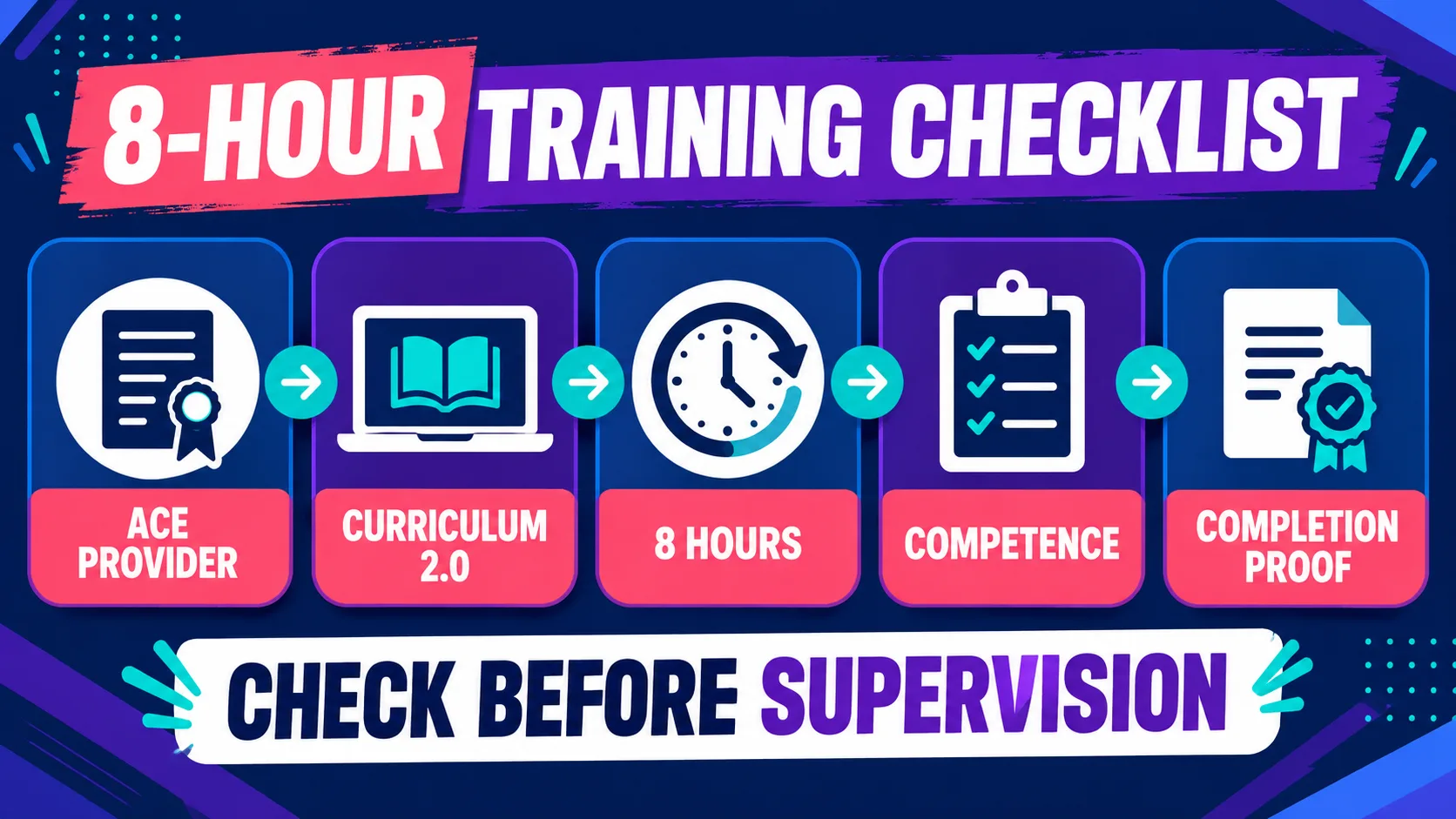
The training is a supervisor-preparation requirement connected to supervision roles. The BACB’s Supervision, Assessment, Training, and Oversight page states that supervisors overseeing people who are acquiring BCBA or BCaBA fieldwork, as well as certain current BCaBA or RBT certificants who require ongoing supervision, must complete an 8-hour supervision training based on the Supervisor Training Curriculum Outline (2.0) before providing supervision. That sentence contains several boundaries:
- It is supervisor training. Completing it does not make someone a BCBA, BCaBA, or RBT and does not replace the credential or other supervision qualifications.
- It is role-specific. The question is not only “Did this person take eight hours?” but also “Does this training and documentation fit the supervision role they are about to perform?”
- It is curriculum-based. The training should be based on the current Supervisor Training Curriculum Outline (2.0), including the learning objectives, tasks, and considerations described there.
- It comes before the relevant supervision begins. A trainee should confirm the supervisor’s training date before signing or starting a supervision relationship.
The BACB curriculum outline also says that the cumulative training duration must be at least eight hours, may be offered in units as brief as one hour, and may be delivered online or in person. It describes opportunities for learners to demonstrate verbal or practical competence in the curricular areas. These details are why a course page that merely promises “eight hours of videos” deserves further questions.
The Five Checks to Complete Before You Enroll
Use this sequence before comparing prices. It moves from the provider to the evidence you will need after completion.
| Check | Question to ask | Red flag |
|---|---|---|
| Provider | Is the organization an eligible ACE Provider or another provider type identified by the current BACB materials? | The page says “BACB certified course” but does not identify the provider basis. |
| Curriculum | Does the offer link to or clearly identify Supervisor Training Curriculum Outline (2.0)? | The outline, learning objectives, or version is never named. |
| Duration | Does the cumulative training reach at least eight hours under the current outline? | The provider counts optional browsing, breaks, or unrelated CE as the required time. |
| Competence | How will the learner demonstrate verbal or practical competence in the curriculum areas? | There is only passive video viewing and no meaningful completion requirement. |
| Proof | What exact completion document will be issued, and what information will it contain? | The provider cannot show a sample or explain how the record is used. |
Save the answers in a folder before you enroll. If the provider changes its page later, you will still have the course name, version, provider information, completion conditions, and promised documentation that you relied on.
What a Usable Training Offer Should Show
A trustworthy course page should make the important facts easy to verify. Look for the provider’s identity and ACE information, the training title and version, the total cumulative duration, the delivery format, the competence activities, and the completion-document process. The official curriculum outline says that ACE Providers must provide the learner with a one-page document showing completion of the full training. If the training is completed as part of a Verified Course Sequence, a syllabus and unofficial transcript showing a passing grade may be required instead.
The same outline also requires the training materials to link to the Supervisor Training Curriculum Outline (2.0) and include a statement that the program is based on the outline but is offered independently of the BACB. That language is a useful authenticity check: BACB curriculum alignment is not the same as BACB endorsement of a particular commercial course.
| Course-page evidence | Why you need it | Follow-up question |
|---|---|---|
| Provider name and ACE status | Confirms who is offering the training under the current provider rules. | Can I verify the provider in the current BACB or ACE materials? |
| Curriculum Outline (2.0) link or version | Shows the course is mapped to the correct supervision curriculum rather than a generic leadership class. | Which objectives and competence activities are included? |
| Eight-hour cumulative schedule | Lets you check whether the claimed duration is the required training time. | Are all modules required, and how is completion recorded? |
| Completion proof and upload instructions | Prevents a completed course from becoming an undocumented course. | What will the supervisor retain and upload to the BACB account? |
How 2026 and 2027 Changes Affect Your Verification
The BACB curriculum outline states that, as of January 1, 2026, the 8-hour supervision training may only be offered by ACE Providers. That makes the provider check more important than an old course page, a discount listing, or a certificate template that has been reused for years.
Separately, major BCBA and BCaBA eligibility and maintenance changes take effect January 1, 2027. The BACB’s Recent and Upcoming Changes page identifies revisions to core requirements, including supervised fieldwork and ongoing supervision. The 2027 BCBA Requirements page and the updated handbooks should control any question about a future pathway.
Do not make either of these mistakes: first, assuming an old commercial course is still eligible because the title has not changed; second, assuming the 2027 eligibility changes automatically answer every question about supervisor training. Treat the supervision-training requirement as its own verification lane and check the current official supervision resources.
| Date checkpoint | What to recheck | Safe action |
|---|---|---|
| Before enrolling in 2026 | Provider eligibility, curriculum version, eight-hour schedule, and proof. | Save the current official outline and the provider’s completion terms. |
| Before supervision begins | Supervisor training completion date and documentation. | Confirm the record before signing or starting the relationship. |
| As 2027 approaches | Updated BACB pages, handbooks, and any provider changes. | Re-verify instead of relying on an old screenshot or cached course page. |
Before Supervision Starts: The Documentation Sequence
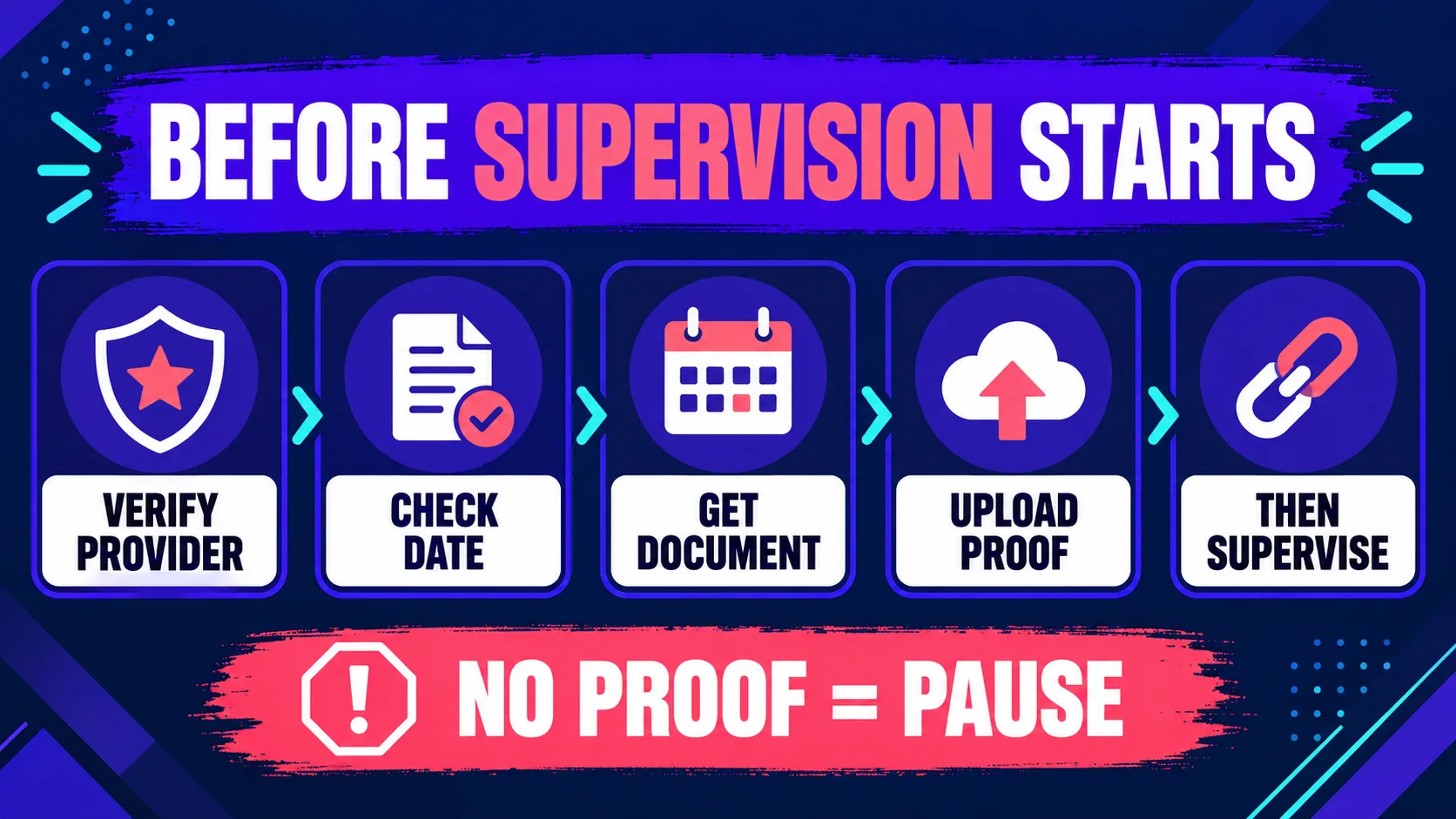
Once the training is finished, the work is not over. The supervisor should keep the completion evidence and follow the current BACB process for uploading or retaining it. The trainee should ask for the training date and confirm that the supervisor is ready to document the supervision relationship. These steps protect both people from discovering a missing record after fieldwork has already started.
- Verify the provider record. Save the provider name, course title, training date, and any ACE or VCS information supplied by the course.
- Verify full completion. Keep the certificate or the documentation described by the applicable BACB materials. A registration receipt is not the same as completion proof.
- Verify the supervisor’s role. Confirm that the person is otherwise qualified for the supervision they plan to provide. The eight-hour course is one requirement, not the entire qualification.
- Verify the timing. The curriculum outline explains timing rules for different learner and supervisor situations. Check the current document rather than copying a date rule from a third-party page.
- Pause when proof is missing. If the provider cannot explain the record or the supervisor cannot confirm completion, stop the start-up process and ask for clarification before supervision begins.
The phrase “no proof = pause” is not meant to create unnecessary bureaucracy. It is a simple risk-control rule. A short delay while a record is verified is easier to manage than reconstructing a supervision history after the fact.
Common Course-Selection Traps
Trap 1: confusing BACB alignment with BACB endorsement. A provider can offer training based on the official outline without the BACB endorsing that commercial provider. Read the provider’s statement carefully. Trap 2: buying the cheapest certificate. Price does not tell you whether the course includes the required duration, competence activities, provider basis, or usable documentation. Compare evidence, not just checkout totals.
Trap 3: counting unrelated supervision education. A general supervision, management, ethics, or leadership CE course may be valuable and still not be the required 8-hour supervision training. Ask how the course maps to the Supervisor Training Curriculum Outline (2.0).
Trap 4: starting fieldwork first. A supervisor and trainee should not treat the training as something that can be fixed later. The official supervision page says the relevant training must be completed before providing supervision.
Trap 5: treating the certificate as the whole plan. Supervision also requires the applicable supervisor qualifications, a written contract or agreement, fieldwork documentation, ongoing supervision, and professional judgment. The course is a gate, not a substitute for the supervision system.
If you are a trainee, ask a potential supervisor: Which current BACB resource governs your role? When did you complete the 8-hour training? Who provided it? What documentation is available? How will we handle the supervision contract, records, feedback, and a pause if requirements are unclear? Clear answers before the relationship starts are a stronger signal than a badge on a profile.
For the exam side of your preparation, use the Free BCBA Mock Exam as a diagnostic. It can help you identify weak content areas while you organize your eligibility and supervision plan. It does not verify a supervisor, replace BACB guidance, or guarantee exam eligibility or a passing score.
Frequently Asked Questions
Who needs BACB 8-hour supervision training?: Under the BACB supervision resources, supervisors who oversee individuals acquiring BCBA or BCaBA fieldwork, and certain supervisors of current BCaBA or RBT certificants who require ongoing supervision, must complete the training before providing the relevant supervision. Confirm the current role-specific details in the applicable handbook.
Does the training make me a BCBA supervisor automatically?: No. The eight-hour training is one part of the supervisor-readiness picture. The supervisor must also meet the qualifications and documentation requirements for the role, follow the applicable supervision rules, and maintain the professional responsibilities described by BACB.
Can the training be completed online?: The current Supervisor Training Curriculum Outline states that the training may be conducted online or in person. The delivery format does not remove the need for the correct provider, cumulative duration, competence component, and completion documentation.
Can any CE provider offer the eight-hour training?: Do not assume that every CE seller is eligible. The curriculum outline says that, as of January 1, 2026, the training may only be offered by ACE Providers, subject to the current BACB materials. Verify the provider status and the course documentation before enrolling.
What should I do if a supervisor cannot show proof?: Pause the start of the relevant supervision and ask the supervisor to verify the training and documentation through the current BACB process. If the answer remains unclear, contact BACB or the responsible organization rather than relying on an informal promise.
Bottom line: Choose BACB 8 hour supervision training by verifying the provider, Curriculum Outline (2.0) alignment, cumulative eight-hour duration, competence activities, completion proof, and timing before supervision begins. The right course is the one you can explain and document—not merely the one with the most recognizable title.
Quick Review Checklist
Use this final checklist to turn bacb 8 hour supervision training into exam-ready reasoning. The goal is not to memorize a label in isolation; it is to identify the relevant evidence and explain why the best answer fits the scenario. Key ideas to review:
- State the central definition or decision point for bacb 8 hour supervision training in your own words.
- Identify the detail that makes bacb 8 hour supervision training different from its closest related ABA term.
- Separate the observable facts in a scenario from assumptions that are not supported by the facts.
- Write one example and one nonexample so you can recognize the concept in a new setting.
Exam application checks:
- Ask what the question is actually requesting before comparing the answer choices.
- Mark the antecedent, response, consequence, or other evidence that supports the selected answer.
- Look for a distractor that describes a related process but does not answer the specific question.
Final self-check:
- Explain how you would verify the interpretation with clear observations or data.
- Change one detail in the scenario and decide whether your answer should change.
- Give a one-sentence rationale that a supervisor or study partner could evaluate.
Take the Free BCBA Mock Exam
When you are ready to apply the idea, use the free practice resource below for additional feedback. Take the Free BCBA Mock Exam



