
Going from BCaBA to BCBA is possible, but it is not an automatic upgrade. The BCBA is a graduate-level certification with its own degree, coursework, supervised-fieldwork, application, and examination requirements. Your BCaBA experience can give you useful clinical context, but every prior course, hour, and document still needs to be checked against the BCBA pathway and the requirements in effect when you apply.
Table of Contents
- Can You Go From BCaBA to BCBA?
- What Changes From BCaBA to BCBA?
- What Does BCaBA Experience Help With?
- Do BCaBA Hours Automatically Count Toward BCBA?
- How Does the 2027 BCBA Change Affect the Transition?
- What Are the Steps for Going From BCaBA to BCBA?
- How Should You Think About This on the BCBA Exam?
- BCaBA-to-BCBA FAQ
- Sources and Date Check
- Take the Free BCBA Mock Exam
If you are already a Board Certified Assistant Behavior Analyst (BCaBA), you have a meaningful foundation in applied behavior analysis. You may already understand data collection, treatment implementation, supervision, and ethical responsibilities. The next step, however, is not simply changing the letters after your name. The BACB describes the BCaBA as an undergraduate-level credential practiced under BCBA supervision, while the BCBA is a graduate-level credential for an independent practitioner who can supervise others.
That distinction gives you the safest planning rule: treat the move as a new BCBA certification application, then investigate whether any previous education or experience can satisfy a specific BCBA requirement. Do not assume that the BCaBA credential itself converts, that BCaBA fieldwork automatically becomes BCBA fieldwork, or that an employer’s job title proves eligibility.
Can You Go From BCaBA to BCBA?
Yes, a BCaBA can pursue BCBA certification, but the transition is a pathway decision rather than a credential upgrade. You must identify a qualifying graduate degree and the applicable BCBA coursework and supervised-fieldwork requirements, submit the required application evidence, and pass the BCBA examination. The BACB—not a school, supervisor, employer, or article—decides whether your record meets the eligibility rules.
Your BCaBA background can still be valuable. It may help you choose a graduate program, recognize the difference between direct implementation and analyst-level work, communicate with supervisors, and interpret case examples. It may also help you notice gaps earlier. Those benefits are preparation advantages, not automatic equivalencies.
What Changes From BCaBA to BCBA?
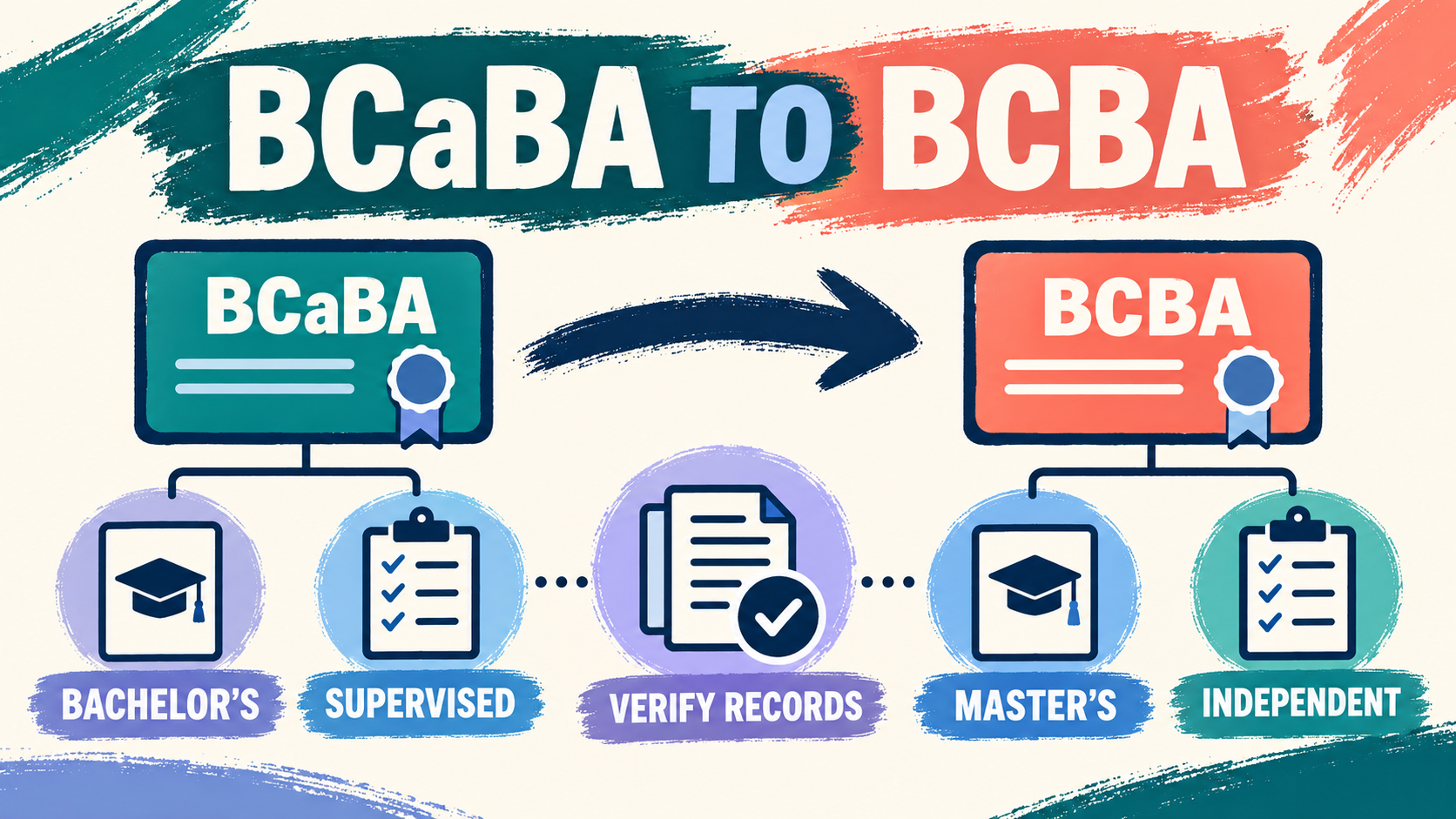
The two credentials sit at different levels of the BACB structure. A BCaBA provides services under BCBA supervision and may supervise RBT work within the applicable rules. A BCBA is a graduate-level practitioner who can independently provide behavior-analytic services and supervise BCaBAs, RBTs, and other professionals who implement interventions.
| Planning question | BCaBA lens | BCBA lens |
|---|---|---|
| Credential level | Undergraduate-level certification. | Graduate-level certification. |
| Practice relationship | Practices under BCBA supervision. | Can practice independently within applicable rules and scope. |
| Degree planning | Bachelor’s-level pathway requirements apply. | A qualifying master’s degree or higher is part of the BCBA pathway. |
| Fieldwork question | BCaBA fieldwork and supervision records follow the BCaBA rules that applied to the record. | BCBA fieldwork must satisfy the BCBA handbook, supervisor, documentation, and percentage requirements. |
| Exam | BCaBA examination and content outline. | BCBA examination and current BCBA Test Content Outline. |
The table is a planning map, not an eligibility determination. A person can have a BCaBA and a qualifying master’s degree, but still need to resolve coursework, fieldwork, supervision, forms, or application-timing questions before applying.
What Does BCaBA Experience Help With?
BCaBA experience can make the BCBA path more understandable because you have seen behavior-analytic services in practice. You may be more comfortable with operational definitions, measurement systems, prompting, reinforcement, treatment integrity, caregiver communication, and supervision meetings. That experience can also help you evaluate whether a graduate program provides real fieldwork access rather than only promising a course sequence. Use your prior experience as a portfolio of evidence, not as a shortcut. Make a list of the following:
- the degree and coursework you completed, including institution, dates, course titles, and syllabi;
- the supervisor names, certification status, supervision contracts, and dates connected to each fieldwork record;
- monthly and final verification forms, activity descriptions, observation records, and any correction history;
- the proportion of activities that represented analyst-level unrestricted work rather than only direct implementation; and
- the requirement edition and application pathway that each record was intended to support.
Then ask a qualified BCBA supervisor or program advisor to identify what is usable, what needs more documentation, and what must be completed again. The word “transfer” can be misleading: a school may accept a course for academic credit while the BACB evaluates a different question about certification eligibility. Keep those decisions separate.
Do BCaBA Hours Automatically Count Toward BCBA?
No automatic rule should be assumed. The fact that an hour was supervised, paid, clinical, or performed by a BCaBA does not by itself prove that it satisfies the BCBA fieldwork requirements. The activity, purpose, supervisor qualifications, contract, timing, supervision contacts, observation, documentation, and applicable requirement edition all matter.
The BACB’s fieldwork resources emphasize documenting the supervision contract, ongoing records, and Monthly and Final Fieldwork Verification Forms. That means a transition plan should preserve the original evidence instead of rewriting old records to fit a new goal. If a previous activity may be relevant to BCBA fieldwork, compare it with the current BCBA Handbook and ask the supervisor to review the exact record. Do not count the hour in your personal total merely because the activity sounds similar.
A useful audit question is: “What BCBA requirement would this specific record satisfy, and which document proves each part?” If you cannot answer both halves, mark the item as needs verification rather than eligible. This protects you from an attractive but unsupported hour total.
How Does the 2027 BCBA Change Affect the Transition?
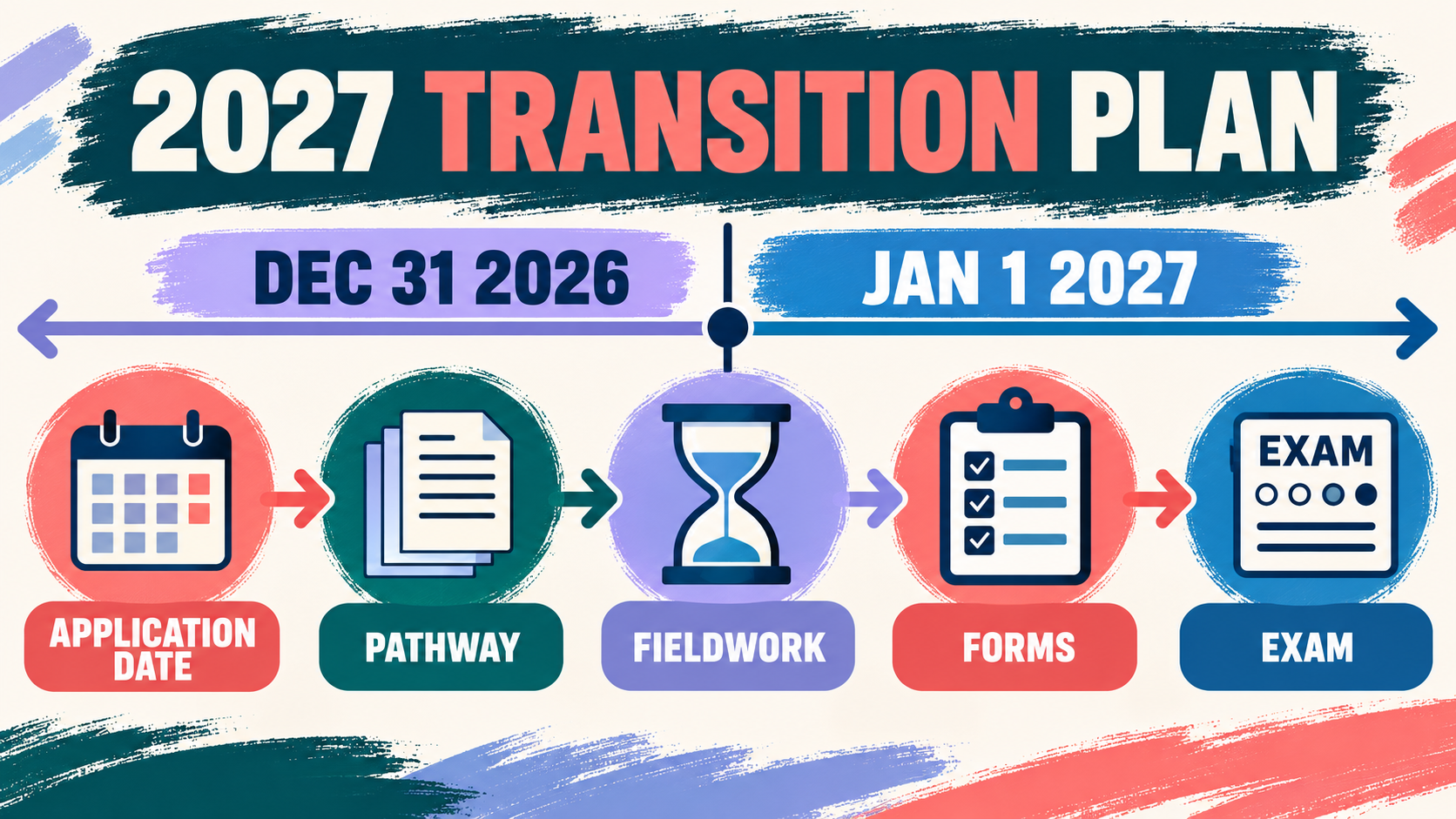
The timing matters because the BACB says significant BCBA and BCaBA certification changes take effect on January 1, 2027. The BACB also states that an application received by December 31, 2026—including payment and all required documents—can be reviewed under the current 2022 requirements. Starting a program, finishing one class, or opening an online account is not the same as submitting a complete application. Under the published 2027 BCBA requirements, applicants use one of two main pathways:
- Pathway 1: a qualifying master’s degree or higher from an APBA-accredited or ABAI-accredited or recognized behavior-analysis degree program, together with practical fieldwork and the BCBA examination; or
- Pathway 2: a qualifying master’s degree or higher, behavior-analytic coursework, practical fieldwork, and the BCBA examination.
The 2027 requirements document lists 2,000 hours for supervised fieldwork or 1,500 hours for concentrated supervised fieldwork, with the relevant supervision and observation conditions. It also lists at least 60% of total supervised fieldwork hours as unrestricted activities for the BCBA route. These numbers should be read with the current BCBA Handbook, not copied into a spreadsheet without checking the fieldwork type, month, form version, and transition date.
Use the BACB’s 2027 transition guides as a planning aid. The guide can help you compare 2022 and 2027 requirements, but it does not replace the handbook or create an exception for a particular BCaBA-to-BCBA record.
What Are the Steps for Going From BCaBA to BCBA?
Work through the transition in this order. It keeps the expensive decisions—such as enrolling in a graduate program or assuming hours will count—behind an evidence check.
- Choose the application date first. Decide whether your realistic application target is before or after January 1, 2027, and read the corresponding BACB transition guidance.
- Identify the BCBA pathway. Ask whether your planned degree is an accredited or recognized program route or whether you will need the behavior-analytic coursework route.
- Audit the graduate degree. Verify the institution, degree level, award date, program status, transcript process, and whether the program itself makes a certification-eligibility claim that is actually supported by BACB requirements.
- Map coursework before enrolling. Put each required content area beside the course, syllabus, credits, and evidence that supports it. Do not assume that BCaBA coursework fills graduate-level BCBA coursework.
- Set up BCBA fieldwork separately. Use a current supervision contract, a qualified BCBA supervisor, a documentation system, and a monthly review process. Keep prior BCaBA records in a separate folder while they are being evaluated.
- Build the exam plan. Study from the current BCBA Test Content Outline and use practice questions to discriminate between role, measurement, supervision, and ethics scenarios—not merely to memorize the BCaBA route.
- Confirm the application packet. Before submitting, check the current handbook, forms, transcripts, payment, supervisor records, and any state-specific licensure or employer requirements that sit outside BACB certification.
This order also works if you are deciding whether to earn the BCaBA first. If your long-term goal is clearly BCBA, compare the extra time and cost of an intermediate credential with going directly into a qualifying BCBA pathway. The right choice depends on your degree status, finances, employment options, supervision access, and timeline—not on the idea that BCaBA is always required first.
How Should You Think About This on the BCBA Exam?
A BCBA exam vignette may present a candidate who has a BCaBA credential, several years of work, and a new graduate degree. The tempting answer is often “the person can immediately practice independently.” That answer skips the eligibility and scope questions. Use a four-part exam screen:
- Credential: Is the person a BCaBA, BCBA applicant, or active BCBA?
- Role: Is the person working under BCBA supervision or practicing within BCBA authority?
- Evidence: Does the scenario name the qualifying degree, contract, fieldwork record, or application approval?
- Rule edition: Does the date place the scenario under current 2022 requirements, 2027 requirements, or another official transition document?
If the vignette only says “the person used to be a BCaBA,” that fact is background—not proof of BCBA eligibility. Look for the requirement that the question is actually testing. This is the same habit you need when auditing your real transition file: identify the credential, identify the rule, and ask what evidence closes the gap.
When you are ready to practice that discrimination, the free BCBA mock exam can serve as an independent study aid for scenario practice. It is not an official BACB product, does not determine eligibility, and does not replace the current BACB handbook or supervision guidance.
BCaBA-to-BCBA FAQ
Do I have to become a BCaBA before becoming a BCBA?: No. BCaBA is not a universal prerequisite for BCBA certification. Some people pursue it for employment, experience, or a staged career plan; others go directly through a qualifying graduate pathway. Compare the two routes with your actual degree, supervision, and financial situation.
Can a BCaBA supervise a BCBA trainee?: Do not assume so. The BACB’s supervision resources distinguish supervising BCaBAs, supervising RBTs, and supervising fieldwork for BCBA or BCaBA certification. Fieldwork supervision is tied to the qualified supervisor requirements in the applicable handbook.
Does becoming a BCBA cancel my BCaBA credential?: The safe question is not whether the old credential disappears; it is whether you are representing your current certification status accurately. Check the BACB’s current credential records and the rules for using each designation. Never describe yourself as a BCBA until the BACB has granted that certification.
What is the biggest mistake when going from BCaBA to BCBA?: Counting experience by job title instead of by documented requirement. A strong transition file names the pathway, degree, coursework, supervisor, contract, fieldwork type, monthly records, forms, and application date. Anything missing stays a question until the BACB or a properly qualified supervisor resolves it.
Sources and Date Check
This article was reviewed on September 29, 2026 against the BACB BCaBA resource page, the BACB BCBA fieldwork resource page, the current BCBA Handbook, the 2027 BCBA Requirements, the BACB fieldwork documentation resource, and the BACB upcoming-changes calendar. Requirements can change, so verify the live official pages before making an application or fieldwork decision.
Take the Free BCBA Mock Exam
If you want a low-pressure way to check your recall, use the free practice resource below. Take the Free BCBA Mock Exam



