
If you are asking “how do I get my BCBA?”, do not begin by downloading another generic checklist. Begin by finding your current gate: qualifying degree, behavior-analytic content, supervised fieldwork, application, examination, or state-practice planning. Your next action depends on the first gate that is not verified.
Table of Contents
- What “How Do I Get My BCBA?” Actually Includes
- Start With a Five-Gate Self-Check
- Identify the Correct Eligibility Window
- Understand the 2027 Pathway Change Without Guessing
- Turn Your Status Into One Next Action
- Build an Evidence Folder Before You Apply
- Separate BACB Certification From State Practice
- Plan Time Without Turning an Estimate Into a Promise
- Use Mock Practice at the Right Gate
- FAQ
- Take the Free BCBA Mock Exam
Short answer: use the current BACB BCBA Handbook and the official transition pages to verify your eligibility path, then map your own evidence to the next unfinished gate. The broad sequence is degree and required content, supervised fieldwork, application, exam authorization and examination, followed by any separate state-practice requirement. This page helps you decide where to start; it does not replace the handbook or promise that an application will be approved. For the complete national sequence after this self-check, use the site’s how do i get my bcba roadmap. This page answers the narrower question: which gate should you verify first?
What “How Do I Get My BCBA?” Actually Includes
The conversational phrase “get my BCBA” hides several different questions. One person may be asking whether a degree qualifies. Another may have finished coursework and need a supervisor. Someone else may be waiting for application review or deciding whether to begin exam practice. Treating all of those readers as if they need the same checklist is why certification advice often feels vague. Use these labels to name the real task:
- Eligibility: do your degree, behavior-analytic content, and fieldwork fit a current BACB pathway?
- Documentation: can you prove the completed requirements with the correct records and signatures?
- Application: is the packet complete enough to submit through the current BACB process?
- Examination: are you authorized and academically ready to prepare for the BCBA exam?
- Practice: does your state require a separate license, registration, or other permission after certification?
The existing BCBA certification roadmap covers the full sequence. This page is intentionally narrower: it helps you identify the first unchecked gate so that the roadmap becomes actionable for your situation.
Start With a Five-Gate Self-Check
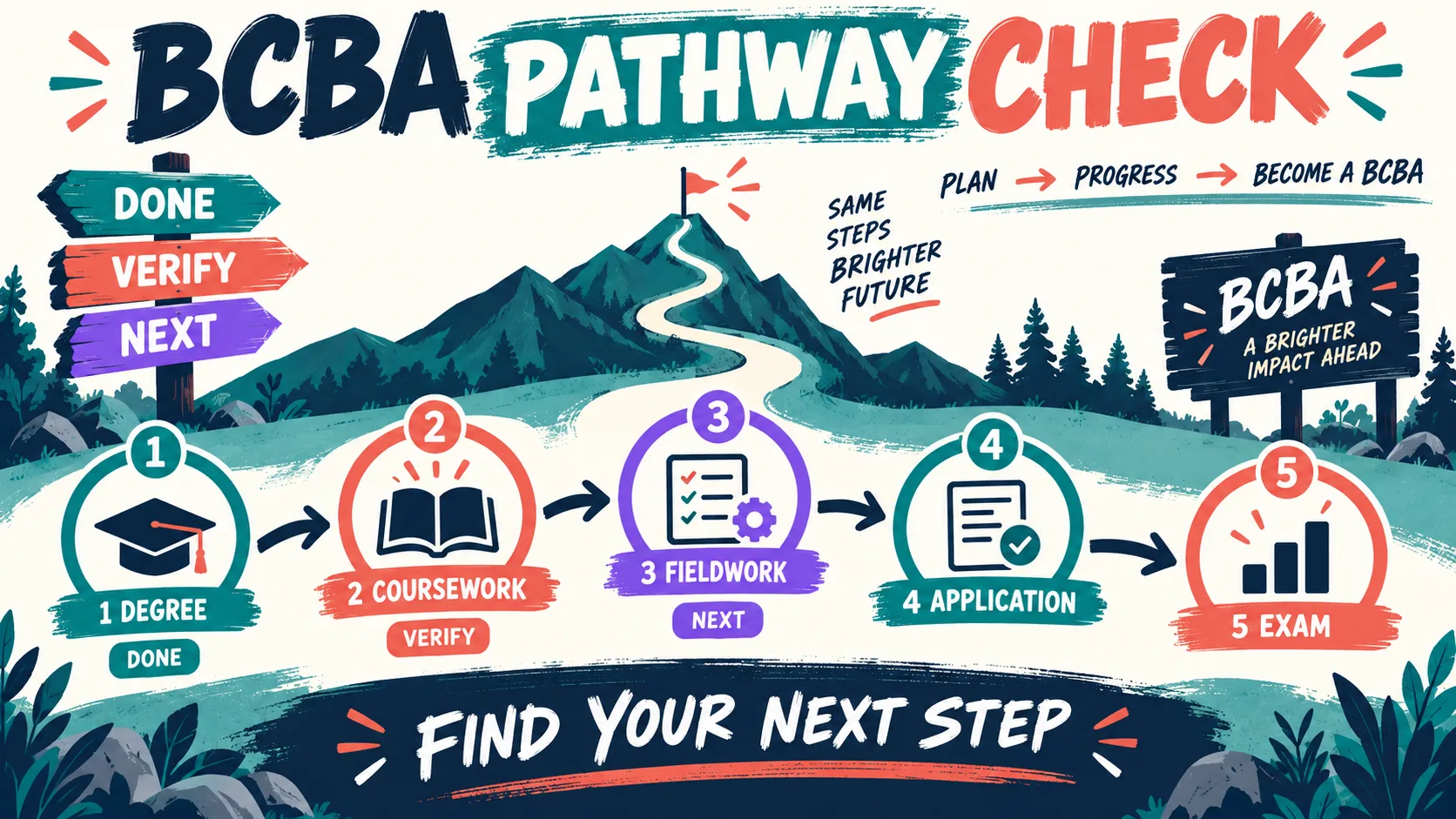
Write one status beside each gate: done, verify, or next. “Done” means you have evidence, not merely a memory or a reassuring program description. “Verify” means the answer may be yes, but you need to compare it with a current BACB source, official record, or supervisor confirmation. “Next” is the earliest unfinished action that should receive your attention.
| Gate | Evidence to locate | If unclear |
|---|---|---|
| Degree | Master’s degree or higher and the applicable pathway/date conditions | Compare the degree and program history with the current handbook |
| Coursework/content | Transcript, coursework or program evidence, and the applicable pathway | Ask the program or BACB-directed source what must be documented |
| Fieldwork | Supervision arrangement, fieldwork records, observations, and verification forms | Do not count hours until the supervisor and current requirements are checked |
| Application | Current application instructions, payment, and required documents | Use the official application page rather than an old forum checklist |
| Exam | Application outcome, authorization status, current handbook, and study plan | Separate exam readiness from eligibility or pass prediction |
Do not jump to the exam gate because it feels more concrete. If the degree or fieldwork gate is unverified, exam scores cannot repair the missing eligibility evidence. The most efficient next step is usually the earliest gate that can block every later step.
Identify the Correct Eligibility Window
BCBA requirements are date-sensitive. The official BACB transition announcement says significant changes take effect January 1, 2027, and that a complete application—including payment and required documents—must be received by December 31, 2026 to be reviewed under the current 2022 requirements. That deadline is not a reason to rush an incomplete packet. It is a reason to identify which rule window you are planning for and verify the current instructions.
| Planning question | Why it changes your next step | Safe action |
|---|---|---|
| When will the complete application be received? | The transition date can determine which requirement set is reviewed | Check the official deadline and do not rely on a submission-start date |
| Which degree or coursework pathway applies? | The evidence needed is not identical for every route or date | Read the current handbook section that matches your route |
| When were fieldwork hours accrued? | Fieldwork documentation and requirements must be evaluated in context | Keep dates, forms, and supervisor records together |
The current 2026-to-2027 BCBA roadmap can help with the full transition sequence. In this article, the key decision is simpler: write down the application window you are targeting and the official page you used to verify it.
Understand the 2027 Pathway Change Without Guessing
The current BCBA Handbook presents eligibility pathways with a degree, behavior-analytic content, supervised fieldwork, and a passing examination as the core components. The official 2027 summary describes two pathways beginning January 1, 2027: an accredited or recognized degree-program route and a behavior-analytic coursework route. The same official page warns readers to review the handbook and stay current with later changes. That means “I have a master’s” is not a complete eligibility answer. You still need to ask:
- Does the degree meet the applicable program and date conditions?
- How will the required behavior-analytic content be documented?
- Which fieldwork requirements and forms apply to the hours you plan to use?
- Will your complete application arrive in the window you are planning for?
Keep a short version note in your planning folder: source URL, date checked, intended application window, and the question you still need to confirm. That is more reliable than copying a number from a social post or an undated study guide.
Turn Your Status Into One Next Action
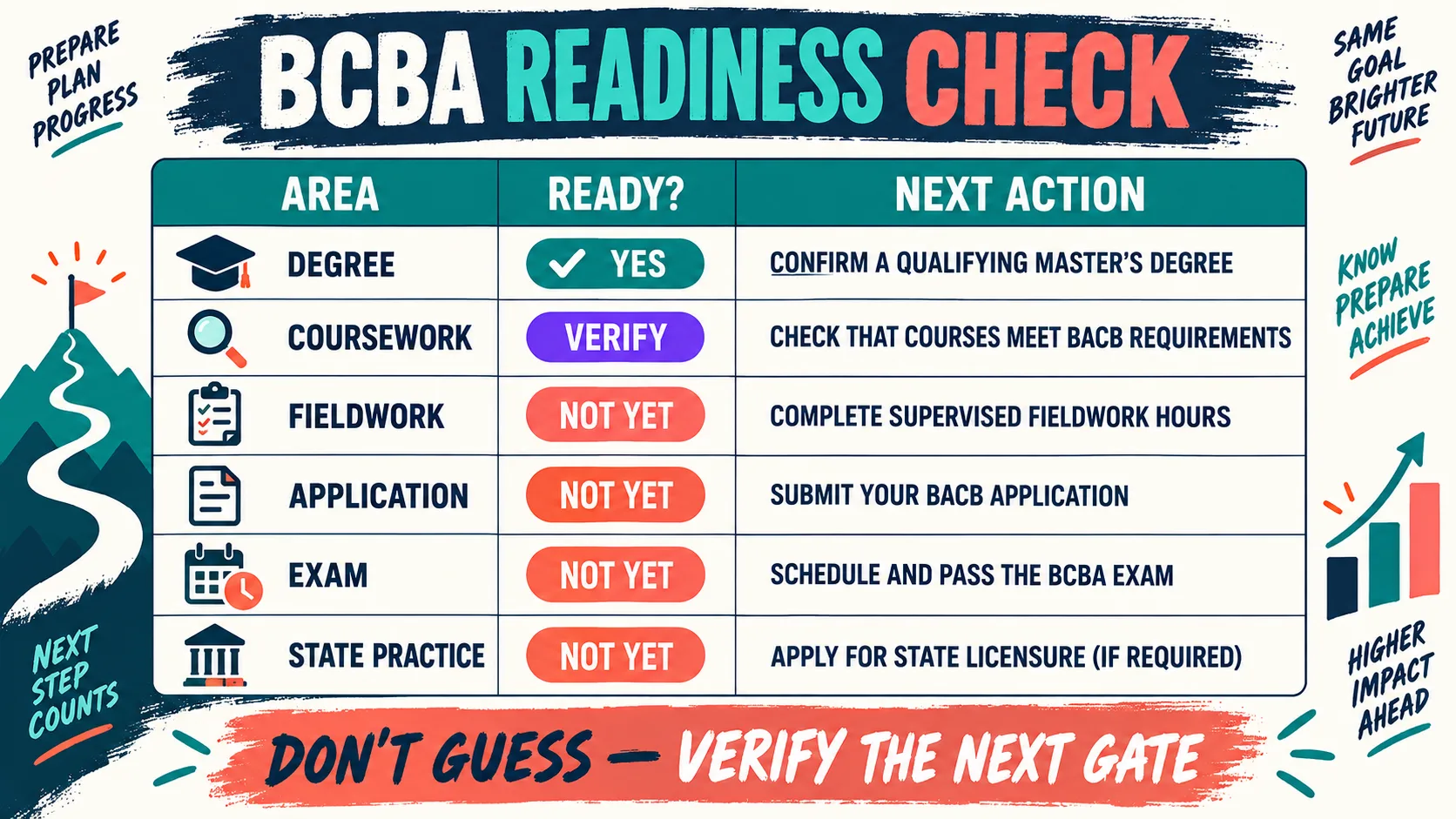
Use the readiness matrix as a decision aid, not an official BACB determination. If a row is “verify,” do not mark it “yes” simply because the answer seems likely. The next action should produce evidence or resolve an ambiguity.
| Current status | Next action | Do not do yet |
|---|---|---|
| Degree not chosen | Compare the program’s degree, content, accreditation or recognition, and date conditions with the handbook | Assume a program’s marketing language guarantees BCBA eligibility |
| Degree complete, content unclear | Collect transcript and pathway evidence, then resolve the content question | Start counting every ABA-related class as qualifying coursework |
| Fieldwork underway | Confirm supervisor, contract, current forms, fieldwork version, and monthly documentation | Wait until the final month to discover missing verification |
| Application submitted or approved | Follow the official communication and build an exam plan around the current authorization | Treat a practice score as exam authorization or a passing guarantee |
Build an Evidence Folder Before You Apply
A readiness plan becomes useful when every “yes” has a source. Create a folder or secure record with a simple index. The index does not need to contain sensitive client information; it only needs to tell you where the relevant official or supervisor-verified record lives.
- Save the current BACB handbook or official page link and note the date you checked it.
- Record the degree name, awarding institution, completion date, and the pathway question it answers.
- Keep transcripts or official program documents in the approved storage location.
- Separate fieldwork logs, supervision contracts, observations, and verification forms from study notes.
- Keep application receipts, correspondence, and any correction request together.
- Store exam authorization and scheduling information separately from unofficial practice results.
The official BCBA application resources should control the packet. An article, program advisor, app, or social-media checklist can help you formulate a question, but it cannot override the current BACB instructions.
Separate BACB Certification From State Practice
Getting the BCBA credential and being permitted to practice in a particular state are related but not identical decisions. The BACB certification is national; a state may impose licensure, registration, notification, supervision, or employer-specific requirements. The exact rule depends on where you will practice and what services you will provide.
| Question | Credential it concerns | Verification source |
|---|---|---|
| Have I met the national certification requirements? | BACB BCBA certification | Current BACB Handbook and official application/examination pages |
| Can I legally practice under this title here? | State license, registration, or practice rule | Current state board or regulator, not a national study page |
| What does my employer or payer require? | Employment, contract, or payer credentialing | Current written employer or payer policy |
Do this state check before accepting a job or advertising services. It prevents a common mistake: assuming that passing the national exam automatically completes every local practice step.
Plan Time Without Turning an Estimate Into a Promise
Your timeline is controlled by the slowest unfinished gate, not by a universal number of months. A degree may be complete while coursework documentation is unresolved. Fieldwork may be accruing while supervision records need correction. An application may be submitted while exam preparation has not started. Label the current bottleneck rather than adding every stage together.
- Program stage: compare degree and content evidence before enrolling or changing routes.
- Fieldwork stage: plan monthly records and supervisor review from the first month.
- Application stage: assemble the complete packet and read the official submission instructions.
- Exam stage: study from the current content outline and use practice results to target weak areas.
- Practice stage: verify state rules and employer or payer requirements before beginning services.
For detailed time scenarios, use the existing BCBA timeline guide and the more specific application and exam-window planning page. This article’s job is to tell you which timeline question to ask next.
Use Mock Practice at the Right Gate
Mock questions are most useful after the eligibility and application gates are understood. If you are still deciding whether your degree or coursework qualifies, a practice score may create false confidence or unnecessary anxiety. If your application is complete and you are preparing for the examination, targeted practice can show whether you can apply concepts under time pressure. Before starting a practice set, confirm:
- You know which exam content outline and official handbook version you are using.
- You can explain whether a missed question reflects a knowledge gap, wording error, or reasoning error.
- You will review explanations instead of treating the percentage as a pass prediction.
- You are using original preparation material and not seeking confidential examination content.
Once your next gate is exam preparation, use the site’s free BCBA mock exam as a separate readiness checkpoint. It is original practice content, not an official BACB exam, not application approval, and not a guarantee of a passing result.
FAQ
What is the first thing I should do to get my BCBA? Identify your current gate and verify it against the current BACB Handbook. If you do not yet have a qualifying graduate degree, start there; if the degree is complete but content is unclear, resolve that evidence question before counting fieldwork or scheduling exam preparation.
Can I get a BCBA with any master’s degree? A master’s degree alone is not a complete answer. The applicable pathway, degree/program conditions, behavior-analytic content, supervised fieldwork, application, and examination requirements all matter. Use the current BACB sources for the pathway and date window you are targeting.
What changes on January 1, 2027? The official BACB transition materials describe significant eligibility changes beginning January 1, 2027, including a two-pathway summary. A complete application received by December 31, 2026 is identified for review under the current 2022 requirements. Confirm the current transition instructions before relying on either date.
Do I need a state license after becoming a BCBA? It depends on the state and the services or employment setting. Check the current state regulator and employer or payer requirements separately from BACB certification.
Bottom line: the answer to “how do I get my BCBA?” is not one universal checklist. Find the earliest unverified gate, collect the evidence, check the current BACB rule window, and take one concrete next action. When you reach the exam gate, use practice to improve reasoning—not to replace official eligibility guidance.
Take the Free BCBA Mock Exam
A useful next step is to apply this idea in a fresh set of BCBA-style practice questions and review the feedback. Take the Free BCBA Mock Exam



