
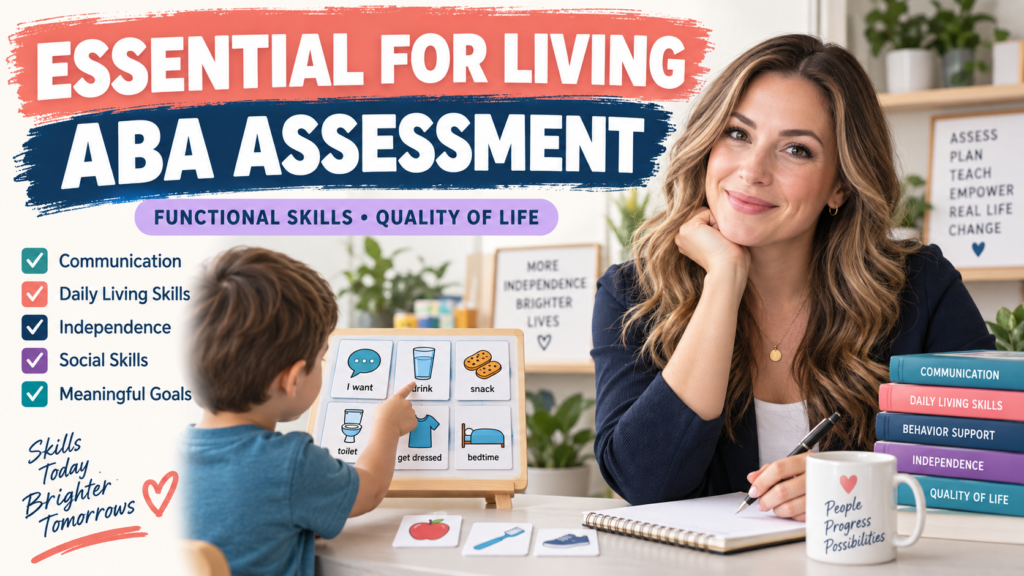
Essentials for Living ABA assessment usually refers to Essential for Living (EFL), a communication, behavior, and functional-skills assessment and curriculum for people with moderate-to-severe disabilities and limited skill repertoires. It is designed to help a team identify meaningful everyday skills, prioritize quality-of-life outcomes, and plan instruction. It is not a diagnosis, a generic developmental checklist, or a replacement for every other assessment a BCBA may need.
Table of Contents
- What Is an Essentials for Living ABA Assessment?
- What Does Essential for Living Assess?
- How Should a BCBA Use the Assessment?
- What Might the Assessment-to-Goal Process Look Like?
- How Is EFL Different From Other ABA Assessments?
- What Are the Limits of the Assessment?
- How Does This Topic Appear on the BCBA Exam?
- Essential for Living Assessment Checklist
- Take the Free BCBA Mock Exam
The most useful way to understand EFL is as a decision tool: what skills matter most for this person’s communication, safety, independence, and participation, what is already present, and what should be taught next? The answer should come from direct assessment, records, observation, collaboration, and the learner’s context—not from a label alone.
This guide explains the scope of the assessment without reproducing proprietary forms or scoring content. For exam context, compare the discussion with the current BCBA Test Content Outline, especially its expectations around designing and evaluating assessments, interpreting data, and selecting client-informed, culturally responsive goals. Table of Contents
What Is an Essentials for Living ABA Assessment?
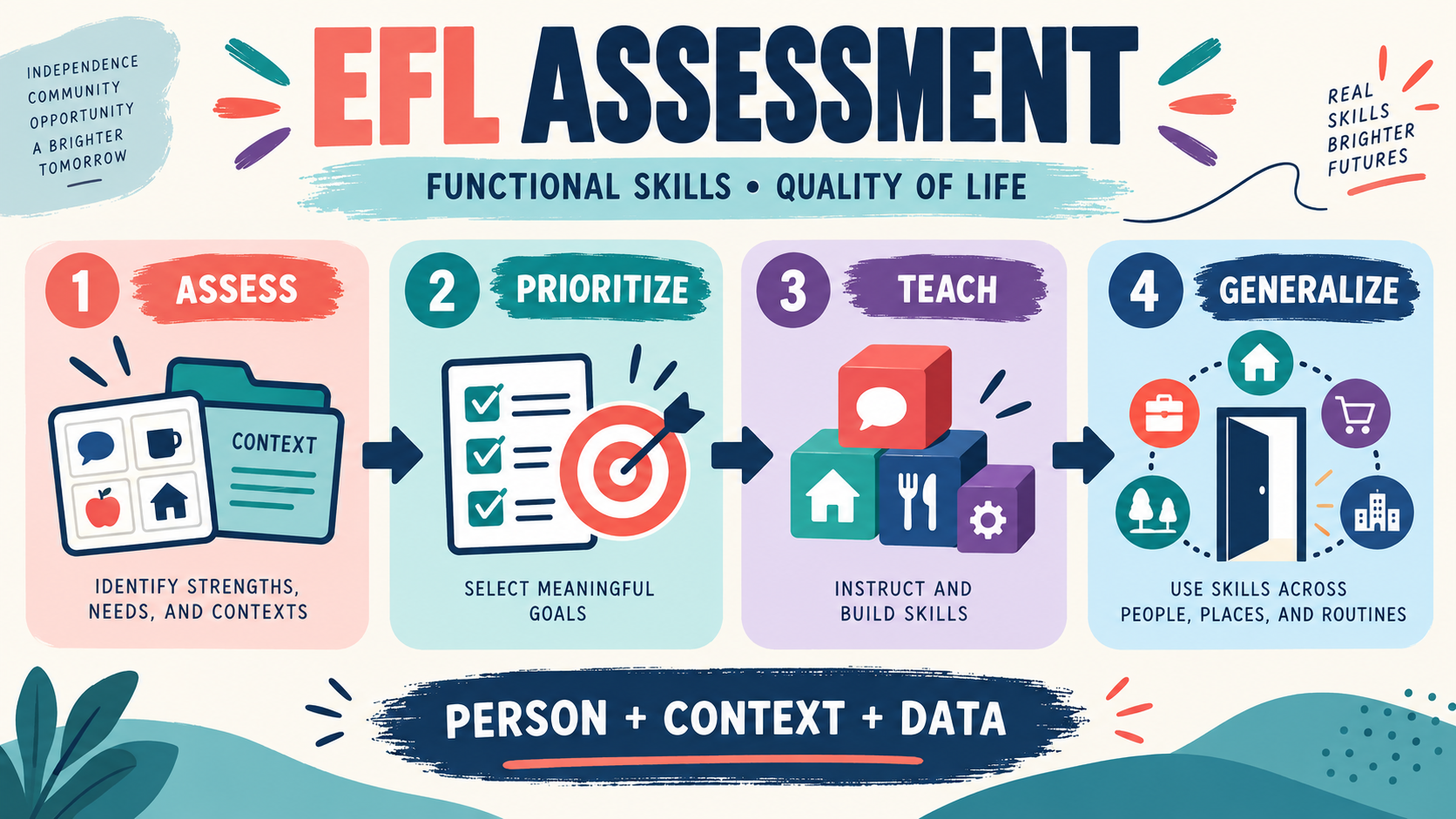
Essential for Living, often shortened to EFL, is a functional life-skills assessment and curriculum. The official EFL overview presents it as a resource for children and adults with moderate-to-severe disabilities, limited skill repertoires, and, in some cases, challenging behavior. Its emphasis is practical: communication, daily living, participation, and skills that can improve a person’s quality of life.
That purpose gives the phrase essentials for living ABA assessment a narrower meaning than “an ABA assessment” in general. EFL is not intended to answer every question in a case. It can help a team identify skill strengths, skill deficits, and instructional priorities, while other assessment methods may be needed to evaluate preference, behavioral function, language, adaptive behavior, or treatment effects.
A strong exam answer therefore includes both the tool’s purpose and its boundary. If a question asks which resource is oriented toward functional communication and everyday living skills for a person with significant support needs, EFL may be a good fit. If the question asks what event maintains aggression, the answer requires a functional assessment process rather than simply naming EFL.
What Does Essential for Living Assess?
The exact content and use of EFL should be learned from its official materials and training. At a high level, the assessment is organized around practical repertoires that affect communication, daily routines, participation, and quality of life. It is not a test of whether a learner matches a typical developmental sequence. Depending on the person and the assessment context, a team may use the results to discuss areas such as:
- functional communication and ways to request, reject, indicate, or respond;
- important daily-living routines and participation skills;
- instructional readiness, toleration, and the conditions that make teaching possible;
- skills that increase independence, safety, choice, or access to preferred activities;
- ways to prioritize teaching when the learner has a limited repertoire or significant barriers to participation.
The goal is not to create the longest possible checklist. A useful assessment connects information to decisions. A skill may be highly important because it changes safety, communication, autonomy, or access to community life—even if it would not appear near the top of a conventional academic curriculum.
How Should a BCBA Use the Assessment?
A defensible workflow keeps the assessment connected to the person and the decision. The following sequence is a study-friendly summary, not a substitute for the official handbook, training, or supervision.
- Clarify the referral question. Identify why the team is assessing now. Is the priority communication, independence, safety, participation, or a barrier to instruction?
- Gather relevant information. Review records, interview caregivers and team members, observe the learner, and include cultural, linguistic, medical, educational, and environmental variables that could change interpretation.
- Identify strengths and needs. Do not treat an absent performance as a permanent trait. Ask what the learner can do, under which conditions, with which supports, and with what consistency.
- Prioritize meaningful targets. Select a small set of skills that are socially significant and useful for the learner’s daily life. A long list is not automatically a good plan.
- Confirm teachability and measurement. Define the response, decide how progress will be measured, and identify the teaching conditions and supports that will be used.
- Reassess and revise. Assessment is not a one-time label. Review data, caregiver and learner input, generalization, maintenance, and whether the goals remain relevant.
The BACB’s current outline emphasizes assessment design and evaluation, interpretation of assessment data, and client-informed and culturally responsive behavior-change procedures and goals. That is the exam-level reasoning to carry into an EFL question: tool selection must serve a meaningful decision.
| Step | Question | Output |
|---|---|---|
| Context | What matters to the learner and support network? | A prioritized referral question |
| Assessment | What skills are present, emerging, or absent under defined conditions? | Strengths, needs, and relevant context |
| Prioritization | Which targets most improve communication, safety, independence, or participation? | A small set of meaningful goals |
| Evaluation | Is instruction producing useful change across people and settings? | Progress data and a revision decision |
What Might the Assessment-to-Goal Process Look Like?
Consider a fictional adult learner who uses limited speech and has difficulty communicating a break request during a community-based activity. The team does not begin by assuming that a single score explains the problem. It gathers information about current communication, opportunities to request, preferred forms, motor and sensory considerations, the environment, and the learner’s own choices as they can be expressed.
An EFL-informed discussion might identify a functional communication target as more urgent than a lower-priority academic task because the target could improve safety and reduce frustration. The team would then define the response, choose an appropriate communication mode, arrange teaching opportunities, and collect data on independent use and generalization. It would also ask whether the skill works with different people and in different settings.
Notice what this example does not claim. It does not say that EFL alone identified the function of a problem behavior, guaranteed a treatment outcome, or replaced a communication assessment. It shows how an assessment resource can help a team prioritize a meaningful skill while still requiring separate analysis and ongoing data.
How Is EFL Different From Other ABA Assessments?
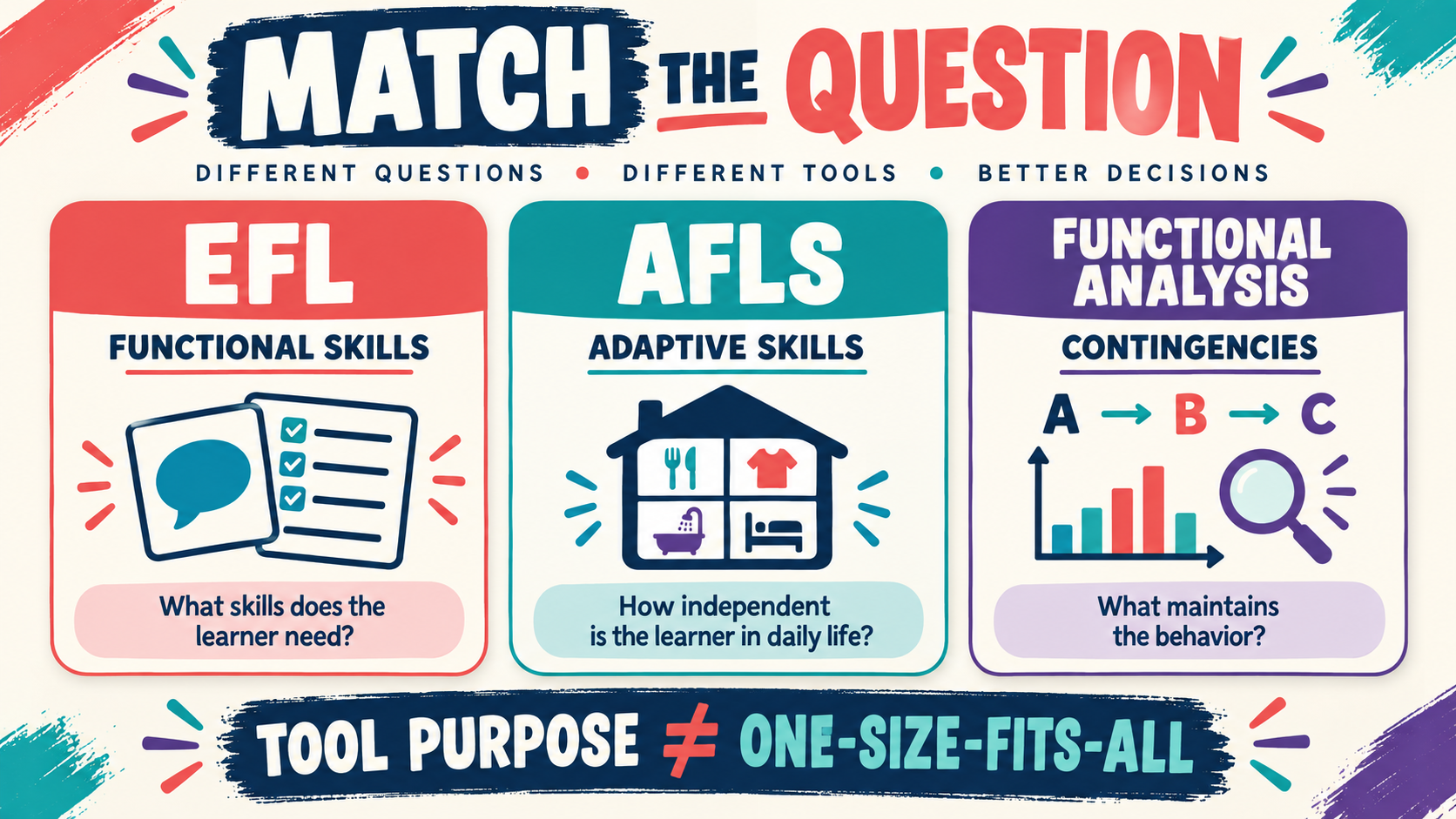
Assessment names can sound interchangeable, but their questions are different. The right comparison is not “Which tool is best?” It is “Which tool or assessment process answers the question we have?”
| Resource or process | Primary question | Why it should not be substituted automatically |
|---|---|---|
| Essential for Living | Which functional communication and life skills should be prioritized for this learner? | Its scope is not every language, adaptive, preference, or behavior-function question. |
| AFLS | Which functional living and adaptive skills are present across specified domains? | It is a neighboring functional-skills resource with its own structure and intended use. |
| VB-MAPP or language assessment | What verbal, language, or learning milestones and barriers should be evaluated? | A language-focused tool may answer a different question from a broad functional-life-skills curriculum. |
| Functional analysis | Which environmental contingencies produce or maintain a behavior under test conditions? | A functional analysis is an experimental analysis of behavior function, not the same task as mapping functional life skills. |
Tools may be used in the same case, but their results should not be merged casually. Describe what each assessment measures, how the information was obtained, and how it changes the next decision.
What Are the Limits of the Assessment?
Every assessment is a sample of behavior under particular conditions. EFL results can be affected by communication access, fatigue, health, sensory conditions, opportunity arrangements, familiarity with the assessor, cultural expectations, and the support available during observation. A learner may demonstrate a skill with one partner or in one routine but not yet generalize it elsewhere. For that reason, avoid three common overstatements:
- “The score tells us everything.” A score is not the same as a complete description of the person or the function of behavior.
- “The tool chooses the goals automatically.” Goal selection still requires professional judgment, stakeholder collaboration, measurement, and ethical attention to meaningful outcomes.
- “One assessment works for every learner.” The population, referral question, communication system, and service context determine whether EFL is an appropriate fit.
The official EFL materials and current BACB framework should be treated as the primary anchors for use. When the question involves diagnosis, medical care, legal requirements, funding, or a behavior’s function, seek the appropriate qualified professional process rather than stretching an assessment beyond its scope.
How Does This Topic Appear on the BCBA Exam?
BCBA-style questions often test assessment selection through a scenario rather than asking for a product definition. Look for the learner characteristics, the referral question, the type of information requested, and the decision the practitioner must make next.
- Match population and purpose. EFL is a functional-life-skills and communication-oriented resource for people with significant support needs; do not select it merely because the case mentions ABA.
- Separate assessment from analysis. If the question asks about maintaining contingencies, select a functional assessment process. If it asks which skills to prioritize for daily participation, a functional-skills assessment may fit.
- Use the least assumptive conclusion. Assessment data inform hypotheses and goals; they do not justify claims that exceed the conditions under which the data were collected.
- Include the client’s context. The current outline emphasizes client-informed and culturally responsive assessment and behavior-change decisions, so a technically neat answer that ignores the person’s communication and values may be incomplete.
A useful study question is: “What decision would change if this assessment result were different?” If the answer is unclear, the tool may not yet be connected to a meaningful clinical or educational question.
Essential for Living Assessment Checklist
Before describing an EFL assessment in a case note, study answer, or team meeting, confirm that you can answer these questions:
- What is the referral question, and why does it matter to the learner?
- Does the learner and context fit the assessment’s intended functional-life-skills scope?
- What information came from observation, records, interviews, and direct assessment?
- Which strengths and needs are being prioritized, and how will they be measured?
- What other assessment or analysis is needed to answer questions outside EFL’s scope?
- How will the team review generalization, maintenance, stakeholder input, and quality-of-life impact?
After reviewing the concept, use the free BCBA mock exam as a separate practice resource. It is not official BACB guidance and does not replace the EFL handbook, training, supervision, or individualized assessment. The short answer is that Essential for Living is a functional communication and life-skills assessment and curriculum used to support meaningful priorities for people with significant support needs. The best BCBA reasoning keeps the tool’s purpose, the learner’s context, the measurement plan, and the limits of the assessment visible at the same time.
Take the Free BCBA Mock Exam
When you are ready to apply the idea, use the free practice resource below for additional feedback. Take the Free BCBA Mock Exam



