
Full verbal model ABA refers to a response prompt in which the instructor provides the entire target verbal response for the learner to imitate, repeat, or use as the next step in a teaching trial. It can create a successful first response, but it is not the same thing as the learner’s verbal operant and it should not be treated as the final level of independence.
Table of Contents
- Full verbal model ABA: What Is It?
- Where Does a Full Verbal Model Fit in ABA?
- Full Verbal Model vs. Related Verbal Prompts
- How to Use a Full Verbal Model in a Teaching Trial
- How to Fade a Full Verbal Model
- What Data Should a BCBA Review?
- BCBA Exam Traps and Ethical Limits
- Full Verbal Model ABA FAQ
- Take the Free BCBA Mock Exam
A full verbal model is most useful when the target response is clear, the learner can benefit from hearing the complete model, and the team has a plan to fade that help. The exact labels vary across training systems: some resources say “full verbal prompt,” while others say “full verbal model.” For BCBA exam questions, focus on what the instructor says, what the learner does, and whether the prompt is still present when the independent response is measured. Table of Contents
Full verbal model ABA: What Is It?
A full verbal model gives the learner the complete vocal form of the response the instructor wants to evoke. For example, after showing a learner a preferred item and arranging an opportunity to request, the instructor might model, “I want the ball,” and then provide an opportunity for the learner to say the phrase. In another program, the instructor might ask, “What is it?” and model “triangle” when the learner needs support to label a picture.
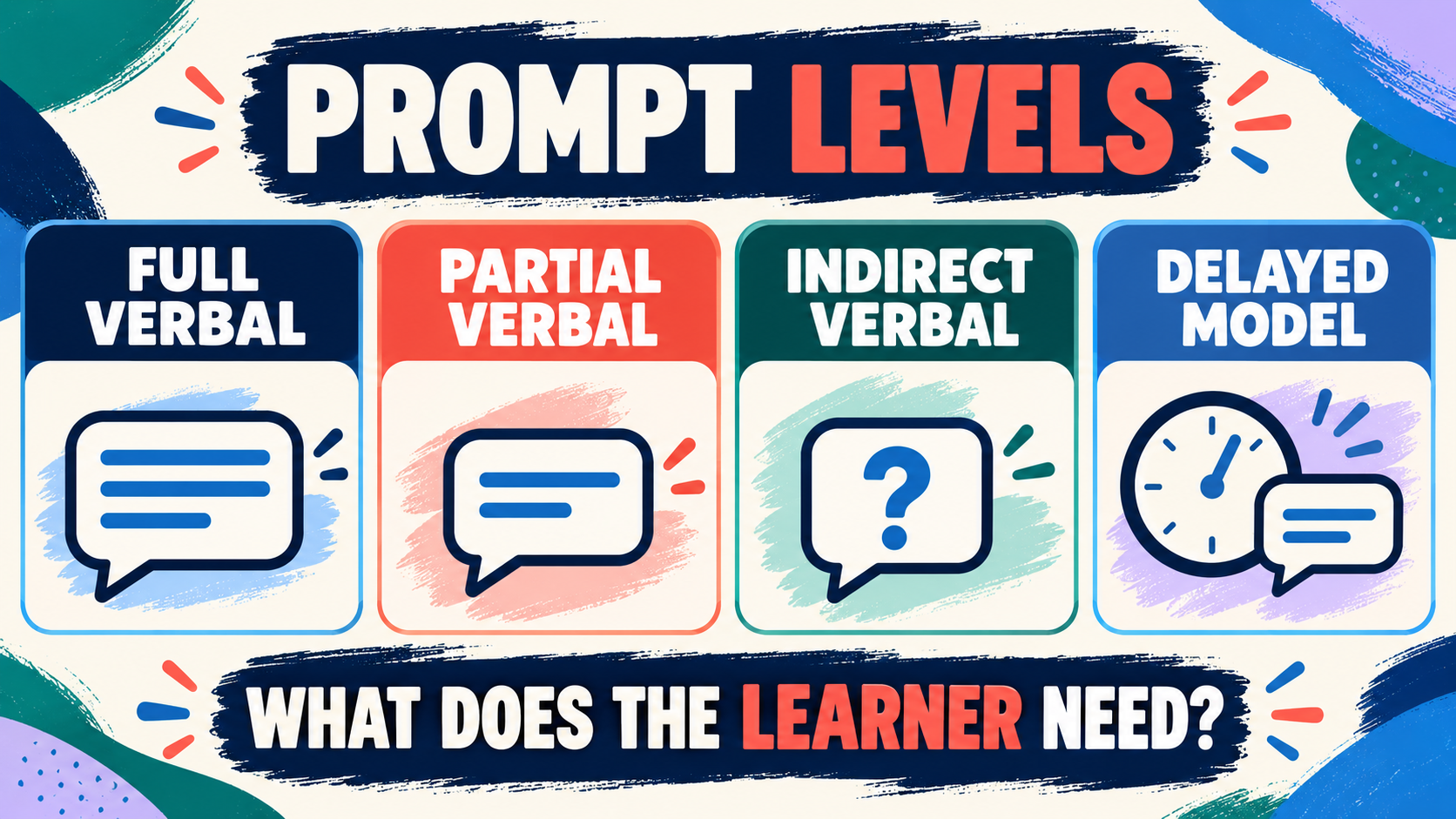
The important feature is the amount of verbal assistance: the whole target response is supplied. A partial verbal model might provide only an initial sound, such as “tri…” for “triangle.” An indirect verbal prompt might ask, “What do you want?” without giving the answer. A full verbal model therefore sits toward the more supportive end of a verbal-prompt continuum, although the relative intrusiveness of prompt types depends on the learner, task, and teaching system.
Do not confuse the prompt with the response class. If an instructor says “ball” and the learner repeats “ball,” the learner’s response may be an echoic because it is controlled by a verbal model with point-to-point correspondence and formal similarity. The instructor’s sentence is still functioning as a prompt in that teaching arrangement. If the instructor models “I want ball” and the learner uses the phrase to obtain the item, the target response may be a mand. The same full verbal model can support different targets; the controlling variables and consequence determine the operant.
Where Does a Full Verbal Model Fit in ABA?
A full verbal model is a response prompt, meaning it is directed toward the learner’s response rather than changing the physical stimulus arrangement. It can be used in discrete-trial teaching, functional communication training, natural-environment teaching, social-communication instruction, or other skill-acquisition contexts. The procedure is not automatically appropriate simply because the learner gives an incorrect response.
Before selecting it, define the response and the natural cue. Ask what the learner should do when the relevant item, event, or instruction is present, and decide how the team will distinguish independent responding from prompted responding. The full model should be brief, consistent, and delivered according to the written teaching plan. It should not become a conversation in which the adult repeatedly supplies the answer before the learner has an opportunity to respond.
A full verbal model may be a reasonable starting point when the learner has not yet contacted the target response, when a complete language form is needed for a functional communication response, or when an errorless teaching arrangement is being evaluated. It may be a poor fit when the model is too difficult to imitate, when the learner needs a visual or motor prompt instead, or when the prompt masks whether the natural stimulus controls behavior.
The BACB Test Content Outline places prompt selection and prompt-fading decisions inside broader skill-acquisition competencies. In practice, that means a BCBA evaluates efficiency, learner dignity, generalization, maintenance, and prompt dependence—not merely whether the learner can perform while the full model is present.
Full Verbal Model vs. Related Verbal Prompts
Terminology is not perfectly uniform across textbooks and agencies. The safest exam strategy is to identify the amount and timing of the assistance in the scenario. The table below uses a practical study definition; a real team should follow its operational definitions and data sheet.
| Prompt arrangement | What the instructor provides | Example | Independence question |
|---|---|---|---|
| Full verbal model | The entire target vocal response. | “I want a break.” | Does the learner respond when the model is delayed or absent? |
| Partial verbal model | Only part of the target, often an initial sound or word. | “I want a…” | Can the learner complete the response from a smaller prompt? |
| Indirect verbal prompt | A cue that signals the response without stating it. | “What do you need?” | Does the natural cue control responding? |
| Delayed verbal model | The same model, presented after a planned time delay. | Wait briefly before saying “I want a break.” | Does the learner respond during the delay before the prompt? |
“Full” describes the completeness of the verbal prompt, not whether the learner is fluent, motivated, or independent. A learner may repeat the entire model accurately and still need instruction to respond to the natural cue without it. That is why prompt-level data should be visible in the program record.
How to Use a Full Verbal Model in a Teaching Trial
The following sequence is an educational example for BCBA students. It is not an individualized treatment protocol and should not replace assessment, supervision, consent, or assent.
- Define the target: Write the exact response, acceptable approximations, the relevant natural cue, and the consequence that makes the response functional.
- Arrange the opportunity: Present the item, activity, question, or instruction so the learner has a reason and opportunity to respond. Avoid prompting before the opportunity exists.
- Allow a response window: Give the learner a brief, consistent opportunity to respond independently when the plan calls for one. Record the latency and response quality.
- Deliver the full model: Say the complete target phrase in a neutral, clear way. Keep the model consistent enough that staff are not accidentally teaching several different response forms.
- Reinforce the target: Deliver the programmed consequence according to the plan, while distinguishing an independent response from a prompted response. A prompted response can be successful practice without being counted as independent mastery.
- Record prompt level: Mark independent, full verbal, partial verbal, delayed verbal, incorrect, or no response as defined by the program. Do not collapse all correct responses into one percentage.
For a functional communication example, suppose a learner reaches toward a closed container. The natural opportunity is access to the container when communication is needed. The instructor may model, “Open, please,” and then honor the appropriate request. The team should also test whether the learner can request when the full model is absent, whether the phrase works with another communication partner, and whether the learner can tolerate a short delay without problem behavior.
How to Fade a Full Verbal Model
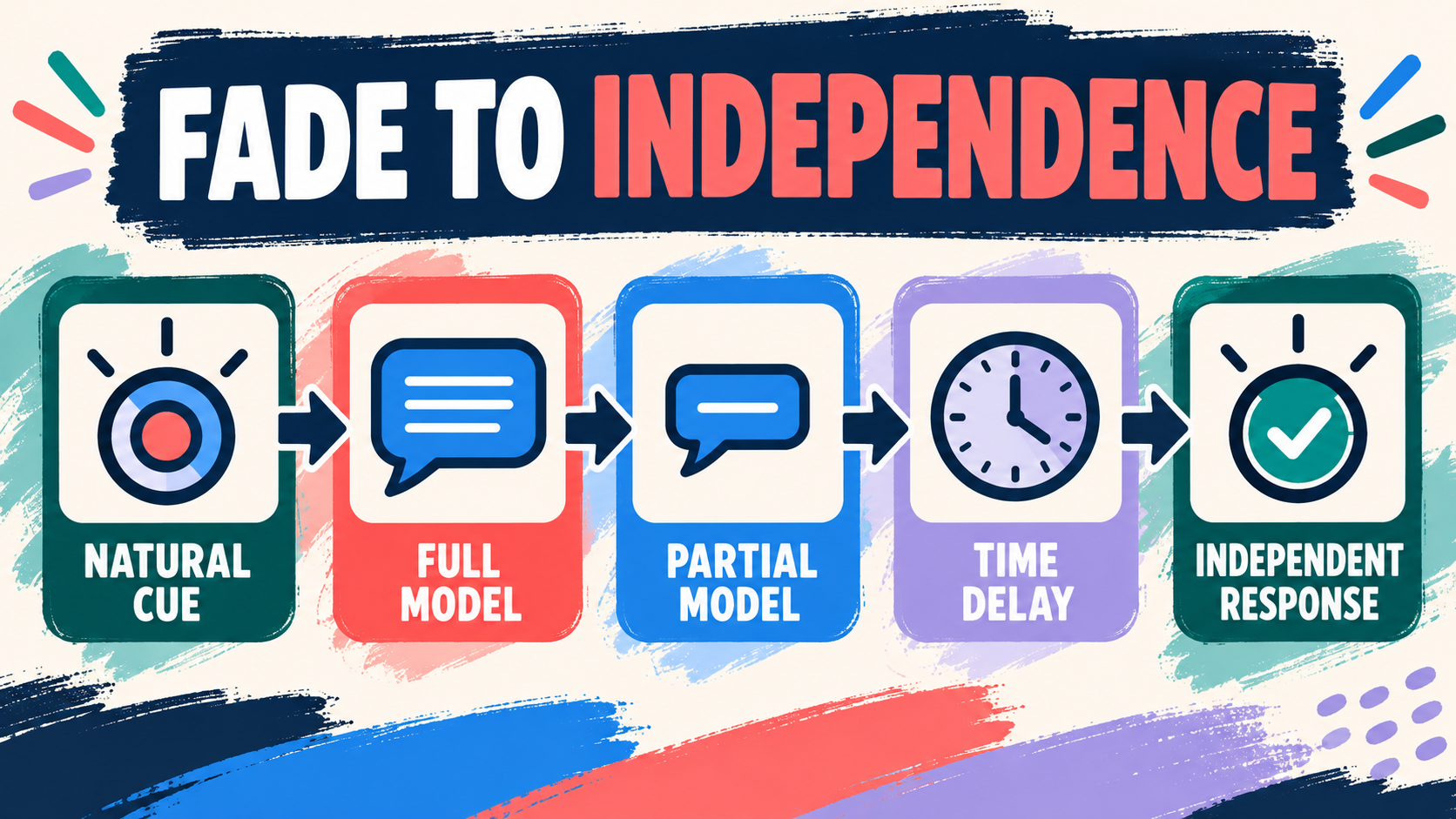
Fading is the planned reduction of assistance so the natural cue—not the adult’s model—comes to control the response. A common path is to move from a full verbal model to a partial verbal model, then to a delayed prompt, and finally to an independent opportunity. That sequence is not mandatory. Research on prompt selection and fading shows that efficient procedures can differ across learners and tasks, so the team should use data rather than assume that one hierarchy will work for everyone.
One option is time delay: initially present the natural cue and the full model together, then gradually increase the delay before the model. If the learner responds during the delay, reinforce the independent response and do not add the prompt. Another option is stimulus or response-prompt fading, such as reducing the words in the model, lowering its volume when appropriate, or shifting from a full phrase to an initial sound. The exact fading dimension must be defined so staff implement it consistently.
Do not fade simply because a learner has one good trial. Set a decision rule using several comparable sessions, independent-response data, latency, errors, and generalization. If performance falls sharply, the team may have faded too quickly, changed the natural cue, or reinforced a response that was not yet functional. If the learner waits for the adult’s phrase on every trial, prompt dependence is a live hypothesis rather than a reason to keep repeating the full model forever.
- Start with enough assistance to produce meaningful practice without overwhelming the learner.
- Plan the next less-intrusive prompt before teaching begins.
- Increase the opportunity for an independent response before delivering the model.
- Reinforce independent responses more strongly or efficiently when that difference is clinically appropriate and defined in the plan.
- Probe new people, materials, settings, and examples so the response does not remain tied to one instructor’s voice.
What Data Should a BCBA Review?
Accuracy alone can make a full verbal model look more effective than it is. A useful data sheet separates independent and prompted responses and identifies the least prompt level that produced the target. Depending on the program, also record latency, response form, errors, opportunities, reinforcer delivery, and generalization probes.
- Independent percentage: Correct responses before the full model or other prompt.
- Prompt-level distribution: How often the learner needed full, partial, delayed, visual, or other assistance.
- Latency: Time from the natural cue to an independent or prompted response.
- Generalization: Performance with different instructors, materials, settings, and communication partners.
- Maintenance: Whether the skill remains after the prompt is faded and teaching intensity changes.
Graph independent responding separately from prompted correctness. A trend of 95% correct with a full model on every trial is not equivalent to 80% independent responding with occasional partial prompts. That distinction is especially important when a question asks whether a skill has been mastered, whether a prompt should be faded, or whether stimulus control has transferred.
BCBA Exam Traps and Ethical Limits
Full verbal model ABA questions often hide the answer in the sequence of events. Look for the following distinctions:
- Prompt versus operant: The adult’s verbal model is a prompt; the learner’s response is classified by its controlling variables and consequence.
- Full versus partial: A complete target phrase is a full model; an initial sound or incomplete phrase is a partial model.
- Prompt present versus independent: A correct response after the model can be prompted accuracy, not independent mastery.
- Model versus echoic: An echoic describes the learner’s verbal response under a verbal model with the relevant correspondence; “full verbal model” describes the teaching assistance.
- Fading versus removing teaching: The goal is transfer to the natural cue, not simply withholding reinforcement or ending instruction.
Ethically, prompting should support effective skill acquisition while minimizing unnecessary intrusion and respecting the learner’s communication, dignity, assent, and access to reinforcement. A model should never be used to force a learner to produce a speech form that is unnecessary for functional participation. If a learner communicates effectively with an AAC response, sign, gesture, or approximation, the team should not assume that a spoken full model is the only acceptable outcome.
Full Verbal Model ABA FAQ
What is a full verbal model in ABA?: It is a verbal response prompt in which the instructor provides the entire target vocal response, such as “I want a break,” for the learner to imitate or use. The learner’s response is still classified separately from the prompt.
Is a full verbal model the same as an echoic?: No. A full verbal model is the assistance supplied by the instructor. An echoic is a learner verbal operant defined by the relation between a verbal antecedent and the learner’s matching vocal response. One teaching trial can contain both.
How is a full verbal model different from a partial verbal model?: A full model gives the entire target response. A partial model gives only part of it, often an initial sound, word, or phrase fragment. The partial version is usually less assistance, but the team should confirm its effect with data.
How do you fade a full verbal model?: Common options include reducing the model, delaying it after the natural cue, or arranging a prompt hierarchy that moves toward independent responding. The correct choice depends on learner-specific data, not on a fixed rule that applies to every program.
Where can I practice full verbal model ABA questions?: Use the free full verbal model ABA BCBA mock exam practice to practice separating full, partial, delayed, and independent responses in scenario-based questions. It is independent study support, not official BACB material.
The exam-ready shortcut is to ask three questions: What did the instructor provide? What did the learner do? Was the learner’s response controlled by the natural cue or by the prompt? Answering those questions keeps the full verbal model in its proper place: useful temporary support on the path to functional, generalized, and independent responding.
Take the Free BCBA Mock Exam
If you want a low-pressure way to check your recall, use the free practice resource below. Take the Free BCBA Mock Exam



