
Short answer: Functional performance describes what a student actually does in everyday school, home, community, or future-work routines that is not limited to academic achievement. It can include communication, self-advocacy, social participation, behavior, organization, mobility, self-care, safety, and independent-living skills. The phrase is often used with academic achievement in special-education planning, so it should not be confused with a functional behavior assessment.
Table of Contents
- What is functional performance?
- What counts as functional performance?
- How should functional performance be described?
- How is functional performance different from FBA, BIP, and accommodation?
- What is an example of functional performance?
- How does the BCBA exam test this term?
- What mistakes should you avoid?
- Functional performance FAQ
- Take the Free BCBA Mock Exam
When someone asks, “what is functional performance?” the intended meaning depends on context. In an IEP or special-education discussion, functional performance concerns the skills and activities that help a learner participate, communicate, manage routines, and move toward greater independence. In an ABA discussion, “functional” may also refer to the function of behavior or to a functional assessment. This article stays with the educational present-levels meaning and shows how a BCBA candidate can recognize the boundary.
The official IDEA regulation on IEP content requires a statement of a child’s present levels of academic achievement and functional performance, including how the disability affects involvement and progress in the general-education curriculum. The U.S. Department of Education’s IDEA overview likewise emphasizes the relationship between present levels, participation, and progress. This is educational study support, not an individualized IEP, eligibility, placement, or legal recommendation. Table of Contents
What is functional performance?
Functional performance is a learner’s observable performance in practical activities that support participation, independence, communication, health, safety, and daily functioning. It is concerned with what the student does under ordinary conditions, not only what the student can demonstrate on a standardized academic task. The relevant activity may occur in a classroom, hallway, cafeteria, playground, home routine, community setting, or transition to work.
In special education, functional performance is commonly documented alongside academic achievement in a present-levels statement. The purpose is not to create a second vague description of the student. It is to show strengths, needs, baseline information, and the way a disability or support need affects involvement and progress. A useful statement helps the team connect present performance to measurable goals, services, supplementary aids, accommodations, and progress monitoring. Consider the difference between these descriptions:
- Vague: “The student has poor functional skills and needs help.”
- Observable: “During arrival, the student independently places belongings in the assigned location in 2 of 5 observed opportunities and needs a verbal prompt to check the visual schedule.”
- Contextual: “The student follows the same routine more independently when the schedule is visible and the adult gives a five-minute warning; performance decreases when the classroom changes unexpectedly.”
The second and third descriptions give the team something it can measure, teach, adapt, and review. Functional performance is therefore not a label for a low score. It is a description of meaningful behavior in context.
What counts as functional performance?
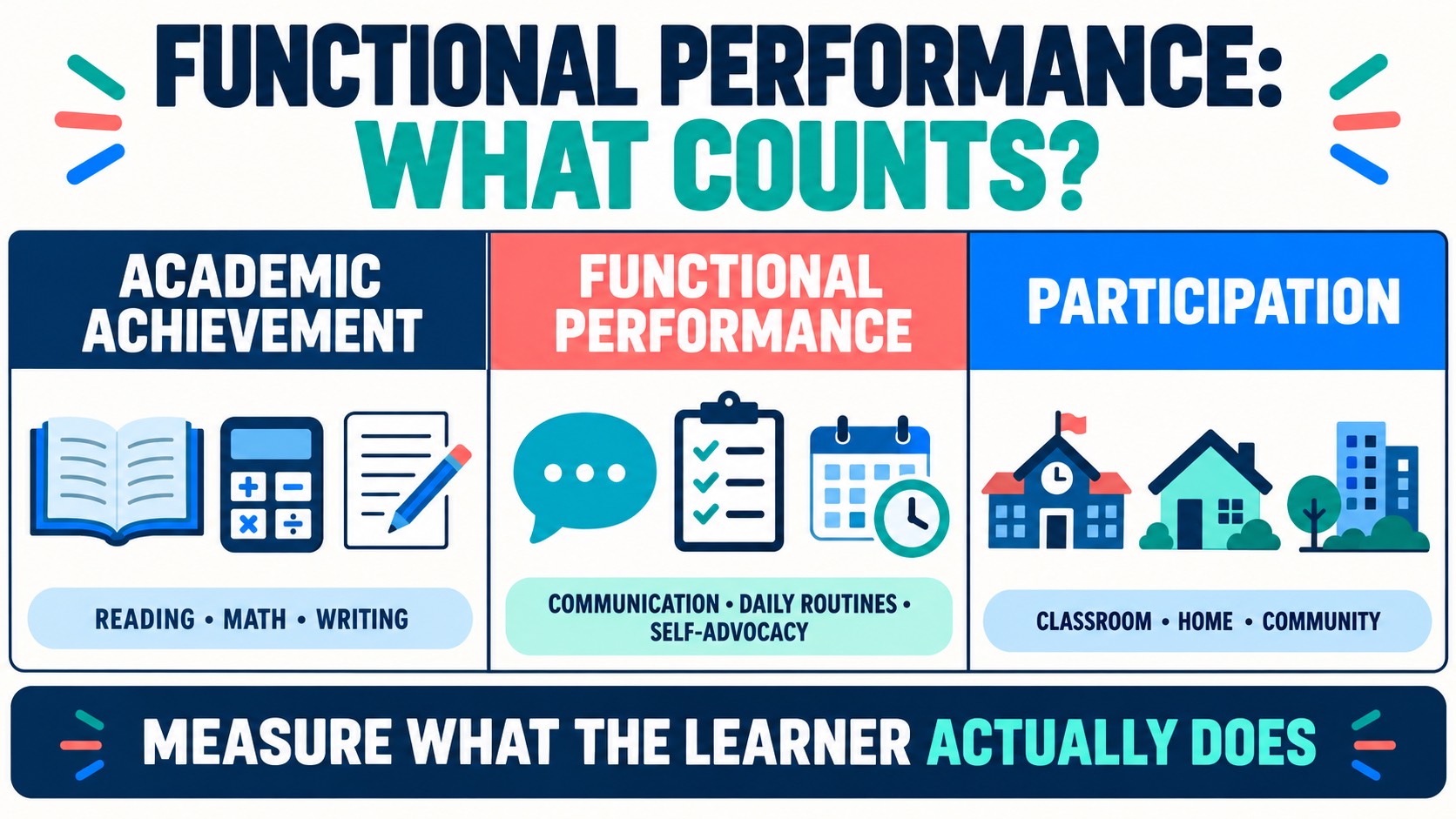
Functional performance can include any nonacademic skill or behavior that affects the learner’s ability to participate and function in meaningful routines. It is not restricted to self-care. The appropriate domains depend on age, environment, communication, disability-related needs, family priorities, and the learner’s goals.
| Domain | Possible observable performance | Why it matters for participation |
|---|---|---|
| Communication | Requests help, answers a teacher, uses an AAC response, or communicates a need during a routine. | The learner can access instruction, relationships, breaks, materials, and safety support. |
| Daily routines | Arrives, organizes materials, follows a schedule, eats, dresses, uses the restroom, or completes a transition. | Independence reduces unnecessary barriers to learning and community participation. |
| Social and behavioral participation | Waits, shares space, joins a group, responds to a peer, uses a replacement response, or recovers after a change. | The learner can remain involved in instruction and nonacademic activities with appropriate support. |
| Self-advocacy and safety | States a preference, asks for clarification, identifies a danger, seeks assistance, or follows a safety routine. | The learner has a practical way to influence the environment and protect access, dignity, and well-being. |
A functional skill may also be academic in content but functional in use. Reading a menu, following written directions, organizing an assignment, or using money in a real routine can involve both academic achievement and functional performance. Categories are useful for planning, but real activities often cross categories.
How should functional performance be described?
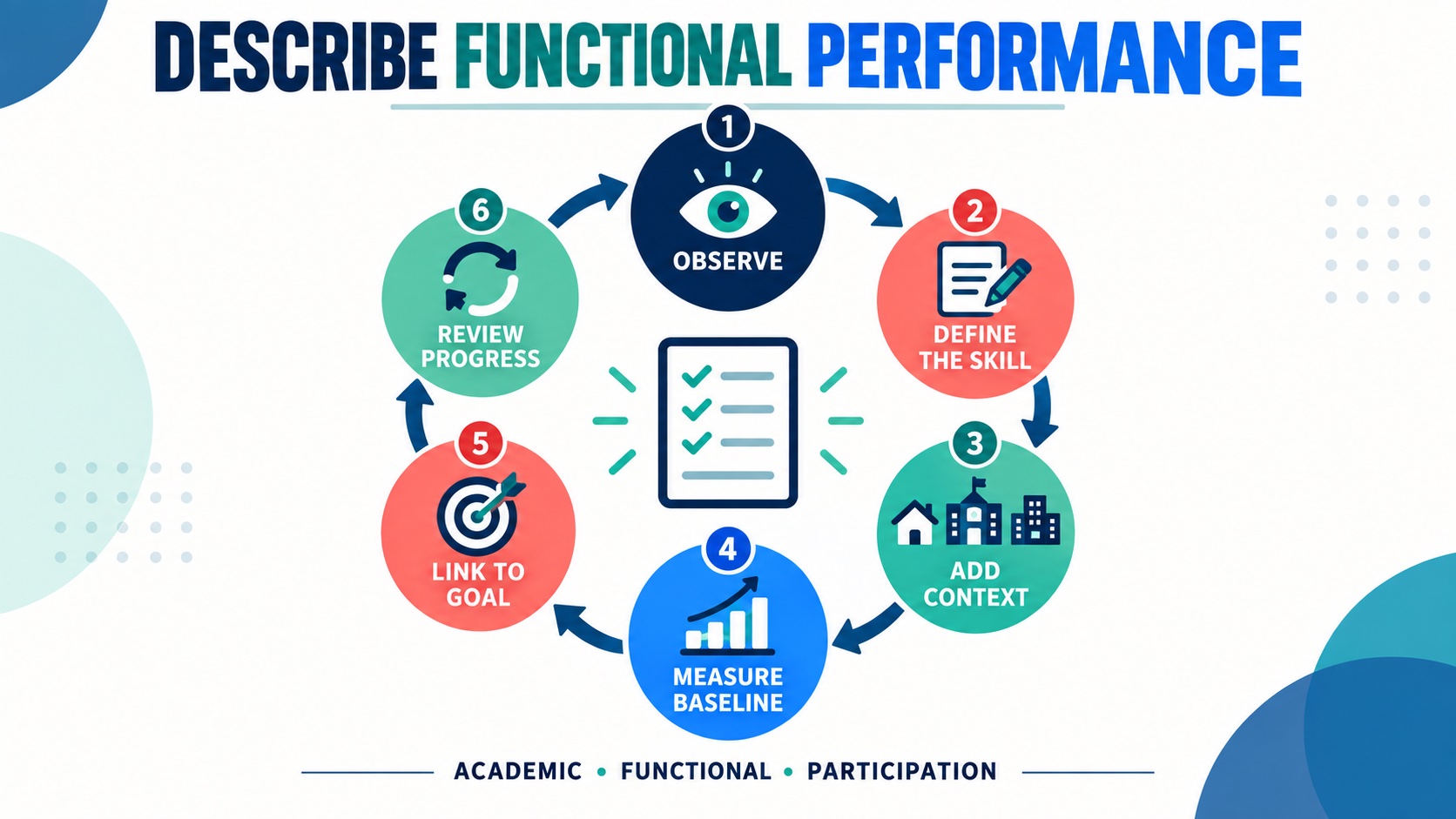
A strong description answers four questions: What does the learner do? Under what conditions? How often or independently does it happen? How does the pattern affect participation or progress? The answer should include current data and strengths, not only deficits. It should also distinguish the learner’s skill from the environment’s demands and supports.
Start with observable performance: Use actions that another observer could identify: initiates a request, completes a three-step routine, remains with a group for eight minutes, selects a break card, or follows a safety signal. Avoid relying on labels such as “unmotivated,” “low functioning,” or “does not understand” unless the statement is followed by observable evidence. An operational description does not remove the learner’s dignity; it makes the support question more precise.
Add context, baseline, and strengths: Performance is context-specific. Record relevant conditions such as setting, communication partner, task difficulty, schedule change, sensory demands, materials, prompt level, and available supports. A student may independently use a help request with a familiar teacher but not during a substitute-led lesson. That difference is important information about generalization and context fit, not proof that the student “can” or “cannot” communicate. Link the description to a measurable goal.
The present level should point toward a meaningful next step. If a student completes the arrival routine in 2 of 5 opportunities, the team may define a goal around independent completion, prompt fading, or generalization to another setting. The exact goal belongs to the educational team. The BCBA reasoning task is to connect baseline, target, teaching arrangement, measurement, and socially important outcome.
| Description element | Better question | Example evidence |
|---|---|---|
| Skill or behavior | What response can be seen or heard? | Uses a help card, starts within two minutes, or completes four routine steps. |
| Condition | Where, when, with whom, and with what support? | Small group, noisy cafeteria, visual schedule present, or adult prompt required. |
| Dimension | What aspect changes the learner’s access or independence? | Frequency, duration, latency, accuracy, prompt level, or percentage of independent opportunities. |
| Educational impact | What meaningful activity becomes easier or harder? | Can join lunch, begin work, communicate a need, or move safely between settings. |
How is functional performance different from FBA, BIP, and accommodation?
These terms can appear in the same school conversation, but they answer different questions. Functional performance describes a present level of practical performance. A functional behavior assessment investigates environmental variables related to a defined behavior. A behavior intervention plan organizes prevention, teaching, consequence, and measurement components for a behavior goal. An accommodation changes access or response conditions so the learner can participate or demonstrate knowledge.
| Term | Primary question | What it is not |
|---|---|---|
| Functional performance | What does the learner actually do in meaningful routines, and how does it affect participation? | It is not automatically a behavior function or a diagnosis. |
| FBA | Which environmental variables may influence a defined behavior? | It is not the same as a present-levels description of every functional skill. |
| BIP | What prevention, teaching, reinforcement, and response plan will address a defined behavior goal? | It is not a synonym for functional performance. |
| Accommodation | What access, timing, presentation, or response change helps the learner participate? | It is not necessarily a teaching procedure that changes the underlying skill. |
The distinctions can work together. A functional-performance statement may show that a student cannot independently request clarification during group instruction. An FBA may be appropriate if refusal or disruption reliably follows difficult tasks. The team might then teach a help request in a BIP or instructional plan, while an accommodation provides an alternate response format. Each document or process has a different job.
What is an example of functional performance?
Imagine a student who understands the academic content during one-to-one instruction but rarely begins independent work in the general classroom. Observation shows that the student looks at the assignment, waits for an adult, and sometimes leaves the area when the worksheet has multiple steps. The student independently begins within two minutes on 1 of 5 opportunities, but begins on 4 of 5 opportunities when the teacher provides a visual first-then cue and a brief choice of which problem to start.
The functional-performance description is not “the student is lazy” or “the student has an escape function.” It is that independent task initiation is low under a defined classroom condition, while performance improves with a clear visual cue and limited choice. The team can then decide whether the target is task initiation, help-seeking, work organization, tolerance, or a combination. It can measure latency and independence, check whether the support generalizes to another teacher, and review whether the arrangement improves meaningful access without creating prompt dependence.
This example shows why context matters. A standardized test may show what the student can answer, while functional performance shows whether the student can access and use that skill during an ordinary routine. Both types of information can be relevant to educational planning.
How does the BCBA exam test this term?
On a BCBA question, look for the scope of the phrase and the data being requested. If the vignette discusses present levels, IEP goals, participation in general education, daily routines, self-advocacy, or independence, functional performance likely refers to practical educational performance. If it asks why a behavior occurs, what consequence maintains it, or which antecedent-consequence relation should be assessed, the question may instead be testing functional behavior or FBA logic.
- Read the setting: school participation and daily routines point toward functional performance; a manipulated assessment condition may point toward functional analysis.
- Identify the unit of analysis: a present-levels statement describes a learner’s performance; an FBA examines environmental relations around a defined behavior.
- Check the outcome: independence, communication, safety, and participation are functional outcomes; academic accuracy may be academic achievement, although real tasks can involve both.
- Look for supports: an accommodation changes access, while teaching and reinforcement may build a new response or improve independent performance.
- Use current authority: for legal or credentialing details, follow the current IDEA rules, school policy, and current BACB materials rather than relying on an old study note.
For a broader behavior-analytic context, review the site’s functional behavior assessment guide only after keeping the vocabulary boundary clear. Then use the free BCBA mock exam to practice identifying whether a scenario is asking about present performance, behavioral function, intervention design, or access support. The mock exam is a practice and feedback resource, not an official BACB product, does not reproduce official exam questions, and does not guarantee certification or exam performance.
What mistakes should you avoid?
- Equating functional with “low-level”: functional performance can include advanced self-advocacy, organization, vocational, communication, and community skills.
- Confusing functional performance with behavior function: the word functional does not automatically mean escape, attention, tangible, or automatic reinforcement.
- Listing deficits without conditions: explain where, when, with whom, and with what support the performance occurs.
- Ignoring strengths and preferences: a useful present-levels statement identifies existing skills that can support the next goal.
- Measuring only what happens at a table: performance in natural routines, transitions, group activities, and community settings may be the meaningful outcome.
- Writing a legal conclusion from a study definition: educational eligibility, IEP content, placement, and services require the appropriate team and current rules.
Functional performance FAQ
Is functional performance the same as adaptive behavior?: They overlap, but the terms are not automatically interchangeable. Adaptive behavior often refers to conceptual, social, and practical skills used in everyday life, while functional performance in an educational context is tied to the learner’s present performance, participation, and progress in relevant school or life routines. Follow the assessment framework and definition being used in the specific document.
Does functional performance include behavior?: Yes. Observable behavior, communication, social participation, self-regulation, organization, safety, and daily routines may all affect functional performance. The key is to describe the behavior and its educational impact. Do not assume that describing functional performance has already identified the function maintaining a behavior.
How is functional performance measured?: Use a measure that matches the activity: percentage of independent opportunities, frequency, duration, latency, task-analysis steps completed, prompt level, communication opportunities, or participation across settings. Collect enough contextual information to interpret the score and check whether the learner is becoming more independent and generalizing the skill.
Why does a BCBA need to understand this term?: BCBAs may collaborate with educational teams on measurable goals, teaching arrangements, behavior support, communication, generalization, and progress monitoring. Understanding functional performance prevents a common vocabulary error: treating a present-levels description as if it were an FBA, or treating an access support as if it were a skill-acquisition program.
Bottom line: Functional performance means what a learner actually does in meaningful, often nonacademic routines and how that performance affects participation and independence. Define the observable skill, add context and baseline, connect it to a meaningful goal, and keep functional performance distinct from behavioral function, FBA, BIP, and accommodation.
Take the Free BCBA Mock Exam
When you are ready to apply the idea, use the free practice resource below for additional feedback. Take the Free BCBA Mock Exam



