

Short answer: BACB international certification is not a single worldwide license. The phrase usually refers to pursuing a BACB credential while living outside the United States, completing training in another country, taking the examination at an international testing site, or planning to practice across borders. Those are different questions. The BACB rules for new applications depend on the applicant’s residence and current jurisdiction policy; the exam location is a separate logistics issue; and local licensure or registration is controlled by the place where services are delivered.
Table of Contents
- What does BACB international certification mean?
- Which four questions must international candidates separate?
- How do residence and application eligibility interact?
- Can international coursework and degrees count?
- Which dates matter for international candidates?
- Does an international testing site prove eligibility?
- How is certification different from local licensure?
- International certification verification checklist
- Common BCBA exam and planning traps
- Quick review and study next step
- BACB international certification FAQ
- Take the Free BCBA Mock Exam
As of the date checked for this guide, the BACB’s International Development & Support page states that it accepts certification applications from residents of specific authorized countries and publishes future changes separately. The page should be rechecked before anyone pays tuition, submits an application, or assumes that a credential can be used as a local license. A degree or fieldwork completed abroad may still need to satisfy the requirements in effect when the application is filed. Table of Contents
What does BACB international certification mean?
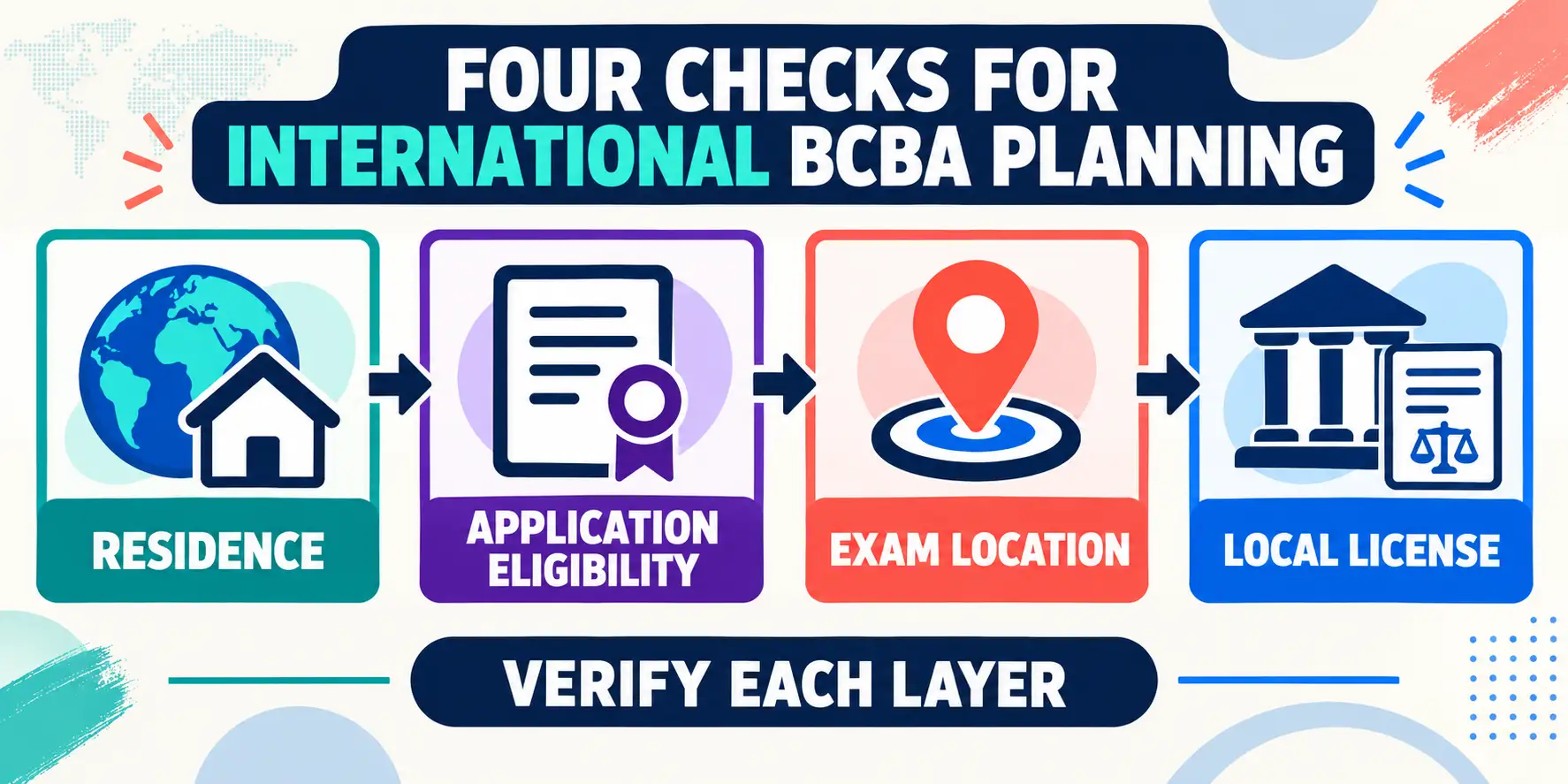
“International certification” is a convenient search phrase, but it can hide four different situations. A candidate may be a resident of an authorized country, may have completed a degree or coursework outside the country where they now live, may want to schedule an examination at an international Pearson VUE site, or may already hold a BCBA credential and plan to relocate. The answer changes depending on which situation applies.
The BACB credential is a professional certification in behavior analysis. It is not automatically a work permit, a state or provincial license, a national license in every country, or a guarantee that an employer or payer will recognize a service arrangement. A candidate should treat the BACB handbook, international page, upcoming-changes tracker, and the rules of the place where services will be delivered as separate source sets.
| What the candidate means | What must be verified |
|---|---|
| Applying while living abroad | Whether the applicant’s residence is currently within the BACB’s authorized jurisdiction and which pathway rules apply on the filing date. |
| Studying outside the United States | Whether the degree, coursework, program recognition, transcripts, and fieldwork meet the current handbook requirements. |
| Testing in another country | Whether a Pearson VUE site is available and whether the candidate has already received BACB authorization to schedule the exam. |
| Practicing after relocation | Whether the certification can be maintained and what local professional, licensing, employer, payer, privacy, and scope rules apply. |
Which four questions must international candidates separate?
Before comparing universities or booking an exam, answer these questions in order. They prevent a common mistake: treating an answer to one question as proof of all four.
- Where do I reside at the time of application? This is a jurisdiction question for new applicants.
- Where was my degree, coursework, or fieldwork completed? This is an evidence and eligibility question.
- Where can I take the examination? This is a testing logistics question after authorization.
- Where will I provide services? This is a local practice, licensure, employer, payer, and legal-context question.
For example, a person may live in an authorized country, complete coursework through a university in another country, test at a third-country site while traveling, and later seek employment in a fourth jurisdiction. One “international certification” answer cannot resolve that entire chain. Each stage needs its own primary source and date.
How do residence and application eligibility interact?
The BACB’s international policy is especially important for new applicants. The live International Development & Support page identifies the countries from which the BACB currently accepts certification applications and explains changes to its international focus. A candidate should record the page’s update date, compare it with the current handbook, and verify the rule that applies on the intended application date. Do not infer application eligibility from any of the following alone:
- A university advertises an ABA or behavior-analysis program.
- A friend in another country already holds a BCBA credential.
- A Pearson VUE site appears in an international city.
- A degree was accepted under an older rule.
- An employer uses the title “behavior analyst” without requiring BACB certification.
- A local regulator recognizes a different behavior-analysis credential.
The safest workflow is to identify residence first, then read the current BACB handbook and international page, then contact the BACB when the facts do not fit a published example. Keep copies of the exact source pages and your written questions. A general article or school admissions representative cannot replace a determination by the certifying board.
Can international coursework and degrees count?
Training location and application jurisdiction are related but not identical. The current BCBA handbook describes degree, coursework, fieldwork, transcript, and pathway requirements. Depending on the pathway and the country, an international degree may require an equivalency evaluation or other documentation. Coursework may also need to be completed through a qualifying institution or be attested through the current process.
For candidates planning around 2027, check whether the intended route is a Pathway 1 degree route or a Pathway 2 behavior-analytic coursework route. Verify the current transition resource rather than relying on a program page that uses “international BCBA” as a marketing phrase. The key question is not whether a course is called ABA; it is whether the education and documentation satisfy the BACB requirement in effect when the application is submitted.
| Evidence | Question to ask | Do not assume |
|---|---|---|
| Degree | Is the institution and degree acceptable under the current pathway? | A foreign degree is automatically equivalent to a US graduate degree. |
| Coursework | Can the program provide the required attestation or documentation? | A course title alone proves content or eligibility. |
| Fieldwork | Can the fieldwork be supervised and documented under the current rules? | Remote or international supervision is automatically acceptable in every situation. |
| Transcript and forms | Will official records and signatures be available in the required format? | An unofficial translation or school webpage replaces official evidence. |
Which dates matter for international candidates?
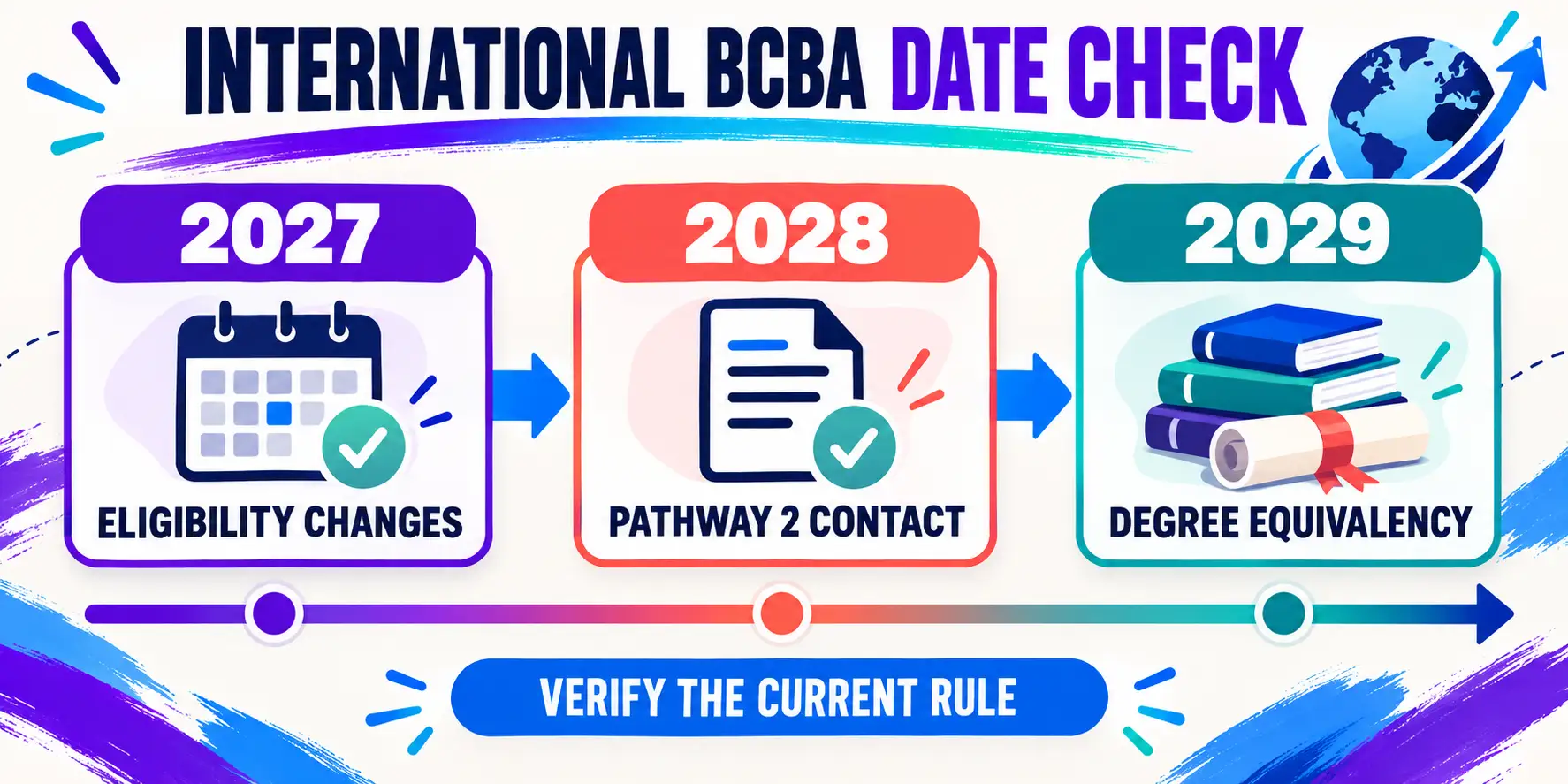
International candidates should treat the transition calendar as a planning screen, not as a reason to rush into an unsuitable program. BACB pages currently identify several dates that can affect jurisdiction, coursework contacts, degree equivalency, and eligibility pathways. The official tracker and handbook should be checked again before an application is filed.
- January 1, 2027: revised BCBA eligibility and maintenance requirements take effect, while some international jurisdiction changes also become relevant.
- January 1, 2028: Pathway 2 program contacts must meet the stated jurisdiction condition described by the BACB.
- January 1, 2029: the BACB lists degree-equivalency requirements for certain Pathway 1 applicants applying through international training routes.
- January 1, 2032: the BACB’s upcoming-changes tracker identifies a future Pathway 1-only eligibility direction for BCBA certification.
The practical response is to build a dated evidence file: residence, intended pathway, degree evaluation, coursework attestation, fieldwork documentation, application plan, and the source page used for each conclusion. If a date changes, update the evidence file rather than continuing from an old screenshot or school brochure.
Does an international testing site prove eligibility?
No. A testing site answers where an authorized candidate may sit for an examination. It does not decide whether the candidate’s degree, coursework, fieldwork, application, or residence satisfies certification eligibility. The BACB examination-information page describes examination delivery and authorized sites; the handbook and application process determine the credential pathway. Use this sequence:
- Confirm the residence and jurisdiction rule for new applicants.
- Confirm the education, fieldwork, and documentation route.
- Submit the application and wait for an approved determination.
- Only then schedule the exam through the authorized process.
- After certification, separately verify the local rules for providing services.
The sequence also matters on the BCBA exam. A stem may include a location, a university, or a testing center as a distractor. Ask which event is being tested: eligibility, examination logistics, certification maintenance, or authority to practice.
How is certification different from local licensure?
BACB certification and local licensure are different credentials or permissions. The BACB determines whether a person meets its certification standards. A state, province, country, employer, payer, or other authority may impose separate requirements for using a professional title, billing, supervising, delivering telehealth, or providing services. A person may hold an active BCBA credential and still need additional local authorization—or may work in a setting where the local rules use a different structure. Do not promise international portability. Instead, ask:
- What title may be used in the destination jurisdiction?
- Is behavior analysis regulated there?
- Is registration or licensure required before practice?
- Do employer, payer, privacy, immigration, or telehealth rules add constraints?
- Does the service model require a local supervisor or professional entity?
For a US-focused reader, the existing states that require BCBA licensure guide handles the domestic licensure question. This article owns the international jurisdiction distinction, not a universal legal answer.
International certification verification checklist
Before paying for a program or treating a search result as a final answer, save evidence for each line:
- Residence on the intended application date.
- Current BACB International Development & Support page and update date.
- Current BCBA handbook and intended eligibility pathway.
- Degree status, equivalency requirement, and official transcript plan.
- Coursework content, attestation route, and applicable transition date.
- Fieldwork supervisor qualifications, forms, and documentation system.
- Application approval before examination scheduling.
- Local practice, licensure, privacy, payer, and employment checks.
- A written question to the BACB when the published pages do not resolve the case.
Common BCBA exam and planning traps
International certification questions often test category errors. Watch for these patterns:
- Testing site equals eligibility: a location to sit for an exam is not proof that an application will be approved.
- Certification equals local license: the BACB credential does not automatically settle local practice authority.
- Training location equals application jurisdiction: where coursework occurred may not answer where the applicant resides.
- Older rule equals current rule: an archived handbook or prior country list may no longer control.
- Existing certificant equals new applicant: maintenance and new-application rules can be different.
- One future date solves everything: 2027, 2028, 2029, and 2032 changes address different requirements.
Quick review and study next step
Quick rule: separate residence, training evidence, testing location, and local practice authority. Then check the current official source for the date that controls the candidate’s situation. Mini question: A candidate sees that a Pearson VUE site is available in another country and concludes that they can apply for BACB certification from any country. What is the problem?
- The testing site determines the candidate’s degree equivalency.
- The testing site proves that local licensure is unnecessary.
- Testing availability and application-jurisdiction eligibility are separate questions.
- International candidates never need an application.
Answer: 3. The candidate must first verify the current application-jurisdiction and eligibility rules, receive authorization, and then use the approved scheduling process. For scenario practice, review the Behavior Analyst Certification Board and BCBA guide, then try the free BCBA mock exam. It is a study resource and does not claim to reproduce official BACB questions.
BACB international certification FAQ
Is BACB certification accepted everywhere? No universal statement is safe. The BACB credential, local regulation, employer expectations, payer rules, and scope of practice can differ by jurisdiction. Verify the destination rules separately. Can I study outside the United States and apply later? Possibly, but the training and documentation must meet the requirements in effect when you apply, and your residence must satisfy the current application policy. Read the current handbook and international page before enrolling.
Can an existing BCBA live outside the authorized application countries? Existing certificants and new applicants are not the same category. The BACB publishes separate maintenance and international guidance; do not apply a new-applicant restriction automatically to an existing certificant.
Does a BCBA credential let me practice in another country? It does not automatically settle local practice authority. Check professional regulation, title rules, employment, privacy, payer, immigration, and telehealth requirements in the jurisdiction where services occur.
What should I do if a university gives a different answer? Ask the university to identify the exact BACB pathway, official documentation, and source date it is relying on. Then compare that information with the live BACB handbook and international page. When the facts remain unclear, contact the BACB directly before paying or submitting.
Source note: This guide uses the BACB International Development & Support page, the official upcoming-changes tracker, and the current BCBA Handbook. Because jurisdiction and transition rules can change, readers should recheck those sources before making an application or practice decision.
Take the Free BCBA Mock Exam
When you are ready to apply the idea, use the free practice resource below for additional feedback. Take the Free BCBA Mock Exam



