
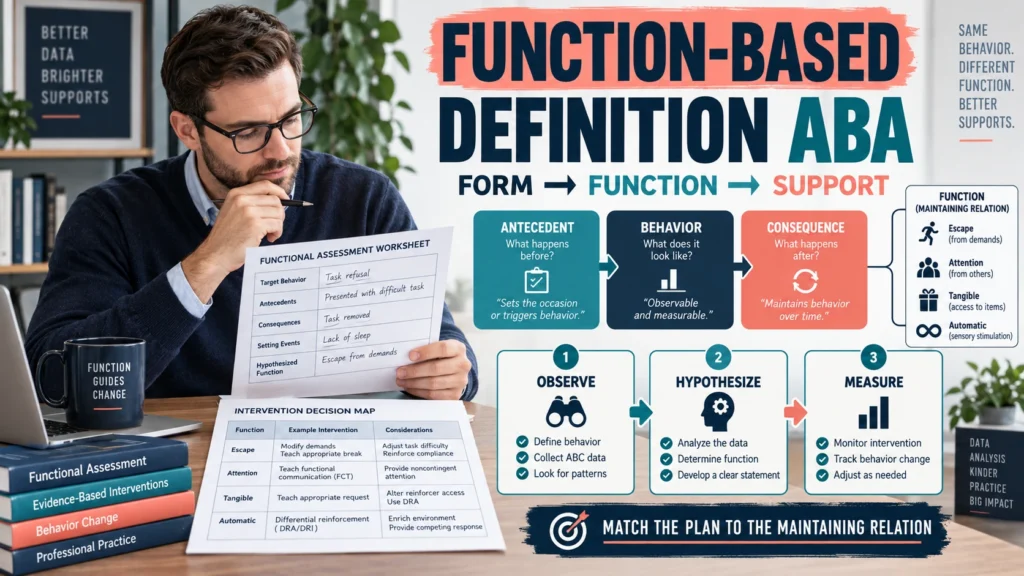
Function based definition ABA: a behavior description that identifies the environmental relation or outcome associated with the response, rather than describing only how the response looks. A function-based description might say that a learner engages in a defined response that reliably delays a demand under specified conditions. It still needs observable boundaries and assessment support; it is not a guess about personality, motivation, or intent.
Table of Contents
- Function Based Definition ABA: What It Means
- Start With an Operational Definition
- Connect the Definition to FBA Evidence
- Separate Topography, Function, and Intent
- Move From FBA Evidence to Function-Based Support
- Choose a Functionally Equivalent Replacement
- Measure Whether the Plan Works
- Use Careful Function-Based Language
- Common Mistakes With Function-Based Definitions
- Frequently Asked Questions
- Sources
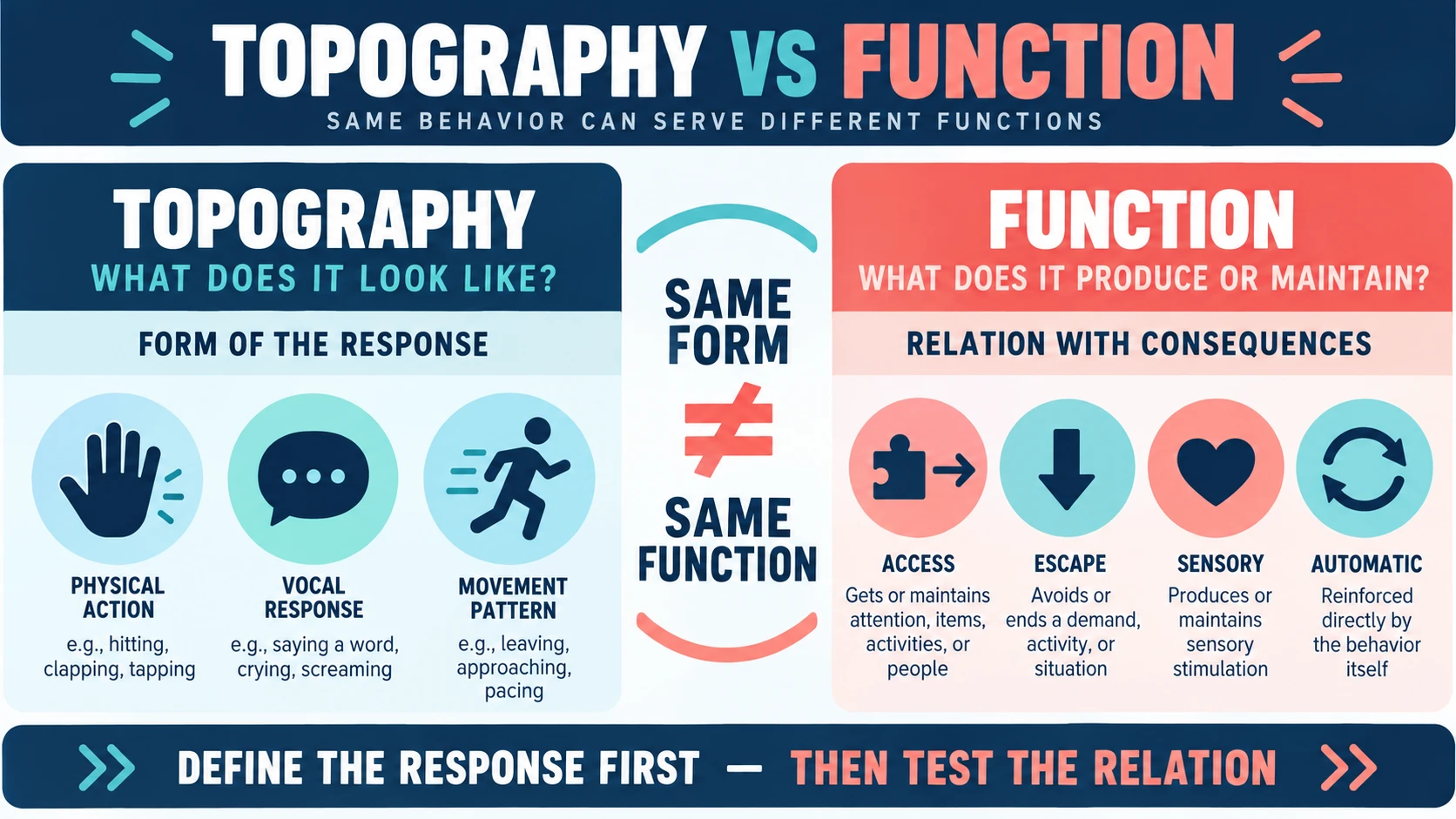
The key distinction is between form and function. Topography answers “What does the behavior look like?” Function asks “What consequence or environmental change does the behavior produce or maintain?” The same topography can contact different consequences, and different topographies can serve a similar function. That is why function-based thinking starts with a measurable response and then uses assessment evidence to guide support.
This is an educational study guide, not a clinical behavior plan. In a real case, a qualified behavior analyst should select the operational definition, assessment method, replacement skill, intervention, and safeguards. For exam alignment, compare this page with the current BACB BCBA Test Content Outline, including operational definitions, descriptive and functional assessment, assessment interpretation, and data-based intervention decisions.
Function Based Definition ABA: What It Means
A function-based definition describes a response in relation to the consequence it produces or the environmental event it changes. For example, “any instance of handing a break card to an adult within 10 seconds of a task demand” is a topography-based description of a communication response. A function-based description of a problem response might refer to behavior that results in a task being delayed or removed, but the statement should still specify the response, the relevant condition, and the observable outcome.
Function-based does not mean vague. “Acts out to get attention” is not a strong definition because “acts out” is unclear and “to get attention” is an unverified interpretation. A stronger record identifies the response form, the antecedent context, what another person did after the response, and the evidence that the consequence is related to future responding.
| Description type | What it answers | Example |
|---|---|---|
| Topography-based | What form did the response take? | “Pushes a material at least 10 centimeters with one or both hands.” |
| Function-based | What environmental relation or consequence is associated with the response? | “A defined response that is followed by a task pause under demand conditions, when assessment supports that relation.” |
| Intent or trait label | What does the observer think the person wanted? | “Manipulative,” “defiant,” or “trying to get attention.” |
A function-based definition is useful only when it improves measurement and decision-making. If two observers cannot identify the response or the consequence in the same way, the definition needs more operational detail. If the function has not been assessed, write a hypothesis as a hypothesis rather than presenting it as a fact.
Start With an Operational Definition
Function-based work does not replace an operational definition. It builds on one. Begin by describing the response in observable and measurable terms, including examples, nonexamples, start and stop boundaries, and the measurement dimension that matters. A function hypothesis cannot be evaluated if the target response changes from one observer to another.
- Specify the response: describe movement, vocal behavior, communication, or another observable event without mentalistic labels.
- Specify the context: identify the relevant instruction, transition, item, interaction, or motivating condition without assuming it caused the response.
- Specify the outcome: state what changed immediately after the response, such as attention, access, task delay, or sensory stimulation.
- Specify the boundary: state when one episode ends and how repeated or overlapping responses are recorded.
- Specify the evidence: identify whether the relation comes from interview, direct observation, descriptive data, or a functional analysis.
For example, “refusal” is a label, not a complete definition. “After an instruction, the learner places both hands under the table and does not contact the assigned materials for 30 consecutive seconds” is more observable. If observations show that adults consistently remove the task after this response, the team may develop a hypothesis about escape-related reinforcement. The definition still needs the response form so observers can detect it reliably.
Connect the Definition to FBA Evidence
Functional behavior assessment, or FBA, is the process of gathering information about variables related to a behavior so the team can develop a function-based support plan. Common information sources include record review, interviews, rating scales, direct ABC observation, and, when clinically appropriate and authorized, a functional analysis. These sources do not all provide the same level of evidence.
Descriptive observation can show that a response often occurs after a demand and is followed by task removal. That pattern may support a hypothesis, but other variables may also be present. A functional analysis arranges conditions to compare behavior across test and control conditions and can provide stronger evidence about a functional relation when conducted by qualified professionals with appropriate safeguards. The evidence-to-definition path should remain visible:
- Describe: record the observable response and the surrounding events.
- Compare: look for repeated patterns across people, activities, settings, and consequences.
- Hypothesize: state a tentative relation using cautious, testable language.
- Assess: collect or review the data needed to distinguish competing explanations.
- Plan: select a function-based support that changes relevant antecedents, teaches an alternative response, and arranges an effective consequence.
“Function” is not an internal trait stored inside a person. In behavior analysis, it refers to a relation between behavior and environmental events under defined conditions. The definition should therefore be revised when new data contradict the original hypothesis or when the same topography contacts different consequences in different contexts.
Separate Topography, Function, and Intent
Topography and function answer different questions, and intent is a third category. An observer may describe what a response looks like without knowing why it occurs. A person may have a goal, preference, or private experience that is not directly observable. Function-based analysis relies on environmental relations and measurable outcomes rather than assuming intent from appearance.
| Same topography | Possible environmental relation | What to verify |
|---|---|---|
| Screaming | Adult attention follows in one context; a difficult task stops in another. | The immediate consequence, its dependency on the response, and later behavior under comparable conditions. |
| Leaving an area | The person may reach a preferred activity, end an interaction, or contact automatic stimulation. | What changes after leaving and whether the same relation repeats across settings. |
| Handing over a card | The communication response may contact a break, an item, attention, or another programmed outcome. | The response definition, the programmed consequence, and whether the skill remains effective over time. |
Do not select an intervention from topography alone. “Hitting” is not an intervention category. The plan depends on what the response produces, the risks involved, the person’s communication repertoire, and the environmental conditions in which the response occurs. A function-based definition helps the team ask those questions without treating the form as the explanation.
Move From FBA Evidence to Function-Based Support
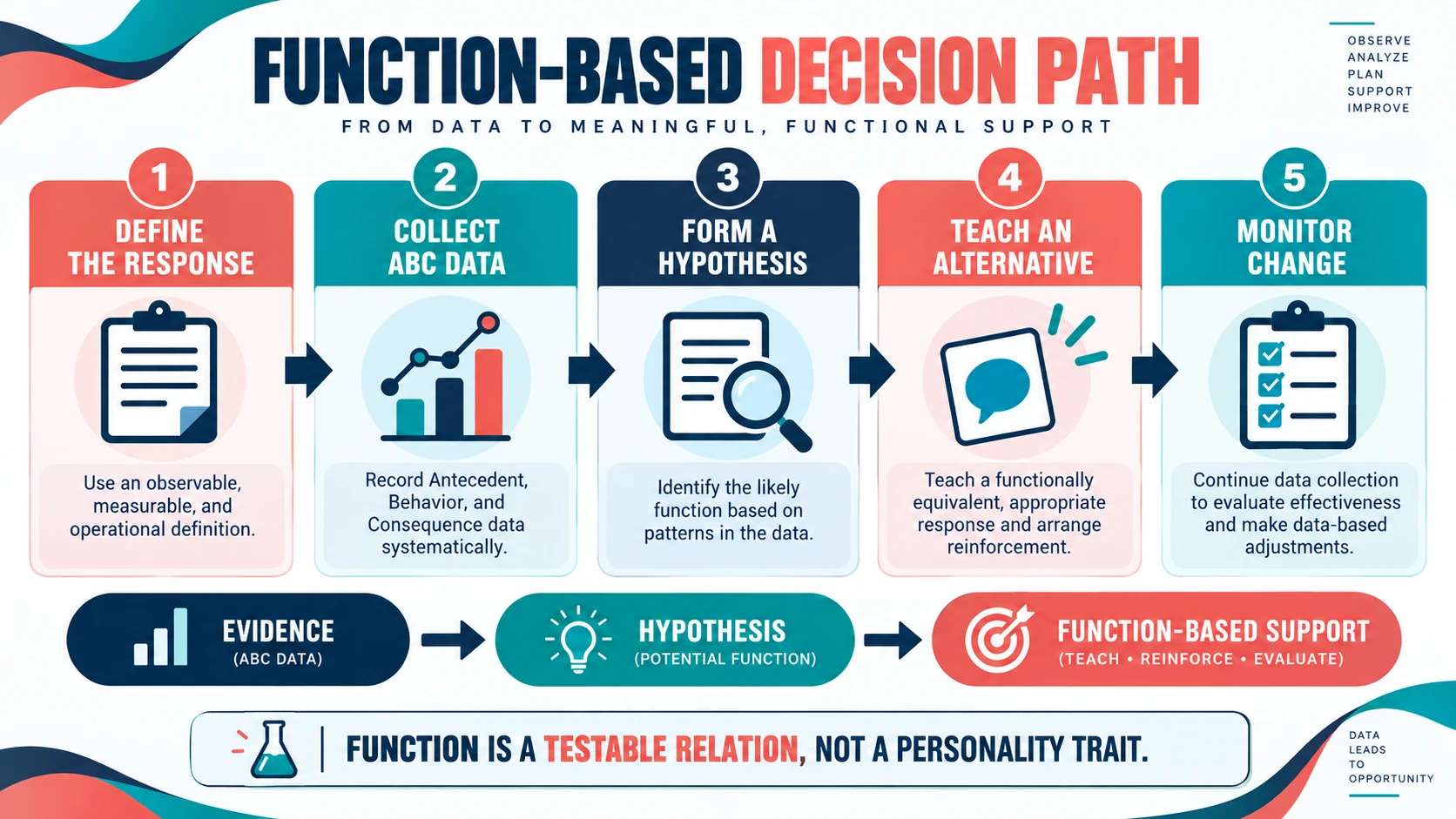
A function-based intervention changes the conditions that are relevant to the assessed relation and teaches a safer, socially meaningful way to contact the same or a more appropriate outcome. It is not simply a consequence chosen because it seems strong enough. The plan should connect the assessment hypothesis to an observable goal and a measurement system.
For a response associated with task removal, a plan might adjust task difficulty, provide choice or predictable breaks, teach an appropriate break request, and reinforce that request according to the approved protocol. For behavior associated with attention, the plan might teach an attention request and arrange meaningful, feasible attention for that response. For behavior associated with access to an item, the plan might teach an appropriate request and clarify when access is available.
These are examples of decision logic, not instructions to implement without assessment. The responsible professional must consider safety, consent and assent when applicable, cultural and contextual fit, communication access, risk of extinction or escalation, and whether the plan can be implemented consistently.
Choose a Functionally Equivalent Replacement
A replacement behavior should be practical, efficient enough to compete with the problem response, and socially valid for the person and the setting. “Use appropriate behavior” is not a teachable goal. The team should specify the response, the prompt or support if needed, the consequence, and how reinforcement will be delivered.
| Hypothesized relation | Candidate replacement | Data to monitor |
|---|---|---|
| Escape from a demand | A break request, help request, or taught task-completion response. | Independent requests, task engagement, problem-response rate, and whether the plan is implemented as written. |
| Social attention | An attention request, greeting, conversation response, or other accessible communication. | Appropriate requests, problem behavior, latency to attention, and generalization across partners. |
| Access to an item or activity | A spoken, signed, pictured, or device-based request with a clear availability rule. | Independent requests, waiting, tolerance of denial or delay, and safe access procedures. |
Functionally equivalent does not mean identical in form. A person who previously pushed materials to end a task may learn to hand over a break card. The card has a different topography, but it may contact a related consequence more safely and efficiently. The team should measure whether the new response works and whether the original risk decreases without removing essential communication.
Measure Whether the Plan Works
Function-based reasoning is incomplete without outcome data. Define what improvement means before implementation. Depending on the goal, measure frequency, rate, duration, latency, percentage of independent opportunities, communication responses, task engagement, or another meaningful dimension. Use a system that fits the behavior and the setting rather than collecting impressive-looking data that observers cannot complete accurately.
- Behavior change: did the target response decrease, increase, or change in its pattern?
- Replacement skill: did the person use the alternative independently and across relevant contexts?
- Procedure integrity: did implementers deliver antecedent supports, prompts, and consequences as planned?
- Generalization: did the skill transfer across people, settings, materials, and times?
- Social validity: do the goal, procedure, and outcome matter to the person and stakeholders?
If the data do not improve, do not conclude that the person is unmotivated or that the function “changed” without reviewing the definition, hypothesis, measurement, treatment integrity, and contextual variables. A plan may fail because the replacement response is inefficient, the consequence is not actually available, the assessment was incomplete, or the environment creates competing contingencies.
Use Careful Function-Based Language
Good documentation makes the level of evidence visible. Use terms such as “hypothesized function,” “descriptive pattern,” “under the assessed condition,” and “data support” when the evidence is limited. Reserve stronger statements for conclusions supported by an appropriate design and measurement. Compare these two statements:
- Overclaim: “The learner refuses because they want to escape work.”
- Evidence-linked: “During 6 of 8 observed demand episodes, task refusal was followed by a task pause; the team is evaluating an escape-related hypothesis with additional data.”
The second statement includes a measurable response, a context, a consequence, and a clear limit. It does not deny the possibility of a function; it keeps the claim proportional to the evidence. That is the reasoning expected when a BCBA exam question asks you to interpret an FBA or select a function-based intervention.
Common Mistakes With Function-Based Definitions
- Replacing the definition with a label: using “attention seeking,” “escape behavior,” or “noncompliance” without a measurable response.
- Confusing intent with function: inferring what a person wants from facial expression or topography alone.
- Skipping the ABC relation: naming a function without describing the antecedent and consequence.
- Using one function everywhere: assuming a response has the same maintaining relation across people, activities, and settings.
- Choosing punishment from form: selecting a procedure because the behavior looks severe rather than using assessment evidence and risk analysis.
- Teaching an inefficient replacement: requiring a long or difficult communication response while the problem response produces a faster outcome.
- Ignoring procedural integrity: treating an intervention as ineffective before checking whether it was implemented as designed.
- Overlooking the person’s voice: failing to consider preferences, assent, communication access, dignity, and social validity.
Frequently Asked Questions
What is a function-based definition in ABA?: It describes a behavior in relation to the environmental consequence or change associated with it, rather than only its physical form. It should still be observable, measurable, and supported by assessment evidence or clearly labeled as a hypothesis.
Is a function-based definition the same as a topography-based definition?: No. A topography-based definition describes what the response looks like. A function-based definition adds the environmental relation or outcome. Strong practice often keeps both visible so observers can identify the response and the team can evaluate the hypothesized function.
Does an FBA automatically prove the function?: No. The strength of the conclusion depends on the assessment methods, data quality, design, and context. Descriptive FBA information can support a hypothesis, while a properly conducted functional analysis may provide stronger evidence of a functional relation.
What is the exam rule for function-based intervention?: Match the intervention to assessment evidence, teach a socially meaningful alternative, arrange a consequence that supports the alternative, and monitor both behavior change and implementation integrity. Do not choose a plan from topography alone.
Bottom line: a function based definition ABA answer connects an observable response to a measurable environmental relation without confusing form, intent, and function. Define the behavior, review FBA evidence, state a cautious hypothesis, teach a functionally relevant alternative, and measure the result. For a separate exam checkpoint, use our function based definition ABA study companion and Take the Free BCBA Mock Exam. It is a practice resource, not an official BACB product.
Sources
- BACB BCBA Test Content Outline (6th ed.)
- U.S. Department of Education: Using Functional Behavioral Assessments to Create Supportive Learning Environments
- Related guide: function-based versus topography-based examples in ABA
- Function-based intervention glossary overview



