
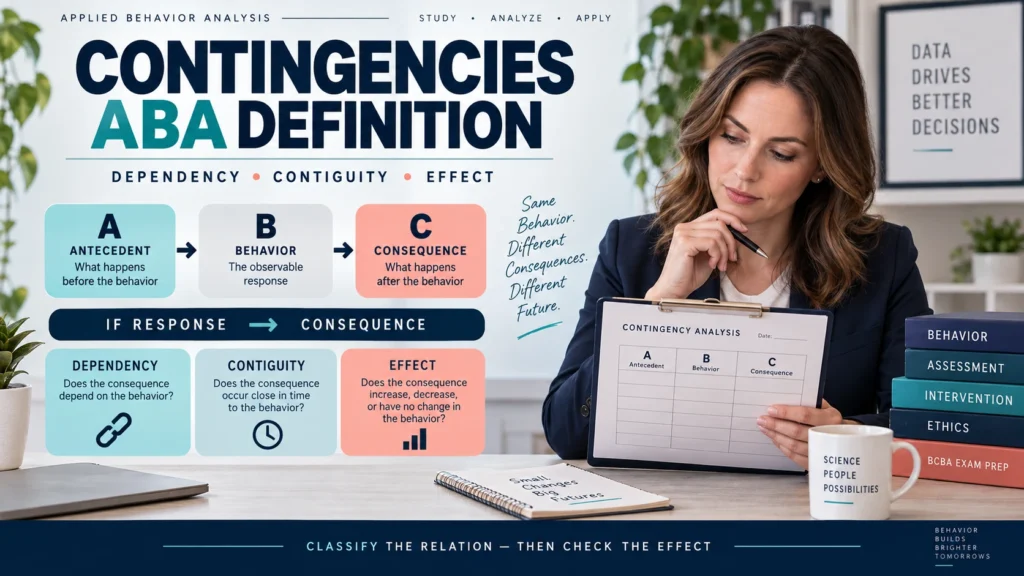
Contingencies ABA definition: a contingency is a relation in which what happens after a response depends, in some specified way, on that response or on another event. For exam questions, do not stop at “something happened after behavior.” Ask whether the consequence was dependent on the response, whether the events were merely close in time, and whether behavior changed later.
Table of Contents
- Contingencies ABA Definition: Start With the Relation
- Use the Three-Term Contingency as a Map
- Separate Contingency From Contiguity
- Classify Direct-Acting and Rule-Governed Control
- Do Not Call a Consequence Reinforcement Yet
- Check Automatic and Socially Mediated Contingencies
- Use a Five-Step Classification Workflow
- Work Through Three Exam-Style Examples
- Keep Descriptive Patterns Separate From Function
- Common Mistakes With Contingencies
- Frequently Asked Questions
- Sources
That sequence of questions keeps three ideas separate: the arrangement of events, the temporal relation between events, and the observed effect on future behavior. They often appear together in an ABA vignette, but they are not interchangeable. This guide uses the three-term contingency as a map and then focuses on the classification decisions that are easy to miss.
This is an educational study guide, not a behavior plan. In a real case, the operational definition, data system, assessment conditions, privacy safeguards, and intervention decisions should come from the responsible behavior analyst and current service plan. For exam alignment, compare the discussion with the current BACB BCBA Test Content Outline, which includes reinforcement and punishment contingencies, automatic and socially mediated contingencies, measurement, and behavior assessment.
Contingencies ABA Definition: Start With the Relation
In behavior analysis, contingency describes a dependency or relation among events. In the most common response-consequence use, a consequence is contingent when its occurrence is conditional on a particular response. The practical test is not whether the consequence was pleasant, intended, or close in time. The test is whether the response made a meaningful difference in whether the consequence occurred, compared with what would have happened without the response.
A contingency can be arranged deliberately, such as “complete the assigned step and then access a break,” or it can emerge from ordinary interactions. It can also be described before anyone knows whether the consequence changes future behavior. That is why a contingency arrangement, a consequence, and reinforcement are related but different terms.
| Concept | Question to ask | What it does not prove |
|---|---|---|
| Contingency | Was one event dependent on a response or condition? | That the response will increase or decrease in the future. |
| Contiguity | Did two events occur close together in time or space? | That the first event produced or controlled the second. |
| Reinforcement | Did a consequence follow behavior and increase its future probability? | That the stimulus was reinforcing simply because someone wanted it to be. |
On a multiple-choice question, look for the verb. “Depends on” points toward contingency. “Occurs immediately after” points toward contiguity or temporal proximity. “Increases future responding” is evidence for reinforcement. “Decreases future responding” is evidence for punishment. The same event can be close in time and contingent, but one fact cannot substitute for the others.
Use the Three-Term Contingency as a Map
The three-term contingency organizes an analysis into an antecedent, a behavior, and a consequence. It is a map for locating events, not a shortcut for labeling their function. A complete answer should state what was present before the response, what the response looked like, and what followed.
| Term | What to identify | Example wording |
|---|---|---|
| Antecedent | The relevant stimulus, instruction, transition, motivating condition, or setting event before the response. | “The teacher placed the worksheet down and said, ‘Start problem one.’” |
| Behavior | The observable and measurable response that meets the operational definition. | “The student pushed the worksheet 10 centimeters away with both hands.” |
| Consequence | The event or environmental change that follows the response. | “The teacher removed the worksheet and paused the demand.” |
Notice that the example does not yet say “escape-maintained.” The ABC sequence is descriptive. It may help a behavior analyst form a hypothesis about a response-consequence relation, but the label should not be inserted into the observation field as if it were directly visible.
Separate Contingency From Contiguity
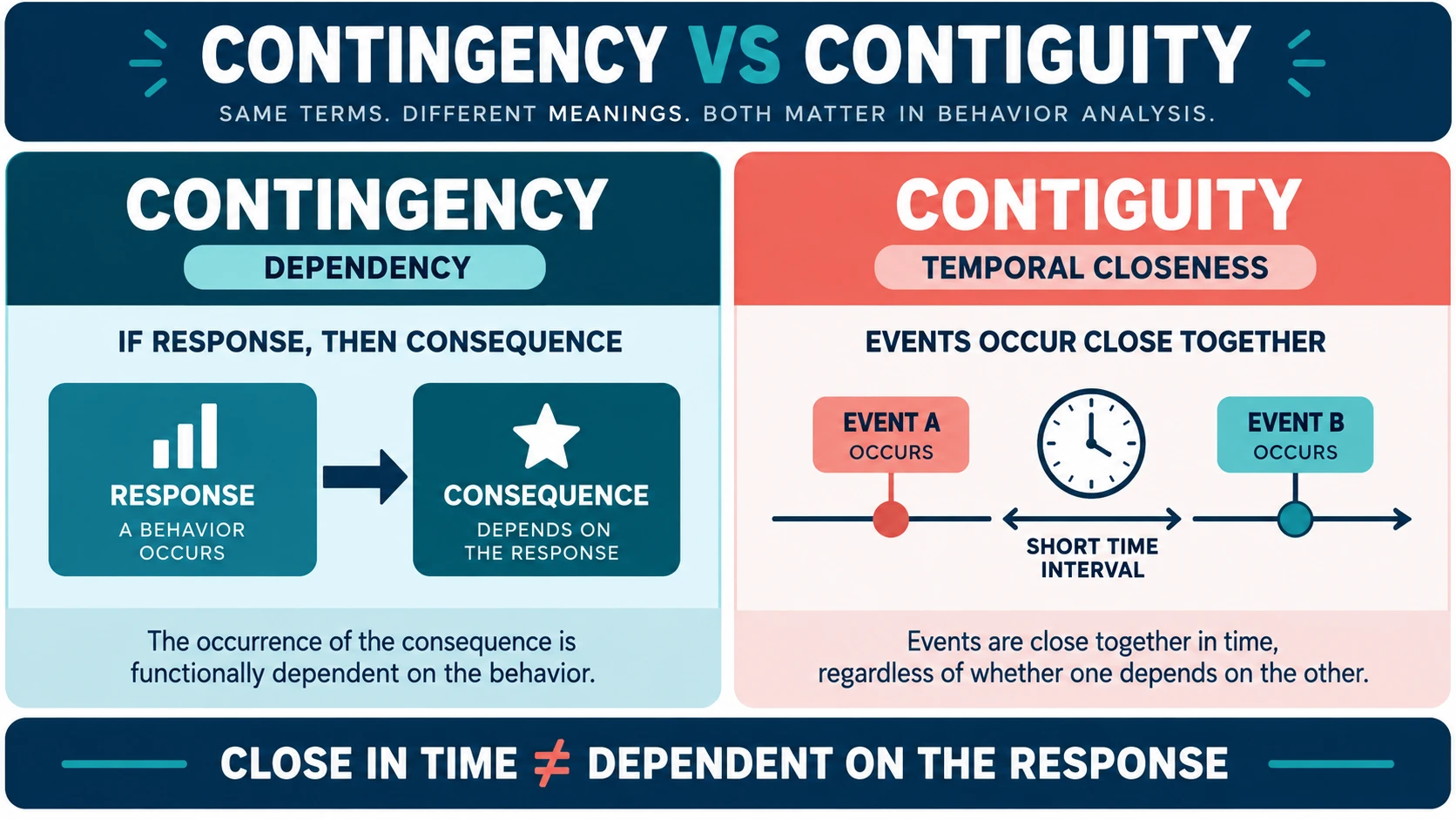
Contiguity refers to temporal or spatial closeness. A consequence may occur immediately after a behavior, which makes the events contiguous, without being dependent on that behavior. For example, a bell may ring immediately after a learner stands up because the schedule happened to reach the end of the period. The bell is close in time, but standing up may not have produced it.
Contingency asks a different question: would the consequence have occurred if the response had not happened, or does the response alter the probability that it occurs? If a teacher gives a break only after a student completes a communication response, the break may be contingent on that response. If the teacher gives the break to everyone at the same scheduled time, its delivery may be time-based rather than response-dependent, even if a response happened just before it.
Exam questions often make the distinction harder by placing events close together. Mark the temporal fact first, then inspect the dependency. Do not infer contingency from immediacy alone, and do not infer reinforcement from contingency alone.
Classify Direct-Acting and Rule-Governed Control
A direct-acting contingency changes the environment in a way the person contacts through their own behavior. The outcome is available through the response and its immediate consequences. A rule can describe the same relation in words, but rule-governed behavior is controlled in part by verbal statements about what will happen rather than only by direct contact with the consequence.
Suppose a learner presses a button and the light turns on. That is a direct environmental outcome if the button press produces the light. Now suppose an instructor says, “If you finish the puzzle, you can play outside,” and the learner completes the puzzle before receiving the activity. The statement may guide behavior as a rule, while the actual activity may still function as a consequence. The question is asking what controls the response at the moment, not whether language appears anywhere in the situation.
| Scenario clue | Likely classification question | Avoid this shortcut |
|---|---|---|
| The response immediately produces a change in the physical or social environment. | Is the consequence directly contacted through the response? | Calling every immediate outcome a reinforcer. |
| A statement describes what will happen if the person responds. | Is behavior being guided by the rule, by direct contact, or by both? | Assuming that a verbal instruction proves the consequence is effective. |
| The outcome is delayed or depends on another person’s later decision. | What event actually mediates the consequence and when is it contacted? | Treating a promised outcome as if it were already observed. |
Do Not Call a Consequence Reinforcement Yet
Reinforcement is defined by its effect on future behavior. A consequence is not a reinforcer merely because it is desirable to the observer, delivered after a response, or described in a token board. If the response becomes more likely under relevant conditions, the consequence may be functioning as reinforcement. If responding decreases, the operation may be punishment. If responding does not change, the consequence may not have the intended effect.
Positive and negative describe whether a stimulus is added or removed, not whether the procedure is good or bad. Positive reinforcement adds a stimulus and increases behavior. Negative reinforcement removes a stimulus and increases behavior. Positive punishment adds a stimulus and decreases behavior. Negative punishment removes a stimulus and decreases behavior. Always inspect both the operation and the observed effect.
- Arrangement: What consequence was scheduled or delivered after the response?
- Operation: Was a stimulus presented or removed?
- Effect: Did the target response increase, decrease, or remain unchanged across comparable opportunities?
- Evidence: Was the change measured well enough to support the label?
Check Automatic and Socially Mediated Contingencies
Another classification asks whether the relevant consequence is produced through the person’s own interaction with the environment or through another person’s behavior. In an automatic contingency, the consequence is produced by the response without a socially mediated delivery being necessary. In a socially mediated contingency, another person’s action, attention, access, escape, or other response is part of the consequence arrangement.
Do not classify from the topography alone. The same form of behavior can contact different consequences in different contexts. A person may tap a surface to produce sensory stimulation in one situation, and tap a desk to obtain attention in another. Identify the consequence and the mediating event before labeling the contingency.
The current BCBA outline treats automatic and socially mediated contingencies as concepts to distinguish, while descriptive data and assessment evidence help determine what is actually occurring in a case. Related study pages on the site cover the three-term contingency, direct-acting contingencies, and automatic versus socially mediated contingencies. Use those pages for neighboring concepts without collapsing their reader tasks into this definition-and-classification workflow.
Use a Five-Step Classification Workflow
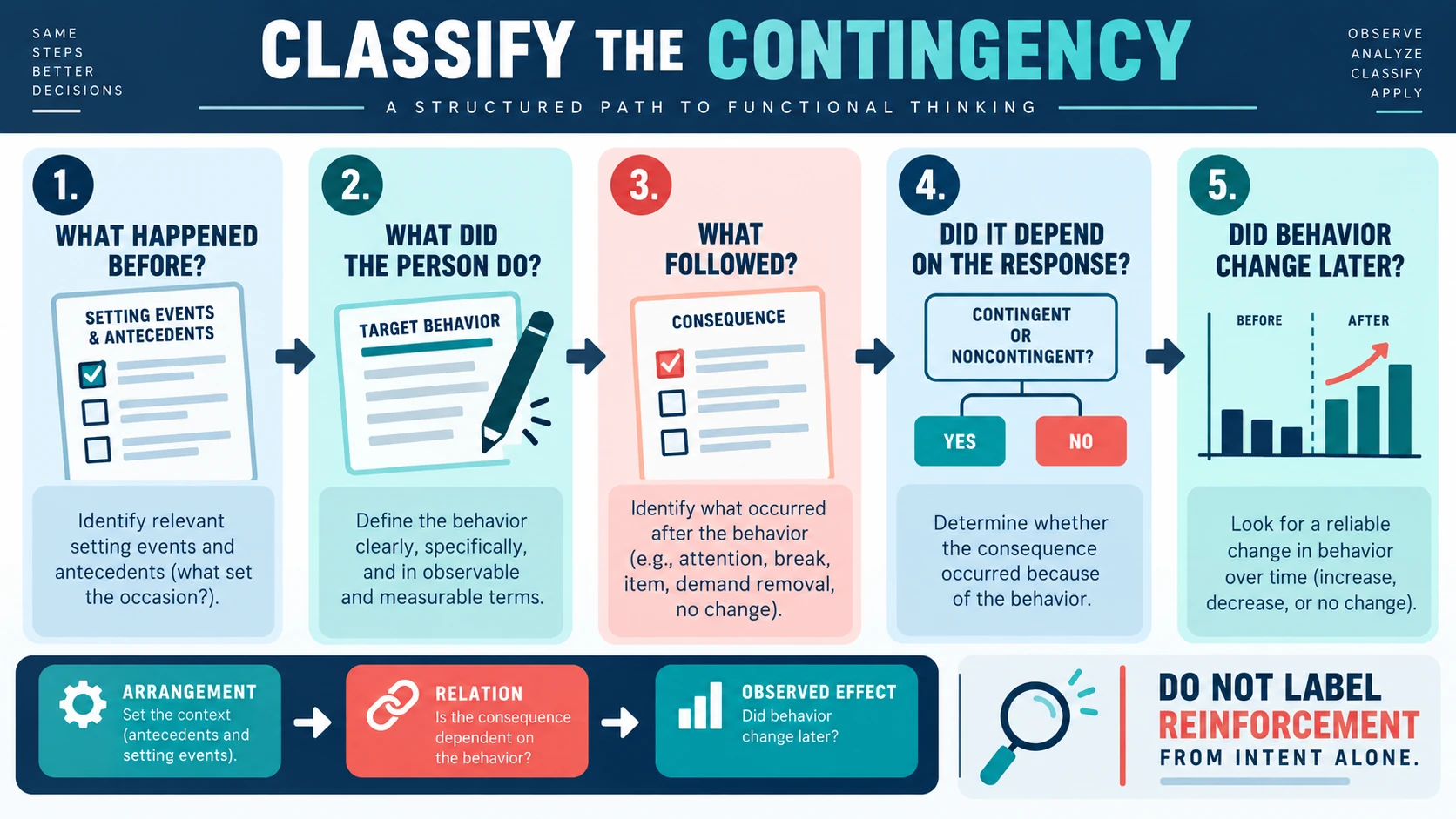
When a question gives you a long scenario, use the same order every time. This prevents a familiar label from taking over before the events have been identified.
- Locate the context: identify setting events, motivating conditions, instructions, transitions, or other antecedent events that set the occasion.
- Define the response: state exactly what the person did in observable terms. Ignore the story’s interpretation until the response is clear.
- Describe what followed: record the immediate environmental change, including what another person did or did not do.
- Test dependency: ask whether that outcome depended on the response, or whether it was scheduled, accidental, or available independently.
- Check the later effect: determine whether comparable responding increased, decreased, or did not change before naming reinforcement or punishment.
This workflow also helps with “best answer” questions. If the prompt asks for the contingency, answer with the event relation. If it asks for contiguity, answer with temporal closeness. If it asks for reinforcement, look for a measured change in future behavior. If it asks for function, do not treat a single descriptive sequence as experimental proof.
Work Through Three Exam-Style Examples
Example 1: A break after a response A student is shown a difficult task. The student hands over a break card, and the teacher removes the task for two minutes. The contingency question is whether the break was delivered because the card response occurred. If the student later uses the card more often under similar task conditions, the consequence may be functioning as reinforcement. The immediate delivery alone establishes neither reinforcement nor an escape function. Example 2: A reward that was already scheduled
A group receives computer time at 3:00 p.m. One student begins humming at 2:59 p.m., and computer time starts at 3:00 p.m. The events are close in time, but the scheduled time—not humming—may control delivery. The correct analysis should not call computer access contingent on humming unless the scenario says access depended on that response. Example 3: A rule and direct contact
An instructor says, “Touch the blue card and the music will start.” The learner touches the card, and the device starts the music. The rule may evoke the response, while the response also directly produces the programmed outcome. If the question asks what is rule-governed, focus on control by the verbal statement; if it asks what consequence followed, identify music access. Keep the question’s unit of analysis in view. In each example, separate the arrangement from the effect. The learner’s preference, the instructor’s intention, or the fact that an outcome looks rewarding cannot replace evidence about dependency and future responding.
Keep Descriptive Patterns Separate From Function
An ABC record, interview, or naturalistic observation can reveal a recurring pattern. That pattern may guide a hypothesis and help the team decide what to measure next. It does not establish a functional relation by itself because the observer did not necessarily manipulate the relevant variables and rule out alternatives.
Prefer a report such as, “In 5 of 7 observations, the demand was followed by material pushing and the task was paused within 10 seconds.” Avoid writing, “Material pushing is maintained by escape,” unless the appropriate assessment supports that conclusion. The first statement preserves the sample; the second adds a causal claim.
This distinction is also useful when reading intervention results. If a new contingency is arranged and behavior changes, examine the design, measurement, procedural integrity, and alternative explanations before claiming a functional relation. In practice, a qualified behavior analyst should connect the evidence to client priorities, safety, consent, and the least intrusive effective plan.
Common Mistakes With Contingencies
- Confusing close with dependent: treating temporal contiguity as proof that the response produced the consequence.
- Confusing contingency with reinforcement: assuming every response-dependent outcome increases behavior.
- Using “positive” as “good”: forgetting that positive means added and negative means removed.
- Using function labels as observations: writing “attention” or “escape” where the form should describe what the other person did.
- Ignoring the later effect: calling a consequence a reinforcer without checking future responding.
- Classifying by topography: assuming the same form of behavior has the same contingency in every setting.
- Overlooking scheduled events: labeling a response as effective when access was already time-based or freely available.
- Overclaiming from descriptive data: treating an ABC pattern as experimental evidence.
Frequently Asked Questions
What is the simplest contingencies ABA definition?: A contingency is a relation in which the occurrence or value of one event depends on another event, often a response. In an ABA scenario, identify the response, the consequence, and whether the consequence would have occurred without that response.
Is a consequence contingent just because it happens after behavior?: No. Happening after behavior establishes temporal order and perhaps contiguity, but contingency requires a dependency. A scheduled event can follow behavior by coincidence without being response-dependent. Does a contingency automatically mean reinforcement?: No. Reinforcement requires an increase in future behavior. A response-dependent consequence may have no measurable effect, may decrease responding, or may function differently than intended.
How should I answer a contingency question on the BCBA exam?: Underline the question’s target: dependency, temporal proximity, operation, future effect, or function. Then state the observable relation and avoid adding a causal or functional label that the scenario does not support.
Bottom line: the best contingencies ABA definition keeps the arrangement, the timing, and the behavioral effect distinct. Find the A-B-C sequence, test whether the consequence depended on the response, and check what happened to future behavior before calling the relation reinforcement or punishment. For a separate exam checkpoint, use our contingencies ABA definition study companion and Take the Free BCBA Mock Exam. It is a practice resource, not an official BACB product.
Sources
- BACB BCBA Test Content Outline (6th ed.)
- APA Dictionary of Psychology: contingency
- Conceptual discussion of contingency and response-dependent relations
- Related guide: reinforcement contingencies in ABA



