
A response-count-versus-time guide for identifying VR and VI schedules on BCBA exam questions. If you are studying the difference between variable ratio and variable interval reinforcement, start with one question: what changes before reinforcement becomes available—the number of responses or the amount of time? A variable ratio (VR) schedule changes the response count. A variable interval (VI) schedule changes the time interval. Both are variable, but they are not interchangeable.
Table of Contents
- What is the difference between variable ratio and variable interval?
- Use the two-axis rule: ratio versus interval, fixed versus variable
- Variable ratio: the number of responses changes
- Variable interval: the amount of time changes
- VR versus VI: side-by-side exam comparison
- What response patterns should you expect?
- A four-step method for BCBA exam vignettes
- Common traps in the difference between variable ratio and variable interval
- How to use VR and VI knowledge responsibly
- Turn the distinction into exam practice
- Difference between variable ratio and variable interval FAQ
- The bottom line
- Sources to study and recheck
- Quick Review Checklist
- Take the Free BCBA Mock Exam
This comparison page has one job: help you classify a vignette quickly, explain why the answer is VR or VI, and avoid claiming that a typical response pattern is a guaranteed outcome. For a broad review of all four simple schedules, use the site’s simple-versus-compound schedules guide. Here we stay focused on the response-count-versus-time distinction.
What is the difference between variable ratio and variable interval?
The defining difference is the dimension that controls access to reinforcement. In a variable ratio schedule, reinforcement follows an unpredictable number of responses that averages to a stated value. In a variable interval schedule, the first qualifying response after an unpredictable amount of time has elapsed produces reinforcement. In shorthand: VR = changing response count; VI = changing elapsed time.
| Question to ask | Variable ratio (VR) | Variable interval (VI) |
|---|---|---|
| What dimension changes? | The number of responses required. | The amount of time that must pass. |
| What does the average describe? | An average response count, such as VR 5. | An average interval, such as VI 30 seconds. |
| What must happen after the requirement? | The response requirement is met, then the consequence is delivered. | The interval elapses, then the first qualifying response is reinforced. |
| Fast exam cue | Count the responses. | Look for the clock. |
Use the two-axis rule: ratio versus interval, fixed versus variable
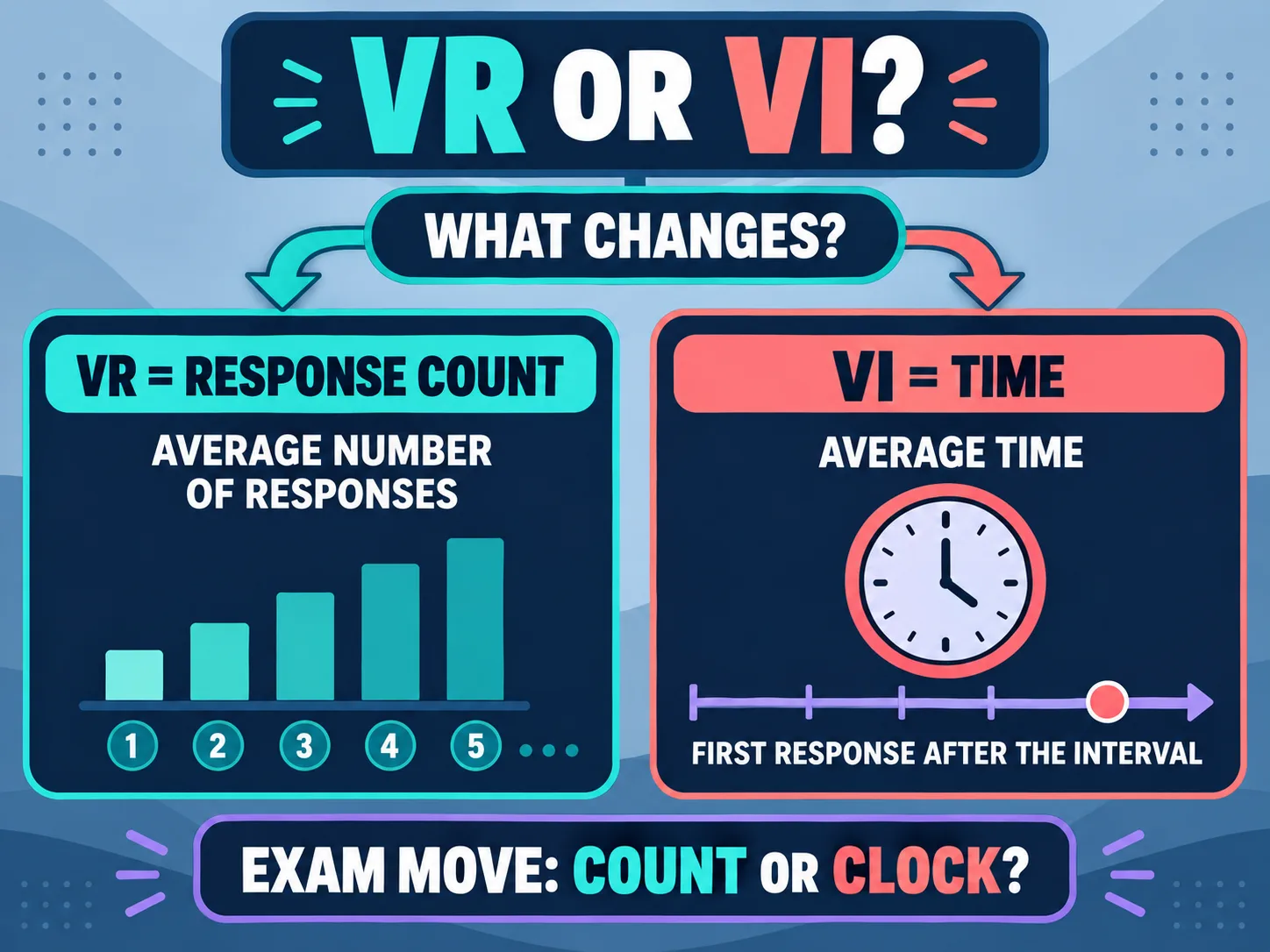
Many exam errors happen because learners treat “variable” as the whole answer. It is only one axis. The first axis asks whether reinforcement depends on responses or time. The second asks whether that requirement is predictable or changes around an average. Ratio and interval identify the dimension; fixed and variable identify its predictability.
Apply the axes in that order. If the stem says “after an average of five correct responses,” you are in the ratio column and the changing requirement points to VR. If it says “after an average of 30 seconds, the first response is reinforced,” you are in the interval column and the changing time points to VI. Do not let a clock example become VR simply because the responses are frequent.
Variable ratio: the number of responses changes
A variable ratio schedule reinforces behavior after a changing number of responses around an average. A label such as VR 5 does not mean that every fifth response is reinforced. It means the schedule is arranged around an average of five responses, while the exact response count varies and is not predictable to the learner.
Imagine a learner earns a token after an average of five completed items, but the actual requirements across opportunities are 3, 7, 4, and 6. The relevant variable is the count of completed responses. Time may pass while the learner works, but elapsed time is not the rule that determines when the token becomes available. The key question is, “How many responses occurred before the requirement was met?”
On a BCBA question, words such as responses, attempts, completed tasks, or correct answers often point toward a ratio schedule. Still, read the entire contingency. A varying number of responses can be a different schedule if the stem describes a compound arrangement or a separate time-based component.
Variable interval: the amount of time changes
A variable interval schedule makes reinforcement available after an unpredictable interval that averages to a stated value. The first qualifying response after that interval has elapsed produces reinforcement. A label such as VI 30 seconds describes an average interval, not a promise that reinforcement occurs exactly every 30 seconds.
For example, suppose a learner is working quietly and a check-in becomes available after changing time periods that average 30 seconds. The learner must emit the relevant response after the interval has elapsed. The schedule is organized by time, not by whether the learner has made three, five, or ten responses. If no qualifying response occurs after the interval, the opportunity waits for the next qualifying response rather than converting into a response-count requirement.
Words such as seconds, minutes, after a changing amount of time, or first response after the interval point toward VI. The phrase “first response” matters: the interval opens an opportunity, but a response is still required for the consequence in a standard interval schedule.
VR versus VI: side-by-side exam comparison
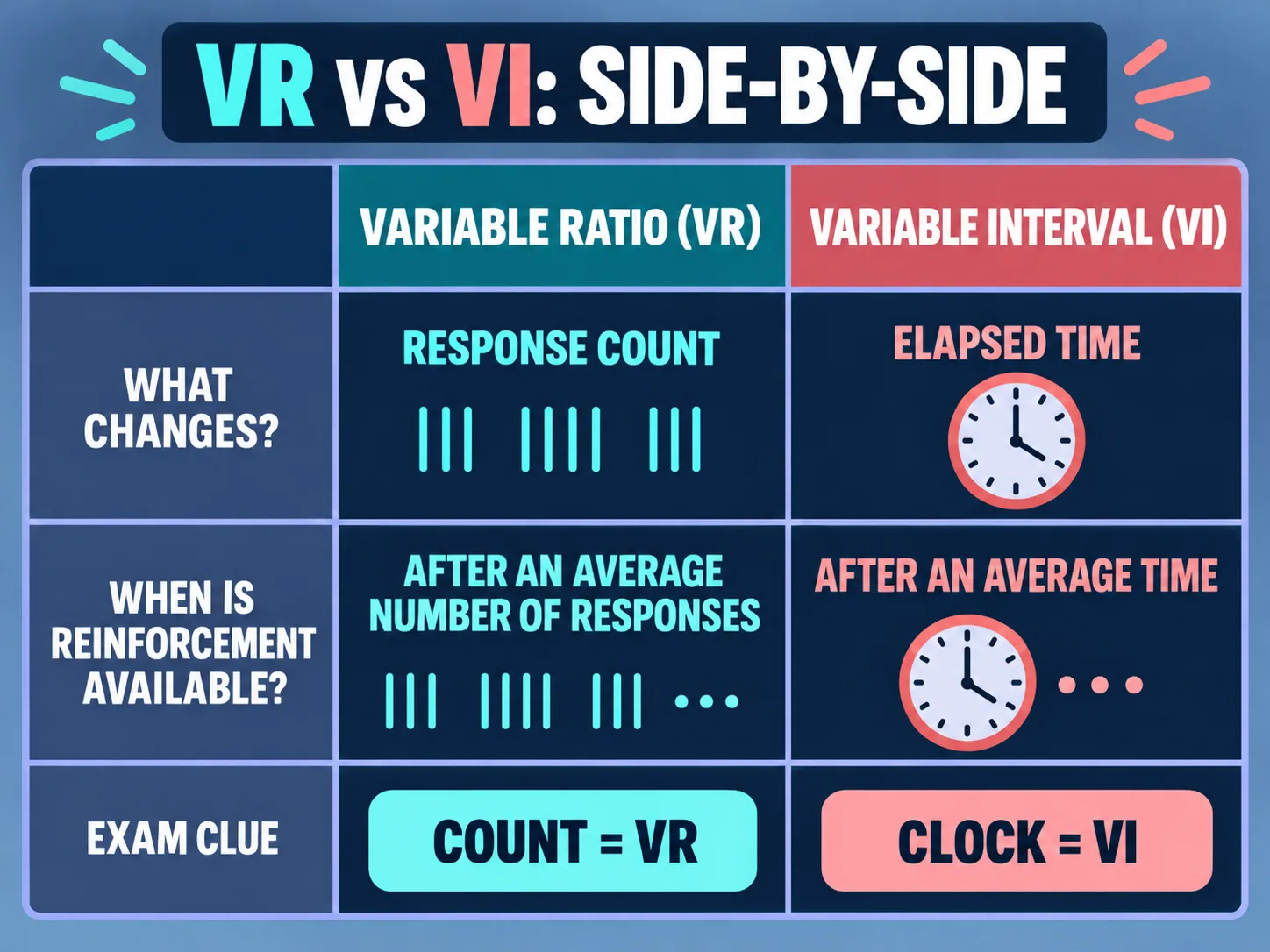
The visual below compresses the distinction into a table. Use it after reading the stem, not before. The goal is to identify the actual contingency rather than match a familiar example by memory.
| If the stem says… | Classify it as… | Why |
|---|---|---|
| After an average of six correct responses, a token is delivered. | VR | The changing requirement is a response count. |
| After an average of 45 seconds, the first correct response earns a token. | VI | The changing requirement is elapsed time, followed by a response. |
| A reward follows every fifth response. | FR, not VR | The response count is predictable rather than variable. |
| The first response after exactly two minutes is reinforced. | FI, not VI | The time requirement is predictable rather than variable. |
What response patterns should you expect?
In classic schedule descriptions, VR commonly produces a relatively high and steady response rate because each additional response can help bring the changing response requirement closer to completion. VI commonly produces a steadier, lower-to-moderate rate because responding faster does not make the interval pass faster. Research comparing variable-ratio and variable-interval performance has examined these response-rate and interresponse-time differences, including in primary schedule research.
Use these patterns as supporting clues, not as the definition. Schedule density, reinforcer quality, response effort, prior learning, and the exact arrangement can change observed performance. If a question explicitly gives the contingency, classify the schedule from the rule before using a typical graph pattern as confirmation.
| Exam step | VR reasoning | VI reasoning |
|---|---|---|
| 1. Find the requirement. | Count responses or completed units. | Measure the interval before a response can produce reinforcement. |
| 2. Check predictability. | The count changes around an average. | The interval changes around an average. |
| 3. Use the pattern cautiously. | Often higher and steadier responding. | Often steadier responding at a lower rate. |
A four-step method for BCBA exam vignettes
- Circle the unit: mark every mention of responses, attempts, correct items, seconds, or minutes.
- Ask what must change: if the number changes, start with ratio; if the time changes, start with interval.
- Ask whether it is predictable: fixed means the requirement is specified; variable means it changes around an average.
- Read the consequence rule: for VI, confirm that the first qualifying response after the interval is reinforced; for VR, confirm that the response count controls access.
The current BACB BCBA Test Content Outline identifies distinguishing simple schedules of reinforcement as task B.9. That is why a good study answer explains the controlling dimension instead of merely naming a familiar example.
Common traps in the difference between variable ratio and variable interval
Trap 1: “Variable” means VR. No. Variable describes predictability; ratio versus interval identifies whether the requirement is responses or time. Trap 2: a clock appears, so the answer must be VI. A clock can be background context. Confirm that elapsed time is actually the programmed requirement. Trap 3: “first response” means ratio. Interval schedules also require a response; the interval determines when the opportunity opens. Trap 4: a common example is the definition. A gambling-style example may suggest VR, but the exact contingency in the stem controls the answer. Trap 5: a typical response rate proves the schedule. It does not; classify the programmed rule first.
How to use VR and VI knowledge responsibly
For study, use the distinction to describe a contingency and interpret data. In practice, a BCBA should not select a schedule from a memorized “best schedule” list without considering the learner, target response, reinforcer, treatment goals, safety, and relevant assessment data. A schedule may also be part of a larger intervention or compound arrangement. Follow the current BACB requirements, supervision, documentation, and individualized decision-making boundaries. For a deeper schedule overview, you can review the site’s variable-ratio guide and reinforcement in ABA guide. Those pages are internal supporting resources; this page should remain the comparison destination for the VR-versus-VI query.
Turn the distinction into exam practice
After learning the difference between variable ratio and variable interval, complete a short practice set and write the reason for every answer in one sentence: “The requirement is a changing response count, so VR,” or “The requirement is a changing time interval followed by a qualifying response, so VI.” If you miss a question, label the error as unit, predictability, consequence rule, or pattern overreach. That error label tells you what to review next.
Use the Free BCBA Mock Exam to test the distinction in changing vignettes. It is a study tool, not an official BACB result. Review the rationale and ask whether you correctly identified the unit, the fixed-versus-variable axis, and the response required after the schedule requirement.
Difference between variable ratio and variable interval FAQ
What is the fastest way to tell VR from VI?: Ask whether reinforcement is organized by a changing number of responses or by a changing amount of time. Count points to VR; a clock points to VI.
Is VR always higher than VI?: Not as an absolute rule. VR often produces higher response rates in classic comparisons, but the observed pattern depends on schedule density, response effort, reinforcer value, history, and the complete arrangement. The contingency rule is the primary classification evidence.
Does VI reinforce the first response after time passes?: Yes, in the standard simple-schedule description, the interval must elapse and the first qualifying response afterward contacts reinforcement. Time opens the opportunity; the response completes the contingency.
What is the difference between VR and FR?: Both are ratio schedules based on response count. FR uses a predictable count, such as every fifth response. VR uses a changing count around an average, such as an average of five responses.
What is the difference between VI and FI?: Both are interval schedules based on elapsed time. FI uses a predictable interval, such as exactly two minutes. VI uses changing intervals around an average, such as an average of 30 seconds.
The bottom line
When comparing variable ratio and variable interval reinforcement, separate the two axes: ratio means responses, interval means time; variable means the requirement changes around an average. Classify the programmed contingency first, use response patterns only as supporting evidence, and explain the answer in the language of the stem. That method is faster, more accurate, and less vulnerable to the common VR-versus-VI exam traps.
Sources to study and recheck
- BACB BCBA Test Content Outline, 6th edition
- Interresponse time structures in variable-ratio and variable-interval schedules
- Explaining performance on interval and ratio schedules with a molar view of behavior
- OpenStax Psychology 2e: Operant Conditioning
- BACB task-list and test-content-outline index
For targeted review, use our difference between variable ratio and variable interval practice questions to apply the concept in exam-style scenarios.
Quick Review Checklist
Use this final checklist to turn difference between variable ratio and variable interval into exam-ready reasoning. The goal is not to memorize a label in isolation; it is to identify the relevant evidence and explain why the best answer fits the scenario. Key ideas to review:
- State the central definition or decision point for difference between variable ratio and variable interval in your own words.
- Identify the detail that makes difference between variable ratio and variable interval different from its closest related ABA term.
- Separate the observable facts in a scenario from assumptions that are not supported by the facts.
- Write one example and one nonexample so you can recognize the concept in a new setting.
Exam application checks:
- Ask what the question is actually requesting before comparing the answer choices.
- Mark the antecedent, response, consequence, or other evidence that supports the selected answer.
- Look for a distractor that describes a related process but does not answer the specific question.
Final self-check:
- Explain how you would verify the interpretation with clear observations or data.
- Change one detail in the scenario and decide whether your answer should change.
- Give a one-sentence rationale that a supervisor or study partner could evaluate.
Take the Free BCBA Mock Exam
A useful next step is to apply this idea in a fresh set of BCBA-style practice questions and review the feedback. Take the Free BCBA Mock Exam



