
Full session DRL ABA refers to a differential-reinforcement-of-low-rates arrangement in which reinforcement depends on the total number of target responses during an entire session. The goal is usually to reduce a behavior to a more appropriate rate, not automatically to eliminate it.
Table of Contents
- What Is Full-Session DRL in ABA?
- When Is Full-Session DRL a Good Fit?
- Full-Session vs. Interval vs. Spaced-Responding DRL
- How to Implement Full-Session DRL
- How to Read Full-Session DRL Data
- BCBA Exam Traps and Common Errors
- Full session DRL ABA FAQ
- Take the Free BCBA Mock Exam
Full-session DRL is a schedule, not a complete treatment plan. A BCBA still needs an operational definition, baseline data, a meaningful criterion, a reinforcer, a safety review, and a plan for teaching or preserving appropriate alternative behavior. The procedure may be useful for behaviors that are acceptable at a lower rate, but it can be a poor fit when every occurrence is dangerous or when the learner needs immediate feedback. Table of Contents
What Is Full-Session DRL in ABA?
Differential reinforcement of low rates, or DRL, provides reinforcement when a target response occurs below a specified rate or frequency. In the full-session arrangement, the criterion applies to the entire observation period. The learner receives the reinforcer at the end of the session if the total count is at or below the stated limit.
Suppose a learner asks a teacher for help 12 times during a 45-minute class. If the initial full-session DRL criterion is no more than 10 requests, the learner may earn the programmed reinforcer at the end of class when the total is 10 or fewer. The exact timing of the requests does not determine whether the criterion is met; the session total does.
This is different from reinforcing “no behavior” for an interval. DRL is designed for a response that may remain appropriate at a lower frequency. For example, asking a teacher for help, making comments, or requesting attention may be useful behaviors that occur too often in a particular context. The BCBA should not use DRL simply because a behavior is inconvenient.
When Is Full-Session DRL a Good Fit?
Selection begins with function and social validity. Review why the behavior occurs, what outcome it produces, and whether reducing—not eliminating—the response is genuinely meaningful to the learner and stakeholders. The research literature describes full-session DRL across different behaviors and settings, but a study result is not a universal prescription. Full-session DRL may be considered when:
- The behavior is acceptable or useful at a lower rate.
- The team can measure the total number of responses accurately.
- The learner can reasonably wait until the end of the session for the programmed reinforcer.
- The criterion can be set from baseline rather than chosen arbitrarily.
- Reducing the behavior will not remove an important communication response.
- The team has a plan to reinforce appropriate alternatives and monitor side effects.
It may be inappropriate when every occurrence creates immediate danger, when the behavior signals an urgent medical or emotional need, when delay to reinforcement will produce repeated failure, or when the target should be replaced rather than merely reduced. For those situations, the team may need functional communication training, antecedent support, a different differential-reinforcement arrangement, or a safety procedure under qualified supervision.
Ethics matter here. The BACB Ethics Code requires behavior analysts to provide effective treatment, minimize risk, involve clients and stakeholders, collect and use data, and continually evaluate behavior-change interventions. A full-session DRL schedule should be revised or stopped if it increases distress, suppresses needed communication, creates unsafe delay, or fails to improve meaningful participation.
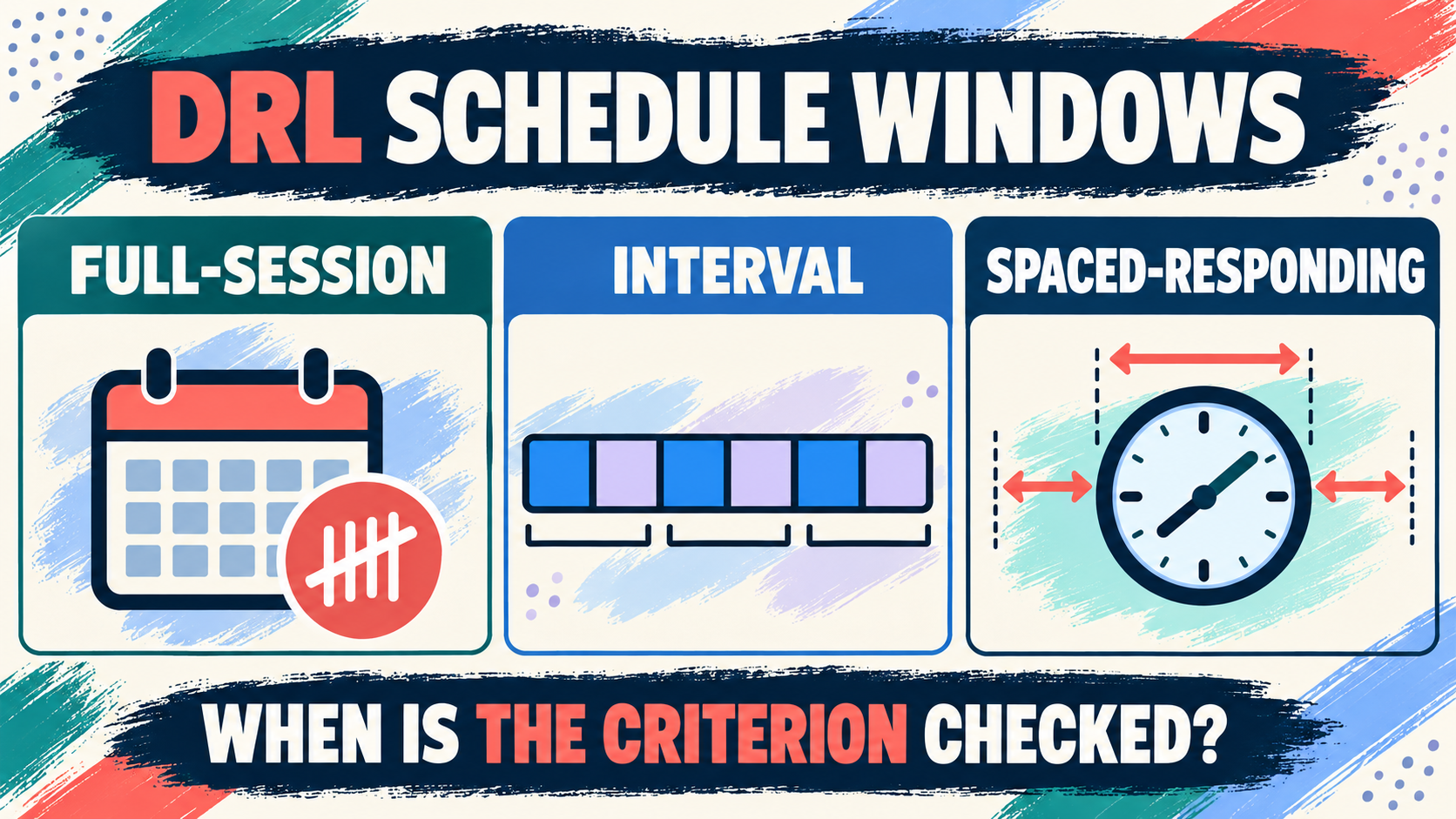
Full-Session vs. Interval vs. Spaced-Responding DRL
Many exam questions turn on the measurement window. Ask when the criterion is checked and when reinforcement is delivered.
| DRL arrangement | Criterion | When reinforcement is available | Key question |
|---|---|---|---|
| Full-session DRL | Total responses at or below a limit across the whole session. | Usually at the end of the session. | Did the session total meet the criterion? |
| Interval DRL | Responses stay below a limit within each interval. | At the end of each interval that meets the criterion. | Did each interval stay below its limit? |
| Spaced-responding DRL | A minimum time must pass between responses. | For a response that occurs after the required interresponse time. | Was the time since the last response long enough? |
A learner could meet a full-session criterion with several responses close together and then long periods with no responses. That pattern might be acceptable for one target and problematic for another. If the timing matters, full-session DRL may not capture the clinical question; consider interval or spaced-responding DRL instead.
How to Implement Full-Session DRL
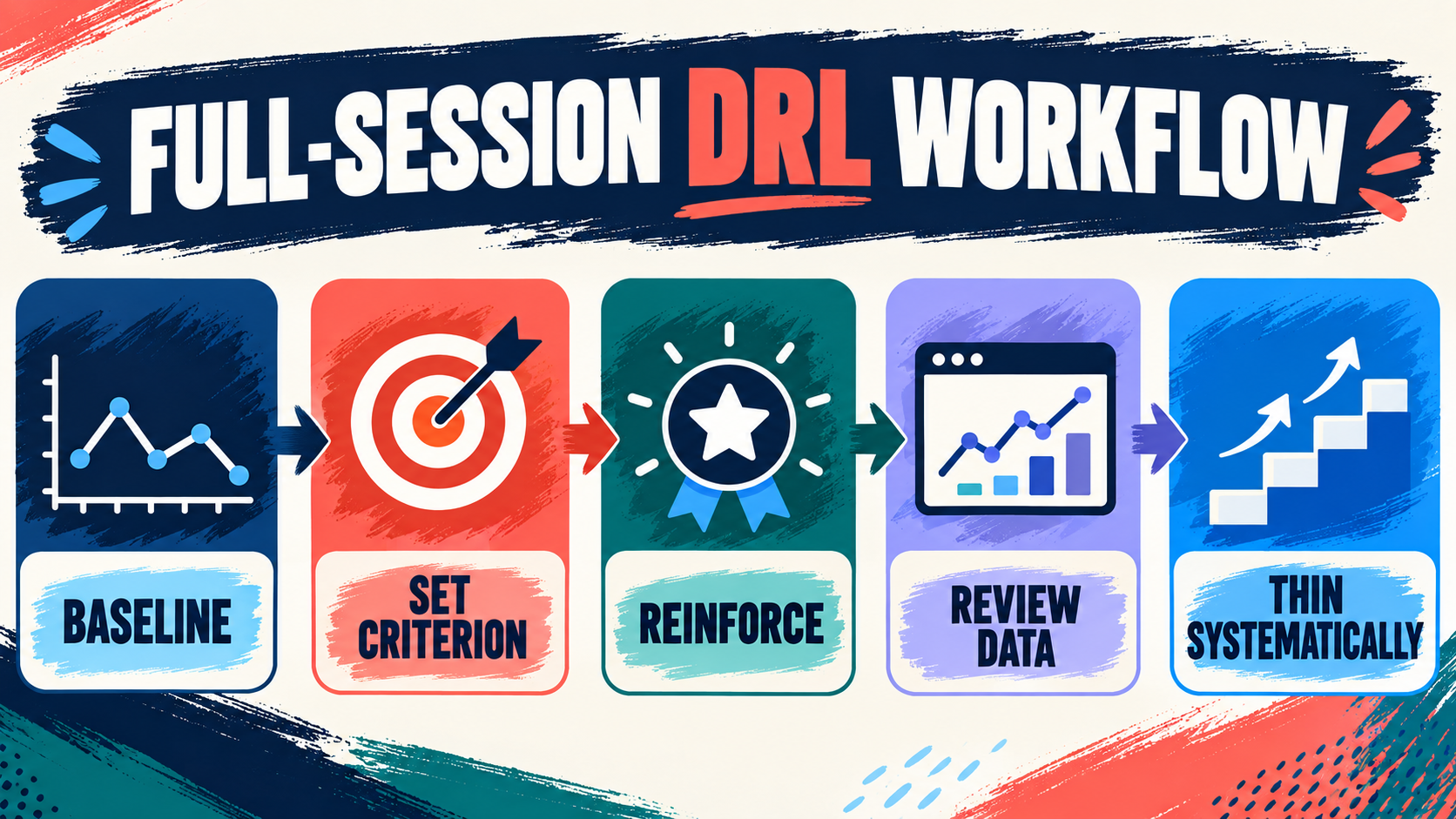
The following sequence describes the logic of a supervised program. It is not a stand-alone protocol for a real client.
- Define the response: State exactly what counts and what does not count. Decide how staff will record repeated or ambiguous events.
- Collect baseline: Measure the total number of responses across comparable sessions. Note session length, opportunities, setting events, and relevant consequences.
- Confirm the goal: Verify that a lower rate is socially meaningful and that the target should not instead be replaced, blocked for safety, or taught through communication training.
- Set the initial criterion: Use baseline data and choose a limit the learner can reasonably contact. A criterion that is impossibly low creates repeated failure and weakens the schedule.
- Specify the reinforcer: Define what is delivered, when, by whom, and how the learner knows the contingency. Confirm that it is actually valuable.
- Explain the contingency: Use language or visual supports the learner understands. Pair the schedule with teaching and prompting if the learner needs another way to respond.
- Review and thin: When performance is stable, change the criterion gradually and continue checking generalization, side effects, and stakeholder acceptability.
Baseline should not be treated as a single number pulled from one unusual day. If session length changes, the raw count may not be comparable. The team may need to standardize the observation period, interpret rate, or examine opportunities before setting the criterion.
Worked example: reducing repeated help requests: Assume a fictional learner asks for help during independent work. Baseline totals across five comparable 40-minute sessions are 14, 12, 16, 13, and 15 requests. The team’s goal is not to eliminate help-seeking; it is to reduce repeated requests while preserving access to support. An initial criterion of no more than 13 requests may be more realistic than a sudden limit of two.
During intervention, the learner records 12, 11, 13, 10, and 9 requests. The team should still ask whether the learner completed work, used a taught “help” card, waited appropriately, and experienced an increase in errors or distress. If the count falls because the learner stops asking for needed help, the data do not support a simple success claim. The plan may need a better replacement response or a different schedule.
How to Read Full-Session DRL Data
Graph the total number of target responses per session and keep the session duration and measurement conditions visible. A useful review includes level, trend, variability, criterion changes, and the learner’s access to replacement behavior. Mark phase lines when the schedule or criterion changes.
- Level: Are totals generally below the criterion?
- Trend: Are totals decreasing, stable, or increasing over time?
- Variability: Are a few successful sessions hiding frequent failures?
- Context: Does the pattern hold across settings and people?
- Side effects: Did errors, frustration, escape, or unsafe behavior increase?
- Replacement: Is the learner using a functional alternative rather than simply suppressing a response?
One study of a full-session DRL procedure for excessive questions reported reduced questions and increased task engagement for one participant, illustrating why outcome measurement should include more than the target count. Another JABA study examined requests for teacher attention and noted the distinction between reducing a rate and eliminating a response. These are evidence examples, not guarantees for a different learner or setting.
BCBA Exam Traps and Common Errors
Full-session DRL questions are often written to test schedule discrimination rather than memorization. Watch for these traps:
- Confusing DRL with DRO: DRL permits the behavior below a criterion; DRO reinforces the absence of the target during a defined interval.
- Confusing full-session with interval DRL: Full-session uses one total for the entire session; interval DRL checks each interval.
- Choosing DRL for dangerous behavior: If every occurrence is unsafe, reducing the rate may be insufficient.
- Ignoring function: A lower count is not enough if the response is an important communication attempt.
- Setting a criterion without baseline: The limit should be data-based and attainable, then adjusted systematically.
- Measuring only suppression: Track engagement, errors, replacement behavior, generalization, and acceptability too.
The best answer usually identifies the schedule by its measurement window and then selects the least intrusive, function-consistent option that meets the client’s needs. If the question emphasizes the time between responses, think spaced-responding. If it emphasizes each segment of a session, think interval DRL. If it emphasizes the total count by the end of the session, think full-session DRL.
Full session DRL ABA FAQ
What does full-session DRL mean in ABA?: It means reinforcement is available when the target behavior occurs no more than a specified number of times during the entire session, usually delivered after the session ends.
Does full-session DRL eliminate a behavior?: Not necessarily. DRL is designed to reduce a response to a lower rate. If elimination or an immediate safety response is required, another function-based plan may be more appropriate. What is the difference between full-session and interval DRL?: Full-session DRL evaluates the total response count across the whole session. Interval DRL evaluates whether the count stays below a limit in each separate interval.
How is the DRL criterion selected?: Use comparable baseline data, the learner’s needs, the social significance of the target rate, and the feasibility of contacting reinforcement. The criterion should be reviewed and adjusted from data, not chosen as an arbitrary punishment.
Where can I practice full-session DRL questions?: Use the free full session DRL ABA BCBA mock exam practice to practice distinguishing full-session DRL from interval, spaced-responding, DRO, and other differential-reinforcement arrangements. It is independent study support, not official BACB material.
Full-session DRL is easiest to remember as a question about the window: count the target across the entire session, compare the total with the criterion, and reinforce if the total is low enough. Good practice adds the necessary context—function, safety, replacement skills, baseline, dignity, and data-based revision—so the schedule is used for a meaningful clinical purpose rather than as a shortcut.
Take the Free BCBA Mock Exam
If you want a low-pressure way to check your recall, use the free practice resource below. Take the Free BCBA Mock Exam



