
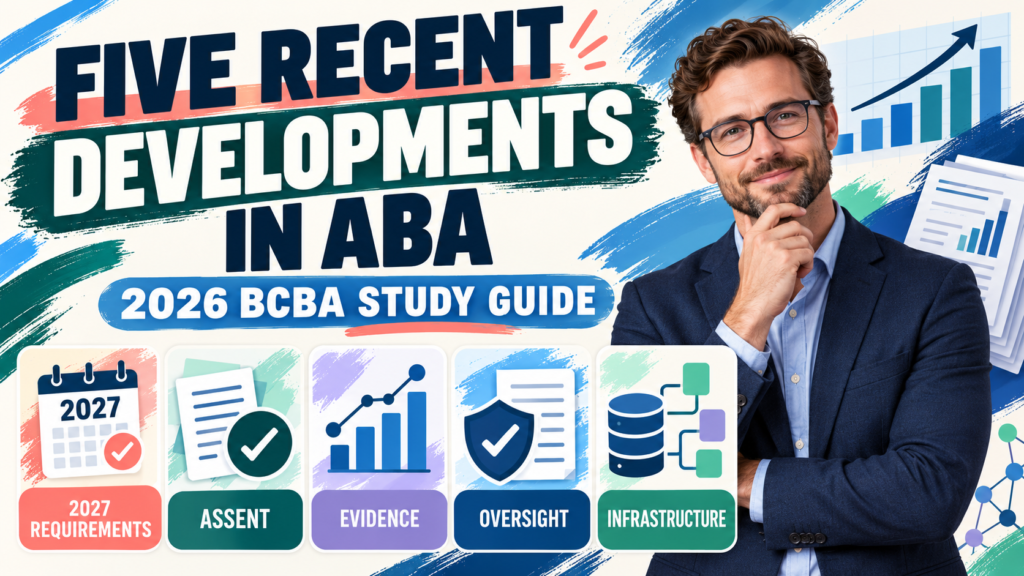
Five recent developments in ABA are especially useful for BCBA candidates to track in 2026: the 2027 certification transition, community-informed and assent-based practice, stronger evidence-based decision frameworks, expanded oversight of Medicaid-funded services, and a more organized professional and research infrastructure. These developments do not replace the foundations of behavior analysis. They show how measurement, ethics, training, and social validity are being applied to a changing field.
Table of Contents
- Why Do Recent Developments in ABA Matter?
- 1. The 2027 BCBA and BCaBA Requirements Transition
- 2. Community-Informed and Assent-Based Practice
- 3. Evidence-Based Practice as a Decision Framework
- 4. Stronger Quality and Oversight Expectations
- 5. A More Mature Professional and Research Infrastructure
- How Should BCBA Candidates Study These Developments?
- Five Recent Developments in ABA FAQ
- Take the Free BCBA Mock Exam
This article is a current study guide, not a prediction of every future policy or a substitute for the BACB handbook. Requirements and guidance can change, so verify time-sensitive details with the official source before making an eligibility or practice decision. Table of Contents
Why Do Recent Developments in ABA Matter?
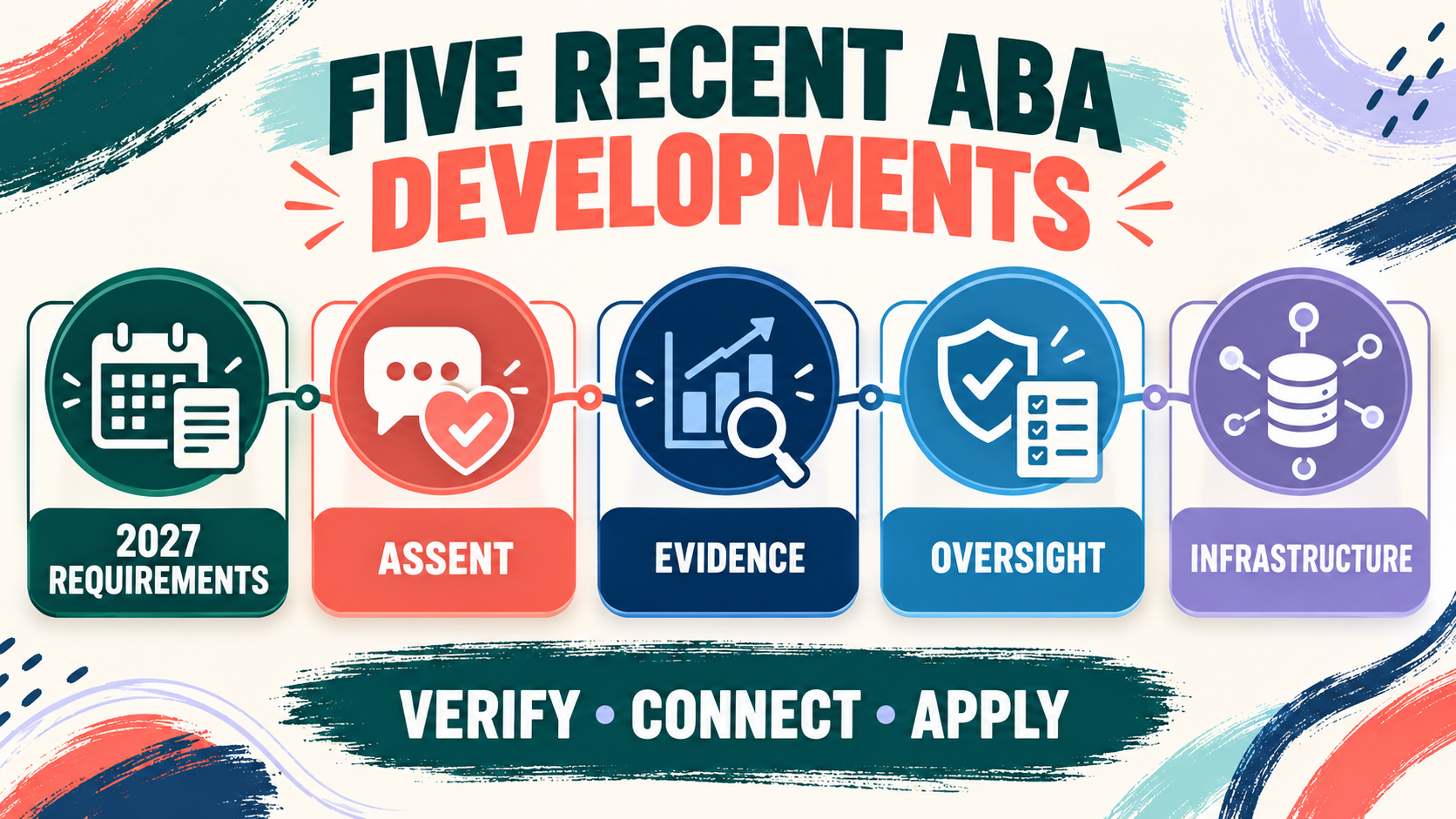
ABA is an applied science, a research tradition, and a professional service system. A development can affect one of those layers without changing the definition of reinforcement, prompting, measurement, or functional assessment. That is why a BCBA candidate should ask two questions: what has changed in the profession, and which core behavior-analytic principle explains the change?
For example, a new certification pathway is an eligibility and training development, not a new schedule of reinforcement. An assent-based practice discussion is an ethics and social-validity development, not a claim that data no longer matter. A Medicaid oversight toolkit is a quality and systems development, not a federal endorsement of one treatment intensity. Separating these levels prevents a current event from becoming an inaccurate exam definition.
The five developments below were selected because they are visible in official guidance, current research, or professional infrastructure during 2026. They also create distinct study opportunities rather than five versions of “ABA is becoming more popular.”
1. The 2027 BCBA and BCaBA Requirements Transition
The most concrete development for many students is the transition to requirements that take effect January 1, 2027. The BACB’s 2027 requirements update directs applicants and certificants to the detailed requirements, transition guidance, and updated handbooks. The BACB’s 2027 BCBA Requirements document summarizes two BCBA eligibility pathways beginning in 2027: an accredited or recognized program pathway and a behavior-analytic coursework pathway, with practical fieldwork and examination requirements still part of the overall route.
For a study guide, the important point is not to memorize a simplified social-media graphic. Eligibility depends on the exact degree, coursework, fieldwork, application timing, and handbook requirements that apply to the person. The BACB also identifies later changes, including future pathway changes, so “2027 requirements” should not be treated as a permanent endpoint.
- Check the effective date: distinguish a rule that applies to an application submitted now from one that begins on January 1, 2027.
- Read the handbook: use the current BACB document for pathway, degree, coursework, fieldwork, and maintenance details.
- Separate eligibility from exam content: do not turn a certification pathway into a definition of a behavior-analytic procedure.
BCBA exam connection: distinguish certification eligibility from the content tested on the examination. A question about fieldwork hours or a pathway is an eligibility question. A question about motivating operations, measurement, or treatment integrity is a task-list content question. They may appear on the same study plan, but they are not the same construct.
2. Community-Informed and Assent-Based Practice
A second development is the field’s more visible attention to assent, autonomy, client voice, and community-informed design. The Organization for Autism Research summary of a community-informed assent-based ABA project describes a research approach that includes community input and behavioral-skills training for service providers. The project is not proof that one protocol fits every client; it is an example of researchers treating lived experience, participation, and acceptability as relevant to how services are developed and evaluated.
This development connects directly to social validity. A behavior-change plan can produce a graph and still miss an important question: are the goals meaningful, are the procedures acceptable, and do the outcomes improve the person’s life as defined with the person and their supporters? Assent is also not identical to a one-time signature or to the absence of visible refusal. It is an ongoing practice of attending to communication, choice, participation, and changes in willingness within the limits of the setting and safety requirements.
BCBA exam connection: when a scenario describes a client communicating discomfort, the answer should not automatically be “increase compliance.” Look for ethical assessment, functional communication, choice, dignity, and the least intrusive effective approach. The current BACB Ethics Code information remains the appropriate source for professional obligations.
3. Evidence-Based Practice as a Decision Framework
A third development is a clearer move toward evidence-based practice as a decision process rather than a slogan. A 2026 Behavior Analysis in Practice framework for evidence-based practice training and supervision describes the value of combining empirical evidence, contextual variables, and professional judgment. That combination matters because a published procedure may not transfer cleanly to a particular learner, setting, communication system, risk profile, or family goal.
Evidence-based practice does not mean choosing the intervention with the most impressive label or copying a study’s protocol without checking fit. It means asking what the evidence says, what the client and stakeholders value, what the context permits, and how the team will measure both benefit and unintended effects. It also makes uncertainty visible. If the evidence is limited, a BCBA should not hide that limitation behind confident language.
A practical evidence-based decision record can include the target and replacement behaviors, the best available research, client and caregiver preferences, contextual constraints, the reason the procedure fits, the measurement plan, and the rule for revising or stopping it. This is useful in supervision, treatment planning, and exam reasoning.
- Evidence: What research or established behavioral principle supports the option?
- Context: What variables make the option feasible, unsafe, or culturally mismatched?
- Voice: What do the client and relevant stakeholders identify as meaningful?
- Data: What will be measured, how often, and what result would change the plan?
4. Stronger Quality and Oversight Expectations
A fourth development is the growing focus on oversight, documentation, medical necessity, and protection from financial or clinical harm in publicly funded ABA services. In August 2026, CMS announced a State Medicaid and CHIP ABA Toolkit. CMS described the toolkit as a resource for states addressing increasing expenditures, inconsistent clinical practices, and fraud concerns while emphasizing individualized, evidence-based care. CMS also stated that the toolkit does not establish new federal requirements, endorse one ABA approach, or direct states to limit medically necessary services.
That distinction is important. Oversight is not the same as a blanket reduction in services, and documentation is not the same as meaningful clinical progress. Strong systems should connect the service delivered, the goal measured, the provider’s competence, the client’s needs, and the outcome observed. A BCBA candidate should be able to recognize why accurate notes, treatment integrity, confidentiality, supervision, and data review matter even when a question is framed as billing or administration.
- Quality: Is the service individualized, evidence-informed, and connected to a measurable goal?
- Integrity: Do the notes, supervision records, data, and delivered procedures match what was planned?
- Protection: Are confidentiality, competence, client dignity, and public resources being handled responsibly?
The development also changes the information environment around ABA. Families, state agencies, insurers, and professionals are asking more often whether services are necessary, effective, respectful, and supported by evidence. A modern practitioner therefore needs both technical behavior-analytic skills and the ability to explain decisions transparently without promising outcomes that the data cannot support.
5. A More Mature Professional and Research Infrastructure
A fifth development is the expansion—and self-critique—of the infrastructure around the ABA profession. A September 2026 Behavior Analysis in Practice article on the infrastructure of the ABA profession describes the growth of certification, licensure, university training, professional associations, reimbursement systems, and quality organizations. The authors also emphasize that the infrastructure is still incomplete and that rapid professionalization creates new challenges.
Research infrastructure is developing alongside service infrastructure. A 2026 article on a participatory action research collaborative across ABA agencies describes shared governance, ethical infrastructure, practitioner training, and client or family advisors as ways to narrow the research-to-practice gap. This is a useful shift from treating research as something produced only in a university and practice as something that happens elsewhere. Better systems can help practitioners ask answerable questions, collect usable data, and involve the people affected by decisions.
BCBA exam connection: professional infrastructure is not a behavior principle, but it affects how ethical and evidence-based practice is supported. Supervision, continuing education, licensure, accreditation, and documentation are systems that shape practice. When studying, keep these levels separate while noticing how they interact.
How Should BCBA Candidates Study These Developments?
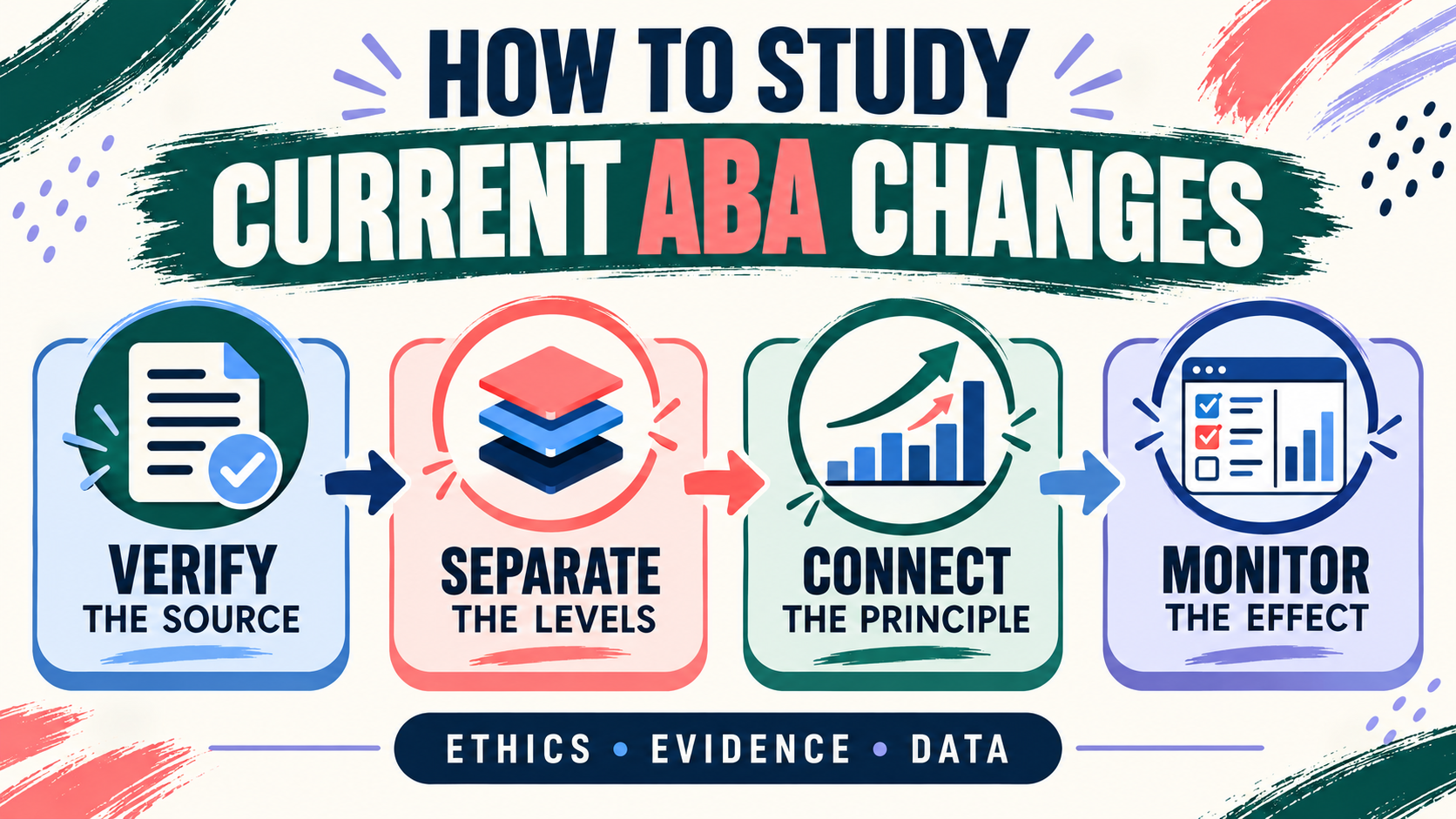
Do not study current developments as five disconnected news headlines. Build a two-column note for each one: “what is changing in the field” and “which BCBA concept helps me reason about it.” For the 2027 transition, the second column includes eligibility, coursework, fieldwork, and source verification. For assent-based practice, it includes social validity, client dignity, choice, and functional communication. For evidence-based practice, it includes data, contextual fit, professional judgment, and revision. For oversight, it includes integrity, documentation, competence, and individualized care. For infrastructure, it includes supervision, training, research-to-practice translation, and systems thinking.
Use primary and official sources when a detail is time sensitive. Record the publication or update date and avoid repeating a competitor’s exact claim without checking the original source. This matters especially for 2027 certification requirements, state policy, Medicaid guidance, and current research. If a page says “the BACB changed the rule,” open the BACB page or document before treating that sentence as fact.
Finally, connect the topic to a scenario. Ask: what is the client’s goal, what is being measured, who is affected, what evidence supports the plan, what risks or unintended effects should be monitored, and what would cause the BCBA to revise the decision? That scenario-based reasoning is more durable than memorizing five trend labels.
Five Recent Developments in ABA FAQ
What are five recent developments in ABA?: For a 2026 BCBA study perspective, five important developments are the 2027 certification transition, community-informed and assent-based practice, evidence-based practice as a decision framework, stronger quality and Medicaid oversight, and expanding professional and research infrastructure.
Are the 2027 BCBA requirements already in effect?: The BACB identifies January 1, 2027 as the effective date for the next requirements transition. Eligibility depends on the exact handbook, pathway, degree, coursework, fieldwork, and application details, so verify the current official materials before relying on a summary.
Does assent-based ABA mean data are no longer important?: No. Assent-based and community-informed practice add attention to participation, autonomy, and social validity. Measurement and evidence remain important; the question is whether the goals, procedures, and outcomes are meaningful and ethically justified for the person.
Does the CMS ABA toolkit create a new federal treatment rule?: CMS says the toolkit does not establish new federal requirements, endorse one ABA approach, or direct states to limit medically necessary care. It is an oversight and quality resource for states, and time-sensitive policy claims should be checked against the current CMS and Medicaid materials.
Where can I practice the exam logic?: Use the free BCBA mock exam for five recent developments in ABA to practice separating current professional context from the behavior-analytic principle a scenario is testing. It is independent study support, not official BACB material.
The main takeaway is that ABA is developing at several levels at once: requirements, ethics, evidence, oversight, and professional infrastructure. Strong BCBA preparation tracks the change without abandoning the core discipline of precise measurement, functional reasoning, socially meaningful goals, and data-based decision making.
Take the Free BCBA Mock Exam
If you want a low-pressure way to check your recall, use the free practice resource below. Take the Free BCBA Mock Exam



