
Short answer: FERB ABA means a functionally equivalent replacement behavior: an appropriate, observable response that gives the learner access to the same class of outcome that previously followed the target behavior. If a learner screams to escape a difficult task, asking for a break may be a FERB because it can access escape in a safer and more efficient form. The label is not a synonym for “good behavior.” The replacement must be selected from functional-assessment information, taught, reinforced, measured, and reviewed.
Table of Contents
- What does FERB ABA mean?
- How does a FERB match behavioral function?
- What is the difference between a FERB and a generic alternative?
- Why do efficiency and reinforcement matter?
- What are common FERB examples?
- How does FERB connect to FCT and DRA?
- How do you check a FERB before calling it effective?
- What should a BCBA measure?
- What FERB mistakes should you avoid?
- What ethical safeguards apply?
- How does FERB ABA appear on the BCBA exam?
- What is a 15-minute FERB study method?
- Bottom line: what should you remember about FERB ABA?
- FERB ABA FAQ
- Take the Free BCBA Mock Exam
On a BCBA exam, the fastest test is to ask, “What did the target behavior produce, and what will the replacement produce?” A generic alternative such as sitting quietly may be socially preferred but not functionally equivalent if it does not contact the relevant reinforcer. Functional equivalence also does not mean that a plan should preserve unsafe outcomes forever; it means the initial replacement is connected to the function so that teaching can compete with the behavior being reduced. Table of Contents: Use the points below as a quick study guide.
What does FERB ABA mean?
A functionally equivalent replacement behavior is a positive alternative that serves the same function as a behavior targeted for reduction. The term is often abbreviated FERB. “Functionally equivalent” refers to the consequence the response produces, not to its outward appearance. Two behaviors can look completely different and still belong to the same functional response class if they produce the same type of reinforcement.
The IRIS Center replacement-behavior guidance emphasizes that a replacement should be observable, measurable, actively stated, and connected to the function identified during the FBA. A request for help, a break card, a gesture, or an AAC response may all be appropriate forms, depending on the learner’s communication repertoire and the outcome that maintains the target behavior. Before calling a response a FERB, identify four parts:
- Target behavior: What observable response is occurring too often, too intensely, or in an unsafe form?
- Maintaining function: What consequence has the learner historically contacted after that response?
- Replacement response: What observable skill can the learner perform instead?
- Functional consequence: What consequence will follow the replacement so it can compete with the target?
Function is not inferred from the topography alone. Hitting, crying, leaving, dropping, or refusing may occur for attention, escape, access to an item, sensory stimulation, or another reason. A FERB decision therefore starts with assessment rather than with a favorite communication script.
How does a FERB match behavioral function?
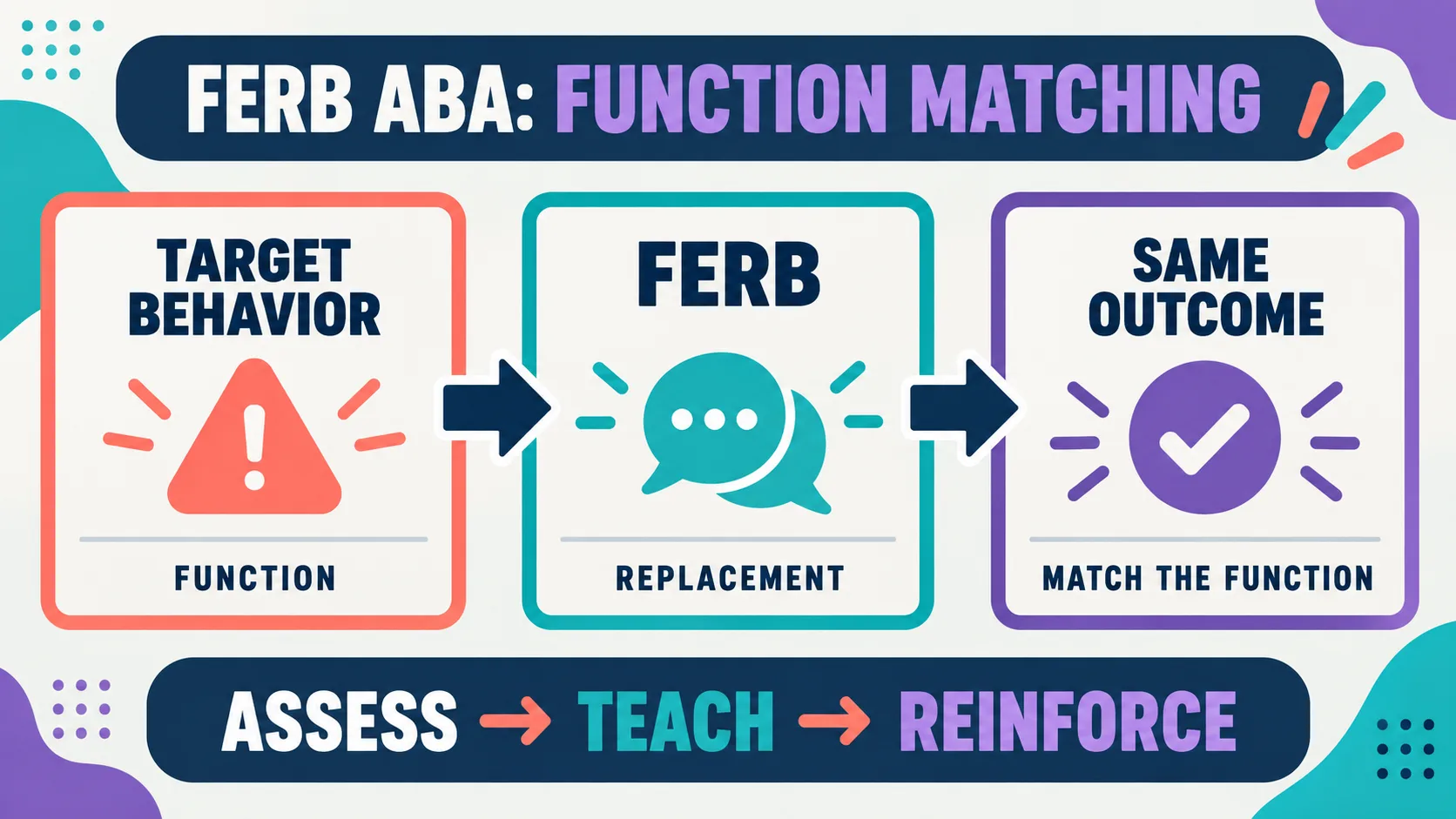
The basic arrangement is simple: assess the relation, teach the replacement, and arrange reinforcement for the replacement. The “same outcome” does not have to be identical in every detail, but it should address the relevant class of reinforcement. If the target behavior produces adult attention, a replacement that only produces a sticker may not initially compete unless the plan also arranges the relevant attention.
| Possible function | Target behavior example | Possible FERB | Function check |
|---|---|---|---|
| Attention | Calling out or grabbing an adult during instruction | Raise a card or say “Excuse me” to request interaction | Does the response produce the relevant attention? |
| Escape | Pushing materials away when a task is presented | Request a break or ask for help | Does it produce an appropriate pause or assistance? |
| Tangible or activity | Taking a preferred item from another person | Request the item, a turn, or more time | Does the request contact appropriate item access? |
| Automatic | A repetitive response that produces direct sensory stimulation | A safer, equally effective sensory or self-regulation response | Does the alternative actually produce the relevant sensory effect? |
What is the difference between a FERB and a generic alternative?
A generic alternative is any behavior someone would prefer to see. A FERB is selected because it gives the learner a practical path to the same functional outcome. “Keep your hands down” may describe an adult expectation, but it does not tell the learner how to obtain attention, escape, an item, or sensory input that previously followed the target response.
The distinction matters because an intervention can reduce a visible response temporarily while leaving the underlying need unanswered. If a team teaches quiet sitting for escape-maintained behavior but never teaches an efficient break request, the learner may not acquire a durable alternative. Functional equivalence does not guarantee success, but lack of functional equivalence is a clear reason to question the plan.
- Generic alternative: selected mainly because it looks appropriate to an observer.
- FERB: selected because it is observable, socially acceptable in context, and connected to the maintaining consequence.
- Long-term goal: shaped toward independence, natural reinforcement, safety, and meaningful participation rather than permanent dependence on a contrived prompt.
Why do efficiency and reinforcement matter?
Matching the function is necessary but not always sufficient. The replacement must also be feasible for the learner. If the target response is quick and reliably produces a consequence, while the new communication response requires ten prompts and a long delay, the target may remain more efficient even when the team has named the same function. Consider four practical dimensions:
- Response effort: Can the learner perform the FERB with the available motor, language, and access skills?
- Speed: Does the replacement contact the outcome soon enough to compete?
- Quality: Is the outcome sufficiently valuable for the learner under current motivating conditions?
- Schedule: Is reinforcement initially frequent enough to establish the new response before thinning is attempted?
A plan can begin with dense reinforcement and later teach waiting, tolerance, delay, or schedule signals. The sequence should make the replacement effective before asking it to compete with a well-established target behavior.
What are common FERB examples?
A FERB can be verbal, signed, gestural, written, device-mediated, or motoric. The form should fit the learner’s repertoire and the setting. The examples below show the logic, but each would require an individualized assessment and operational definition.
- Attention: Instead of yelling across the room, the learner taps an attention card or raises a hand; the planned response is followed by brief, relevant interaction.
- Escape: Instead of throwing materials when work begins, the learner points to a break symbol or says “help”; the plan arranges assistance or a defined break while teaching task participation.
- Tangible access: Instead of grabbing a toy, the learner requests a turn or uses a timer card; access follows according to the agreed routine.
- Automatic or sensory effect: Instead of an unsafe form of stimulation, the team evaluates a safer response that produces a comparable sensory consequence and is acceptable to the learner.
Do not confuse a replacement with a demand to suppress communication. A break request is not a license to remove every demand indefinitely, and a request for attention is not a reason to require eye contact. The function-based response should protect autonomy while supporting a meaningful goal.
How does FERB connect to FCT and DRA?
Functional communication training, or FCT, teaches a communicative response that accesses the reinforcer maintaining problem behavior. It is one common way to teach a FERB. The FCT practitioner guide describes the importance of selecting a communication response that is functional for the individual, while the broader FCT review explains how assessment, prompting, reinforcement, and generalization interact.
Differential reinforcement of alternative behavior, or DRA, reinforces a defined alternative response. A FERB may be the alternative in DRA, but the terms answer different questions: FERB describes the functional relation; DRA describes the reinforcement procedure. An alternative in DRA still needs a separate function match.
How do you check a FERB before calling it effective?
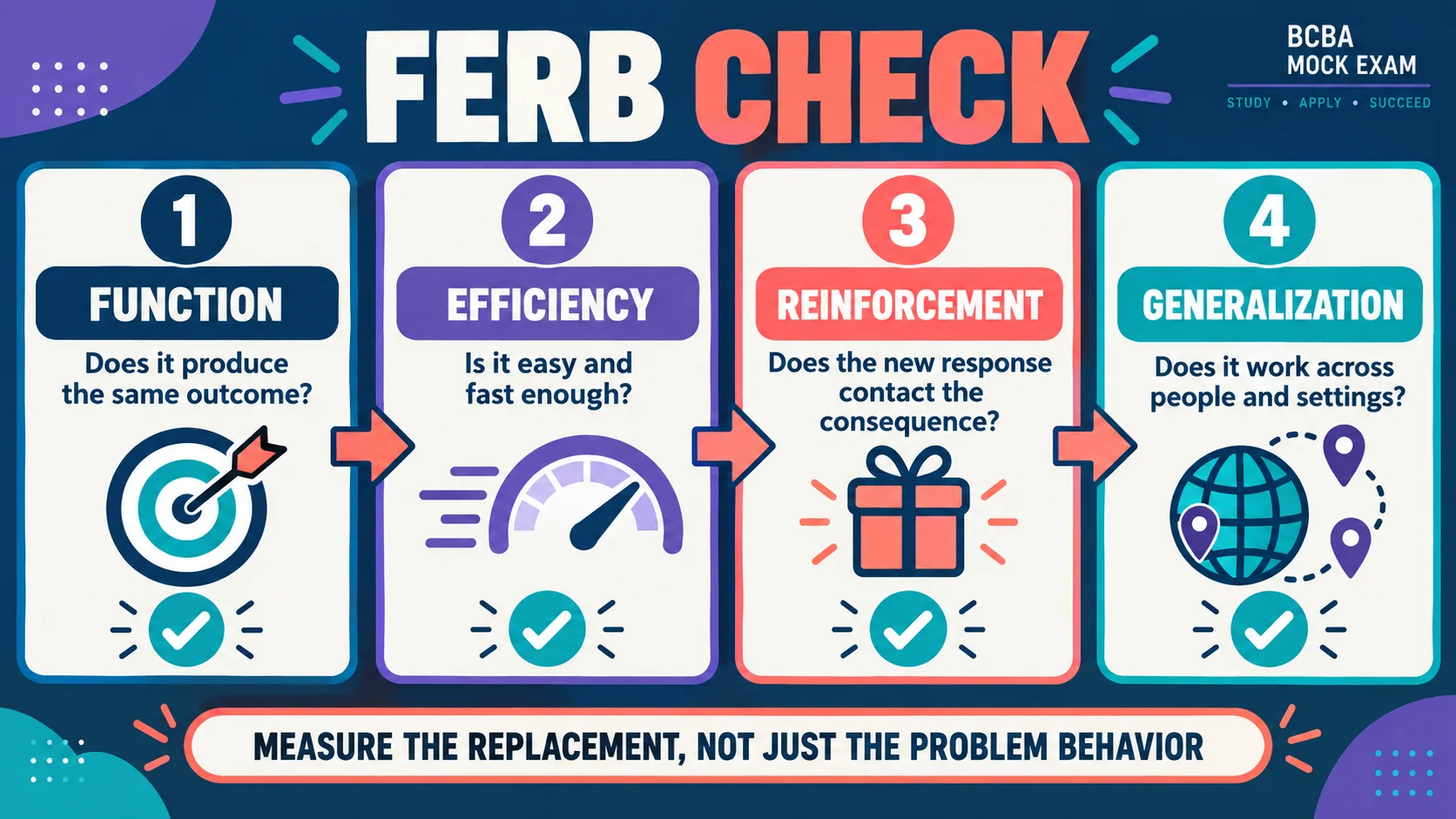
Use a four-part review before concluding that a replacement is working. First, verify that the target function was supported by assessment rather than by a label. Second, verify that the replacement is easy enough and produces the relevant consequence. Third, review whether the learner actually emits the response under natural opportunities. Fourth, examine maintenance and generalization across people, tasks, and settings.
The positive behavior support literature emphasizes that replacement skills should be functionally equivalent, efficient, and socially valued. That combination prevents a common error: declaring success because the target behavior decreased while the learner gained no practical way to communicate, participate, or regulate.
What should a BCBA measure?
Measure both sides of the change. A lower rate of the target behavior is important, but it does not show that the FERB was acquired or that the person’s quality of life improved. A useful data system can include:
- Target behavior: frequency, rate, duration, intensity, or latency using an operational definition.
- FERB acquisition: independent opportunities, prompted opportunities, percentage correct, and prompt level.
- Consequence contact: whether the planned functional outcome followed the FERB and how quickly it was delivered.
- Efficiency: response effort, time to complete the response, and whether the replacement competes with the target.
- Generalization: performance across people, places, materials, tasks, and communication partners.
- Social validity: acceptability, dignity, contextual fit, and the learner’s or stakeholder’s perspective.
When reinforcement schedules are thinned, continue measuring both the FERB and any resurgence of the target behavior. The review on schedule thinning after FCT is a useful reminder that a replacement can be acquired but become fragile when reinforcement changes too quickly.
What FERB mistakes should you avoid?
Most FERB errors come from skipping the functional relation or making the replacement harder than the behavior it is supposed to compete with. Watch for these traps:
- choosing “sit quietly” without identifying what the target behavior produced;
- teaching a request but failing to deliver the relevant consequence after the request;
- assuming the same topography has the same function across learners;
- using a replacement that requires more effort, language, or delay than the target;
- removing the target behavior’s consequence without teaching and reinforcing a workable alternative;
- treating a decrease in problem behavior as proof of communication, learning, or social validity.
Also avoid overclaiming. A function-based hypothesis can be revised when data do not match the prediction. Good ABA decision-making treats a FERB as a measurable intervention component, not as a label that makes an intervention automatically ethical or effective.
What ethical safeguards apply?
The BACB Ethics Code for Behavior Analysts provides the professional boundary for competence, client dignity, informed consent, assent, stakeholder protection, and responsible intervention. A functionally equivalent behavior should expand the learner’s effective options, not simply make the person easier for adults to manage. Before implementation, ask whether the plan:
- targets a meaningful outcome and uses language that is respectful and observable;
- allows the learner to communicate discomfort, refusal, or a need for a different response form;
- avoids requiring eye contact, forced speech, or socially normative behavior unrelated to the goal;
- protects safety while the new response is being taught and prompted;
- includes a plan for fading prompts and building natural reinforcement, independence, and generalization.
Check current BACB ethics resources before applying a procedure; a study article is not authorization to modify a client’s plan.
How does FERB ABA appear on the BCBA exam?
The current BCBA Test Content Outline includes function-based intervention, differential reinforcement, measurable goals, client preferences, social validity, and data-based decisions. An exam item may never use the abbreviation FERB; it may describe a replacement response and ask which option is functionally equivalent. Use this five-step exam routine:
- Identify the consequence. What does the target behavior obtain or avoid?
- Match the outcome. Which answer gives access to the same class of reinforcer?
- Check the response. Is the replacement observable, measurable, and within the learner’s repertoire?
- Check efficiency. Can it compete in speed, effort, and reinforcement value?
- Limit the claim. Does the option require assessment, measurement, prompting, or stakeholder input before implementation?
Common distractors include a response that looks socially appropriate but serves a different function, a response that matches the function but is impossible for the learner to perform, and an answer that eliminates the target without teaching an alternative. If the question supplies FBA data, let those data control the answer rather than relying on assumptions about what the behavior “means.”
What is a 15-minute FERB study method?
Draw three columns labeled target, function, and replacement. Write one observable target behavior, the consequence it produces, and a replacement that could contact the same outcome. Add a fourth line: “What data would show that the replacement is independent, efficient, and generalized?”
Then create one non-example. If the target is escape-maintained, “sit quietly” may be a desirable classroom behavior but not necessarily a FERB. A break request or help request is a stronger candidate because it addresses the identified outcome. Finish with two practice questions using the free BCBA mock exam. It is an independent study resource, not an official BACB examination or a guarantee of a passing result.
Bottom line: what should you remember about FERB ABA?
FERB ABA is a function-based replacement concept, not a generic synonym for appropriate behavior. Start with assessment, identify the maintaining consequence, choose an observable response that can contact the same outcome, and make the response efficient enough to compete. Teach and reinforce it, measure both the target and replacement, plan for generalization, and protect the learner’s dignity and choice. On the BCBA exam, the best answer usually makes the function–replacement–reinforcement relation explicit.
FERB ABA FAQ
What does FERB stand for in ABA? FERB stands for functionally equivalent replacement behavior. It is an observable alternative that serves the same function as the behavior targeted for reduction. Is FCT the same as FERB? No. FCT is a communication-based teaching procedure that often teaches a FERB. FERB describes the functional relation of the replacement; FCT describes a way to teach communication. What is the most important FERB exam question? Ask what the target behavior produces and whether the proposed alternative can produce the same outcome. Then check response effort, measurement, and ethical fit.
Take the Free BCBA Mock Exam
When you are ready to apply the idea, use the free practice resource below for additional feedback. Take the Free BCBA Mock Exam



