

Short answer: An ABA interventionist is a job title commonly used for a person who provides direct behavior-analytic support, implements teaching or behavior plans, records data, and communicates observations to a supervisor. The title is not a universal credential. An employer, state, school district, or service provider may define the role differently. A careful description therefore separates what the person is trained and authorized to do from what a BCBA or another qualified supervisor designs, approves, and monitors.
Table of Contents
- What is an ABA interventionist?
- What does an ABA interventionist do?
- How is the role different from an RBT or BCBA?
- What data and feedback should the role provide?
- How does supervision shape the role?
- Is ABA interventionist a BACB credential?
- How do you check role scope before acting?
- What ethical safeguards apply?
- How does ABA interventionist appear on the BCBA exam?
- What is a 15-minute role-boundary study method?
- Bottom line: what should you remember?
- ABA interventionist FAQ
- Take the Free BCBA Mock Exam
For BCBA exam questions, look for scope, supervision, data, and decision authority. A direct-care professional may carry out a written procedure and report that the data are changing, while a BCBA is responsible for assessment-based recommendations, intervention design, clinical decisions, and oversight within the applicable rules. The exact title matters less than the responsibilities stated in the scenario. Table of Contents: Use the points below as a quick study guide.
What is an ABA interventionist?
ABA interventionist is a descriptive employment label, not a single nationally standardized certification. In one setting, the person may provide one-to-one instruction and collect session data. In another, the person may support a classroom, coach caregivers under supervision, or implement a behavior intervention plan. The title alone does not establish a degree, credential, scope of practice, or independent authority. A useful role definition has four parts:
- Direct implementation: the person follows an approved teaching, skill-acquisition, or behavior-support procedure.
- Observation and measurement: the person records defined responses, prompts, consequences, and relevant context.
- Communication: the person reports progress, barriers, safety concerns, and questions to the designated supervisor.
- Supervised improvement: the person receives training, feedback, and competency checks rather than being expected to invent clinical changes alone.
Some interventionists hold the Registered Behavior Technician credential, while others do not. Some work toward a BCBA or another profession. A reliable article or job description should state the local requirements instead of implying that every interventionist has the same credential.
What does an ABA interventionist do?
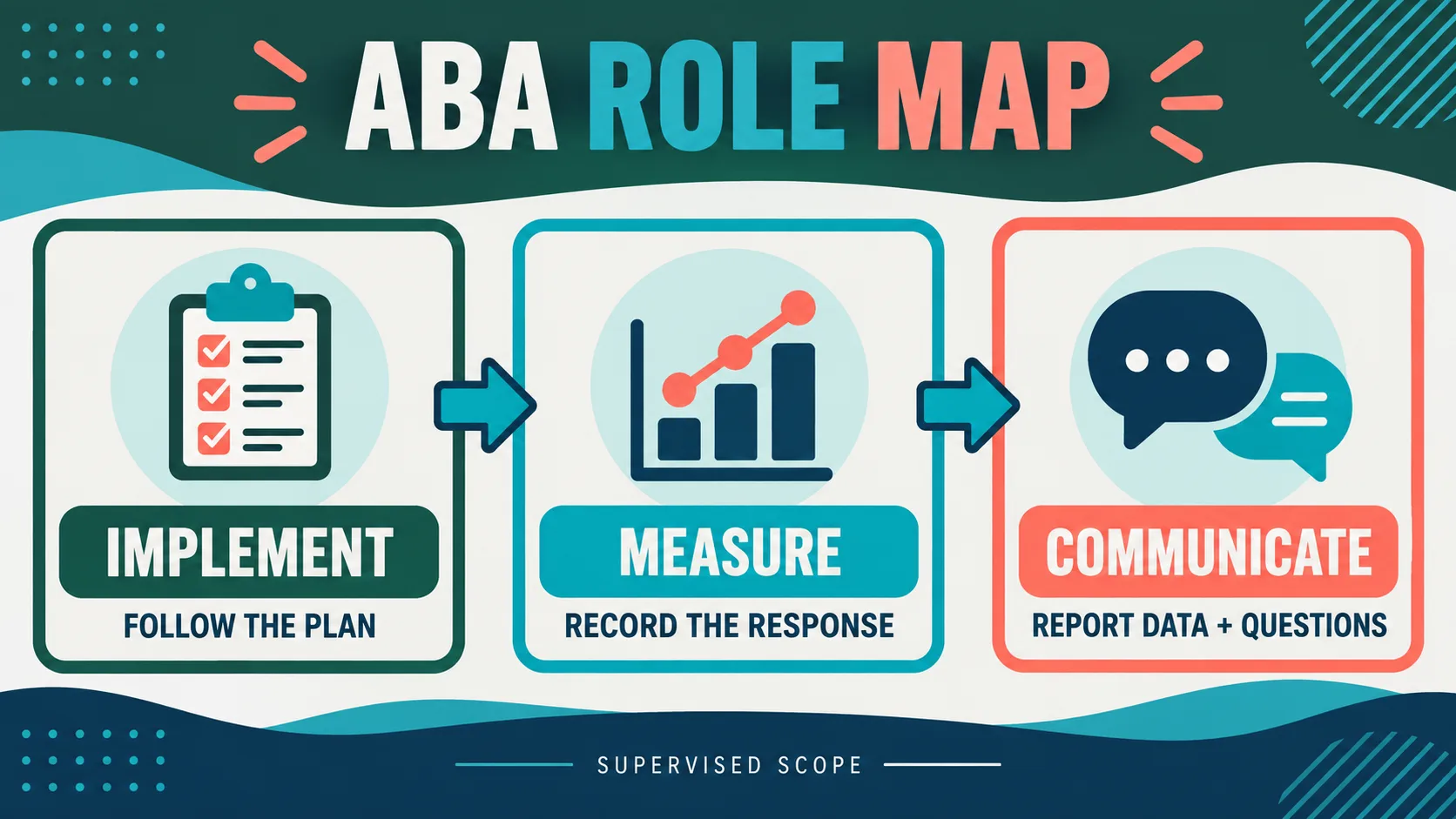
Day-to-day work usually combines implementation, measurement, and communication. The person may prepare materials, arrange teaching opportunities, deliver prompts and reinforcement according to the plan, support functional communication, practice daily-living skills, and record what happened. The actual tasks depend on the plan, the learner’s needs, the setting, and the person’s demonstrated competency.
In a well-organized team, the interventionist does not merely “run therapy.” The person helps produce usable information about whether the procedure can be implemented as written and whether the learner is contacting the intended teaching opportunities. That information helps the supervisor decide whether a plan needs clarification, more training, a different measure, or a clinical revision.
- Review the current plan and ask questions before a session begins.
- Prepare materials and arrange opportunities that match the written procedure.
- Use approved prompts, reinforcement, error correction, and safety steps.
- Record the learner’s defined response and the relevant consequence.
- Communicate unusual events, barriers, injuries, assent concerns, and data patterns promptly.
These responsibilities are different from independently selecting a function, changing a reinforcement schedule, adding a punishment procedure, or rewriting goals without authorization. A person can notice a problem and report it without being the person who has authority to solve it clinically.
How is the role different from an RBT or BCBA?
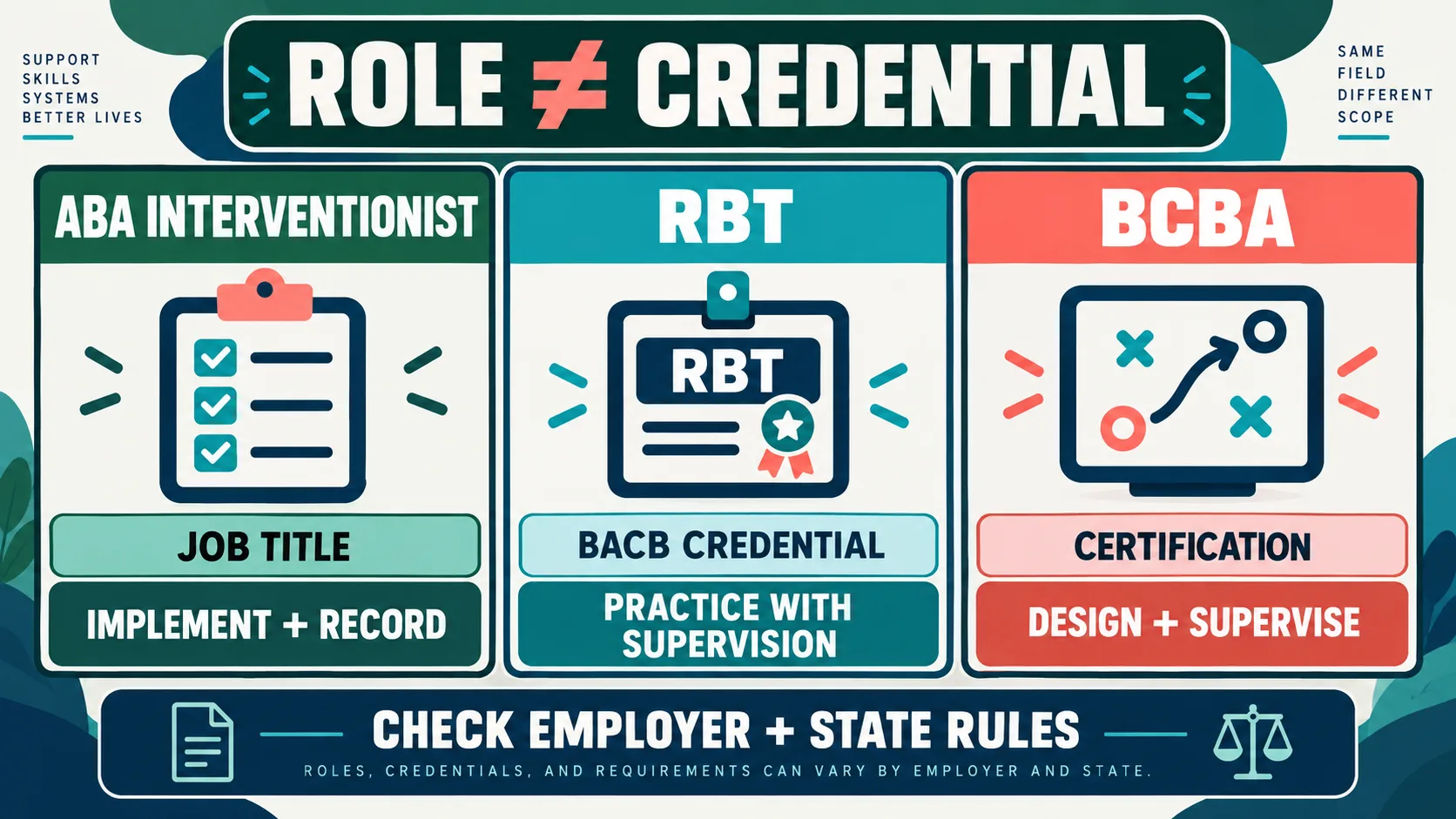
The terms can overlap in real workplaces, so the safest comparison is based on credential and responsibility rather than title. An RBT is a BACB credential with defined requirements and ongoing supervision. A BCBA is a professional certification with responsibilities that include assessment, intervention design, supervision, and data-based decisions within the applicable standards. “ABA interventionist” may be an employer’s job title and may describe someone with or without an RBT credential.
| Label | What it identifies | Common work focus | Boundary question |
|---|---|---|---|
| ABA interventionist | An employer or setting-specific job title | Direct implementation, observation, data, and team communication | What training and authorization does this employer or program require? |
| RBT | A BACB paraprofessional credential | Implement behavior-analytic services under ongoing supervision | Who is the responsible supervisor and what tasks are within competence? |
| BCBA | A BACB graduate-level certification | Assessment, intervention design, supervision, evaluation, and collaboration | Does the decision require qualified clinical judgment, authorization, or state licensure? |
This table is a study aid, not a substitute for a handbook, state law, employer policy, or supervision agreement. A BCBA may delegate implementation tasks to a trained person, but delegation does not transfer the supervisor’s responsibility for appropriate oversight or make the delegate an independent behavior analyst.
What data and feedback should the role provide?
Data collection should be tied to the operational definition and the decision the team needs to make. “The session went well” is not a measurement. A useful record may include the number of opportunities, independent responses, prompts, errors, latency, duration, reinforcement delivered, and procedural deviations. The correct dimension depends on the behavior and the plan.
An interventionist can also provide implementation data. If a procedure is difficult to follow, the person can record which step was unclear, which materials were missing, or which event interrupted the routine. This is valuable information for a supervisor, but it should be reported as an observation rather than silently corrected through an unapproved procedure change.
- Record what was defined: use the agreed measurement system rather than a vague impression.
- Record context: note relevant setting events, schedule changes, prompts, and safety events.
- Separate learner and staff data: a learner’s performance and procedural fidelity answer different questions.
- Report patterns: bring repeated barriers or changes to supervision instead of making a private clinical conclusion.
The BACB supervision and training resources emphasize role-specific oversight and competency. The data system should make it possible to see whether the interventionist can implement the skill reliably and whether the learner is benefiting under the planned conditions.
How does supervision shape the role?
Supervision is more than a signature or a quick end-of-session conversation. A supervisor should clarify the task, demonstrate the skill, arrange practice, observe performance, provide feedback, and check whether the skill generalizes. The interventionist should know who to contact when the plan is unclear, the learner shows distress, a safety concern appears, or the data do not fit the expected pattern.
Supervision also has limits. The BCBA’s current resources distinguish supervising ongoing services, supervising future behavior analysts, training, and assessment roles. Employer titles do not erase those distinctions. An interventionist should not be left to infer a treatment change from a single difficult session or from an informal comment.
- Review the plan and scope before implementation.
- Demonstrate competency before working independently on a new procedure.
- Use feedback and data to improve fidelity, not to assign blame.
- Escalate questions about safety, consent, assent, or unexpected effects promptly.
- Document training, observation, and follow-up when required by the setting.
Is ABA interventionist a BACB credential?
No. “ABA interventionist” is generally a job title, while RBT, BCaBA, and BCBA are BACB certification labels with their own requirements. Some job postings may require or prefer an RBT credential; others may use the title for a school or service role with different qualifications. A job title cannot be used as evidence that a person has passed a BACB examination.
For current credential requirements, use the relevant BACB handbook and the employer or state authority. Do not infer that completing an employer’s training makes someone eligible to use a protected certification title, supervise others, or practice independently.
How do you check role scope before acting?
Before acting on a request, run a scope check. First ask whether the task is implementation, measurement, training, assessment, or treatment design. Next check the written plan, supervision agreement, employer policy, and applicable law. Then decide whether the person has demonstrated competency and whether the task requires a supervisor’s approval. If any part is unclear, pause the clinical change and ask the designated supervisor. A simple decision sequence is:
- What is the task? Name the observable action rather than relying on a title.
- What document controls it? Locate the plan, protocol, training instruction, or supervision agreement.
- What authority is required? Identify whether the task involves independent assessment, treatment design, or a restricted credential.
- What should be reported? Record the question, data, barrier, or safety concern and contact the responsible supervisor.
What ethical safeguards apply?
The BACB Ethics Code for Behavior Analysts sets professional expectations for competence, informed consent, client dignity, confidentiality, and responsible supervision. An interventionist’s work should support meaningful goals and preserve the learner’s communication, assent, safety, and right to respectful treatment.
Ethical implementation includes more than following a data sheet. The team should make sure the interventionist has adequate training, understands how to respond to assent withdrawal or distress, can report concerns without retaliation, and is not asked to perform outside demonstrated competence. A person who notices an ethical problem should bring it to the responsible supervisor or the appropriate reporting channel.
- Use respectful, observable descriptions instead of labels that imply blame or intent.
- Protect private learner information in notes, conversations, and digital systems.
- Pause and escalate when safety, assent, consent, or competency is uncertain.
- Document concerns and follow the setting’s approved reporting pathway.
How does ABA interventionist appear on the BCBA exam?
The current BCBA Test Content Outline emphasizes intervention design, procedural integrity, data-based decisions, collaboration, and supervision. A question may describe a technician, therapist, paraprofessional, or interventionist rather than using the exact job title. Read the verbs in the scenario: implements, records, reports, assesses, designs, supervises, or modifies. Use this five-step routine:
- Identify the role: is the person a credentialed professional, a trainee, or only described by an employer title?
- Identify the action: is the person implementing a plan or making an independent clinical decision?
- Check competency: has the person been trained, observed, and authorized for the task?
- Check supervision: who is responsible for the service and available for questions?
- Choose the safest answer: select the option that protects the client and uses data, collaboration, and appropriate scope.
Common traps include assuming “interventionist” means BCBA, assuming an RBT can independently redesign a plan, or treating a data collector’s observation as a completed functional assessment. For a broader plan-implementation review, see the ABA interventionist and behavior-plan implementation review; this page keeps the narrower role-and-scope intent.
What is a 15-minute role-boundary study method?
Write three columns labeled title, action, and authority. Put “ABA interventionist,” “RBT,” and “BCBA” in the first column. In the second, write verbs such as implement, measure, report, assess, design, and supervise. In the third, note which actions require a plan, demonstrated competency, ongoing supervision, or qualified clinical judgment.
Then practice with a short vignette: a direct-care worker notices that a reinforcement schedule is not producing the expected change. The strongest next step is usually to document the data and consult the responsible supervisor—not to invent a new schedule. Use the free BCBA mock exam for timed practice. It is an independent study resource, not an official BACB examination or a guarantee of a passing result.
Bottom line: what should you remember?
An ABA interventionist is usually a direct implementation and support role, but the exact job scope varies. The title is not a BACB credential and does not establish independent authority. Strong practice connects implementation to a written plan, data, competency, supervision, communication, ethics, and local requirements. On the BCBA exam, read the action verbs and choose the answer that respects the difference between carrying out a procedure and making a clinical decision.
ABA interventionist FAQ
What does an ABA interventionist do? Depending on the setting, an interventionist may implement teaching or behavior-support procedures, collect data, support skill acquisition, communicate observations, and work under an appropriate supervisor. Is an ABA interventionist the same as an RBT? Not necessarily. RBT is a BACB credential; ABA interventionist is generally an employer or setting-specific job title. An employer may require an RBT credential, but the words are not interchangeable.
Can an ABA interventionist change a behavior plan? The answer depends on the plan, training, supervision, employer policy, and applicable law. A direct-care worker should document concerns and consult the responsible supervisor rather than making an independent clinical change without authorization. Does the job title qualify someone to become a BCBA? No. BCBA eligibility and certification depend on current BACB requirements, education, coursework, fieldwork, examination, and other applicable standards—not on the job title alone.
Take the Free BCBA Mock Exam
When you are ready to apply the idea, use the free practice resource below for additional feedback. Take the Free BCBA Mock Exam



