
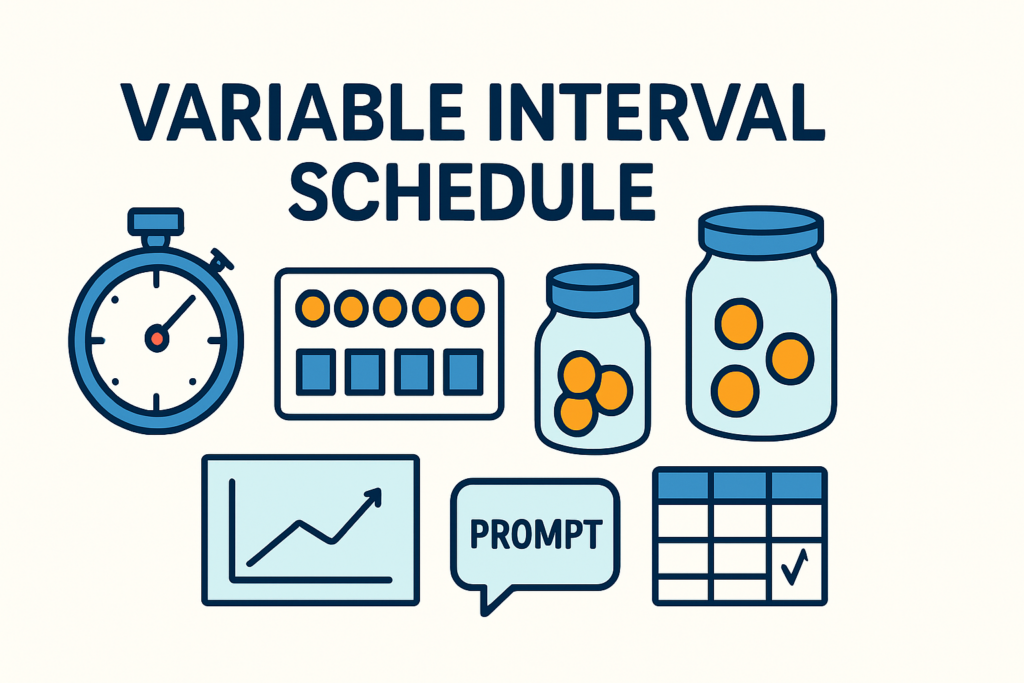
Understanding reinforcement schedules is fundamental to applied behavior analysis, and the variable interval schedule presents unique challenges for BCBA candidates. This schedule produces steady response patterns that maintain behaviors in natural environments, making it essential for both clinical practice and exam success.
Table of Contents
- What is a Variable Interval Schedule?
- Variable Interval Schedule in Practice: ABA Examples
- Why Variable Interval Schedules Matter on the BCBA Exam
- Quick-Reference Checklist and Summary
What is a Variable Interval Schedule?
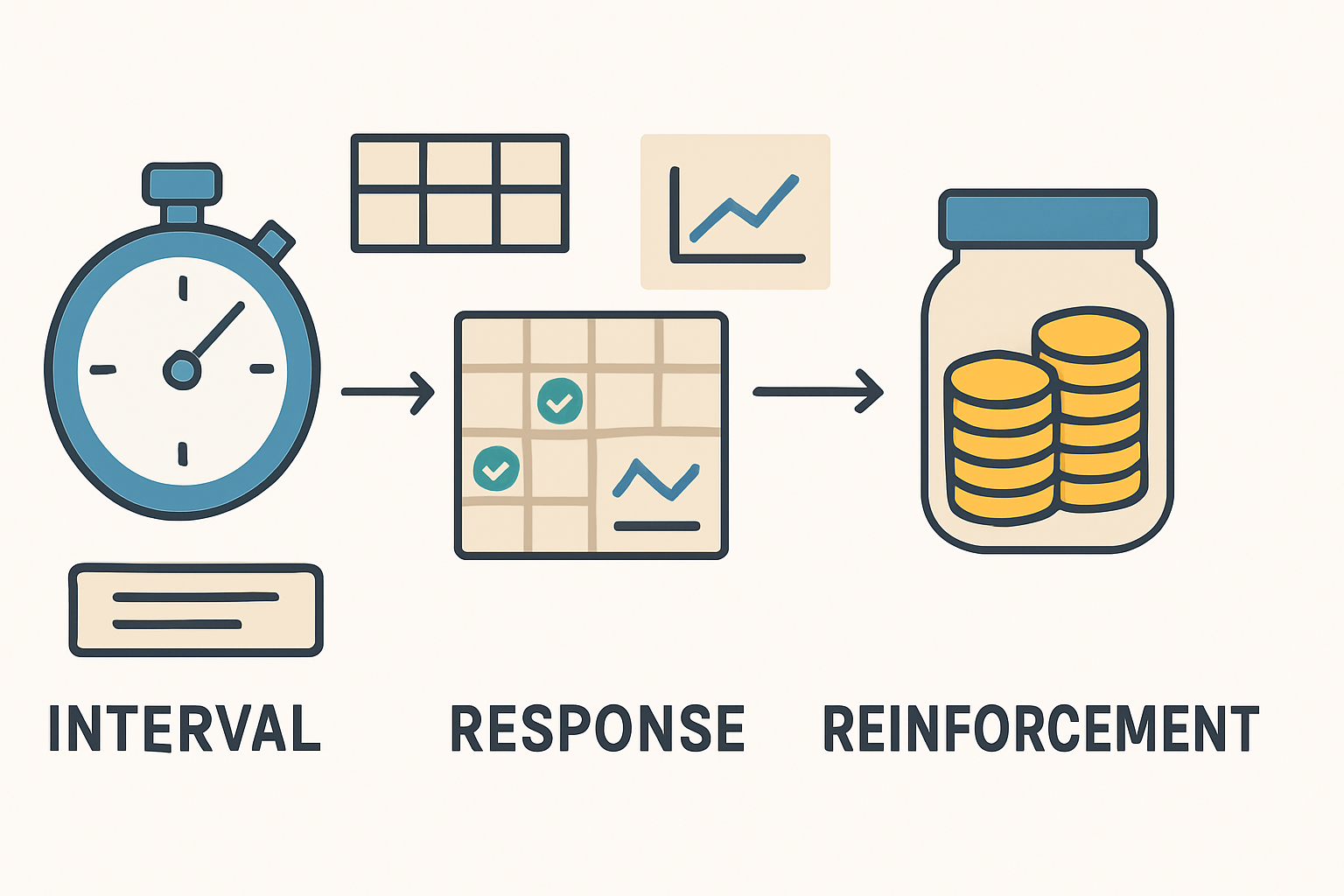
A variable interval schedule delivers reinforcement for the first response after a variable amount of time has passed. The key distinction is that the time requirement varies unpredictably around an average.
The Defining Rule and Key Characteristics
In a VI schedule, reinforcement becomes available after varying time intervals, but only for the first response that occurs after each interval elapses. This creates a moderate, steady response rate with minimal post-reinforcement pauses.
- Time-based requirement: Reinforcement depends on time passing, not response count
- Variable intervals: Time requirements change unpredictably (e.g., VI-5 means average 5 minutes)
- First response after: Only the first behavior after interval completion earns reinforcement
- Steady responding: Produces consistent, moderate response rates without pauses
- Resistance to extinction: Behaviors maintained on VI schedules extinguish slowly
Variable Interval Schedule in Practice: ABA Examples
Real-world applications help solidify your understanding of how VI schedules maintain behaviors in clinical and natural settings.
Example 1: Checking Email
This common behavior demonstrates VI reinforcement in everyday life. The antecedent is no new email notification. The behavior involves pressing refresh or checking the inbox. The consequence is a new email arriving after varying intervals (2 minutes, 10 minutes, 5 minutes).
The hypothesized function is access to social information or attention. This is VI rather than VR because reinforcement depends on time elapsed, not number of responses. Understanding these distinctions is crucial for functional assessment accuracy.
Example 2: Manding for Attention During Parallel Play
In therapeutic settings, children often demonstrate VI-maintained behaviors. The antecedent is therapist engagement with another client. The behavior includes saying “Look!” or tapping the therapist. The consequence is therapist attention after varying intervals of non-engagement.
This pattern maintains because attention becomes available at unpredictable times. The child learns that checking in periodically yields reinforcement, creating a steady rate of attention-seeking behavior.
Example 3: Supervising Independent Work
Educational settings frequently employ VI schedules naturally. The antecedent is a student working independently. The behavior involves looking up at the teacher. The consequence is teacher praise after variable intervals (3, 7, 4 minutes).
This maintains on-task behavior through intermittent reinforcement. Students learn that periodic checking yields teacher attention, creating consistent work habits without constant supervision.
Why Variable Interval Schedules Matter on the BCBA Exam
VI schedules appear frequently on the BCBA exam because they test your ability to distinguish time-based from response-based reinforcement. Mastery requires recognizing subtle contextual cues.
Common Exam Traps and How to Avoid Them
Exam questions often include distractors that test precise understanding. Watch for these common traps:
- Confusing VI with VR: Look for time vs. number requirements in the scenario
- Missing ‘first response after’: Reinforcement only follows the first behavior after interval completion
- Overlooking variability: Intervals must vary unpredictably around an average
- Ignoring limited holds: When reinforcement windows are restricted, it’s not simple VI
- Misidentifying FI patterns: Fixed intervals produce scalloped response patterns, not steady rates
Linking VI Schedules to Other Task List Items
Understanding VI schedules connects to multiple BACB Task List items. This knowledge supports comprehensive exam preparation across domains.
- B-5: Define and provide examples of schedules of reinforcement
- B-6: Use interventions based on reinforcement principles
- G-21: Use schedules of reinforcement effectively in treatment
- Measurement systems: VI schedules require precise time-based data collection
Quick-Reference Checklist and Summary
Use this practical guide to quickly identify VI schedules in exam scenarios and clinical observations.
Your VI Schedule Identification Checklist
When analyzing a reinforcement scenario, ask these critical questions:
- Is reinforcement time-based rather than response-count based?
- Does the time requirement vary unpredictably around an average?
- Is reinforcement delivered for the first response after time elapses?
- Does the behavior pattern show steady, moderate responding without pauses?
- Are there no restricted windows (limited holds) for reinforcement?
If you answer yes to all questions, you’re likely dealing with a variable interval schedule.
Key Takeaways for Your Studies
Mastering VI schedules requires understanding their unique characteristics and applications. Remember these essential points:
- VI schedules reinforce after variable time intervals, producing steady response rates
- They maintain behaviors for generalized reinforcement like attention or information
- Exam questions frequently test your ability to distinguish VI from VR and FI
- Real-world applications include social behaviors maintained by intermittent attention
- Understanding VI supports effective differential reinforcement interventions
For authoritative information on reinforcement schedules, consult the Behavior Analyst Certification Board resources and peer-reviewed literature on schedule effects.
Next step for BCBA exam prep
Turn this topic into exam-day practice
Use this topic as a focused review, then test it in exam-style conditions with a free mock before deciding whether five full-length mocks are the right next step.
Start the Free BCBA Mock Exam
Continue with Five Full-Length Mocks — $99
Review the included materials and access details before ordering. No pass guarantee is implied.



