

Short answer: An echoic to tact transfer is a verbal-behavior procedure that uses a learner’s echoic repertoire to help establish a tact. The instructor presents a nonverbal stimulus, provides an echoic model or prompt when needed, and then transfers control to the nonverbal stimulus by fading the echoic prompt. The final test is not whether the learner can repeat the word. It is whether the learner labels the stimulus independently when the relevant nonverbal stimulus is present.
Table of Contents
- What is echoic to tact transfer?
- How does the procedure work?
- How do you know stimulus control transferred?
- What data should a BCBA collect?
- What does a worked example look like?
- What are the prompting and generalization boundaries?
- What are the BCBA exam traps?
- Echoic to tact transfer FAQ
- Take the Free BCBA Mock Exam
For the BCBA exam, keep three relations separate: an echoic is controlled by a vocal verbal stimulus and has point-to-point correspondence; a tact is controlled by a nonverbal stimulus and is typically maintained by generalized reinforcement; and a transfer procedure is the teaching arrangement used to move control from one prompt to the target stimulus. This page focuses on that transfer procedure, not on replacing the site’s general echoic or tact definitions. Table of Contents
What is echoic to tact transfer?
Echoic-to-tact transfer is a method for teaching a learner to label a nonverbal stimulus when an echoic prompt can temporarily support vocal responding. Suppose the learner can repeat “ball” after hearing “ball,” but does not yet say “ball” when shown a ball. The echoic repertoire provides a bridge: the instructor models the word, the learner echoes it, and the instructor then presents the ball again with a tact opportunity. Prompt fading is used so the learner eventually says “ball” because of the ball or the relevant nonverbal context, not because an adult just said “ball.”
The procedure is therefore about transfer of stimulus control. The echoic prompt is useful at the start, but it should not remain the controlling variable. A prompted echo is evidence that the learner can vocalize the word under one condition. It is not yet evidence that the learner has acquired an independent tact.
A peer-reviewed applied study of transfer procedures described echoic-to-tact work as part of a sequence for teaching tacts, and related research examined how control can transfer from supplemental prompts to the target stimulus. These studies support the procedure as a teachable arrangement, but their results should not be treated as a promise that one prompting sequence will work for every learner or every language target.
How does the procedure work?
A clear procedure begins with an operational definition of the target tact and a plan for what prompt will be delivered, when it will be faded, and what counts as independent. The exact number of prompt levels and timing rules should be individualized and documented rather than copied mechanically from a study.
- Select the nonverbal stimulus: choose an item, action, person, picture, or event that is relevant to the learner’s communication goal and can be presented consistently.
- Check the prerequisite repertoire: confirm that the learner can attend to or interact with the stimulus and can echo the target vocal model, with whatever response form is appropriate for that learner.
- Present the target stimulus: show or arrange the item in a way that makes the intended nonverbal controlling variable available. Avoid adding unnecessary verbal cues that could become the real SD for the response.
- Provide the echoic prompt if needed: model the target word or use the planned prompt level. Record whether the response was independent, prompted, incorrect, or absent.
- Create a tact opportunity: re-present the nonverbal stimulus or ask the planned tact question while fading the echoic model. The learner’s response should now be evaluated against the nonverbal stimulus.
- Reinforce the target response: deliver the programmed, socially appropriate consequence for an independent or correctly prompted response according to the plan. Do not make access to basic needs contingent on vocal performance.
- Probe and fade: test the target with less echoic support, vary the item or context as appropriate, and move toward independent tacting rather than accumulating more prompted repetitions.
The sequence can look fluid in practice. A practitioner may present a picture, model “cup,” observe the learner echo “cup,” then present the picture again and ask “What is it?” If the learner needs the model again, the practitioner follows the written prompt plan and records that the response remained prompted. The teaching value comes from arranging a gradual change in control, not from asking “What is it?” repeatedly while leaving the same full verbal prompt in place.
How do you know stimulus control transferred?
Look for responding when the nonverbal stimulus is present and the echoic prompt is absent or meaningfully reduced. A learner who says “cookie” only after the instructor says “cookie” is demonstrating echoic responding or prompted tact performance, depending on the exact arrangement. A learner who sees the cookie, says “cookie” without the model, and continues to do so across planned probes is showing stronger evidence of tact control.
Do not decide from one correct response. Probe across multiple targets and, when appropriate, across people, materials, positions, examples, and settings. If the learner labels a picture only when it is held in one location or only after the instructor asks a particular question, the relevant control may still be narrow. The teaching team should identify what changed before the response and fade irrelevant prompts carefully.
- Prompt absent: the learner responds after the nonverbal stimulus is presented without the full echoic model.
- Prompt delayed or reduced: the learner continues to respond as the echoic support becomes less immediate or less complete.
- Control varied: the learner responds with relevant new examples, communication partners, or contexts rather than one memorized card routine.
| Term | Controlling variable | What the response looks like | Exam clue |
|---|---|---|---|
| Echoic | Vocal verbal stimulus | Vocal response has point-to-point correspondence and formal similarity with the model | “Say ball.” → “Ball.” |
| Tact | Nonverbal stimulus | Vocal label or comment controlled by an object, event, action, or other nonverbal variable | Sees ball → says “ball.” |
| Echoic-to-tact transfer | Initially the echoic prompt; eventually the nonverbal stimulus | Prompted vocal response is shaped toward independent tacting | Model → echo → fade model → tact |
| Receptive-to-tact transfer | Initially a listener response or receptive prompt; eventually the nonverbal stimulus | Learner identifies or contacts the item, then labels it | “Touch cup” → “What is it?” → “Cup” |
What data should a BCBA collect?
Data should show both acquisition and control transfer. If the only measure is total correct words, a team may mistake prompted repetition for independent tacting. Define the response and prompt levels before teaching begins, then record enough detail to answer the actual question: is the learner becoming more independent under the nonverbal stimulus?
- Opportunity count: number of valid tact opportunities presented for each target.
- Prompt level: full echoic model, partial model, delayed model, tact question, gesture, or independent, using the program’s operational definitions.
- Response classification: independent correct, prompted correct, incorrect vocal response, no response, or response controlled by an unintended verbal cue.
- Latency: time from the tact opportunity to the vocal response when latency is relevant to the instructional question.
- Generalization: independent tacts across exemplars, settings, communication partners, and naturally occurring opportunities.
- Fidelity: whether staff presented the nonverbal stimulus, delivered the planned prompt, reinforced the defined response, and implemented the fade consistently.
A simple data pattern might show prompted correct responding rising first, followed by independent correct responding as the echoic prompt is delayed or faded. If independent responding stays low while prompted responding stays high, do not claim transfer has occurred. Review the target’s value, the stimulus arrangement, the prompt hierarchy, the reinforcement consequence, response effort, and whether the program is asking for a tact that is meaningful to the learner.
What does a worked example look like?
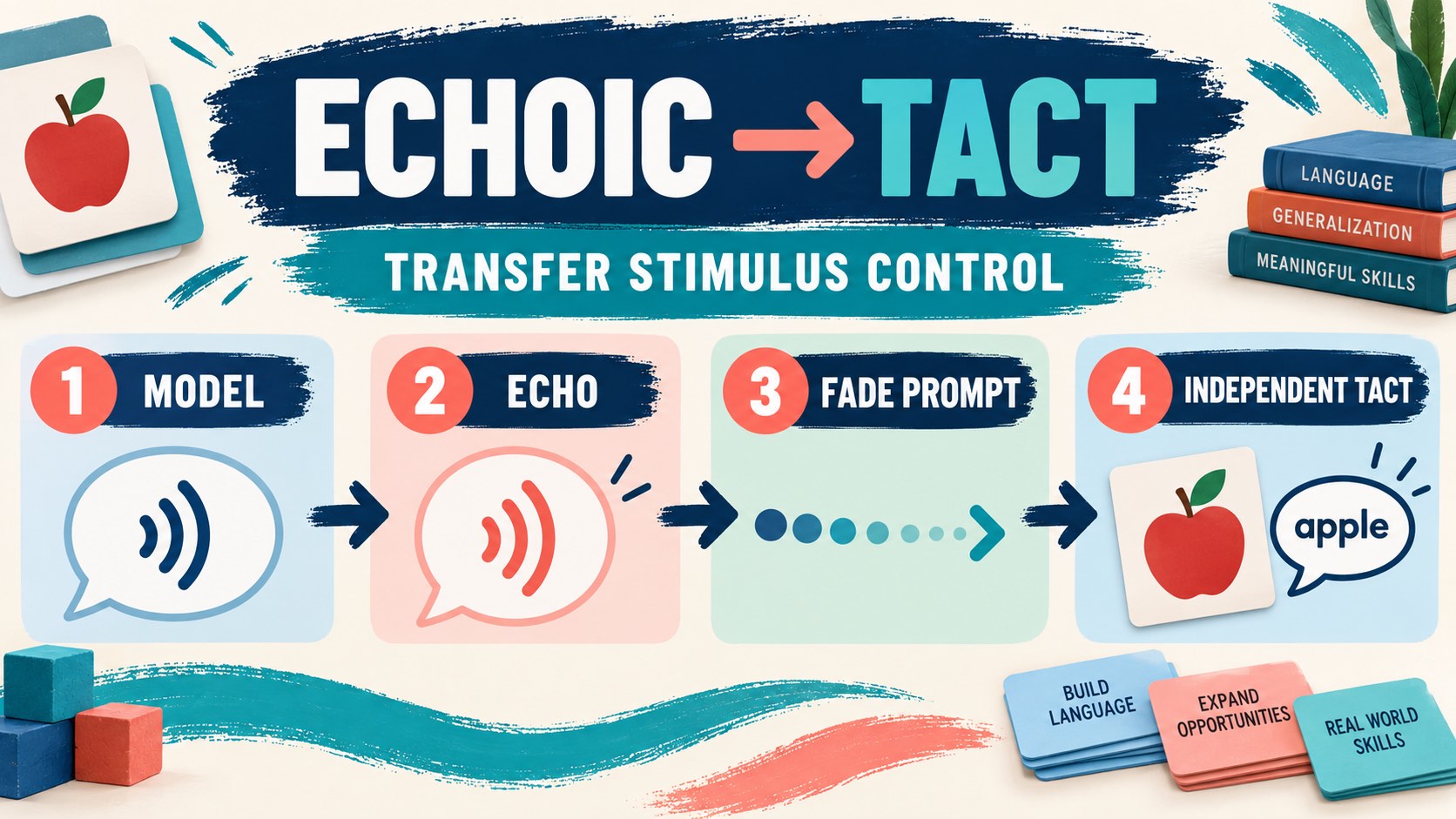
Suppose the target is a vocal tact for “train.” The instructor presents a toy train or a relevant picture and waits briefly. If the learner does not respond, the instructor provides the planned echoic model, “train.” The learner echoes “train” and receives the programmed consequence. On the next opportunity, the instructor presents the train again but delays or reduces the model. If the learner says “train” without hearing the model, that response is scored as independent only if the operational definition says the nonverbal stimulus was sufficient and no other prompt controlled the response.
Now imagine that the learner says “train” only after the instructor asks, “What is it?” The result may still be useful, but the team should not automatically call it an independent tact. The question itself may be functioning as a verbal cue. A later probe can present the train without that question, or can vary the cue according to the goal, so the team can determine whether the response transfers to the intended context.
The same logic applies to a learner who repeats “train” immediately after an adult says it but does not label the train when it is visible. The learner may have a strong echoic response and a developing tact repertoire. The procedure should build on that strength while continuing to measure the difference between echoic performance and nonverbal stimulus control.
What are the prompting and generalization boundaries?
Prompting is not a reason to ignore assent, communication modality, or learner preferences. A vocal tact should not be treated as the only valid way to communicate. If a learner uses sign, AAC, a picture system, or another effective communication form, the team should not remove that access simply to force vocal speech. The target should be socially meaningful, accessible, and consistent with the individualized plan.
Prompt fading also needs a plan for avoiding prompt dependence. Vary unnecessary features of the materials, use an appropriate delay or fading sequence, and check whether the learner can respond with different examples. If a learner only labels a single flashcard after the same adult asks the same question, the program may have produced narrow performance rather than a generalized tact.
The primary transfer studies are useful evidence, but they do not remove the need for individualized assessment. Review learner history, response effort, reinforcement value, possible speech or language factors, and the social validity of the target. Consult appropriately when the case exceeds the practitioner’s competence. The current BCBA Test Content Outline provides exam scope; it does not prescribe one universal prompting script.
What are the BCBA exam traps?

- Calling every echoed word a tact: if the vocal model controls the response, the response is echoic or prompted, not yet an independent tact.
- Leaving the echoic prompt in place: transfer requires a plan to fade or delay the prompt and test control by the nonverbal stimulus.
- Confusing the question with the stimulus: “What is it?” may become an unintended verbal cue. Read the procedure and identify what reliably evokes the response.
- Scoring prompted correct as independent: record prompt level so acquisition and independence are not collapsed into one percentage.
- Assuming one study proves universal effectiveness: applied studies are tied to their participants, targets, procedures, and measurement conditions.
- Forgetting alternative communication: a verbal target should not override effective AAC, sign, or other communication access without a defensible, individualized reason.
- Skipping generalization: a tact learned with one picture and one instructor may not occur with real objects, new people, or naturally occurring opportunities.
Quick review: Echoic-to-tact transfer uses an echoic prompt as a bridge, then fades that prompt so a nonverbal stimulus controls the tact. Measure independent and prompted responses separately, check prompt fidelity, and probe across meaningful examples. For additional application practice, try the free BCBA mock exam. It is a study resource and does not claim to reproduce official BACB questions.
Echoic to tact transfer FAQ
What is the goal of echoic-to-tact transfer? The goal is to move control from an echoic prompt to a nonverbal stimulus so the learner can label or comment independently. Is an echoic prompt the same as a tact? No. An echoic is controlled by a vocal verbal model and has point-to-point correspondence. A tact is controlled by a nonverbal stimulus. An echoic prompt may be used temporarily while teaching a tact.
How do I know the tact is independent? Probe the target with the echoic prompt absent or faded, while the intended nonverbal stimulus is present. Record the prompt level and repeat the probe across relevant examples instead of relying on one response.
Can echoic-to-tact transfer be used with AAC or sign? Transfer procedures can be adapted to a learner’s communication modality, but the goal should be meaningful communication rather than forcing speech. Define the response form and consult the individualized plan and qualified team.
Take the Free BCBA Mock Exam
When you are ready to apply the idea, use the free practice resource below for additional feedback. Take the Free BCBA Mock Exam



