
Quick answer: The clearest examples of higher order conditioning in real life involve a new neutral stimulus being paired with an already conditioned stimulus. The first stimulus has learned to signal an unconditioned event, and the second stimulus begins to produce a similar conditioned response even though it was never directly paired with the original unconditioned stimulus. In ABA and BCBA exam language, higher-order conditioning is also called second-order conditioning.
Table of Contents
- What is higher-order conditioning?
- How does the two-level conditioning chain work?
- What are examples of higher order conditioning in real life?
- How is it different from similar ABA concepts?
- What are the common BCBA exam traps?
- Can you solve a higher-order conditioning question?
- How should you study the concept?
- Higher-order conditioning FAQ
- Sources for further study
- Take the Free BCBA Mock Exam
For example, a child may first become excited when a familiar ice-cream truck melody predicts ice cream. If the child repeatedly hears that melody immediately after seeing a particular street corner, the street corner may later evoke excitement too. The corner did not directly predict ice cream at first; it borrowed predictive value from the already conditioned melody. That two-step learning history is the key to recognizing examples of higher order conditioning in real life.
This guide uses original, everyday scenarios to show the stimulus chain, then separates higher-order conditioning from operant reinforcement, stimulus generalization, and sensory preconditioning. Treat the scenarios as study models, not as proof that every emotional reaction in daily life has been experimentally demonstrated. Table of Contents
What is higher-order conditioning?
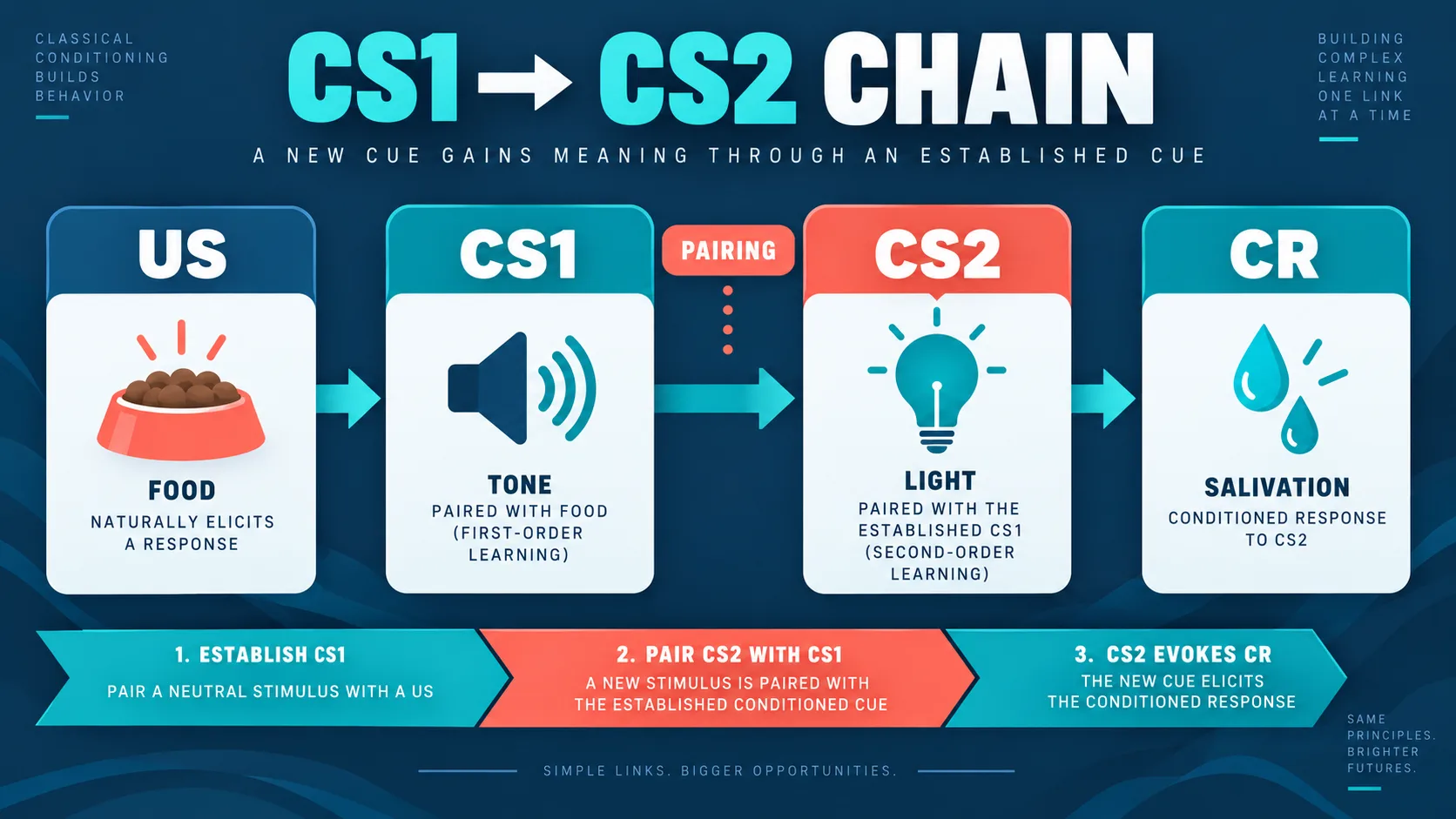
Higher-order conditioning occurs when a neutral stimulus is paired with a stimulus that has already become conditioned. The original conditioned stimulus was established through a first learning relationship with an unconditioned stimulus. After the second pairing, the new stimulus can evoke the conditioned response associated with the first stimulus.
The APA Dictionary of Psychology describes second-order conditioning as a classical-conditioning process in which a conditioned stimulus helps establish another stimulus as a cue for the response. “Higher-order” is the broader term because the chain can continue beyond the second level, although BCBA study questions commonly focus on the first two links. There are four labels to keep straight:
- Unconditioned stimulus (US): an event that elicits a response without prior pairing in the example.
- Unconditioned response (UR): the response produced by the US.
- Conditioned stimulus (CS): a previously neutral stimulus that acquired signal value through pairing.
- Conditioned response (CR): the learned response evoked by the CS.
The most important clue is not that the second stimulus “feels familiar.” The clue is the sequence: the first CS already predicts the US, and the new stimulus is paired with that first CS. If the question does not provide that learning history, describe the event cautiously rather than forcing the higher-order label.
How does the two-level conditioning chain work?
Imagine a simple first-order example before adding the second stimulus:
| Learning stage | Stimulus relationship | What to notice |
|---|---|---|
| Before conditioning | Neutral stimulus + US → UR | The neutral stimulus does not yet reliably signal the US. |
| First-order learning | CS1 + US → CR | CS1 gains predictive value through the US. |
| Second-order learning | CS2 + CS1 → CR | CS2 borrows signal value from CS1; the US is not the direct partner in this new pairing. |
| Test | CS2 → CR | The new stimulus can evoke a response similar to the first CS. |
In a real-life story, the labels may be hidden inside ordinary details. “The ringtone became exciting” is not enough. Ask what the ringtone predicted, which stimulus was conditioned first, and what event was paired with the new cue. That reconstruction turns a vague story into a behavior-analytic learning history.
What are examples of higher order conditioning in real life?
The examples below are deliberately different so you can practice finding the same structure across settings. They are not claims that a person’s behavior has been clinically assessed. 1. A familiar playlist and a favorite café: A student regularly listens to one upbeat playlist while meeting friends at a café where enjoyable conversations and a favorite drink occur. After enough pairings, the playlist becomes CS1 and evokes anticipation. Later, the student repeatedly hears the playlist while walking past the café’s distinctive mural, before entering. The mural is initially neutral, but it is paired with CS1. Eventually, seeing the mural alone may evoke anticipation. The mural is functioning as CS2 in this learning story.
The exam clue is the order. The playlist acquired its meaning from the enjoyable event first; the mural then acquired meaning through the playlist. If the student simply likes many colorful murals, that would be a different explanation, such as generalization or a preference, not enough by itself to establish higher-order conditioning.
2. A school notification and the classroom door: Suppose a student first learns that a specific notification sound predicts a preferred activity or an important class event. The sound becomes CS1 and produces an alert, anticipatory response. Later, the student repeatedly sees a particular classroom door immediately before the notification sounds. After that pairing, the door may evoke the same alert response before the sound occurs. The door is the newly conditioned CS2.
This example also shows why “real life” does not mean “operant.” If the student walks faster because arriving early produces extra free time, walking faster may be an operant response influenced by its consequence. The door’s immediate elicitation of an anticipatory reaction is the respondent-conditioning portion of the story.
3. A clinic hallway and a previously conditioned cue: Imagine that a person has learned to feel tense when a particular monitor alarm sounds because the alarm has repeatedly preceded an uncomfortable procedure. The alarm is CS1. Later, the person repeatedly sees a distinctive hallway sign immediately before the alarm. The sign may begin to evoke tension as CS2, even before the alarm sounds.
Use this example carefully. A sign can also acquire meaning through verbal rules, direct instruction, or a complicated history that is not described. A BCBA-style answer should say that the pattern could illustrate higher-order conditioning only when the question supplies the repeated CS2–CS1 pairing and a learned response. Do not diagnose anxiety or recommend treatment from a study vignette.
How is it different from similar ABA concepts?
Several answer choices can sound plausible because they all involve learning or stimulus relations. Use the source of the stimulus value as the sorting rule.
| Concept | Core question | Fast distinction |
|---|---|---|
| Higher-order conditioning | Was a new neutral stimulus paired with an established CS? | The new cue borrows signal value through a CS1–CS2 chain. |
| Operant reinforcement | Did a consequence change the future frequency of behavior? | Look for behavior followed by a consequence and a change in future responding. |
| Stimulus generalization | Does the learned response spread to similar stimuli? | Similarity is the key; a new stimulus does not necessarily need a CS1 pairing. |
| Sensory preconditioning | Were two neutral stimuli paired before either acquired value? | The order starts with a neutral–neutral relation, not a new cue paired with an established CS. |
What are the common BCBA exam traps?
When a question uses a story instead of labels, slow down before choosing the term. These are the errors most likely to turn a correct observation into the wrong answer:
- Calling every new association higher-order conditioning: look for the specific CS2–CS1 pairing and the prior conditioning of CS1.
- Confusing “second” with a second US: the second-order step uses an established CS as the learning partner.
- Replacing respondent language with reinforcement language: an elicited response is not automatically a behavior strengthened by a consequence.
- Ignoring the learning history: the same visible response can have different explanations depending on what preceded it.
- Treating a similar stimulus as CS2: similarity suggests generalization unless the stem describes a pairing history.
- Overreading the BACB outline: use the current outline for exam scope, but do not claim that this exact phrase is a separately named BACB task unless the source says so.
A compact memory aid is “conditioned cue teaches the next cue.” First identify what CS1 predicts. Then ask whether CS2 was repeatedly paired with CS1. Finally, identify the response that appears when CS2 is presented alone.
Can you solve a higher-order conditioning question?
Mini question: A learner first begins to orient toward a particular chime because it reliably precedes a preferred activity. Over the next week, the learner repeatedly sees a blue icon immediately before the chime. Later, the blue icon alone produces orientation. Which explanation best fits the new blue-icon response?
- Positive reinforcement, because orientation increased.
- Stimulus generalization, because the icon and the chime are both sensory events.
- Higher-order conditioning, because the icon was paired with an already conditioned chime.
- Extinction, because the preferred activity was not described in the final test.
Best answer: 3. The chime is CS1 after its history with the preferred activity. The blue icon is paired with CS1 and later evokes a similar response, making it CS2. The question does not describe a consequence delivered after orientation, so positive reinforcement is not the best label for this particular learning relation.
How should you study the concept?
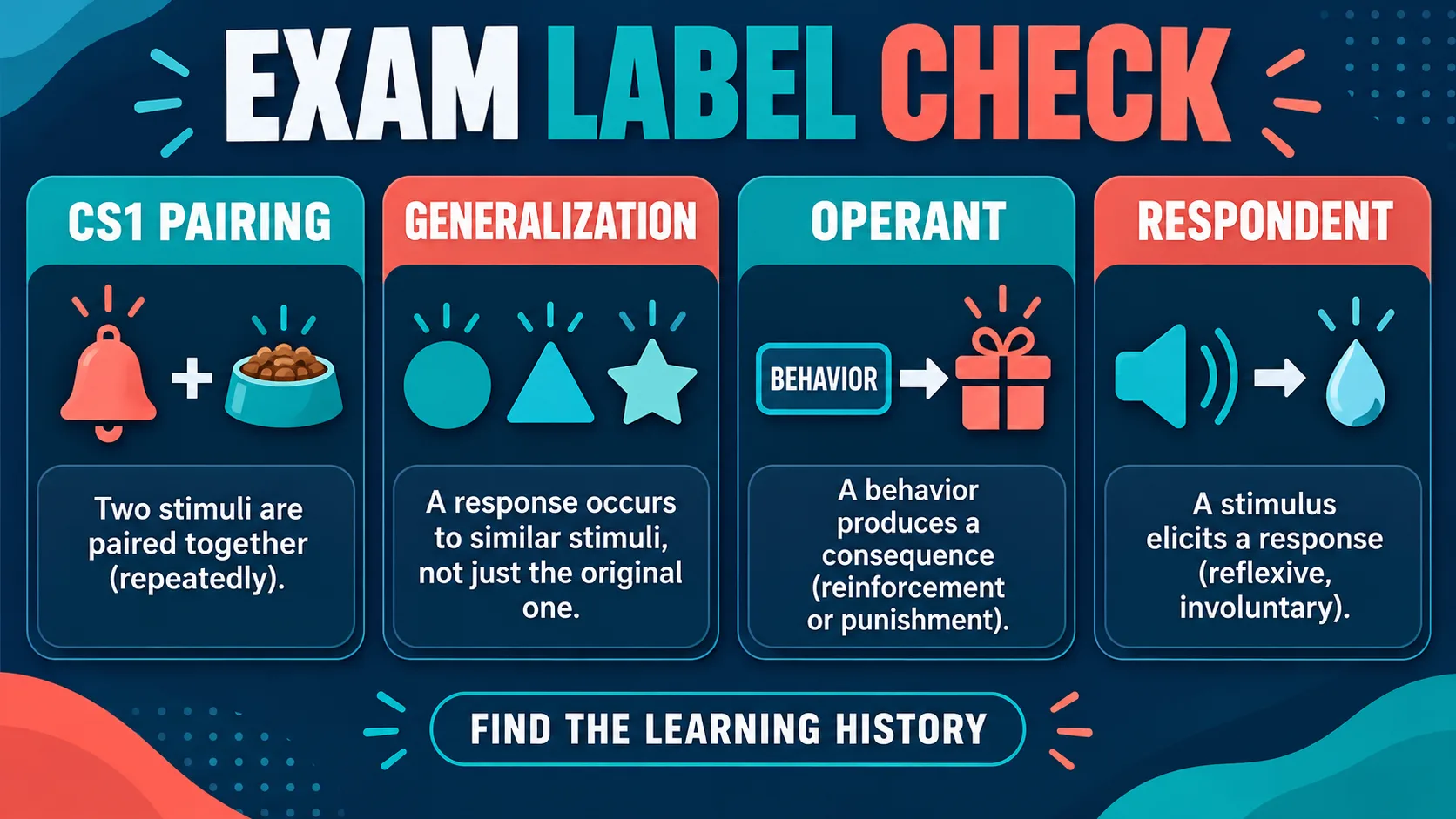
Turn each scenario into a four-line map instead of memorizing a definition in isolation:
- Name the original US and the response it naturally evokes.
- Identify CS1 and explain how CS1 acquired signal value.
- Identify CS2 and confirm that it was paired with CS1, not merely similar to it.
- State whether the final response is elicited or changed by a consequence.
The current BACB test-content page links the BCBA Test Content Outline, 6th edition. Use that official outline to check the broader assessment, learning, and behavior-change scope for your exam preparation. The outline is an exam-scope source, while the APA Dictionary definition and the open psychology example help you verify the concept and terminology.
After you can label the chain, use our free BCBA mock exam as a timed practice step. It is a study aid for feedback, not official BACB questions, an official partnership, or a passing-score guarantee.
Higher-order conditioning FAQ
Is higher-order conditioning the same as second-order conditioning? Usually, yes. Second-order conditioning is the most common example of higher-order conditioning: a new stimulus is paired with an established conditioned stimulus. “Higher-order” can also describe later levels in the chain.
Does higher-order conditioning require reinforcement?: Do not use operant reinforcement as the defining requirement. The key evidence is a respondent-conditioning history in which a new cue is paired with an established conditioned cue. A real-life situation can contain both respondent and operant processes, so label the part the question actually describes.
Is a similar stimulus automatically a second-order conditioned stimulus?: No. Similarity by itself points more directly toward stimulus generalization. A second-order example requires a learning history in which the new stimulus was paired with the established CS.
Can one everyday reaction prove higher-order conditioning?: No. One observation can suggest a hypothesis, but it does not reveal the person’s complete learning history or demonstrate a controlled conditioning process. Use cautious language in applied work and keep the exam label tied to the facts provided.
Sources for further study
- APA Dictionary of Psychology: second-order conditioning
- BACB Test Content Outlines
- BCBA Test Content Outline, 6th edition
- Introduction to Psychology: Classical Conditioning
- Higher-Order Conditioning: What Is Learnt and How it Is Expressed
Bottom line: The best examples of higher order conditioning in real life show a new neutral cue gaining signal value from an already conditioned cue. Find the original US, map CS1, verify the CS2–CS1 pairing, and then rule out operant reinforcement and stimulus generalization before selecting the answer.
Take the Free BCBA Mock Exam
When you are ready to apply the idea, use the free practice resource below for additional feedback. Take the Free BCBA Mock Exam



