

Short answer: If you are looking for BCBA supervision materials, start with the current BACB rule source for your role, then add the work tools and records that let you apply that source. A useful folder usually contains a handbook or supervision hub, a checklist or meeting form, a supervision log, feedback notes, and a review step. You do not need every PDF with “supervision” in its filename; you need the material that answers your decision and preserves the evidence behind it.
Table of Contents
- What are BCBA supervision materials?
- Which materials fit each role?
- How should you build a supervision-materials folder?
- Do the 2027 BCBA changes affect the materials you need?
- How do BCBA supervision materials connect to exam study?
- What mistakes should you avoid?
- What is a simple review workflow?
- BCBA supervision materials FAQ
- Take the Free BCBA Mock Exam
The phrase can describe different needs. A BCBA trainee may need fieldwork guidance and verification forms. A BCBA supervisor may need supervisor training, a fieldwork checklist, feedback tools, and a way to reconcile signatures. An RBT or BCaBA may need a different handbook and an ongoing-supervision form. This guide maps those materials without treating a third-party template as an official BACB requirement. Table of Contents
What are BCBA supervision materials?
BCBA supervision materials are the sources, tools, and records used to plan, conduct, document, and review behavior-analytic supervision. The most important distinction is between a rule source and a work tool. A current BACB handbook or official resource page explains what the Board requires or recommends. A calendar, checklist, agenda, spreadsheet, or note template helps people carry out the work. The tool may be useful without being an official BACB form.
The BACB’s Supervision, Assessment, Training, and Oversight page organizes resources by role. Its overview distinguishes supervising fieldwork, supervising BCaBAs, supervising RBTs, assessing RBTs, and training RBTs. That role-based structure is a better starting point than downloading a generic “supervision packet” from an unknown source.
For a BCBA candidate, the current BCBA Handbook is the central credential source. It connects supervised fieldwork with monthly and final verification forms, the fieldwork checklist, a sample supervision contract, documentation guidance, and supervisor-training resources. For exam study, the BACB task-list hub and the BCBA Test Content Outline answer a different question: what knowledge and skills the examination assesses. A strong materials system therefore has four layers:
- Rule source: the current handbook, official hub, transition page, or form instructions.
- Work tool: a checklist, meeting agenda, calendar, log, or feedback rubric.
- Evidence: observations, activity records, feedback, hours, signatures, and version information.
- Review: a recurring check that identifies what is complete, what is missing, and who owns the next action.
Which materials fit each role?
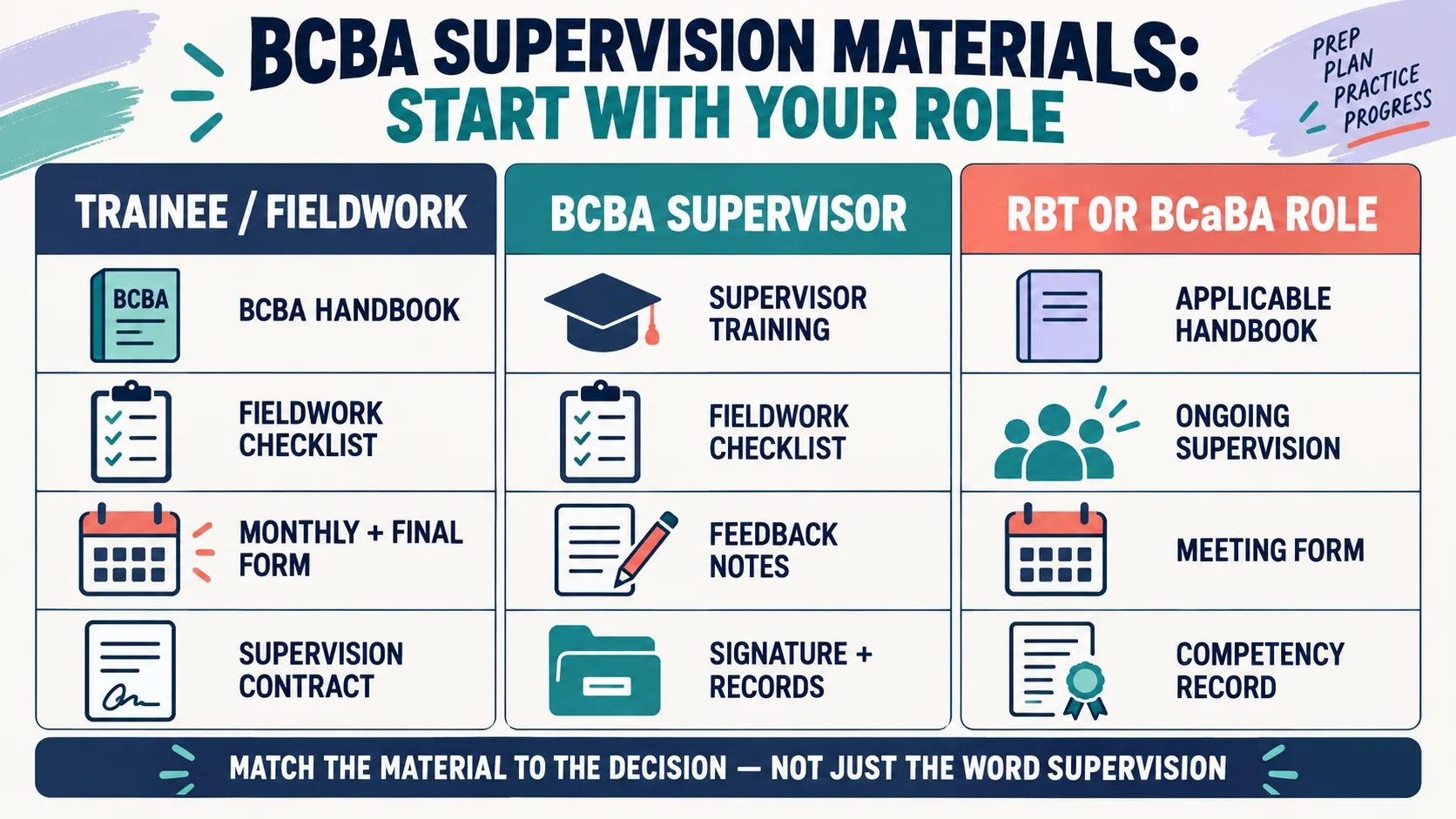
The same document can be useful to more than one person, but the reason for using it changes. A trainee needs to show that fieldwork activities and records align with the applicable requirements. A supervisor needs to provide competent oversight, give feedback, and sign the correct record. An RBT or BCaBA needs the handbook and meeting materials that match that credential’s ongoing-supervision rules.
| Role | Start with | Useful work tools | Evidence to review |
|---|---|---|---|
| Trainee / fieldwork | BCBA Handbook and supervised-fieldwork resources | Fieldwork checklist, calendar, activity log, meeting agenda | Activity records, observations, feedback, hours, applicable monthly and final forms |
| BCBA supervisor | Supervision hub, handbook, and supervisor-training curriculum | Observation plan, feedback rubric, case-review agenda, signature tracker | Supervision notes, competency evidence, follow-up actions, signed records |
| RBT or BCaBA role | The applicable handbook and ongoing-supervision section | Meeting form, competency record, schedule, feedback notes | Required supervision evidence, competency results, signatures, correction log |
Notice that a supervision log is not automatically the same as a verification form. The log is a working record that helps you reconstruct what occurred. The official form is a separate document with its own fields, version, and signature expectations. Use the official instructions to decide which evidence belongs on which form.
How should you build a supervision-materials folder?
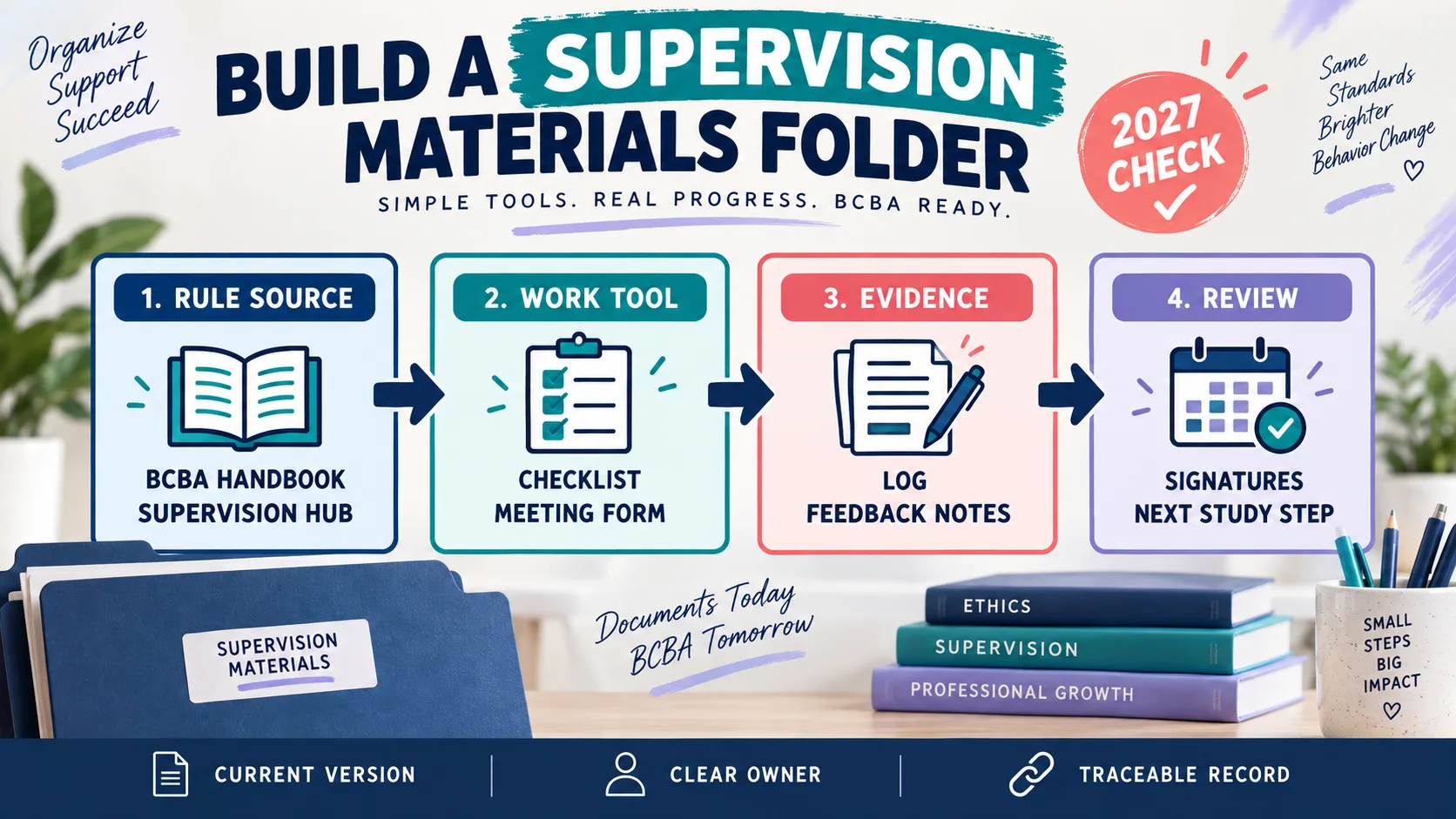
A practical folder can be digital or paper. What matters is that a reader can tell which source controls, which tool was used, what evidence was created, and what happens next. A simple structure is:
1. Rule source: Save the link and access date for the applicable BACB handbook, supervision hub, form instructions, and transition guidance. Do not rely on a downloaded file with an old filename if the official page has changed. Put the credential and role in the folder name so a BCBA fieldwork record is not confused with an RBT supervision record.
2. Work tool: Choose only the tools that support the next decision. A trainee may need a checklist that separates unrestricted and restricted activities, a calendar for recurring meetings, and a log that records the activity, date, setting, and reviewer. A supervisor may need an observation plan, a feedback template, and a case-review agenda. These tools should make observable actions easier to document; they should not silently rewrite BACB requirements.
3. Evidence record: Keep the record specific enough to support later review. Depending on the role and applicable rules, that may include a dated activity description, observation details, feedback, competency evidence, hours, corrections, and signatures. Protect client information and access permissions. A helpful record answers “what happened, when, under whose responsibility, and where is the supporting evidence?”
4. Review and next action: End each review with a short status: complete, needs correction, or waiting for a decision. Name the owner and due date. For example, “Trainee reconciles the March log with the monthly form by April 5” is more useful than “check paperwork.” This turns supervision materials into a quality system rather than a stack of files.
Do the 2027 BCBA changes affect the materials you need?
Yes, the date and pathway matter. The BACB’s 2027 BCBA Requirements page states that applicants applying after January 1, 2027, will use the 2027 Monthly and Final Fieldwork Verification Forms. It also describes the 2027 fieldwork framework, including the unrestricted-activity proportion and supervisor qualifications. Use that page together with the current BCBA Handbook rather than copying a form from an older article or a third-party download. That does not mean every person should replace every record immediately. First identify the relevant application timing, fieldwork requirement edition, supervisor arrangement, and form version. Then ask:
- Which version applies to this trainee or applicant?
- Is the record for an individual supervisor or multiple supervisors at one organization?
- Does the current form require a field that the private log does not capture?
- Who is responsible for reconciling the record before a signature?
For a rule-sensitive question, the answer should be “check the current BACB source and document the version,” not “use the template that appeared first in a search.” The 2027 page is a planning source; it is not a substitute for reading the handbook sections that apply to your situation.
How do BCBA supervision materials connect to exam study?
Supervision materials and exam materials overlap, but they are not interchangeable. The BCBA Test Content Outline is the study map. It organizes the examination into domains, including personnel supervision and management. The handbook and supervision pages are the rule and practice sources. A checklist or log is a study aid only if it helps you reason about the task; it is not proof that you have mastered it. To study efficiently, turn each material into a question:
- Handbook: Which rule or definition controls this scenario?
- Checklist: What observable step must occur, and what would count as incomplete?
- Meeting form: What feedback or competency decision is being documented?
- Log: Can another reviewer reconstruct the activity without guessing?
- Verification form: Which fields, signatures, and version checks are required?
Then mix questions instead of studying one form in isolation. A BCBA exam stem may give you a polished record and ask what is missing, or it may describe a supervision decision without naming the form. Practice identifying the role, the responsibility, the evidence, and the ethical or technical boundary before choosing an answer.
What mistakes should you avoid?
- Treating a template as official: label third-party tools as tools and link back to the current BACB source.
- Using a stale version: check the official page, effective date, and form edition before copying fields.
- Confusing a log with verification: a private working record does not automatically replace an official form.
- Collecting files without an owner: every correction or signature request needs a person and a date.
- Using one packet for every role: BCBA fieldwork, BCaBA supervision, and RBT supervision have different source paths.
- Over-documenting client information: keep records useful, secure, and limited to what the work requires.
- Studying the checklist but not the decision: exam questions test application, not recognition of a file name.
What is a simple review workflow?
Use this 30-minute workflow when you are unsure which BCBA supervision materials to collect:
- Name the role: trainee, supervisor, BCaBA, RBT, or another responsible individual.
- Name the decision: begin supervision, document fieldwork, review competency, complete a form, or prepare for an exam.
- Open the current official source: handbook, supervision hub, form instructions, or 2027 transition page.
- Select one work tool: checklist, agenda, log, or feedback rubric that supports that decision.
- Define the evidence: write down the fields, observations, signatures, and version checks that must be recoverable.
- Schedule the review: assign an owner, date, and correction path before the folder gets crowded.
After the materials are organized, use a mixed practice set to test whether you can apply them under time pressure. The free BCBA mock exam is a natural next step for practice questions about supervision, documentation, and exam reasoning. It is an independent study resource, not an official BACB exam and not a guarantee of a passing result.
Bottom line: The best BCBA supervision materials system is not the biggest download folder. It is a role-matched chain from the current BACB source to a practical tool, a traceable record, and a scheduled review. Check the 2027 version boundary when it applies, keep official forms separate from personal templates, and study the decision that each material supports.
BCBA supervision materials FAQ
What is the first BCBA supervision material a trainee should read? Start with the current BCBA Handbook and its supervised-fieldwork section, then open the applicable fieldwork checklist and verification-form instructions. The exact form version depends on the trainee’s timing and pathway.
Is a BCBA supervision log an official BACB form? Not automatically. A private log can organize activities and evidence, but it should not be presented as an official BACB form unless it is actually published by the BACB. Use the official verification forms and instructions when they apply.
What materials does a BCBA supervisor need? The supervisor should identify the applicable handbook, supervision hub, supervisor-training requirements, fieldwork checklist, observation and feedback tools, and signature or verification records. The exact set depends on whether the supervisor oversees trainees, BCaBAs, RBTs, or another role.
Do I need every document listed on the BACB website? No. Use the resources that match your role and decision. Keep a short source list, then add only the work tools and evidence records needed to complete and review that work. Where should I check for 2027 changes? Start with the official 2027 BCBA Requirements page and the current BCBA Handbook. Confirm the effective date and form version before relying on a checklist or template.
What should I do if two resources appear to conflict? Record the conflict, check the effective date and credential, and follow the current official source or contact the BACB for clarification. Do not resolve a rule conflict by silently editing a personal template.
Sources and further reading: Review the BACB supervision and training hub, the BCBA Handbook, the 2027 BCBA Requirements, and the BACB task-list hub. These sources can change; check the official pages again when you begin a new fieldwork or supervision cycle.
Take the Free BCBA Mock Exam
When you are ready to apply the idea, use the free practice resource below for additional feedback. Take the Free BCBA Mock Exam



