
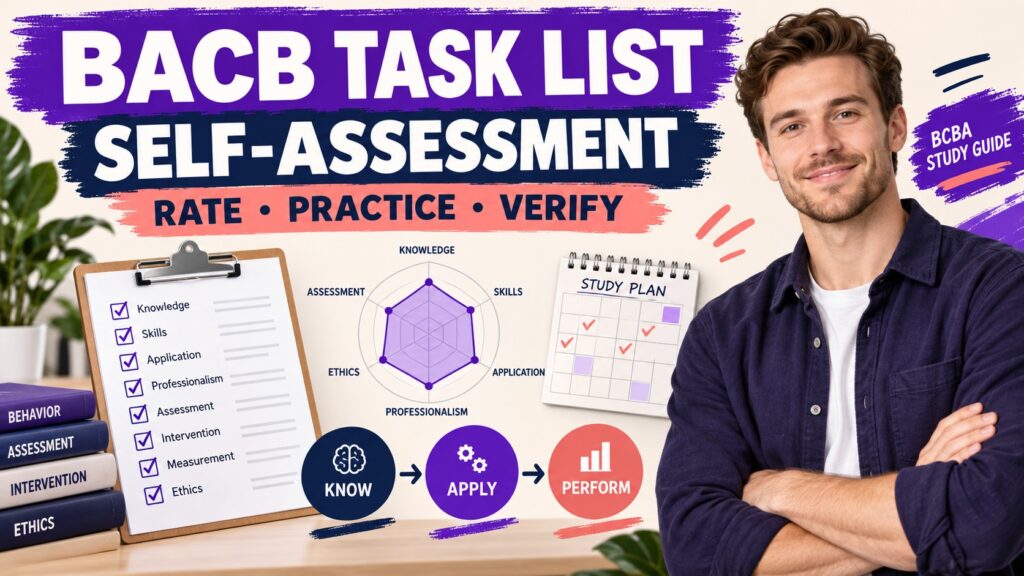
Short answer: A BACB task list self assessment is a structured way to rate your current BCBA knowledge and skill against the exam content, identify evidence for each rating, and choose what to study or practice next. It is a study and supervision tool—not an official BACB application form, a substitute for a supervisor’s evaluation, or proof that a candidate is independently competent.
Table of Contents
- What is a BACB task list self-assessment?
- What should you rate?
- How should you build a BACB task list self assessment?
- How is self-assessment different from verification?
- How do you score and prioritize the results?
- How do you turn the score into a study plan?
- What are common self-assessment mistakes?
- BACB task list self assessment FAQ
- Take the Free BCBA Mock Exam
The current BACB resource is the BCBA Test Content Outline (TCO), 6th edition, which became effective for the BCBA examination beginning January 1, 2025. Many candidates still search for “BACB task list self assessment” because the older phrase is familiar. A useful page should honor the search term while directing learners to the current official outline and avoiding a copy of the entire document. Table of Contents
What is a BACB task list self-assessment?
A task-list self-assessment is a self-rating process in which a candidate reviews a defined exam or practice skill, records how confidently they can explain or perform it, and documents what evidence supports that judgment. For BCBA study, the most current anchor is the BACB task-list and test-content page, which points candidates to the 6th-edition BCBA Test Content Outline.
The word self matters. Your rating tells you what you believe you can do today; it does not independently verify accuracy, fluency, ethical judgment, or performance under supervision. A candidate can feel very confident after reading a definition and still miss a scenario question. Conversely, a low confidence rating can reflect test anxiety even when the underlying skill is strong. Use the assessment to create a feedback loop:
- Rate: estimate your current level for a narrowly defined skill.
- Test: explain, retrieve, or apply the skill without looking at notes.
- Verify: compare the response with an authoritative source, practice rationale, supervisor observation, or work product.
- Act: schedule the next study, rehearsal, generalization, or consultation step.
For a broad overview of what changed in the current exam content, see the site’s BCBA 6th-edition task-list guide. This page takes the narrower next step: how to use a BACB task list self assessment as a study process without confusing it with the official exam blueprint or a competency decision.
What should you rate?
A useful self-assessment rates more than recognition. For each topic, decide which of the following levels you can demonstrate:
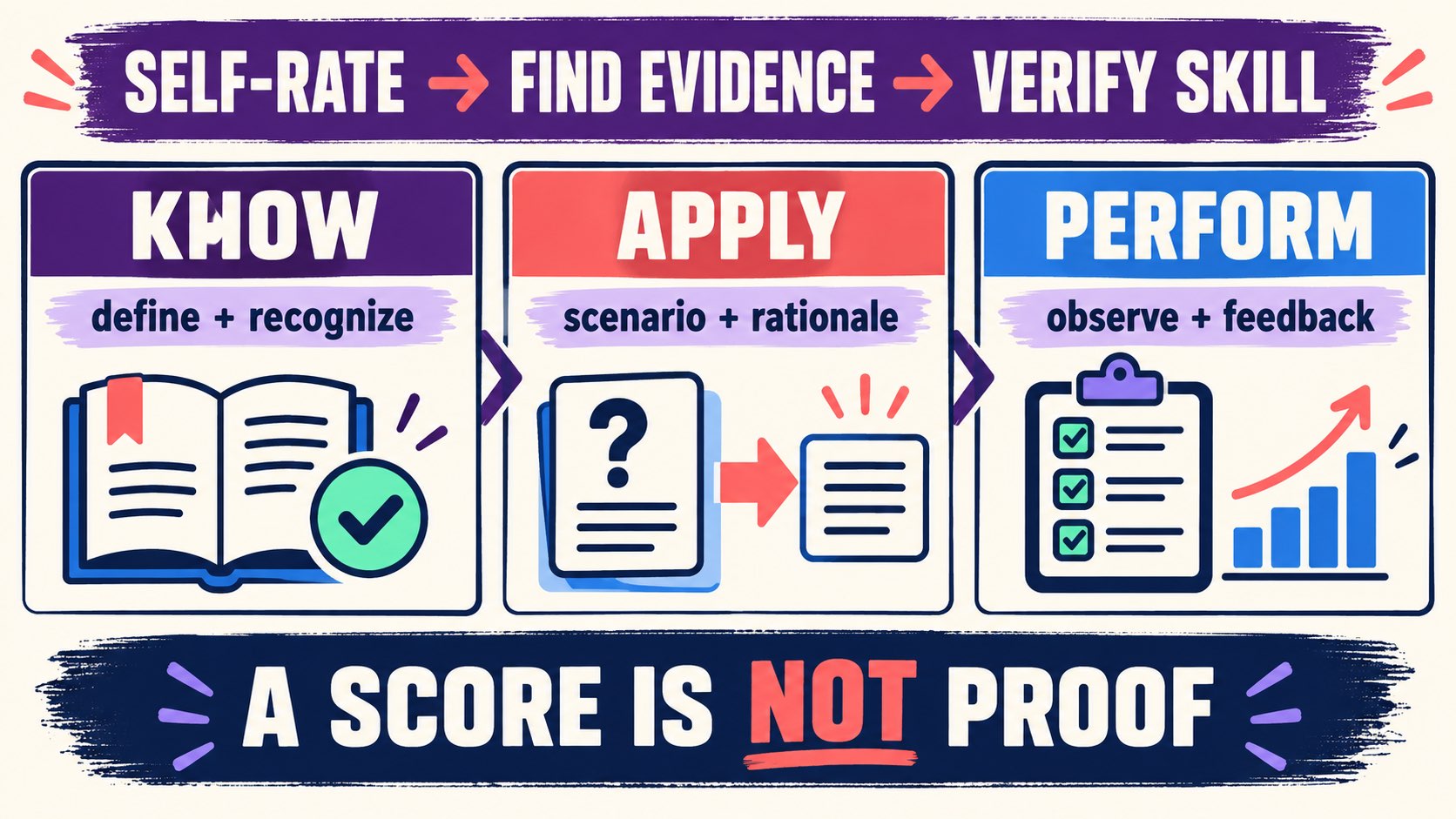
- Know: define the concept, identify its boundaries, and recognize a straightforward example without relying on a cue.
- Apply: choose or explain a procedure in a new scenario, justify the decision with data or function, and reject plausible distractors.
- Perform: carry out the relevant action accurately in a simulated or supervised context, document it, and respond to feedback.
Do not mark an item “mastered” just because you highlighted it, watched a video, or answered one easy question. The rating should name the performance evidence you have. For example, “I can define differential reinforcement” is a knowledge statement. “I can select DRA instead of DRO when the replacement response must contact the same functional reinforcer” is an application statement. “I can implement the written procedure with fidelity and record the required data” is a performance statement.
How should you build a BACB task list self assessment?
Start with the current official outline, then create your own short prompts rather than copying every line into a public worksheet. Keep each row narrow enough to test in a few minutes. A row such as “behavior change” is too broad; a row such as “distinguish positive reinforcement from negative reinforcement in a three-term contingency” is easier to rate and revisit.
- Choose the source version: write the edition and access date at the top of your sheet. Do not mix an old task list with current exam claims without labeling the difference.
- Group by domain: organize prompts under the current domains, such as concepts and principles, measurement, experimental design, ethics, assessment, behavior change, intervention selection, and supervision.
- Write a testable prompt: use a verb such as define, distinguish, calculate, interpret, select, design, implement, or evaluate.
- Add an evidence field: record a missed question, a correct rationale, a graph interpretation, a role-play observation, a permanent product, or a supervisor note.
- Set a review date: a rating without a next check becomes a static confidence list rather than a learning system.
Make the sheet copyright-safe and practically useful. The BACB publishes the official outline; your self-assessment can link to it and summarize your own prompts, but it does not need to reproduce the complete official text. It should also avoid presenting a commercial template as an official BACB form.
How is self-assessment different from verification?
Self-assessment is an efficient first screen, but high-stakes decisions need stronger evidence. The best verification method depends on whether the skill is verbal, analytical, or performance-based.
| Claim | Self-check | Stronger verification | Typical next step |
|---|---|---|---|
| Define a concept | Explain it from memory and give an example | Source check plus a novel scenario question | Correct the boundary or misconception |
| Interpret data | Describe level, trend, variability, and a decision | Timed graph set with rationale review | Practice the missed visual-analysis dimension |
| Select an intervention | Choose a procedure and state why it fits | Case rationale, data review, and supervisor feedback | Compare function, evidence, fit, and risk |
| Implement with fidelity | Talk through the steps or rehearse them | Direct observation, checklist, or reviewed work product | Practice the exact step that broke down |
The distinction protects both learners and clients. A spreadsheet can show that you rated yourself highly; it cannot make a procedure safe or prove that you can implement it independently. Fieldwork and supervision decisions must follow the applicable BACB requirements, site policies, and supervisor judgment.
How do you score and prioritize the results?
Use a simple scale that separates confidence from evidence. One practical version is:
- 0 — not yet familiar: you cannot explain the term or locate the relevant source.
- 1 — recognition: you can identify a definition or example but need notes for boundaries.
- 2 — application: you can solve a new scenario and explain why close alternatives are wrong.
- 3 — supported performance: you can carry out or produce the skill with supervision, feedback, or a checklist.
- 4 — stable performance: evidence shows accurate, ethical, and generalizable performance across more than one context.
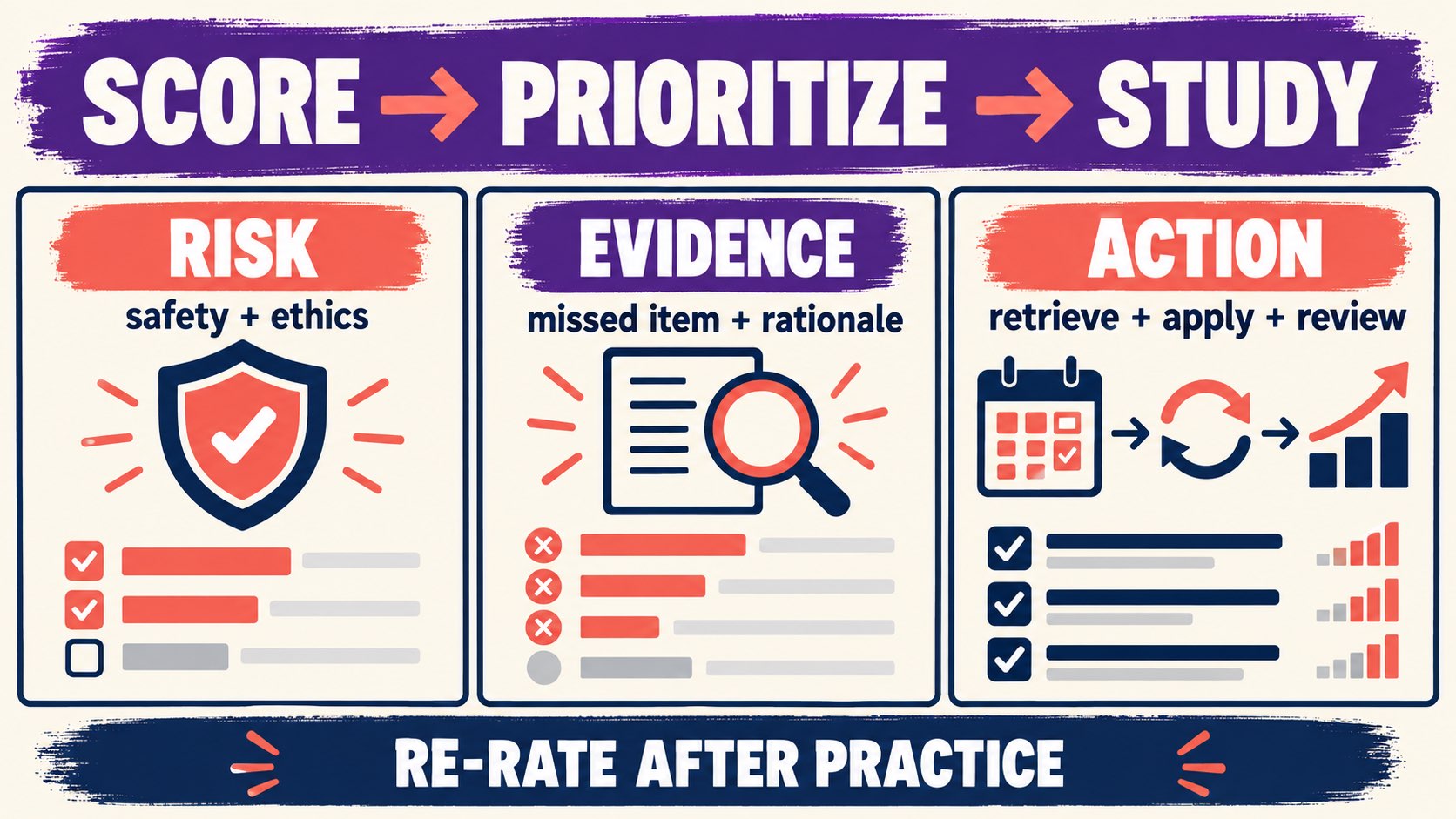
These numbers are a planning device, not a BACB score or a passing prediction. Prioritize a topic using at least three dimensions:
- Risk: could misunderstanding the topic create an ethical, safety, or client-impact problem?
- Exam importance: does the topic recur across the current outline or connect to several commonly confused concepts?
- Evidence gap: is the rating based on a real retrieval, application, observation, or only familiarity?
A low-confidence item with high risk and high exam relevance moves to the front of the plan. A high-confidence item with no evidence gets a verification task, not a permanent “done” label.
How do you turn the score into a study plan?
Convert each priority into a visible action. A good weekly plan does not say “study ethics” for three hours. It says what you will retrieve, what evidence you will produce, and how you will decide whether to revisit the topic.
- Choose one weak cluster: select a connected group such as reinforcement contingencies, measurement selection, or assessment interpretation.
- Retrieve before rereading: answer a short prompt from memory, then compare it with the official source and your notes.
- Apply: complete a new scenario, graph, calculation, or decision matrix without copying the worked example.
- Explain the trap: write why the tempting alternative is wrong. This turns an error into a discrimination skill.
- Re-rate with evidence: update the score only after the new task is complete, and schedule a later maintenance check.
Use the 5th-to-6th edition crosswalk guide only to understand historical terminology and transition context. For current exam preparation, verify that your study prompts point back to the current BACB source rather than relying on an old outline or an undated social-media checklist.
What are common self-assessment mistakes?
- Rating recognition as mastery: seeing a familiar phrase is not the same as generating a correct answer.
- Using one easy question: a single item cannot demonstrate generalization across wording, people, materials, or contexts.
- Mixing editions silently: label older resources and confirm current exam claims against the BACB source.
- Calling the sheet official: a personal checklist is not a BACB form, credential decision, or supervisor sign-off.
- Ignoring evidence fields: without the missed question, graph, observation, or work product, the score cannot guide targeted correction.
- Studying only weak topics: maintain strong domains with brief retrieval so the total profile does not decay.
- Skipping ethical boundaries: knowing a procedure is not enough; know when to seek supervision, consultation, referral, or a safer alternative.
Quick review: rate a narrow skill, retrieve it without notes, apply it in a new scenario, record the evidence, and schedule the next verification. For scenario practice after you identify your weak domains, try the free BCBA mock exam. It is a study resource and does not reproduce official BACB questions.
BACB task list self assessment FAQ
Does the BACB require a task-list self-assessment form? A personal self-assessment is a study or supervision tool. Do not present a third-party worksheet as an official BACB form. Check the current BACB requirements and your supervisor’s documentation expectations for any formal fieldwork or application process.
Is the task list the same as the current BCBA Test Content Outline? Candidates often use “task list” as a familiar search phrase. The current BACB exam resource is the BCBA Test Content Outline, 6th edition. When studying, identify the source version and date instead of mixing editions without explanation.
Can I use a confidence score to predict my exam result? No. A score can help allocate study time, but it is not a scaled BACB score or a reliable pass prediction. Use performance on varied practice questions and rationale review as stronger evidence of exam readiness.
How often should I repeat the self-assessment? Repeat it after a meaningful study or practice cycle, then use spaced checks to test maintenance. Repeating the same worksheet immediately can measure familiarity with the worksheet rather than durable learning.
What should I do when I cannot verify a performance skill? Mark the item as an evidence gap, identify the appropriate supervisor or qualified consultant, and choose a safe learning activity such as modeling, role-play, checklist rehearsal, or direct observation. Do not infer independent competence from reading alone.
Take the Free BCBA Mock Exam
When you are ready to apply the idea, use the free practice resource below for additional feedback. Take the Free BCBA Mock Exam



