

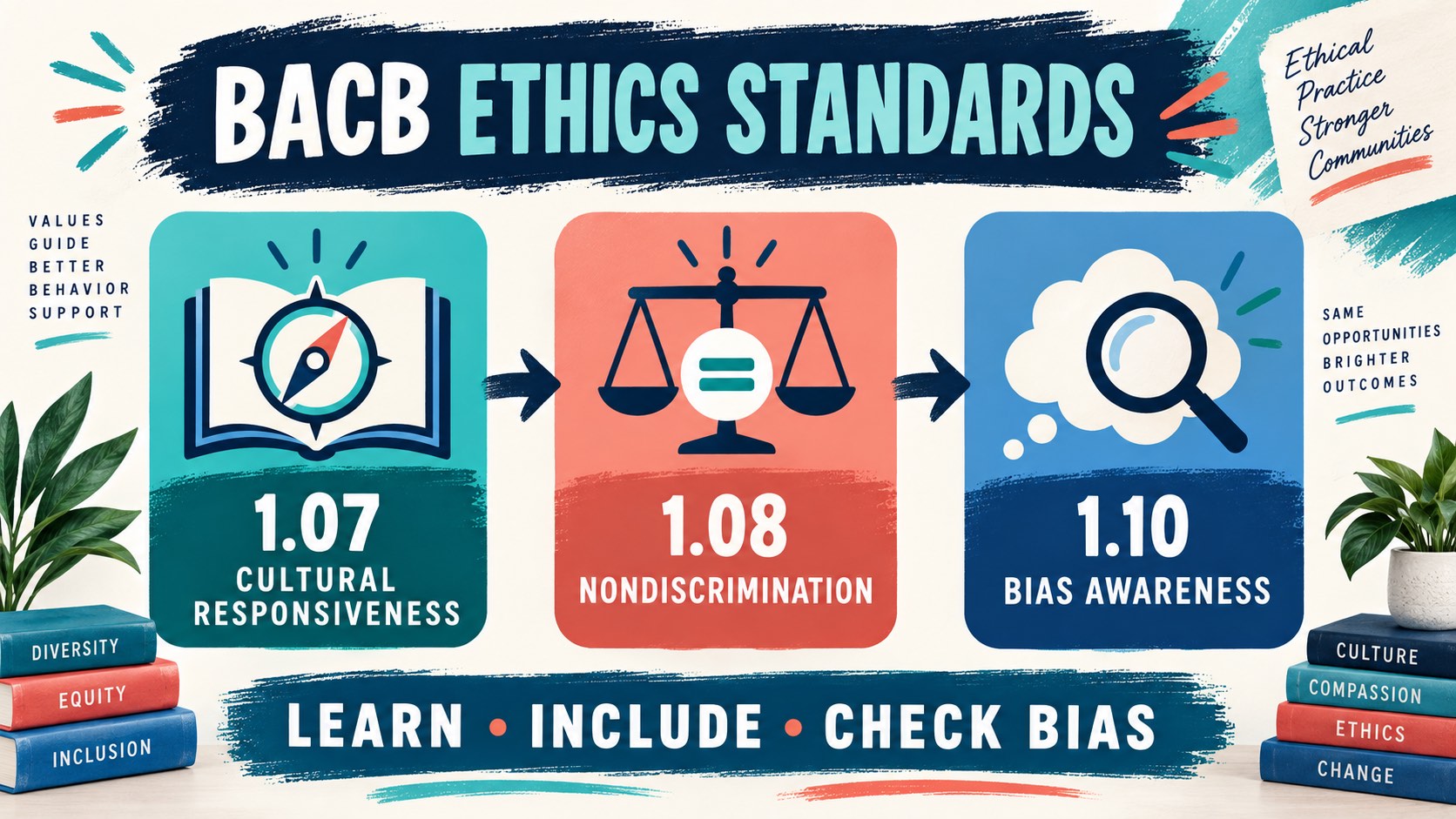
Short answer: In ABA, discrimination and ethics is not about whether a learner discriminates between stimuli. It is about whether a behavior analyst treats people equitably and inclusively, without discriminatory conduct. The current BACB Ethics Code places this duty in Standard 1.08, while Standards 1.07 and 1.10 add related expectations about cultural responsiveness, diversity, and awareness of personal biases.
Table of Contents
- What does discrimination mean as an ethical issue in ABA?
- Which BACB standards apply to nondiscrimination?
- How is ethical discrimination different from stimulus discrimination?
- How should a BCBA respond to a possible discrimination concern?
- What does the decision process look like in a case?
- What should be documented and reviewed?
- What are the BCBA exam traps?
- Discrimination and ethics in ABA FAQ
- Take the Free BCBA Mock Exam
That distinction matters for the BCBA exam. A question may use the word discrimination to describe stimulus control, or it may ask you to identify an ethical concern involving a client, caregiver, supervisee, or colleague. Read the target of the sentence before choosing an answer. This guide treats discrimination as an ethical issue in the behavior-analytic sense and keeps it separate from the stimulus-discrimination concept. Table of Contents
What does discrimination mean as an ethical issue in ABA?
Ethical discrimination occurs when a professional’s treatment, access, decision, communication, or opportunity is unfairly affected by a person’s identity or another protected basis. In behavior analysis, the concern can involve direct services, assessment, supervision, employment-related interactions, training, research, public communication, or collaboration with stakeholders. The first question is not “Is this person different?” The first question is “Is the professional acting equitably and inclusively, and can the decision be justified by the person’s needs and the service context?”
BACB Ethics Code Standard 1.08, Nondiscrimination, says behavior analysts do not discriminate against others and behave toward others in an equitable and inclusive manner. The standard names characteristics such as age, disability, ethnicity, gender expression or identity, immigration status, marital or relationship status, national origin, race, religion, sexual orientation, socioeconomic status, and any other basis proscribed by law. The official Code is the controlling source for the exact wording and should be read with applicable law, licensure rules, employer policy, and professional context.
This does not mean every person receives an identical service. Equitable practice can require an accessible format, a qualified interpreter, a culturally responsive assessment, a change in communication method, or a referral when the practitioner lacks competence. The ethical question is whether the difference is connected to legitimate client needs and professional responsibility, rather than an unsupported stereotype, preference, exclusion, or convenience.
Which BACB standards apply to nondiscrimination?
Standard 1.08 is the direct nondiscrimination rule, but a BCBA exam scenario may also test adjacent standards. The current BACB Ethics Code for Behavior Analysts and the BCBA Test Content Outline should be your primary references.
- Standard 1.07, Cultural Responsiveness and Diversity: the behavior analyst develops knowledge and skills related to cultural responsiveness and diversity, evaluates personal biases and ability to meet diverse needs, and evaluates related abilities in supervisees and trainees.
- Standard 1.08, Nondiscrimination: the behavior analyst does not discriminate and behaves in an equitable and inclusive manner.
- Standard 1.10, Awareness of Personal Biases and Challenges: the behavior analyst monitors factors that could interfere with effective professional work, takes appropriate steps, documents actions, and considers the outcome.
- TCO E.9–E.11: the exam outline asks candidates to engage in cultural humility, apply culturally responsive and inclusive activities, and identify personal biases that may interfere with professional activity.
These standards overlap without being interchangeable. A practitioner might need professional development under 1.07, recognize that a bias is affecting a decision under 1.10, and correct an inequitable action under 1.08. The best exam answer usually names the action that most directly fits the facts, then takes a practical step that protects the client and improves the service.
How is ethical discrimination different from stimulus discrimination?
The word discrimination has more than one technical use. In behavior analysis, stimulus discrimination describes a pattern of responding: behavior occurs more often in the presence of one stimulus than another because of a history of differential reinforcement. That is a behavioral process, not automatically an ethical violation. Ethical discrimination concerns how a professional treats people or allocates professional opportunities.
| Question type | Ethical discrimination | Stimulus discrimination | Fast clue |
|---|---|---|---|
| What is being analyzed? | Professional conduct, access, treatment, or opportunity | A learner’s response pattern in the presence of stimuli | Person or professional action versus stimulus and response |
| What explains the pattern? | Bias, exclusion, inequitable treatment, or a legitimate individualized need | Differential reinforcement and stimulus control history | Ethics standards versus learning history |
| What should the BCBA do? | Protect dignity, check the Code and law, consult, correct, and document | Define stimuli and responses, review contingencies, and evaluate data | Choose the action that fits the problem level |
| Is it automatically wrong? | Unfair discrimination is an ethical concern; individualized access supports may be appropriate | No. Stimulus discrimination can be a normal learning outcome | Do not answer from the word alone |
How should a BCBA respond to a possible discrimination concern?
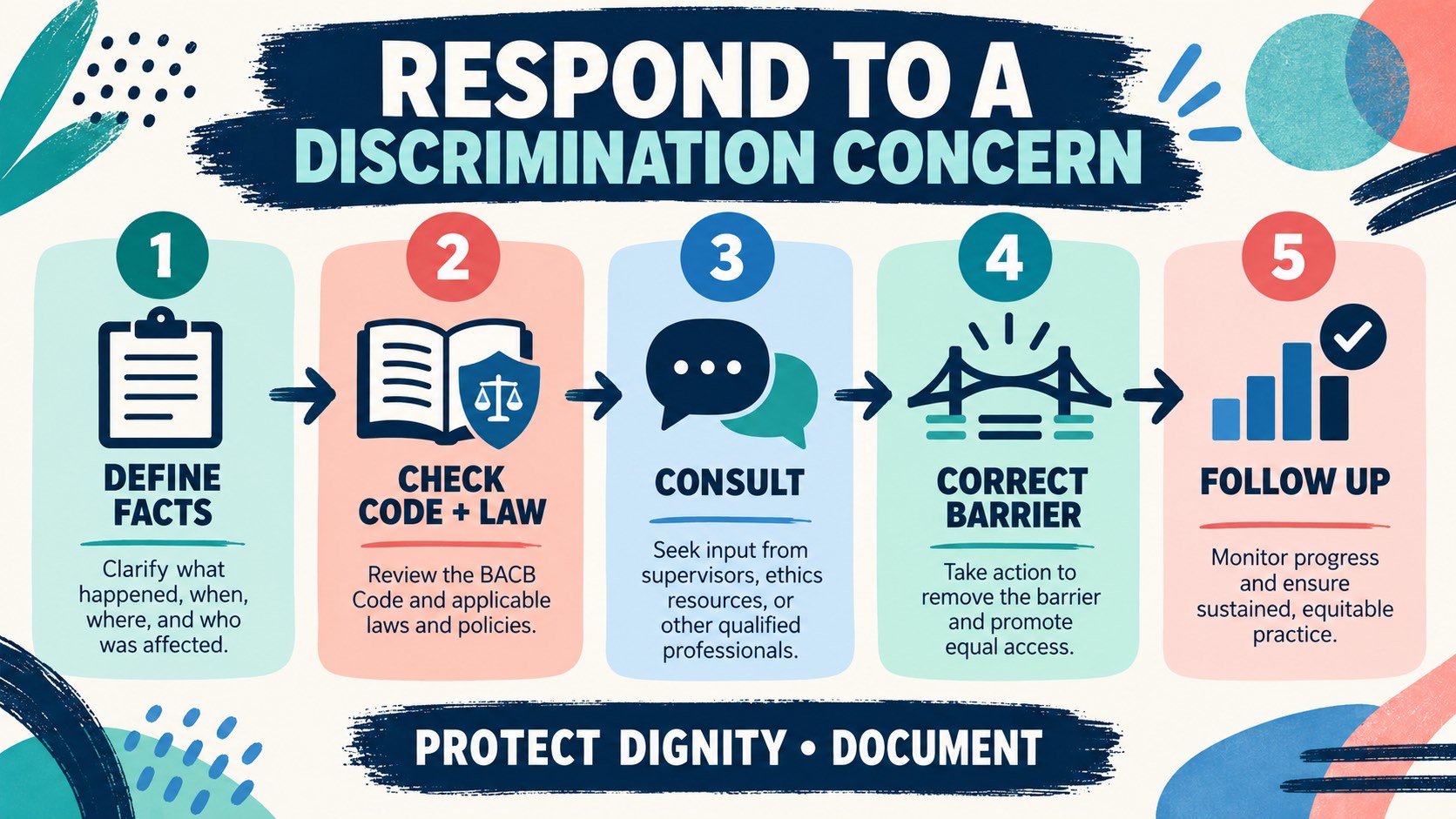
A useful response begins with facts, not a label. The practitioner should protect the person affected while determining whether the issue is a service barrier, a bias, a communication mismatch, a competence limitation, a legal requirement, or a combination. The following sequence supports exam reasoning; it does not replace jurisdiction-specific legal or ethics advice.
- Describe the observable decision: record what access, treatment, statement, referral, assignment, or opportunity changed, who made the decision, and when it occurred.
- Identify the affected person and risk: consider dignity, safety, access to needed services, confidentiality, supervision quality, and the possibility of continued harm.
- Check the relevant sources: review the current BACB Code, the BCBA TCO when studying, applicable law or licensure rules, written policy, and the actual service agreement.
- Test the rationale: ask whether the difference is tied to an individualized need, competence boundary, accessibility requirement, or evidence-based service condition. Separate that rationale from assumptions about a group.
- Consult and correct: seek qualified consultation when the issue is outside the practitioner’s competence, remove the barrier when possible, and make a referral or transition plan when the service cannot be provided appropriately.
- Document the action and follow up: record the concern, consultation, steps taken, communication, outcome, and any change needed in training or supervision.
Inclusive practice is more than avoiding an offensive statement. It can affect how intake questions are asked, how assent and preferences are assessed, whose goals are prioritized, whether materials represent the learner’s context, how caregivers are included, and whether supervision gives trainees a fair opportunity to learn. The peer-reviewed guidance on implicit bias in behavior analysis is useful context, but the current BACB Code remains the primary standard for exam and compliance language.
What does the decision process look like in a case?
Imagine that a clinic routinely offers a caregiver meeting only in one language, assumes that a caregiver who uses an interpreter is “not engaged,” and lowers the family’s participation in planning without checking what access support is needed. The ethical question is not whether every meeting must look identical. The question is whether the clinic has created an avoidable barrier and then interpreted that barrier as a deficit.
A stronger BCBA response would identify the communication barrier, ask the family what format and support would make participation possible, arrange qualified language access when appropriate, and review whether the goals and procedures reflect the family’s priorities and context. The practitioner should consult organizational and legal requirements, document the steps, and avoid promising that one accommodation solves every case. If the problem includes a pattern of unequal treatment or retaliation, the practitioner should escalate through the appropriate ethics, compliance, or regulatory channel rather than quietly changing a note.
On an exam, the tempting wrong answer may be to label the caregiver as noncompliant, to ignore the issue because the treatment data look good, or to provide an identical service without considering access. The better answer usually protects the person, gathers relevant information, consults current requirements, and adapts the professional process without making unsupported assumptions.
What should be documented and reviewed?
Documentation should make the decision understandable to another qualified reviewer. It should not turn a protected characteristic into a diagnosis or assume that a group characteristic explains an individual’s behavior. Useful records may include:
- Access facts: communication method, scheduling barrier, accommodation requested, materials used, and who was included in the decision.
- Service rationale: the individualized need, competency issue, safety reason, evidence, or policy that supports a different arrangement.
- Bias check: the assumption considered, alternative explanation, consultation obtained, and how the person’s own preferences or perspective were invited.
- Outcome review: whether access, participation, dignity, service quality, and stakeholder understanding improved after the change.
- Supervision action: training, feedback, policy clarification, or monitoring needed to prevent the same barrier from recurring.
Data do not make an inequitable process ethical. A program can show strong response rates while still excluding a caregiver from meaningful participation or using goals that are not socially significant for the learner. Review outcome data alongside assent, stakeholder input, accessibility, cultural context, and the person’s right to respectful treatment.
What are the BCBA exam traps?
- Confusing two meanings: stimulus discrimination is not automatically ethical discrimination. First identify whether the scenario concerns a stimulus-response relation or professional conduct.
- Assuming equality means sameness: an individualized accessibility support can promote equitable participation; identical treatment is not always equitable treatment.
- Using 1.07 as the whole answer: cultural responsiveness and diversity development are important, but an actual inequitable action may also implicate Standard 1.08.
- Ignoring personal bias: Standard 1.10 asks the practitioner to recognize interference, take steps, document, and consider outcomes.
- Calling a caregiver noncompliant too quickly: check communication access, context, feasibility, and whether the professional process created the barrier.
- Giving legal certainty: BACB ethics, licensure law, employment policy, and civil-rights requirements can interact. Use the current source and consult the proper professional when the question is jurisdiction-specific.
- Stopping at consultation: consultation is often a step, not the final action. Protect the person, correct the barrier when possible, document, and follow up.
Quick review: If the question is about how a person is treated, start with nondiscrimination and equity. If it is about how a learner responds to stimuli, start with stimulus control and differential reinforcement. If bias or cultural context may interfere with service delivery, connect the facts to Standards 1.07 and 1.10 as well as 1.08. For additional application practice, try the free BCBA mock exam. It is a study resource and does not claim to reproduce official BACB questions.
Discrimination and ethics in ABA FAQ
Is discrimination always an ethics violation in ABA? No. Stimulus discrimination is a normal behavioral process and can be a teaching objective. The ethical concern is unfair or prohibited treatment of people, exclusion, or inequitable professional conduct. What BACB standard is most directly related to discrimination? Standard 1.08 is titled Nondiscrimination. Standards 1.07 and 1.10 often provide the surrounding reasoning about cultural responsiveness, diversity, and personal bias.
Does equitable treatment mean every client receives the same procedure? No. A procedure may need to be adapted for communication, accessibility, culture, safety, competence, or individualized goals. The rationale should be relevant, documented, and respectful rather than based on stereotype or convenience.
What should I do if the exact situation is not in the Code? Define the observable concern, protect the person from ongoing harm, review the current Code and applicable requirements, seek qualified consultation, document the process, and follow up. Do not treat a study guide as a substitute for professional or legal advice.
Take the Free BCBA Mock Exam
When you are ready to apply the idea, use the free practice resource below for additional feedback. Take the Free BCBA Mock Exam



