

In ABA ethics, “dual relationship” is the familiar search phrase, while the current BACB Ethics Code uses multiple relationships. The practical question is not whether every unexpected contact is automatically unethical. It is whether two or more roles are creating a conflict of interest, risk of harm, impaired objectivity, or unclear professional boundaries—and what you do next.
Table of Contents
- What “dual relationship aba” Means in the BACB Code
- Run a Dual Relationship ABA Risk Screen
- Separate Contact From a Second Role
- Communicate the Concern Without Shaming
- Document the Decision and Safeguards
- Resolve, Refer, or Transfer the Case
- Apply the Framework to Common Scenarios
- Common Exam and Practice Traps
- Frequently Asked Questions
- Sources and Verification Notes
- Take the Free BCBA Mock Exam
People searching for dual relationship ABA often want a quick yes-or-no answer. A safer answer starts with facts. A behavior analyst may encounter a client’s family at a community event, receive a social-media request, be offered paid work outside the case, or discover that a supervisee is also a close friend. These situations do not all carry the same level of risk, but they all deserve a deliberate screen rather than an impulsive acceptance or rejection.
This guide turns the current BACB language into a study and practice workflow: identify the roles, assess power and possible harm, communicate early, document the decision, and create safeguards or a resolution plan. It is educational information, not legal advice or a substitute for the current Code, employer policy, licensure rules, supervision, or case-specific consultation.
What “dual relationship aba” Means in the BACB Code
The BACB Ethics Code for Behavior Analysts uses the term multiple relationships. Standard 1.11 says that behavior analysts avoid entering into or creating multiple relationships because they may produce a conflict of interest that harms one or more parties. It also directs behavior analysts to communicate the risks, continually monitor for development, take steps to resolve a relationship when one arises, create safeguards when immediate resolution is not possible, and document actions and eventual outcomes.
That wording matters. “Dual relationship” is useful search language and commonly describes two overlapping roles, but the Code’s term is broader: there may be two, three, or more roles, and the roles may be professional, personal, familial, financial, or otherwise connected to the client, stakeholder, supervisee, trainee, or someone closely associated with a client. Use the current BACB wording when writing a note, consulting a supervisor, or answering a BCBA exam question.
The Code does not turn every shared location or brief social contact into a finding of misconduct. A short greeting at a grocery store is different from accepting a client’s parent as a paid business partner. The analysis depends on the roles, the power difference, the foreseeable effect on judgment or services, privacy, exploitation risk, and whether the overlap can be prevented or resolved. When the answer is unclear, uncertainty is a reason to pause and consult—not a reason to quietly proceed.
Run a Dual Relationship ABA Risk Screen
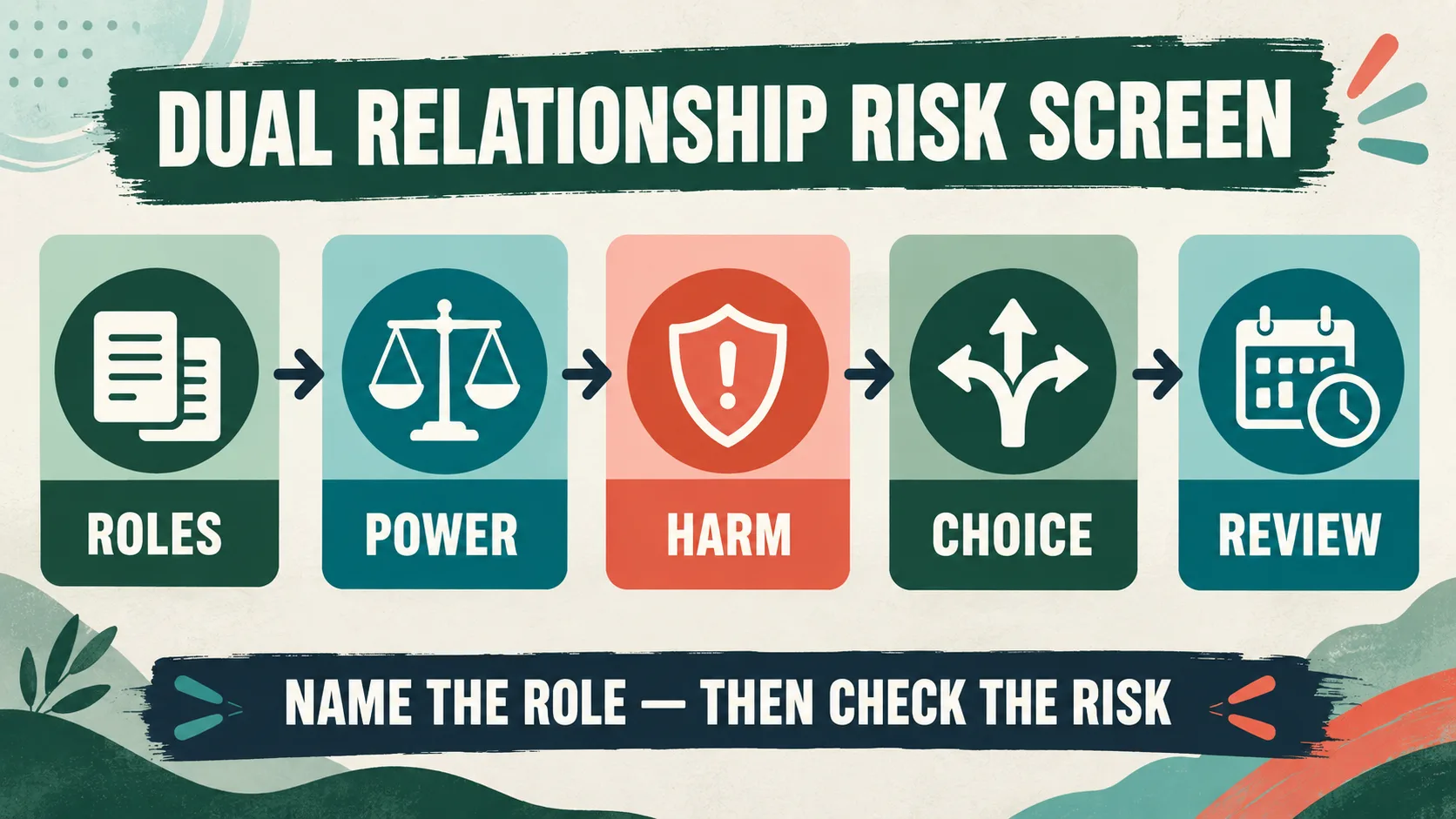
Use a short screen as soon as you notice a possible overlap. Write the answers using observable facts, not labels such as “we are close” or “it feels fine.” The goal is to make the risk visible to you and to the person who may help you decide.
| Screen question | What to examine | Evidence to record |
|---|---|---|
| What are the roles? | Name the professional role and the second role: friend, relative, employer, landlord, tutor, babysitter, business contact, or another connection. | People involved, dates, setting, and the exact request or event. |
| Where is the power? | Consider access to services, supervision, evaluation, scheduling, money, employment, recommendations, or confidential information. | Decisions each person controls and any dependency or pressure. |
| What could be harmed? | Check objectivity, confidentiality, client welfare, treatment decisions, supervision quality, and the ability to say no freely. | Specific foreseeable harm, not a general statement that it feels uncomfortable. |
| Can it be prevented? | Ask whether declining, referring, changing roles, or using another service channel would prevent the overlap. | Options considered and why each is workable or unavailable. |
| What needs monitoring? | If the overlap cannot end immediately, identify the boundary, reviewer, time frame, and trigger for a new decision. | Safeguards, follow-up date, consultation, and eventual outcome. |
Separate Contact From a Second Role
Community contact is sometimes unavoidable, especially in small towns, schools, rural areas, or tightly connected service systems. The ethical task is to distinguish contact from a new role. A brief hello in public may be handled with privacy-preserving discretion. A recurring social, financial, employment, or caregiving arrangement is more likely to add expectations that compete with the professional role.
- Incidental contact: You see a client’s family in a store or at a large public event. Protect privacy, avoid discussing services, and follow the client’s lead about acknowledgment.
- Social overlap: A family invites you to a private celebration, asks to connect on a personal account, or expects an ongoing friendship. Clarify the professional boundary before accepting.
- Financial overlap: A stakeholder offers paid babysitting, a side business arrangement, a loan, or a referral commission. The added financial role may affect objectivity, access, or the person’s ability to refuse.
- Supervision overlap: A supervisor, supervisee, trainee, or employer is also a close friend or family member. The power and evaluation structure deserve an early consultation and a documented plan.
Communicate the Concern Without Shaming
Many boundary problems worsen because the first conversation is delayed or framed as a personal accusation. A calm, specific conversation protects the client and gives the other person a chance to understand the professional reason for a limit.
- Start with the fact: “You asked me to provide paid childcare outside the treatment relationship.” Avoid guessing motives.
- Name the roles: Explain that the professional role would overlap with a financial or caregiving role.
- Explain the risk: Connect the boundary to objectivity, confidentiality, client welfare, power, or the ability to make independent decisions.
- Offer a safe next step: Decline, refer to another person, consult a supervisor, change the communication channel, or create a time-limited safeguard.
- Confirm the plan: State who will do what, by when, and how follow-up will occur. Do not promise an outcome that requires another person or agency to decide.
Document the Decision and Safeguards
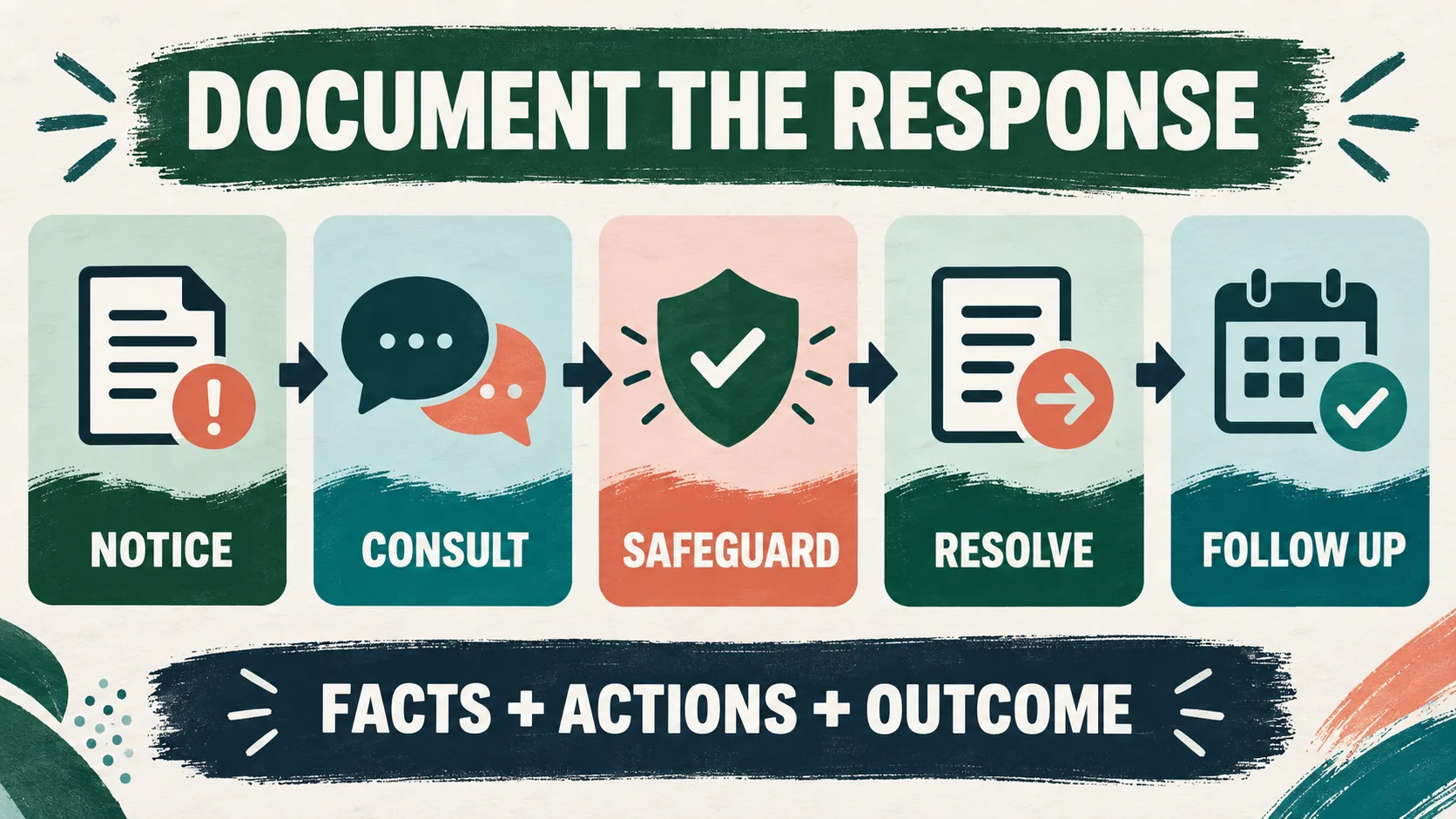
Documentation should let a later reviewer understand the situation without reconstructing it from memory. Follow your employer’s record system, privacy rules, and retention policy. Keep the note factual, proportionate, and in the correct record rather than hiding a material decision in a personal text thread.
| Document | Why it matters | Useful wording |
|---|---|---|
| The trigger | Shows when and how the possible overlap came to attention. | “On [date], [person] requested [specific role or action].” |
| The role map | Makes the professional role, second role, power, and affected parties explicit. | “Current role: ____. Proposed or emerging role: ____. Related parties: ____.” |
| Consultation | Shows who reviewed the concern and what source or policy informed the response. | “Consulted [role] on [date]; reviewed current Code Standard 1.11 and applicable policy.” |
| Action and safeguard | Connects the risk to a specific boundary, referral, separation, or interim protection. | “We will [action]; until [date], [safeguard] applies; [reviewer] will monitor.” |
| Outcome and follow-up | Closes the loop and records whether the overlap ended, changed, or needs another decision. | “On [date], [outcome] occurred; remaining risk is ____; next review is ____.” |
Avoid turning documentation into a character judgment. “The parent is manipulative” is not a useful fact; “the parent offered a paid side role after asking me to change the schedule” is reviewable. Also avoid copying unnecessary clinical or identifying details into a general ethics note. Record what the decision-maker needs to know, use secure systems, and follow the applicable privacy requirements.
Resolve, Refer, or Transfer the Case
Match the response to the risk and your authority. Prevent the second role when possible. If it already exists or cannot end immediately, use safeguards, a plan to resolve it, and documentation of actions and outcomes.
- Resolve directly: End the added role, clarify the communication channel, return or decline a benefit, or re-establish the defined professional role.
- Consult: Bring the facts to the appropriate supervisor, ethics contact, clinical director, employer, or other qualified reviewer. Ask for the decision and rationale to be documented.
- Safeguard temporarily: Separate scheduling or financial decisions, add review by another qualified person, restrict private communication, or change who evaluates the work.
- Refer or transfer: If the conflict cannot be managed without threatening welfare or objectivity, use the applicable continuity-of-services and transition procedures rather than abandoning the client.
- Escalate when the supervisor is involved: RBTs should follow the current RBT Ethics Code and notify the appropriate manager or entity when the overlapping relationship involves their supervisor.
Do not promise a particular result from a transfer, complaint, or employer review. State the action you control, who decides the next step, and the follow-up date. Employer and licensing rules may be stricter than the BACB baseline.
Apply the Framework to Common Scenarios
Scenario questions often test the sequence rather than a memorized label. Use the same five-part screen:
- A caregiver asks the RBT to babysit: The second role adds paid caregiving, access, and expectations outside treatment. Pause, inform the supervisor, document the request, and follow the organization’s response.
- A BCBA and client family volunteer at the same small community event: Shared community membership may be unavoidable. Protect privacy, avoid discussing services, identify whether a recurring personal role is forming, and consult if the contact becomes more than incidental.
- A supervisee is also a close friend: Friendship may affect feedback, evaluation, scheduling, or the supervisee’s freedom to disagree. Map the power and consider a different evaluator or added review.
- A family offers a valuable gift after a difficult treatment period: Consider the current gift rule, the value and pattern of the exchange, and whether accepting would create a financial or relational expectation. Do not use gratitude to skip the analysis.
Common Exam and Practice Traps
Keep these distinctions in your notes:
- Using the old number: The current behavior-analyst Code uses Standard 1.11 for Multiple Relationships. Confirm the version before quoting an older code or study guide.
- “Consent makes it ethical”: Consent does not automatically remove power, dependency, impaired objectivity, or risk of harm.
- “Every contact is a violation”: Incidental contact and an established second role are not identical. Analyze facts and foreseeable effects.
- “Only romantic relationships count”: Financial, social, familial, employment, caregiving, and supervisory overlaps can also create conflicts.
- “Document only if someone complains”: The current Code specifically connects safeguards and eventual outcomes with documentation. Record the decision while facts are fresh.
- “Solve it privately”: A supervisor or ethics reviewer may be the right safeguard, especially when the other role involves power or the supervisor is part of the concern.
If you are preparing for the BCBA examination, use the official Code as the source of truth and then test whether you can apply it to a new scenario. The free BCBA Mock Exam can help you practice identifying the relevant concept and explaining your reasoning; it does not replace the BACB Code, supervision, or professional judgment.
Frequently Asked Questions
Does the BACB use the term dual relationship?: The current Ethics Code for Behavior Analysts uses multiple relationships. “Dual relationship” remains common search and teaching language for an overlapping professional and nonprofessional role, but use the current Code’s wording when you document or cite the standard.
Is every dual relationship automatically unethical?: Do not rely on an automatic label. Identify the roles, power, foreseeable harm, objectivity, privacy, avoidability, and applicable rules. The current Code directs behavior analysts to avoid creating multiple relationships, address those that arise, use safeguards when immediate resolution is not possible, and document the response.
What should I do if the relationship has already developed?: Pause the new activity, record the facts, consult the appropriate supervisor or ethics resource, and create a resolution or safeguard plan. If the supervisor is part of the concern, follow the organization’s escalation route and the applicable role-specific ethics code.
Can a client or caregiver’s agreement make the overlap acceptable?: Agreement is one fact, not a complete risk analysis. Power, dependency, confidentiality, financial pressure, and welfare can remain even when someone says yes. Explain the boundary and obtain qualified consultation before proceeding.
What is the best way to study dual relationships for the BCBA exam?: Memorize the current term and standard, then practice applying the sequence: identify roles, evaluate risk, communicate, safeguard or resolve, and document the outcome. Always verify the current Code and any updated exam materials before relying on an older study note.
Sources and Verification Notes
This article uses the current BACB Ethics Code for Behavior Analysts as its primary authority. The BACB advises readers to check its ethics-code index periodically for current versions. The RBT discussion is role-specific and should be read with the current RBT Ethics Code. A state practice alert may add jurisdictional expectations, so confirm the rules that govern your license, employer, funder, and service setting.
- BACB Ethics Codes.
- BACB Ethics Code for Behavior Analysts, including Standard 1.11 Multiple Relationships.
- BACB RBT Ethics Code (2.0).
- BACB July 2023 Newsletter, for an official multiple-relationship scenario interpretation.
- New York State Applied Behavior Analysis Practice Alert: Dual Relationships.
Take the Free BCBA Mock Exam
A useful next step is to apply this idea in a fresh set of BCBA-style practice questions and review the feedback. Take the Free BCBA Mock Exam



