

A practical owner-level dashboard for connecting clinical quality, access, people, authorization, and revenue decisions without chasing one misleading number. If you searched for ABA practice KPIs, you probably want more than a list of percentages. You want to know whether services are helping clients, whether families can access care, whether the team can sustain delivery, and whether the revenue cycle is healthy enough to support the work. A useful KPI system turns those questions into repeatable measures with an owner, a review cadence, and a decision rule.
Table of Contents
- What ABA Practice KPIs Are
- The KPI Design Contract
- Four KPI Domains to Balance
- Improving ABA Practice Profitability Without Narrowing Care
- Weekly and Monthly Review Rhythm
- Balancing Measures and Boundaries
- Dashboard Tools Are Not the KPI System
- Turn Metrics Into Better Decisions
- Frequently Asked Questions
- Quick Review Checklist
- Take the Free BCBA Mock Exam
This guide gives you a compact framework for building that system. It covers four domains—clinical, access, people, and revenue—then adds authorization and documentation checks that connect the domains. The examples are fictional. There is no universal “good” target for every ABA practice because payer mix, service model, caseload, geography, reporting maturity, and client needs change the denominator. Scope note: This is an educational practice-management guide, not financial, legal, clinical, employment, or compliance advice for a particular organization. Define metrics with your qualified leadership, billing, clinical, privacy, and accounting partners.
What ABA Practice KPIs Are
An ABA practice KPI is a defined measure that helps the organization answer a recurring operating question and decide what to do next. The word “key” matters. A dashboard with 80 unexplained tiles is not automatically better than a review with 12 well-governed measures. A KPI should be understandable to the person who owns the next action. Examples include:
- Clinical: Are goals progressing, is treatment being implemented as designed, and are outcomes meaningful to the client and family?
- Access: Are authorized services available, scheduled, and delivered without avoidable gaps or cancellations?
- People: Can the practice recruit, support, supervise, and retain the team needed to deliver safe care?
- Revenue cycle: Are claims clean, denials visible, payments posted, and accounts receivable moving through the expected process?
The measure alone is not the KPI system. The system also needs a definition, data source, time window, owner, cadence, threshold or decision rule, and balancing measure. A rising billable-hours number could reflect better access—or excessive workload that increases turnover and reduces treatment quality. A lower cancellation rate could reflect improved scheduling—or pressure on families that harms fit. Pair the number with the context that prevents a narrow optimization from becoming the organization’s only goal.
The KPI Design Contract
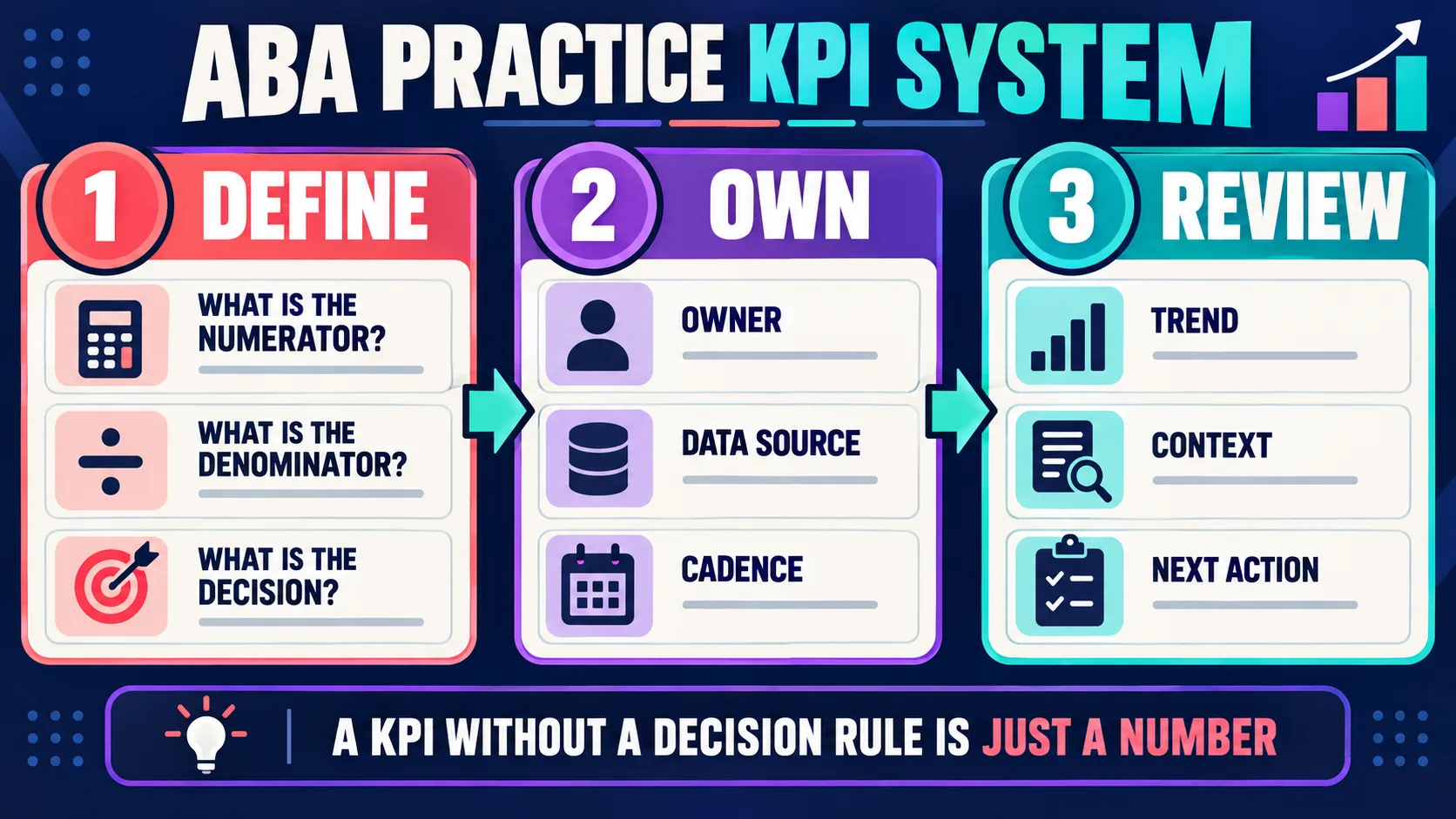
Before you put a metric on a dashboard, write a short “contract” for what it means. This makes the number reproducible when staff, software, payer rules, or locations change. It also prevents two teams from using the same label for different calculations.
| KPI field | Question to answer | Example for a fictional metric |
|---|---|---|
| Definition | What exactly is counted, and what is excluded? | Completed authorized units, excluding cancelled or unbillable entries under the written rule. |
| Numerator/denominator | What math produces the rate, percentage, count, or average? | Delivered authorized units ÷ scheduled authorized units × 100. |
| Owner and source | Who validates the data and where does it come from? | Operations lead checks the scheduling report against authorization and billing exports. |
| Cadence and action | How often is it reviewed, and what happens when it changes? | Review weekly; investigate a two-week shift before changing staffing or scheduling rules. |
| Balancing measure | What could improve while an important outcome gets worse? | Review caregiver experience, treatment fidelity, staff overtime, and client progress beside utilization. |
Put a short definition beside the dashboard tile and link to the longer data dictionary. If the definition changes, record the version and show a phase line; otherwise, a reporting change can look like an improvement.
Four KPI Domains to Balance
A manageable first dashboard can use four groups. The exact metric names will differ by practice, but the questions should remain visible. 1. Clinical quality and meaningful progress: Clinical KPIs should describe whether services are moving toward meaningful, individualized outcomes. Possible measures include goal-progress reviews completed on time, treatment-fidelity checks, caregiver participation, generalization checks, safety-plan review completion, or the proportion of active programs with a documented next decision. Avoid reducing clinical quality to the number of sessions delivered. More units do not automatically mean better outcomes.
2. Access and authorization: Access measures show whether authorized care can actually happen. Track authorization utilization, time from referral to first scheduled service, cancellation and no-show patterns, open capacity, unfilled authorized hours, and the age of authorization requests. Always define the denominator. “Utilization” based on all authorized units is not the same as utilization based on units that were schedulable and clinically appropriate.
3. People, supervision, and workload: People measures help leaders see whether the delivery system is sustainable. Examples include time to fill a role, staff retention, vacancies, supervision completion, training completion, overtime, caseload distribution, and the share of staff with a documented support plan. Pair productivity with workload and experience measures. A practice can improve billable hours for a month while increasing burnout, turnover, or missed supervision.
4. Revenue cycle and financial operations: Revenue-cycle KPIs can include clean-claim rate, initial denial rate, days in accounts receivable, aged A/R, payment posting lag, gross and net collection rate, authorization-to-billing mismatches, and cost to collect. Each metric needs its own definition. For example, gross collection rate compares payments with gross charges and can be distorted by the charge schedule; net collection rate adjusts for valid contractual adjustments. Do not use a blended number to conceal payer-specific problems.
These domains are connected. A denied claim can delay care resources; an authorization gap can create both access and revenue problems; staff turnover can affect treatment fidelity and scheduling. The dashboard should make those relationships easier to investigate, not pretend that one domain explains all the others.
Improving ABA Practice Profitability Without Narrowing Care
Improving ABA practice profitability is a decision problem, not a single revenue number. Profitability depends on what the practice collects after valid contractual adjustments, what it spends to deliver services, how much authorized capacity is actually usable, and how quickly cash moves through the revenue cycle. A practice can increase gross charges while losing margin through denials, unfilled hours, overtime, rework, or delayed payment.
Start by separating gross collections from net collections. Gross collection rate compares payments with gross charges, but the charge schedule may not represent the amount the payer allows. Net collection rate removes valid contractual adjustments before comparing payments with collectible revenue. Neither metric explains profitability by itself; pair it with cost to deliver, payer mix, service utilization, and the time required to collect.
| Profitability signal | What to examine | Balancing measure |
|---|---|---|
| Net collections | Allowed revenue, payments, contractual adjustments, payer mix, and collection lag. | Access, correct billing, timely documentation, and client service continuity. |
| Denial leakage | Denial rate, avoidable denial reason, appeal recovery, and days from denial to resolution. | Coding accuracy, authorization fit, documentation quality, and staff rework time. |
| Usable capacity | Authorized hours, clinically appropriate availability, scheduled units, cancellations, and unfilled slots. | Client fit, caregiver experience, treatment fidelity, and staff workload. |
| Delivery cost | Direct labor, supervision, benefits, overtime, recruiting, training, and administrative time by service model. | Retention, supervision completion, safe staffing, and clinical quality. |
Review profitability by payer, location, service line, and time period when the data support that level of detail. A blended practice average can hide one payer with repeated authorization gaps or one location with excessive staffing cost. Use a decision rule such as “investigate a two-month decline in net collections alongside denial reasons and usable capacity before changing staffing.” Do not respond to a single noisy month by reducing clinically necessary services.
Financial review also needs professional boundaries. Leaders should use qualified accounting, billing, legal, compliance, and clinical partners for decisions that affect contracts, claims, employment, client access, or care. The dashboard should surface a question and an owner; it should not turn a ratio into an automatic clinical or employment decision.
Weekly and Monthly Review Rhythm
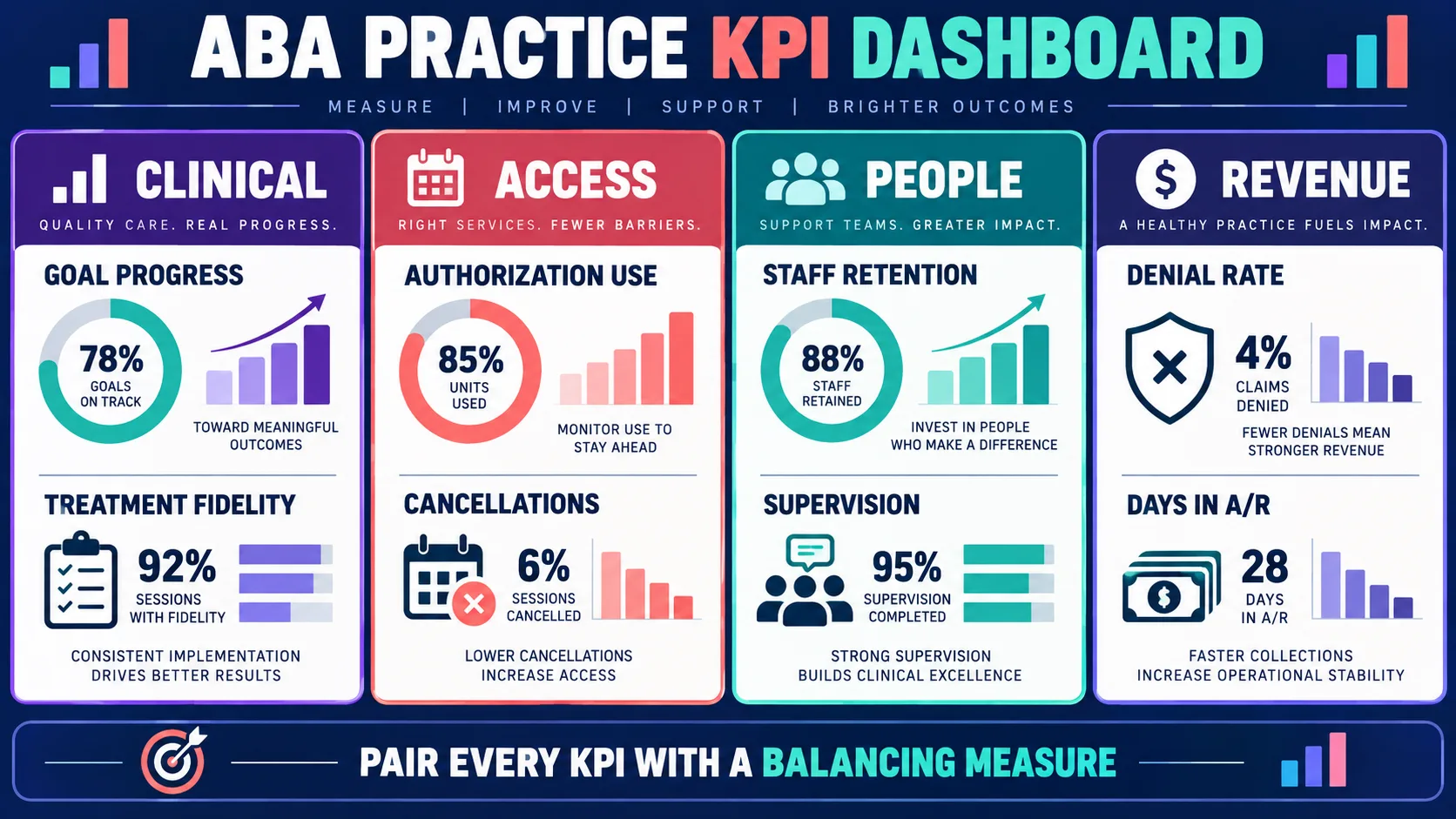
Use cadence to protect attention. A weekly huddle can focus on signals that need a near-term owner. A monthly review can examine mature trends, payer or location differences, and whether the previous action worked. A quarterly review can revisit definitions, strategic fit, and whether a KPI should be retired.
| Review | Focus | Output |
|---|---|---|
| Weekly | Exceptions, urgent access gaps, denials, staffing risks, missing documentation, and safety-related signals. | One owner, next action, due date, and a note about data quality. |
| Monthly | Mature trends by payer, location, program, and staffing context; compare with the prior period. | Keep, investigate, or change decision with a documented rationale. |
| Quarterly | Whether definitions, targets, data sources, and the KPI set still match the practice strategy. | Retire, revise, or add a KPI; record the version change. |
Imagine a fictional dashboard showing 78% of goal-progress reviews on track, 85% authorization utilization, 88% staff retention, and a 4% initial denial rate. Ask whether records are complete, units were schedulable, retention hides overtime, or denials cluster by payer or code before choosing an action.
A helpful meeting sequence is: state the metric definition, describe the trend, name the context, identify the risk, assign the owner, and document the next check. Do not spend the whole meeting debating colors. A red tile without an owner is just an alarm; a green tile without a balancing measure can be false reassurance.
Balancing Measures and Boundaries
Balancing measures are the safety rails of KPI work. If the primary metric improves, the balancing measure asks what may have worsened. Examples include:
- Pair utilization with cancellations, caregiver experience, staff workload, and clinical appropriateness.
- Pair billable hours with treatment fidelity, documentation timeliness, supervision, and retention.
- Pair denial reduction with correct coding, authorization fit, appeal quality, and access—not premature write-offs.
- Pair shorter referral-to-service time with informed consent, staffing capacity, and clinical fit.
- Pair goal progress with generalization, maintenance, client preference, and meaningful participation.
Ethics and privacy are part of the dashboard design. Review the current BACB Ethics Code resources when a metric could influence client welfare, documentation, supervision, or professional judgment. Use the HHS HIPAA professional resources and your organization’s policies when dashboards contain protected information. Limit access, use the minimum necessary detail, keep exports controlled, and do not paste identifiable client data into an unapproved tool.
Also separate a KPI from a compliance requirement. A dashboard can tell you that a field is missing; it does not decide whether a claim, treatment, authorization, or supervision action is lawful or ethical. Qualified leaders must interpret the evidence within the applicable rules, contracts, and client plan.
Dashboard Tools Are Not the KPI System
Practice software can calculate and display rates, but its default tiles are not automatically the right KPIs. Start with the operating question, denominator, decision rule, privacy controls, and audit trail, then choose the tool. See the ABA data analytics guide for visual analysis and the ABA practice guide for startup context.
Turn Metrics Into Better Decisions
A good first dashboard does not need to be huge. Choose one or two measures in each domain, write the definition and owner, review them on a predictable cadence, and add a balancing measure before increasing the number of tiles. Once the process is stable, add detail only when it changes a decision.
For exam preparation, the same discipline helps with scenario questions: identify what the measure actually captures, check the denominator and context, and choose the next action that protects client welfare and data quality. Use the Free BCBA Mock Exam as a separate practice checkpoint. Treat the result as study data, not an official BACB score or a practice-performance benchmark.
Frequently Asked Questions
What are the most important ABA practice KPIs?: Start with a balanced set across clinical quality, access/authorization, people/supervision, and revenue cycle. The best set depends on your practice model. Each metric should have a definition, source, owner, cadence, decision rule, and balancing measure.
What is a good KPI target for an ABA practice?: There is no universal target that applies to every ABA practice. Payer mix, service model, caseload, location, authorization rules, and reporting maturity change the result. Use internal trends and clearly labeled external benchmarks rather than treating a published percentage as a promise.
How often should an ABA practice review KPIs?: Review urgent exceptions weekly, mature trends monthly, and the KPI set itself quarterly. The cadence should match how quickly the owner can act and how long the data takes to stabilize.
Why does every KPI need a balancing measure?: A balancing measure checks whether improving one number creates a hidden cost elsewhere. For example, higher utilization should be reviewed beside cancellations, staff workload, caregiver experience, and client progress.
Can a practice-management platform choose the right KPIs?: No. A platform can calculate and display data, but leaders must define the question, denominator, decision rule, privacy controls, and professional boundaries. Choose the tool after the KPI contract is clear.
Bottom line: ABA practice KPIs work when they connect a clearly defined number to a responsible decision. Balance clinical quality, access, people, and revenue; show the denominator; assign an owner and cadence; review context and balancing measures; then act on evidence rather than dashboard colors.
Quick Review Checklist
Use this final checklist to turn aba practice kpis into exam-ready reasoning. The goal is not to memorize a label in isolation; it is to identify the relevant evidence and explain why the best answer fits the scenario. Key ideas to review:
- State the central definition or decision point for aba practice kpis in your own words.
- Identify the detail that makes aba practice kpis different from its closest related ABA term.
- Separate the observable facts in a scenario from assumptions that are not supported by the facts.
- Write one example and one nonexample so you can recognize the concept in a new setting.
Exam application checks:
- Ask what the question is actually requesting before comparing the answer choices.
- Mark the antecedent, response, consequence, or other evidence that supports the selected answer.
- Look for a distractor that describes a related process but does not answer the specific question.
Final self-check:
- Explain how you would verify the interpretation with clear observations or data.
- Change one detail in the scenario and decide whether your answer should change.
- Give a one-sentence rationale that a supervisor or study partner could evaluate.
Take the Free BCBA Mock Exam
When you are ready to apply the idea, use the free practice resource below for additional feedback. Take the Free BCBA Mock Exam



