

DTT meaning ABA is a common search question because the abbreviation appears in study guides, clinical programs, school documents, and parent conversations. DTT usually means discrete trial teaching or discrete trial training: a structured teaching format that creates short, clearly defined learning opportunities. A trial has a beginning, a learner response, a consequence, and a boundary before the next opportunity.
Table of Contents
- DTT Meaning ABA: What the Abbreviation Covers
- Decode the Five Parts of a Discrete Trial
- Use Prompts, Error Correction, and Data Together
- DTT vs NET vs the Broader ABA Model
- Program Generalization and Maintenance
- BCBA Exam Distinctions and FAQ
- Sources for Further Study
- Quick Review Checklist
- Take the Free BCBA Mock Exam
DTT is based on behavior-analytic principles, but DTT is not the same thing as the entire ABA service model. ABA can include natural environment teaching, functional communication training, chaining, play-based instruction, behavior reduction, caregiver coaching, and other approaches. The useful BCBA exam question is therefore not “Is this ABA or DTT?” but “What teaching format is being used here, what is the target response, and what decision do the data support?”
DTT Meaning ABA: What the Abbreviation Covers
In ABA, a discrete trial is a small teaching unit arranged so that the practitioner can present a cue, observe a response, deliver a programmed consequence, and begin the next opportunity. “Discrete” means the trial is distinguishable from the next trial. The boundary may be a short pause, a material reset, a data entry, or another consistent signal that one opportunity has ended.
DTT is especially useful when a skill benefits from clear repetition, carefully selected examples, immediate feedback, and precise measurement. It can be used for receptive identification, imitation, matching, tacting, academic responses, communication, and many other skills. Whether DTT is appropriate depends on the learner, the target, the environment, preferences, social validity, and the decision the team needs to make.
A common mistake is to define DTT as “repeating instructions until the learner gets it.” That description leaves out the contingency and the data. A well-designed DTT arrangement specifies what the cue means, what counts as a correct or incorrect response, what prompt is available, what consequence follows, how the response is recorded, and how the learner will use the skill outside the teaching format.
Decode the Five Parts of a Discrete Trial
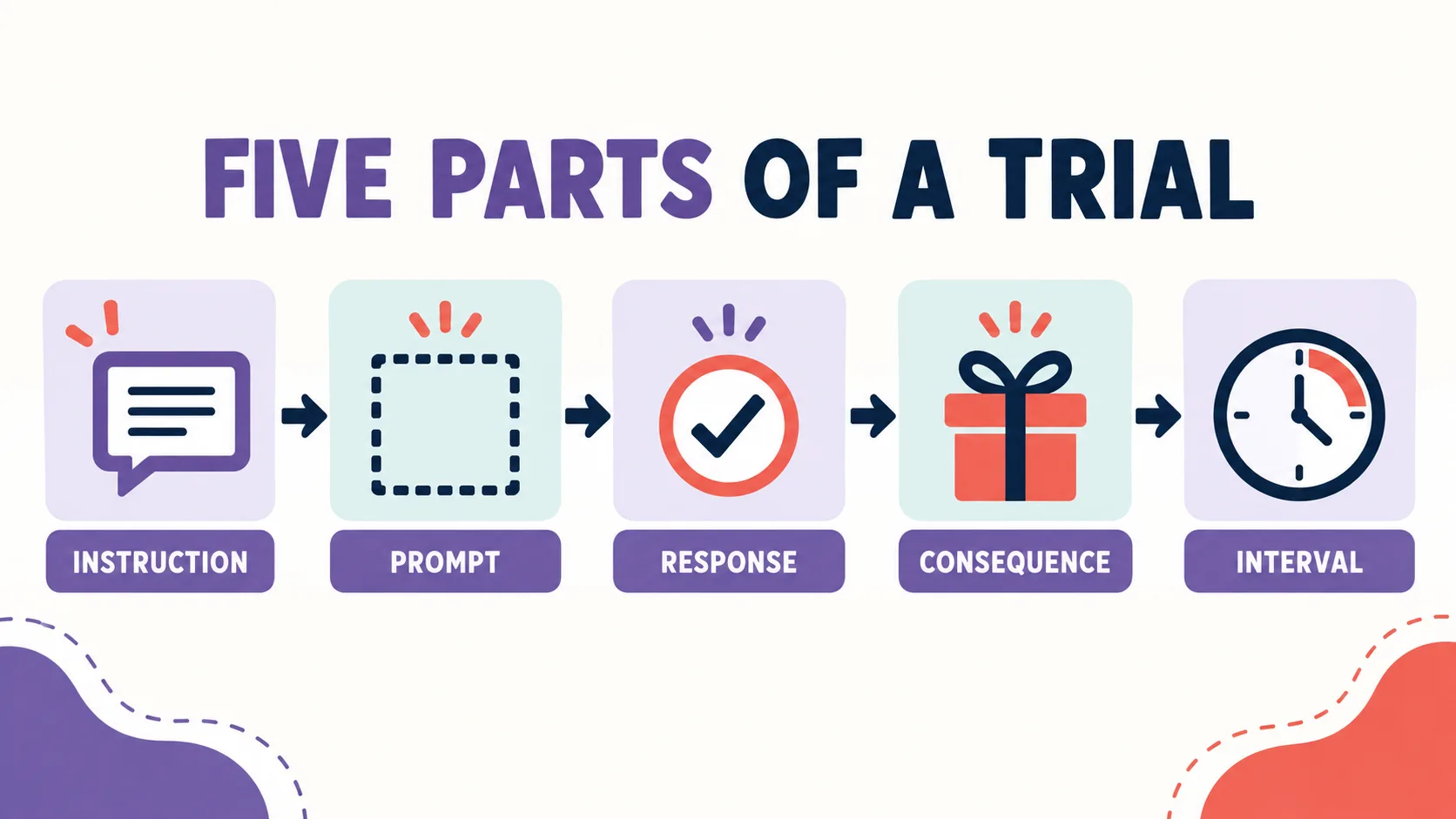
Different textbooks describe the parts with slightly different labels, but the same functional sequence appears repeatedly. Some frameworks combine the instruction and discriminative stimulus, while others list the prompt as a separate component. For exam reasoning, identify the function of each event rather than memorizing only one wording.
| Trial part | What happens | BCBA question |
|---|---|---|
| Instruction or SD | The practitioner presents the cue or arranges the stimulus condition that signals what response is relevant. | What should occasion the independent response? |
| Prompt | An added support helps the learner contact the correct response when independent responding is not yet reliable. | How will prompt dependence be prevented? |
| Response | The learner emits the target behavior, an error, or no response within the defined opportunity. | Can the observer score it consistently? |
| Consequence | The practitioner delivers reinforcement, correction, feedback, or another planned consequence based on the response. | Does the consequence support the intended learning relation? |
| Intertrial interval | The current opportunity ends and materials, attention, or the learner’s position may be reset before the next trial. | Is the boundary clear without creating unnecessary downtime? |
Consider a receptive-identification example. The practitioner presents an array, says “Point to the cup,” waits for the planned response window, and records whether the learner points independently. If the learner does not respond or responds incorrectly, a prompt may be delivered according to the plan. A correct response may contact praise, a token, access to a preferred item, or another individualized reinforcer. The materials are then reset and the next opportunity begins.
The same sequence can teach many different skills, but the response definition must change with the target. “Correct” might mean touching one picture, imitating a motor action, saying a word, sorting an item, or completing a step. A trial is not precise merely because it is short. Precision comes from a clear operational definition, a defined response window, and a consistent consequence rule.
Use Prompts, Error Correction, and Data Together
Prompting is often part of DTT, but a prompted response is not the same as an independent response. The data sheet should make that distinction visible. If a learner responds correctly only after a model or gesture, scoring the trial as simply “correct” can hide the actual level of stimulus control. A more useful system records independent correct, prompted correct, error, and no response, with the prompt level defined in advance.
Prompt fading is the process of reducing the added support so control transfers to the intended instruction or stimulus. Depending on the learner and target, a plan may use most-to-least prompting, least-to-most prompting, a time delay, stimulus fading, graduated guidance, or transfer trials. No single hierarchy is automatically best. The decision should be tied to the learner’s performance and the risk of reinforcing prompt dependence.
| Scenario | What to record | Next decision |
|---|---|---|
| Correct before any prompt. | Independent correct and latency if relevant. | Deliver the planned consequence and continue the programmed variation. |
| Correct after a model, gesture, or verbal prompt. | Prompt level and prompted correct. | Apply the fading or transfer step; do not treat it as independent mastery. |
| Incorrect response or no response. | Error type, response window, and correction delivered. | Check task difficulty, prompt plan, stimulus control, and reinforcement before adding volume. |
| Performance changes across materials or instructors. | Condition-specific accuracy and prompt level. | Plan generalization or revise the controlling stimulus rather than averaging away the difference. |
Error correction should produce another opportunity to contact the correct relation, not a long lecture or a confusing sequence of repeated prompts. A correction might involve re-presenting the instruction, providing a prompt, allowing the response, and then arranging a brief transfer trial. The exact procedure must follow the individualized plan and be implemented by trained people. For exam questions, focus on the function: the correction should reduce repeated errors and support transfer to independent responding.
Data also guide the movement between targets. A mastery decision should be stated before teaching begins, and it should usually include independent performance, not only prompted performance. If accuracy is high because the same prompt is delivered every time, the data may describe prompt following rather than the target skill. Conversely, if an error pattern appears only with one distractor or one position, an average session percentage may conceal the instructional problem.
DTT vs NET vs the Broader ABA Model
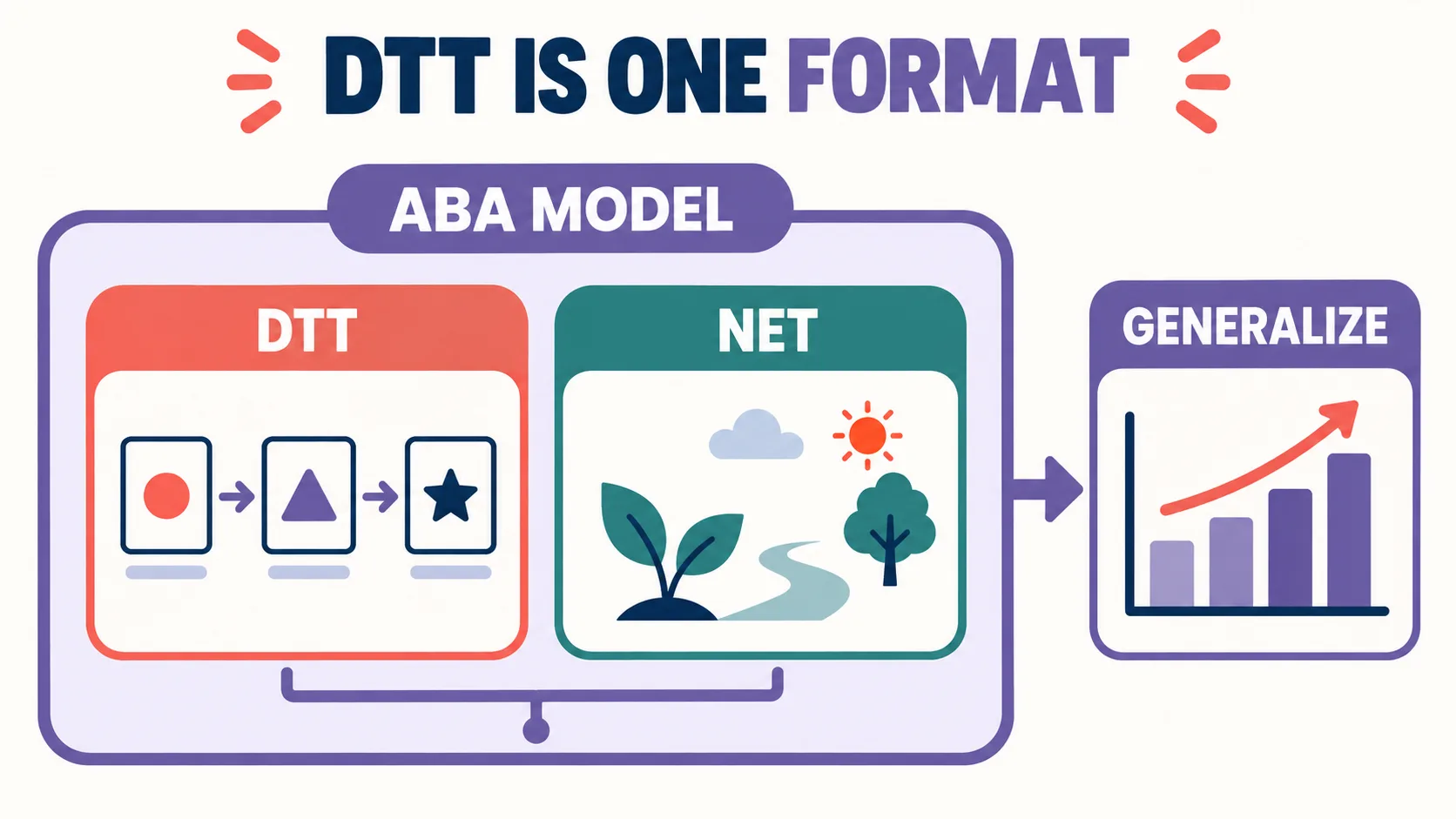
DTT and natural environment teaching, or NET, are teaching formats that can both be used within behavior-analytic programming. DTT usually makes the teaching opportunity more explicit and controlled: the instructor arranges the cue, response opportunity, consequence, and trial boundary. NET embeds teaching in naturally occurring activities, motivation, materials, communication, and consequences. Many effective programs combine formats rather than treating them as competing identities.
| Term | Primary emphasis | Do not confuse it with… |
|---|---|---|
| DTT | Structured, clearly bounded teaching trials with planned prompts, consequences, and data. | The entire ABA service model. |
| NET | Teaching within natural activities, motivation, materials, communication, and consequences. | Unplanned teaching with no measurable target or decision rule. |
| ABA services | The broader science-informed assessment, intervention, teaching, data, collaboration, and decision-making model. | One instructional format used during a session. |
The boundary matters because a learner can perform well in a highly controlled trial and still need support using the skill in daily life. Program natural variations deliberately: change examples, people, materials, settings, instructions, and the time between opportunities when those changes are relevant. DTT can create a strong learning history, but generalization and maintenance are separate outcomes that should be measured.
Program Generalization and Maintenance
Data from DTT should answer more than “Did the learner get this trial right?” They should help the team decide whether to continue teaching, fade a prompt, add exemplars, move to a natural context, or revisit the operational definition. A brief probe with a new person or material can reveal whether the learner learned the target relation or memorized a narrow sequence.
Generalization means the response occurs with relevant new stimuli, people, settings, or materials. Maintenance means the response continues over time after the teaching arrangement or reinforcement schedule changes. These outcomes can be programmed through multiple exemplars, natural-environment practice, varied instructors, delayed probes, and reinforcement that remains meaningful to the learner.
When interpreting data, keep independent and prompted performance separate. Also keep acquisition, generalization, and maintenance probes separate. A single blended percentage can look reassuring while masking a sharp drop when the prompt is removed or the setting changes. Clear data help the BCBA make a defensible, individualized decision.
For targeted practice with DTT components, prompt fading, data interpretation, and DTT-versus-NET scenarios, the Free BCBA Mock Exam can help you find study gaps. It is a practice diagnostic, not a clinical treatment plan or a guarantee of passing.
BCBA Exam Distinctions and FAQ
What does DTT stand for in ABA?: DTT commonly stands for discrete trial teaching or discrete trial training. Both labels refer to a structured teaching format made of identifiable learning opportunities. The abbreviation does not mean that every ABA service is delivered through DTT.
What is the difference between DTT and ABA?: ABA is the broader science-informed framework and professional service model. DTT is one teaching format that can be used within an ABA program. An ABA program may also include NET, functional communication training, chaining, caregiver coaching, assessment, and other individualized procedures.
Is a prompt one of the parts of every discrete trial?: Many DTT descriptions list a prompt as a separate trial component, while other descriptions emphasize the instruction, response, consequence, and intertrial boundary. In practice, a prompt is used when needed and should be scored and faded so it does not replace the intended instruction or SD as the controlling stimulus.
Why are data important in DTT?: Data show whether responding is independent, prompted, incorrect, or absent; they also help the team evaluate progress, mastery, generalization, and maintenance. Without a clear data system, repeated trials can create activity without showing whether the target skill is improving.
Should DTT be used for every learner or every skill?: No. The instructional format should fit the learner, target, context, preferences, risks, and decision. DTT can be useful for some skills and learners, while NET or another approach may better capture a naturally occurring response. A qualified professional should individualize the plan and monitor outcomes.
What should I verify before using this for BCBA exam study?: Check the current BACB task-list and examination materials for the version that applies to your exam. Core DTT concepts are stable, but examination outlines, policies, and terminology resources can change.
Sources for Further Study
- Indiana Resource Center for Autism: Discrete Trial Teaching—What Is It?
- Texas SPED Support: Discrete Trial Training
- Behavior Analyst Certification Board: BCBA Task List
- ERIC: Discrete Trial Training Evidence-Based Practice Brief
- Using Transfer Trials to Teach Tacting
- Data Collection During Discrete Trial Teaching
This article is for educational and BCBA exam-preparation purposes. An individualized DTT plan should be selected, trained, monitored, and revised by qualified professionals using current assessment information, learner preferences, safety requirements, social validity, and applicable professional standards.
Quick Review Checklist
Use this final checklist to turn dtt meaning aba into exam-ready reasoning. The goal is not to memorize a label in isolation; it is to identify the relevant evidence and explain why the best answer fits the scenario. Key ideas to review:
- State the central definition or decision point for dtt meaning aba in your own words.
- Identify the detail that makes dtt meaning aba different from its closest related ABA term.
- Separate the observable facts in a scenario from assumptions that are not supported by the facts.
- Write one example and one nonexample so you can recognize the concept in a new setting.
Exam application checks:
- Ask what the question is actually requesting before comparing the answer choices.
- Mark the antecedent, response, consequence, or other evidence that supports the selected answer.
- Look for a distractor that describes a related process but does not answer the specific question.
Final self-check:
- Explain how you would verify the interpretation with clear observations or data.
- Change one detail in the scenario and decide whether your answer should change.
- Give a one-sentence rationale that a supervisor or study partner could evaluate.
Take the Free BCBA Mock Exam
When you are ready to apply the idea, use the free practice resource below for additional feedback. Take the Free BCBA Mock Exam



