

If you are asking how much does BCBA supervision cost, there is no single BACB price. A candidate may pay a private supervisor by the hour, share a group-supervision fee, receive supervision through an employer, or pay for supervision as part of a university or fieldwork program. Publicly advertised private rates commonly span a broad range, often roughly $35 to $150 per hour, but that is a market snapshot—not a BACB fee schedule and not a promise of what any supervisor will charge.
Table of Contents
- How Much Does BCBA Supervision Cost?
- What Are You Actually Paying For?
- How Many Supervision Hours Do You Need?
- How Do You Calculate the Cost?
- What Changes the Price?
- Which Supervision Arrangement Costs Less?
- What Should a Supervision Contract Include?
- How Should You Handle the 2027 Transition?
- What Cost Mistakes Should Candidates Avoid?
- Frequently Asked Questions
- Sources for Further Study
- Quick Review Checklist
- Take the Free BCBA Mock Exam
The useful answer is a budgeting method: identify the fieldwork pathway, estimate the supervision hours required in each supervisory period, multiply those hours by the quoted rate, and then compare the contract terms. The current BACB handbook sets fieldwork and supervision rules; it does not set the price a private supervisor must charge. This guide keeps those two questions separate.
How Much Does BCBA Supervision Cost?
Private BCBA supervision is commonly advertised at approximately $35–$150 per hour, with the actual quote depending on location, supervisor experience, individual versus group format, the amount of feedback included, and whether the supervisor is also providing fieldwork opportunities. Some public guides report individual rates around $75–$80 per hour, while other providers publish flat monthly or block prices. These figures are not official BACB rates, and a broad internet range should never replace a written quote.
Your personal cost may be much lower if an ABA employer provides qualified supervision as part of employment. “$0 direct fee” does not mean the arrangement is free: you may be accepting a particular caseload, schedule, location, employment commitment, or limited choice of supervisor. University programs can also bundle supervision into tuition or add a separate fieldwork fee. The right comparison is total cost plus the quality, documentation, flexibility, and fit of the arrangement.
Before comparing numbers, ask one clarifying question: Is this price for supervision of a BCBA trainee’s fieldwork, or for a BCBA supervising service delivery to clients? Those are different services. This article focuses on the cost a BCBA candidate may pay or indirectly incur while accruing supervised fieldwork.
What Are You Actually Paying For?
A supervision fee can cover more than a video call. Depending on the agreement, it may include observation, fieldwork review, feedback, documentation review, competency coaching, and communication about recorded hours. A low quote may cover only a meeting, while a higher quote may include structured fieldwork support. Compare the service bundle, not just the headline rate.
| Cost component | What it may cover | Question to ask |
|---|---|---|
| Supervision meetings | Individual or group meetings, case review, feedback, and planning | Is the rate hourly, monthly, or per meeting? |
| Observation and fieldwork support | Direct observation, review of unrestricted activities, and coaching | Are observations included, or billed separately? |
| Documentation | Monthly logs, verification forms, audit preparation, and record review | Who completes and signs each required form? |
| Administrative terms | Scheduling, cancellations, travel, materials, and payment timing | What happens if a meeting is canceled or hours are unavailable? |
If the quote is described as “supervision,” but it does not explain what happens to your fieldwork documentation, pause before paying. A supervisor may be excellent clinically and still be a poor fit for your schedule, population, required activities, or documentation system.
How Many Supervision Hours Do You Need?
The cost calculation begins with the current rule set that applies to your fieldwork. The BACB’s current BCBA handbook describes two main fieldwork types: 2,000 hours of Supervised Fieldwork with supervision at 5% of hours per supervisory period, or 1,500 hours of Concentrated Supervised Fieldwork with supervision at 10% of hours per supervisory period. The handbook also describes monthly limits, contacts, observations, individual-versus-group requirements, and unrestricted-activity requirements.
Those rules are not the same as “pay for 5% or 10% of all fieldwork hours in advance.” Supervision is calculated within each supervisory period, and the monthly fieldwork hours must meet the applicable minimums and maximums. For a simple example, if you record 100 fieldwork hours in a month under a pathway requiring 5% supervision, the rule-based minimum would be 5 hours of supervision for that month. If a supervisor charges $80 per hour, the arithmetic estimate is 5 × $80 = $400 for that period. Your actual arrangement may use a different rate, group format, monthly package, or employer benefit.
Always match the calculation to the handbook version and transition guidance that apply to you. The BACB’s official Supervision, Assessment, Training, and Oversight page directs candidates and supervisors to the relevant handbook and fieldwork resources.
How Do You Calculate the Cost?
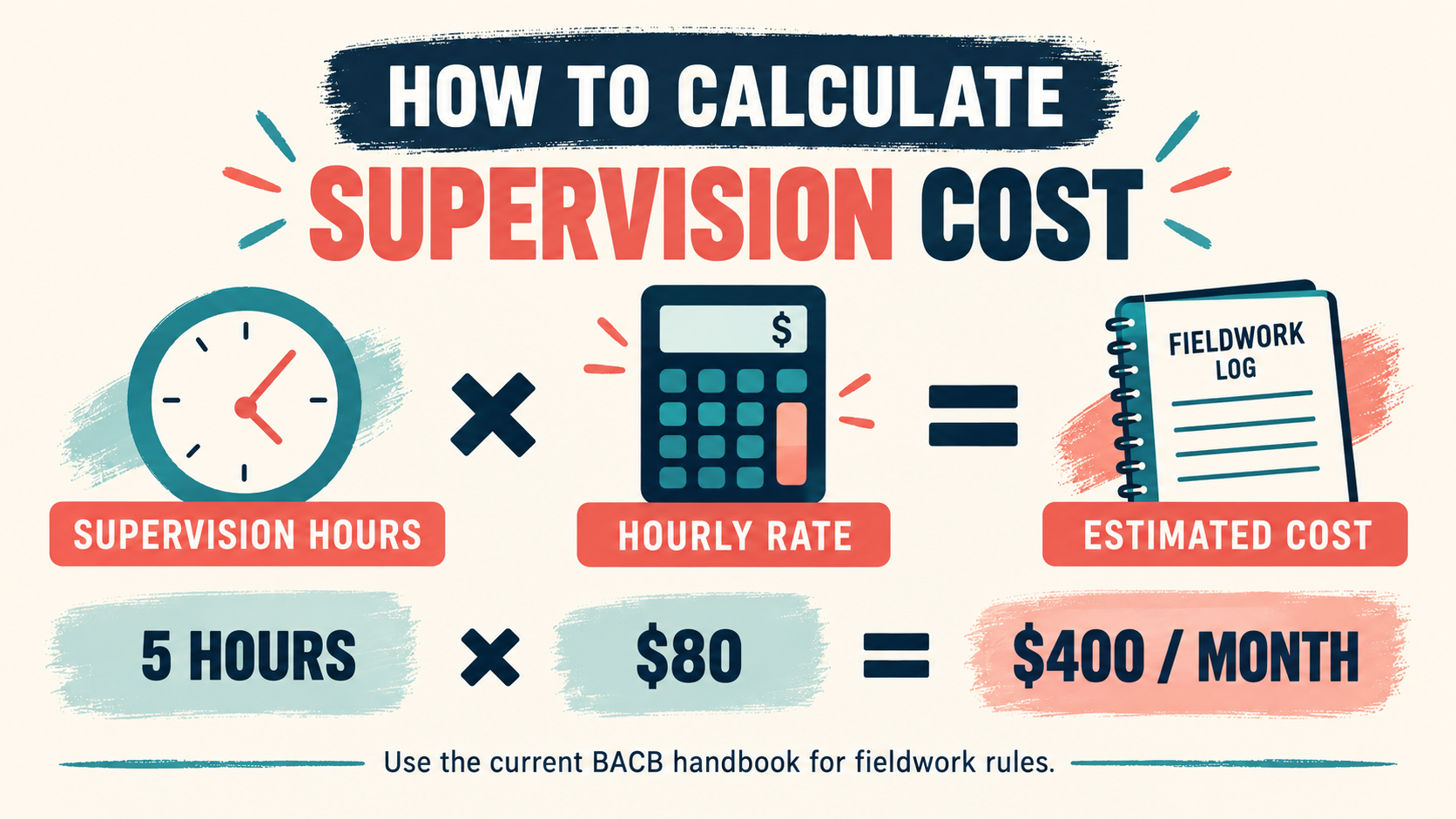
Use this four-step worksheet before comparing providers:
- Estimate fieldwork hours per supervisory period. Use the schedule you can realistically complete, not the maximum you hope to complete.
- Apply the supervision percentage. Use the current pathway rule for the supervisory period. Do not mix a standard-fieldwork percentage with a concentrated-fieldwork plan.
- Multiply required supervision hours by the quoted rate. If the supervisor charges $80 per hour and your estimate is 5 hours, the direct estimate is $400.
- Add non-hourly costs. Include enrollment, program, observation, travel, materials, cancellation, or documentation fees if the contract lists them.
For a monthly package, divide the price by included hours to find the effective hourly rate. For group supervision, divide the session fee by the paying participants only if the agreement allocates the fee that way. A group meeting must still be structured and documented under the applicable BACB rules.
| Budget line | Example | Calculation |
|---|---|---|
| Fieldwork in the month | 100 hours | Starting schedule |
| Supervision percentage | 5% | 100 × 0.05 = 5 hours |
| Quoted rate | $80 per hour | 5 × $80 = $400 |
| Other fees | $0 in this illustration | Add actual contract fees separately |
This is an arithmetic illustration, not a recommended rate or a guaranteed monthly amount. If your fieldwork hours change, the supervision requirement and the cost estimate may change with them.
What Changes the Price?
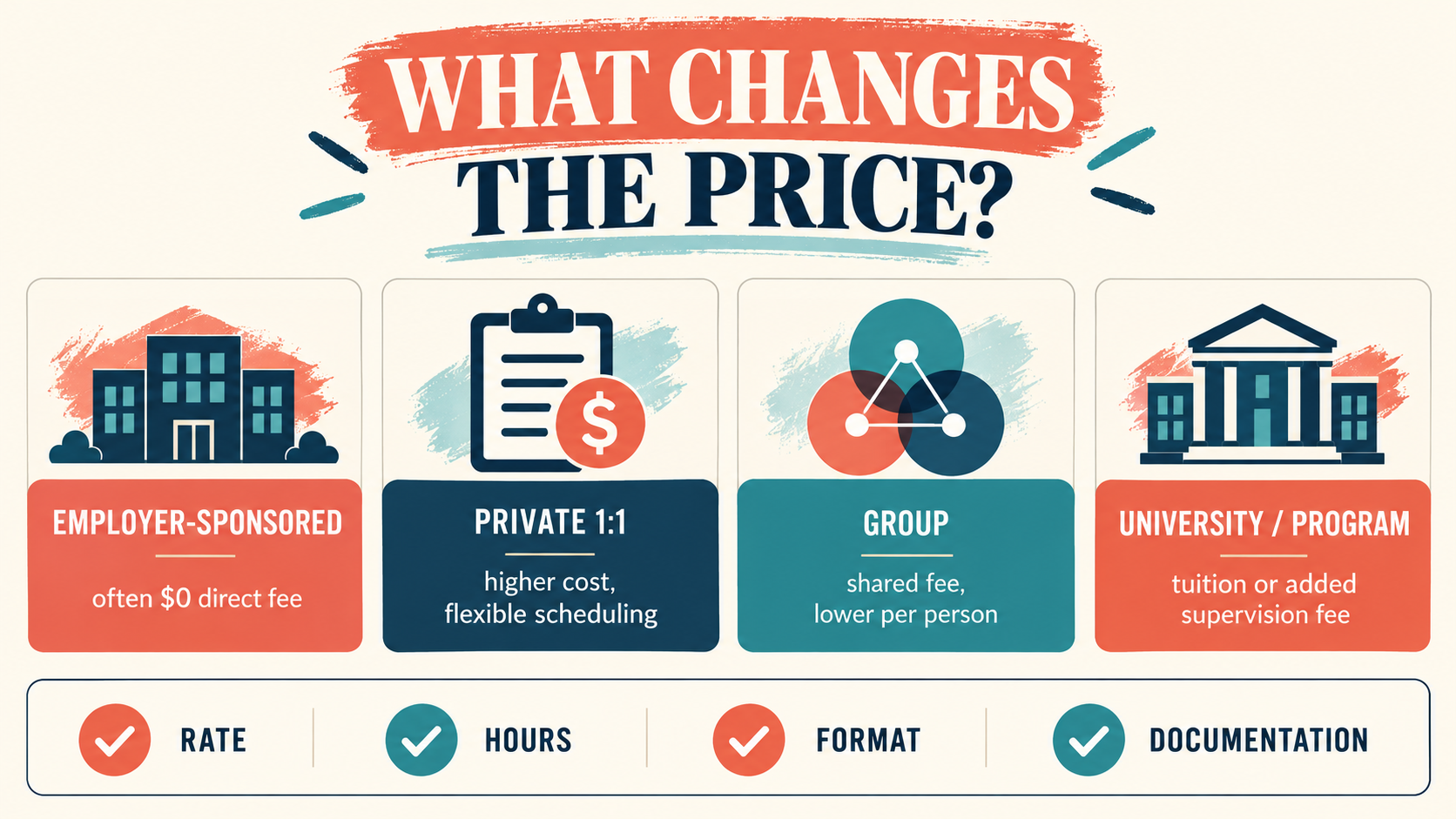
Four variables explain most price differences: rate, hours, format, and documentation. A supervisor with a specialized population or a small number of openings may charge more. Individual supervision usually costs more per participant than group supervision because the supervisor’s time is less distributed. Remote access can reduce travel, but it does not automatically make a program compliant or appropriate.
Employer-sponsored supervision may be included in compensation, but ask whether all fieldwork activities are available at the job. A position can provide a supervisor while still limiting unrestricted activities, observations, client populations, or the pace at which you can accrue hours. “Included” is valuable only if the arrangement lets you complete qualifying work and maintain accurate records.
University-affiliated programs may bundle supervision into tuition or charge a separate practicum fee. That route can provide coursework coordination, a peer cohort, and a documentation system, but the total price may be higher than a stand-alone hourly quote. Compare the complete cost of the program, not just the supervision line.
Which Supervision Arrangement Costs Less?
There is no universally cheapest option because the arrangements exchange money for flexibility, access, and structure:
- Employer-sponsored: often the lowest direct cash cost, but tied to job conditions and available fieldwork opportunities.
- Private individual: more control over supervisor selection and scheduling, usually with the highest direct hourly price.
- Group: may lower the fee per candidate, but each candidate must still receive appropriate feedback, observation, and documentation.
- University or program: may coordinate coursework and fieldwork, but supervision can be bundled with tuition or program fees.
Compare two options using the same worksheet: total expected direct cost, expected months to finish, included observation and feedback, supervisor qualifications, cancellation rules, and the likelihood that you can complete the right fieldwork activities. A cheaper rate that leaves you without qualifying hours can become the more expensive choice.
What Should a Supervision Contract Include?
Before you pay or begin accruing hours, request a written agreement. The BACB provides a BCBA resource hub for supervising and training, including fieldwork resources and a sample supervision contract. Use the current official documents as your reference point, then make sure your agreement explains:
- The supervisor’s name, certification status, role, and contact information.
- The fieldwork pathway and the rules the arrangement is designed to follow.
- The hourly, monthly, block, group, or program fee and the payment schedule.
- What counts as a supervision contact, observation, meeting, feedback session, or record review.
- Who provides access to clients, unrestricted activities, data, and other fieldwork opportunities.
- How forms, logs, audits, cancellations, travel, and termination are handled.
A contract cannot make nonqualifying hours count. It also cannot waive current BACB requirements. Treat the contract as an accountability and planning document, not as a substitute for the handbook.
How Should You Handle the 2027 Transition?
The BACB’s current BCBA resource page tells candidates to review the updated handbook and guidance for meeting BCBA requirements during the 2027 transition. Do not freeze one number or supervision percentage into a universal promise: your start date, pathway, document version, and transition status may affect which requirements apply.
Use the official BCBA fieldwork resource page and current handbook before signing. Ask which handbook version and fieldwork requirements your plan follows, and document the answer; a 2025 or 2026 search result may not describe every candidate’s 2027 path.
What Cost Mistakes Should Candidates Avoid?
- Using a national range as a quote. Published rates are market examples; your provider, location, format, and contract control the actual price.
- Budgeting only for meetings. Add observation, documentation, travel, program, and cancellation fees when they apply.
- Assuming $0 means no tradeoff. Employer-sponsored supervision may involve employment conditions, a specific caseload, or limited flexibility.
- Multiplying the wrong percentage. Apply the current rule to the hours in the relevant supervisory period and pathway.
- Paying before confirming fieldwork access. A supervisor may be qualified but unable to provide the clients, activities, observations, or documentation you need.
- Ignoring the 2027 transition. Verify the current BACB handbook and official transition guidance before relying on an old agreement or online calculator.
Frequently Asked Questions
What is the average cost of BCBA supervision?: There is no official BACB average. Public private-supervision listings and guides commonly show a broad range, often about $35–$150 per hour. Treat that as a starting point for questions, not a guaranteed quote.
Can BCBA supervision be free?: Yes, an employer or university program may include supervision without a separate direct hourly charge. Check the total employment or tuition cost and confirm that the arrangement provides the qualifying activities and documentation you need.
How do I estimate my monthly supervision cost?: Multiply your fieldwork hours in the supervisory period by the applicable supervision percentage, then multiply the required supervision hours by the quoted rate. Add any separate fees and confirm the result against the current BACB handbook.
Is group supervision cheaper than individual supervision?: It can reduce the fee per person because the supervisor’s time is shared, but cost is not the only issue. The group must still be structured and documented under the applicable rules, and you need enough individualized feedback and observation.
Does the BACB set supervision prices?: No. The BACB sets certification and fieldwork requirements, while supervisors, employers, universities, and programs set their own prices and contracts. The BACB’s official resources should be used for rules, not for a universal market rate.
Sources for Further Study
- BACB: Supervision, Assessment, Training, and Oversight — official supervision resources, supervisor training, and handbook links.
- BACB BCBA Handbook, updated February 2026 — current fieldwork overview and documentation requirements.
- BACB BCBA Fieldwork Resources — current fieldwork forms, guidance, and 2027 transition links.
- BCBA Fieldwork Hours & Requirements: 2026 Guide — an example of publicly reported private-supervision pricing and budgeting calculations.
- Remote BCBA Fieldwork Supervision: Costs and Considerations — questions to ask about remote supervision and cost tradeoffs.
The best next step is to turn a quote into a complete budget: required hours, effective hourly rate, included services, documentation, and transition rules. Once your fieldwork plan is clear, use the free BCBA mock exam as a separate preparation tool rather than treating supervision itself as exam preparation.
Quick Review Checklist
Use this final checklist to turn how much does bcba supervision cost into exam-ready reasoning. The goal is not to memorize a label in isolation; it is to identify the relevant evidence and explain why the best answer fits the scenario. Key ideas to review:
- State the central definition or decision point for how much does bcba supervision cost in your own words.
- Identify the detail that makes how much does bcba supervision cost different from its closest related ABA term.
- Separate the observable facts in a scenario from assumptions that are not supported by the facts.
- Write one example and one nonexample so you can recognize the concept in a new setting.
Exam application checks:
- Ask what the question is actually requesting before comparing the answer choices.
- Mark the antecedent, response, consequence, or other evidence that supports the selected answer.
- Look for a distractor that describes a related process but does not answer the specific question.
Final self-check:
- Explain how you would verify the interpretation with clear observations or data.
- Change one detail in the scenario and decide whether your answer should change.
- Give a one-sentence rationale that a supervisor or study partner could evaluate.
Take the Free BCBA Mock Exam
If you want a low-pressure way to check your recall, use the free practice resource below. Take the Free BCBA Mock Exam



