
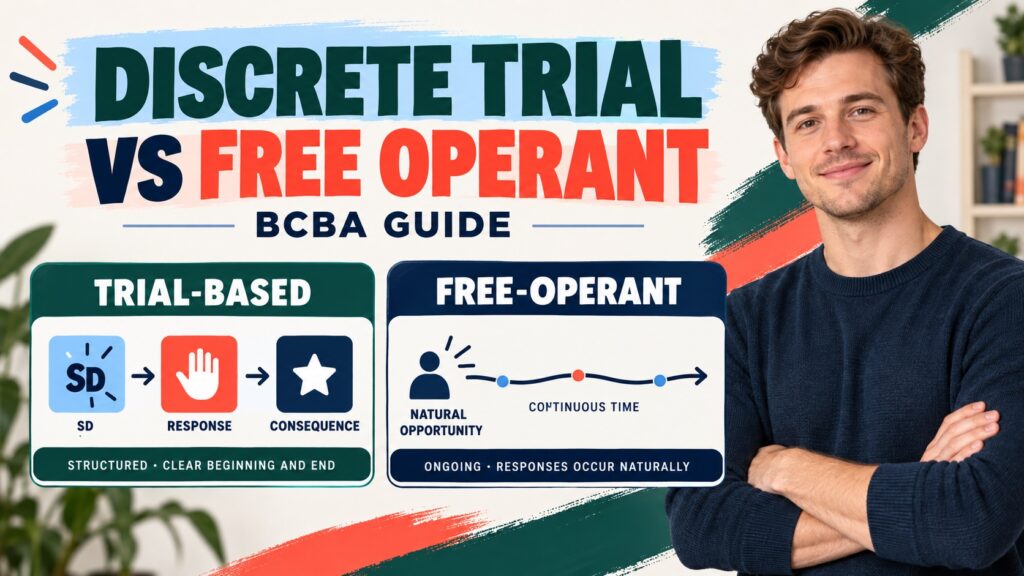
Short answer: A discrete-trial arrangement creates separate, countable learning opportunities with a clear start, response opportunity, consequence, and transition to the next opportunity. A free-operant arrangement allows the response to occur more continuously or whenever the relevant conditions are present, so the analyst often measures rate, duration, latency, or independent opportunities across time. The choice depends on the learning question, not on a belief that one format is always better.
Table of Contents
- What is the core difference between the two arrangements?
- How does a discrete-trial arrangement work?
- How does a free-operant arrangement work?
- Discrete trial vs free operant: side-by-side comparison
- How do you choose between the two arrangements?
- What data and evidence should a BCBA consider?
- What are the BCBA exam traps?
- Discrete trial vs free operant FAQ
- Take the Free BCBA Mock Exam
For the BCBA exam, discrete trial vs free operant is usually a comparison of how the environment is arranged and how behavior is measured. Discrete-trial teaching is a common trial-based example, but “trial-based” and “DTT” are not interchangeable in every sentence. Free-operant teaching is not the absence of teaching or measurement; it is a different way of making responding available and observable. Table of Contents
What is the core difference between the two arrangements?
The central difference is the structure of response opportunities. In a trial-based arrangement, the analyst defines an opportunity and can often identify when it begins, what response is scored, what consequence follows, and when the next opportunity starts. In a free-operant arrangement, the learner can emit the response across an ongoing period; the analyst arranges the environment and records behavior as it occurs rather than waiting for every response to be initiated by a formal trial.
Both arrangements can include antecedents, prompts, reinforcement, error correction, and data collection. “Free” does not mean that reinforcement is free, that behavior is uncontrolled, or that the learner is left without support. It refers to greater freedom for the response to occur within the arranged environment. Similarly, a discrete trial is not defined only by sitting at a table. A clear response opportunity can be embedded in a natural setting.
How does a discrete-trial arrangement work?
A discrete trial breaks a teaching opportunity into a visible sequence. A typical trial may include an antecedent or SD, a response window, a consequence for the response, and a brief transition before the next opportunity. The exact procedure depends on the target, learner, prompt plan, reinforcement arrangement, and mastery criteria. The important exam clue is the bounded opportunity, not the furniture in the room.
Suppose a learner is being taught to select the picture for “juice.” The instructor presents the relevant materials, delivers an instruction, waits for the defined response interval, scores the selection, and delivers the programmed consequence. After the consequence or correction, the instructor prepares the next opportunity. The analyst can report independent correct responses out of valid trials, prompt level by trial, errors, latency, and interobserver agreement.
- Clear start: the learner encounters a defined instruction, stimulus arrangement, or response opportunity.
- Defined response: the scoring rule identifies what counts as correct, incorrect, prompted, or no response.
- Contingent consequence: reinforcement, correction, or another planned consequence follows according to the procedure.
- Transition: the opportunity ends and the next trial is separated by a planned pause or change in materials.
- Trial-level data: the denominator is usually the number of valid opportunities, so the analyst can evaluate accuracy and prompting.
Trial-based instruction is useful when the team needs repeated practice with a precise skill, wants to compare prompt levels, or needs a clear mastery criterion. It can also make errors and teaching decisions visible. That structure does not make the arrangement automatically more effective; the analyst still has to consider response effort, reinforcement, generalization, learner assent, and whether the target matters.
How does a free-operant arrangement work?
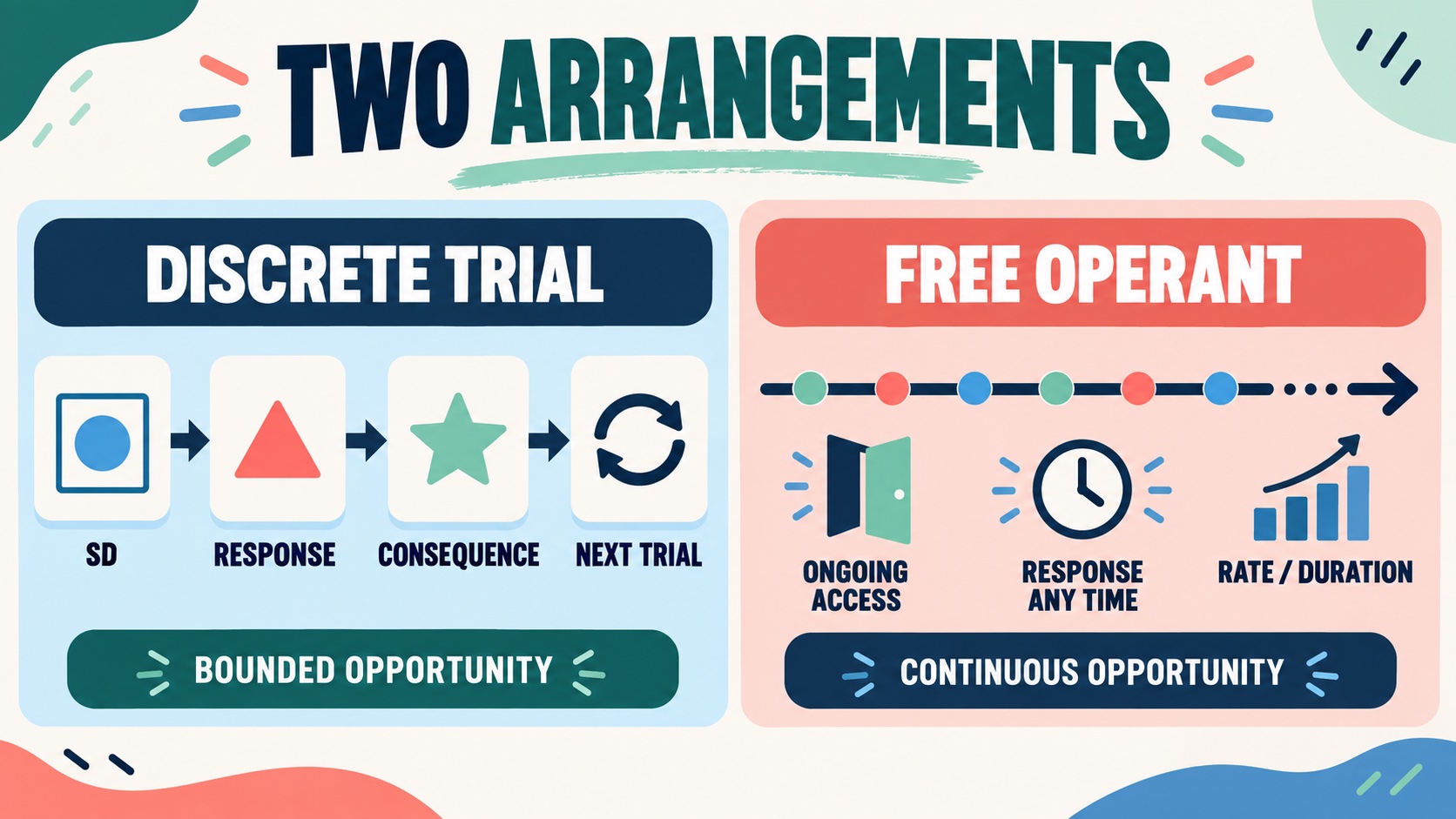
In a free-operant arrangement, the relevant response can occur at many points during an observation or teaching period. The analyst may arrange materials, access, cues, communication partners, or consequences, then measure what the learner does across time. A learner might independently request help during a classroom activity, select items during a free-access observation, or practice a motor response whenever the materials are available.
The procedure can still be carefully designed. The BCBA may define the response, arrange an SD or natural cue, establish a measurement interval, set a reinforcement contingency, and determine how staff will respond. The difference is that the opportunity is not necessarily a sequence of adult-presented, one-response trials. A free-operant arrangement is therefore compatible with precision and data integrity.
- Ongoing opportunity: the response can occur without waiting for a new formal trial to be presented.
- Natural or arranged context: materials, activities, and cues are organized to make the target response possible.
- Time-based observation: the analyst often defines a session or observation window rather than a fixed number of trials.
- Rate or duration data: responses per minute, time engaged, latency to initiate, and independent initiations may be more informative than percent correct.
- Generalization information: behavior can be observed with different materials, people, or routines closer to the learner’s real environment.
Free-operant does not mean “natural environment teaching” in every case. NET is a family of naturalistic teaching arrangements, while free-operant describes how response opportunities are available. A free-operant arrangement can be used in a natural setting, a preference assessment, a fluency procedure, or an experimental comparison. Read the full scenario before assigning the label.
Discrete trial vs free operant: side-by-side comparison
| Feature | Trial-based / discrete trial | Free operant | Common data |
|---|---|---|---|
| Opportunity | Bounded, repeated opportunity | Response can occur across an ongoing period | Valid trials or observation time |
| Instructional cue | Often a presented SD, instruction, or prompt | Natural or arranged cue may be continuously available | Cue exposure, latency, or initiation |
| Consequence | Follows the scored trial response | Follows the response whenever the programmed contingency is met | Reinforcement rate and contingency integrity |
| Best first question | Can the learner perform this precise component with support and practice? | Does the skill occur independently, fluently, or across real opportunities? | Accuracy versus rate, duration, latency, or generalization |
How do you choose between the two arrangements?
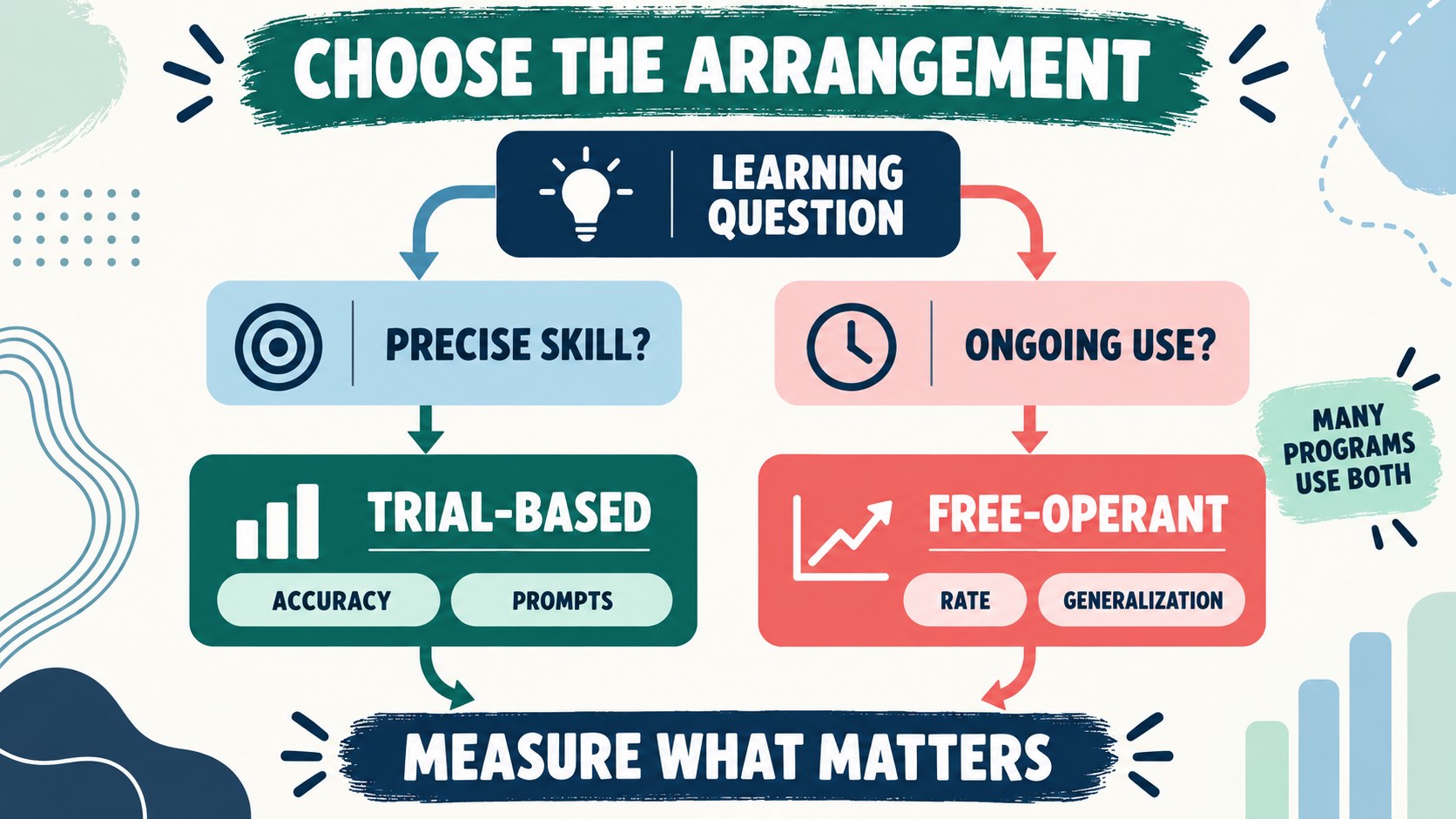
Start with the behavior-change question rather than the label. If the team needs to teach a small, observable component and evaluate prompted versus independent responding, a trial-based arrangement may provide useful control. If the team needs to know whether the learner initiates a communication response during daily activities, a free-operant arrangement may provide more representative information. Many programs use both at different stages.
- Define the target: specify the response and the socially meaningful outcome.
- Identify the current barrier: is the problem missing skill, weak stimulus control, low fluency, limited motivation, poor generalization, or an inefficient consequence?
- Choose the opportunity format: use bounded trials for precise acquisition questions or ongoing opportunities for initiation, rate, duration, and transfer questions.
- Match reinforcement: make the consequence functionally relevant and feasible, then check response effort and delay.
- Plan for transfer: vary people, materials, settings, and cues as appropriate instead of assuming trial accuracy equals real-world use.
- Review data: change the arrangement when the measurement shows a problem; do not switch formats simply because one looks more familiar.
Example: a learner can label pictures correctly in a trial-based session but rarely labels objects during play. The trial data support acquisition under that arrangement; they do not prove generalization. The next decision may be to arrange free-operant opportunities during play, adjust the cues and reinforcement, and measure independent labels per minute or across naturally occurring opportunities. The goal is not to replace DTT with free operant as a rule. The goal is to test the missing component.
What data and evidence should a BCBA consider?
The measure should fit the arrangement and the question. Percent correct can be useful when the denominator is a valid set of trials, but it can hide whether the learner initiates behavior without prompts. Rate can be useful in free-operant observation, but it can be misleading if observation time, opportunities, or reinforcement access differ across sessions.
- Trial-based acquisition: independent correct, prompted correct, incorrect, no response, latency, and prompt level per valid trial.
- Free-operant initiation: independent responses per minute, latency to initiate, duration engaged, or percentage of naturally occurring opportunities.
- Contingency integrity: whether the programmed consequence followed the eligible response and whether other consequences competed.
- Generalization: performance with new people, materials, settings, instructions, or naturally available outcomes.
- Social validity and burden: whether the arrangement is acceptable, practical, accessible, and meaningful for the learner and the people implementing it.
The current BCBA Test Content Outline places trial-based and free-operant procedures within the exam framework, but it does not say that one arrangement is universally preferred. Research comparing restricted- and free-operant programming is also arrangement- and outcome-specific. The recent systematic replication is useful because it examines acquisition and fluency under defined conditions; it should not be used to promise that every learner will learn faster in one format.
For a broader DTT foundation, review the site’s discrete trial teaching guide. For free-access preference assessment, use the separate free-operant preference assessment guide. Those pages are related resources, not substitutes for this arrangement comparison.
What are the BCBA exam traps?
- “Free” means unstructured: false. A free-operant arrangement can have an operational definition, programmed consequence, observation window, and high treatment integrity.
- DTT means table work only: false. The defining clue is the bounded trial sequence, not the location.
- No SD exists in free operant: too absolute. Natural or arranged stimuli can influence responding; the opportunity is simply not restricted to a formal trial sequence.
- Percent correct is always the best measure: false. Initiation, rate, latency, duration, and generalization may be more relevant.
- Trial-based accuracy proves generalization: false. A skill may be accurate under prompts or structured cues and still need transfer programming.
- NET and free operant are synonyms: false. NET is a naturalistic teaching approach; free-operant describes how response opportunities are arranged.
- One arrangement is ethically superior in every case: false. Evaluate learner needs, assent, access, burden, safety, outcomes, and data.
- The arrangement label answers the whole question: false. Identify the target, contingency, measurement, and decision the scenario asks you to make.
Quick review: trial-based means bounded opportunities; free operant means ongoing availability for the response. Match accuracy and prompt data to acquisition questions, and match rate, duration, latency, and generalization data to ongoing-use questions. Then review the contingency and learner context before deciding. For additional application practice, try the free BCBA mock exam. It is a study resource and does not claim to reproduce official BACB questions.
Discrete trial vs free operant FAQ
Is a discrete trial the same as a trial-based procedure? A discrete trial is a common example of a trial-based procedure. Trial-based is the broader arrangement category, so use the stem’s exact features rather than assuming every trial-based procedure has an identical DTT script.
Can a program use both arrangements? Yes. A team may use discrete trials to establish a precise response, then arrange free-operant opportunities to assess initiation, fluency, generalization, or use in a natural routine. The transition should be based on data and the learning goal.
What is the biggest measurement difference? Trial-based programs often use trial-level accuracy and prompt data. Free-operant programs often use rate, duration, latency, or independent opportunities across time. Either arrangement can use more than one measure when the question requires it.
What is the fastest exam clue? Look for a defined start, response window, consequence, and next-trial transition for a trial-based answer. Look for behavior that can occur at any time during an arranged period, with measurement across time, for a free-operant answer.
Take the Free BCBA Mock Exam
When you are ready to apply the idea, use the free practice resource below for additional feedback. Take the Free BCBA Mock Exam



