

Short answer: Behavior Intervention Plans (BIPs) can be difficult to implement in natural settings because the plan has to fit real people, routines, resources, and competing demands—not just look correct on paper. These BIP implementation barriers may involve a plan that does not address the likely function, inconsistent implementation across staff, limited training or coaching, unclear responsibilities, inadequate resources, weak treatment-integrity measurement, and poor fit with the setting.
Table of Contents
- What is the best short answer?
- Which BIP implementation barriers are most common?
- How can a team diagnose the real problem?
- What fixes improve implementation fidelity?
- Why are natural settings and buy-in important?
- How should a BCBA reason through the problem?
- What mistakes should you avoid?
- BIP implementation barriers FAQ
- Take the Free BCBA Mock Exam
This is the key idea behind the question behavior intervention plans are sometimes difficult to implement. The difficulty does not prove that ABA is ineffective or that the student cannot learn. It may show that the system around the plan is not ready, the plan is too complex, the intervention is not function-based, or the team has not yet created a practical way to implement and monitor it. A BCBA-style answer looks for the implementation barrier before changing the entire intervention.
Research on school teams has identified barriers such as inconsistent implementation, inadequate resources, ineffective plans, lack of training, and behavior causes that the plan cannot address by itself. California’s PENT implementation guidance similarly emphasizes team involvement, training, coaching, feedback, and treatment-integrity measurement. This article turns those findings into an exam-ready troubleshooting framework. It is educational study support, not individualized clinical or school advice. Table of Contents
What is the best short answer?
The best short answer is that BIPs are often hard to implement because of systems barriers, not because a behavior plan automatically fails in natural environments. A classroom, home, or community setting may include multiple adults, limited time, changing routines, competing priorities, staff turnover, and different beliefs about behavior support. Even a technically sound plan can break down when the people responsible for carrying it out do not receive clear training, feedback, materials, or decision rules.
For a multiple-choice question, be careful with absolute options. “ABA does not work in natural settings” is an unsupported conclusion. “The plan is always ineffective” skips the fidelity question. A stronger answer identifies barriers such as limited resources, inconsistent staff implementation, differing guiding philosophies, or insufficient training and then recommends assessment of implementation before making a major plan change.
- Plan problem: the intervention does not match the hypothesized function or the observable context.
- Implementation problem: staff cannot or do not carry out the written steps consistently.
- Measurement problem: the team cannot tell whether the plan was implemented or whether the behavior changed.
- System problem: schedules, staffing, materials, policies, or competing routines make the plan impractical.
Which BIP implementation barriers are most common?
The phrase BIP implementation barriers refers to variables that prevent a team from delivering the planned procedures as intended. The barriers can interact. For example, a plan may require a prompt and reinforcer within five seconds, but no reinforcer is available, three staff members use different prompt wording, and no one records opportunities. The resulting data may look like an intervention failure even though the intervention was never delivered with adequate fidelity.
| Barrier | Observable sign | Why it matters |
|---|---|---|
| Function mismatch | The plan teaches a response that does not produce the outcome maintaining behavior. | The replacement response may not compete with the target behavior. |
| Inconsistent staff use | Different adults use different prompts, consequences, or definitions. | The student contacts unpredictable contingencies and fidelity cannot be assumed. |
| Training and coaching gap | Staff received a document but little modeling, rehearsal, or feedback. | Knowing what a plan says is not the same as performing each step accurately. |
| Resource mismatch | The plan requires time, materials, staffing, or space the setting does not have. | A procedure that cannot occur during the routine will not maintain high fidelity. |
| Measurement gap | Data record outcomes but not opportunities, prompts, or implementation steps. | The team cannot separate a learner response problem from an implementation problem. |
Another barrier is plan complexity. A BIP with ten loosely defined steps may sound comprehensive, but every extra step creates another opportunity for drift. The strongest plan is not necessarily the longest one. It should specify the observable behavior, prevention strategy, replacement skill, reinforcement, response procedure, data system, and review process in language the actual implementers can use during the routine.
How can a team diagnose the real problem?
Before changing a BIP, separate three questions: Was the plan implemented? Was it implemented in the right context? If it was implemented with reasonable fidelity, did the learner’s behavior change? These questions prevent the team from treating a fidelity failure as proof that the behavioral principle or intervention package is ineffective.
A practical diagnostic sequence starts with direct observation or a reliable implementation checklist. The team can compare the written plan with what happens in the setting, then review whether the relevant opportunities occurred. If staff did not have the materials, did not know the prompt sequence, or could not deliver the planned consequence, the next action is implementation support—not an immediate conclusion that the student is resistant.
- Clarify the step: rewrite vague phrases such as “redirect appropriately” into observable actions.
- Check opportunity: confirm that the antecedent, routine, and learning opportunity actually occurred.
- Observe fidelity: record whether the implementer completed the critical steps, not just whether the student responded.
- Review the function: ask whether prevention, replacement teaching, and reinforcement address the current hypothesis.
- Check acceptability: ask whether the plan fits the student, family, culture, classroom, and available resources.
- Compare outcomes: interpret behavior data alongside fidelity and context data.
This process also protects the learner from unnecessary escalation. If the plan was implemented inconsistently, increasing response effort or adding a punishment procedure may make the situation worse. The ethical and scientifically useful first step is to identify the variable that is preventing consistent, function-based support.
What fixes improve implementation fidelity?
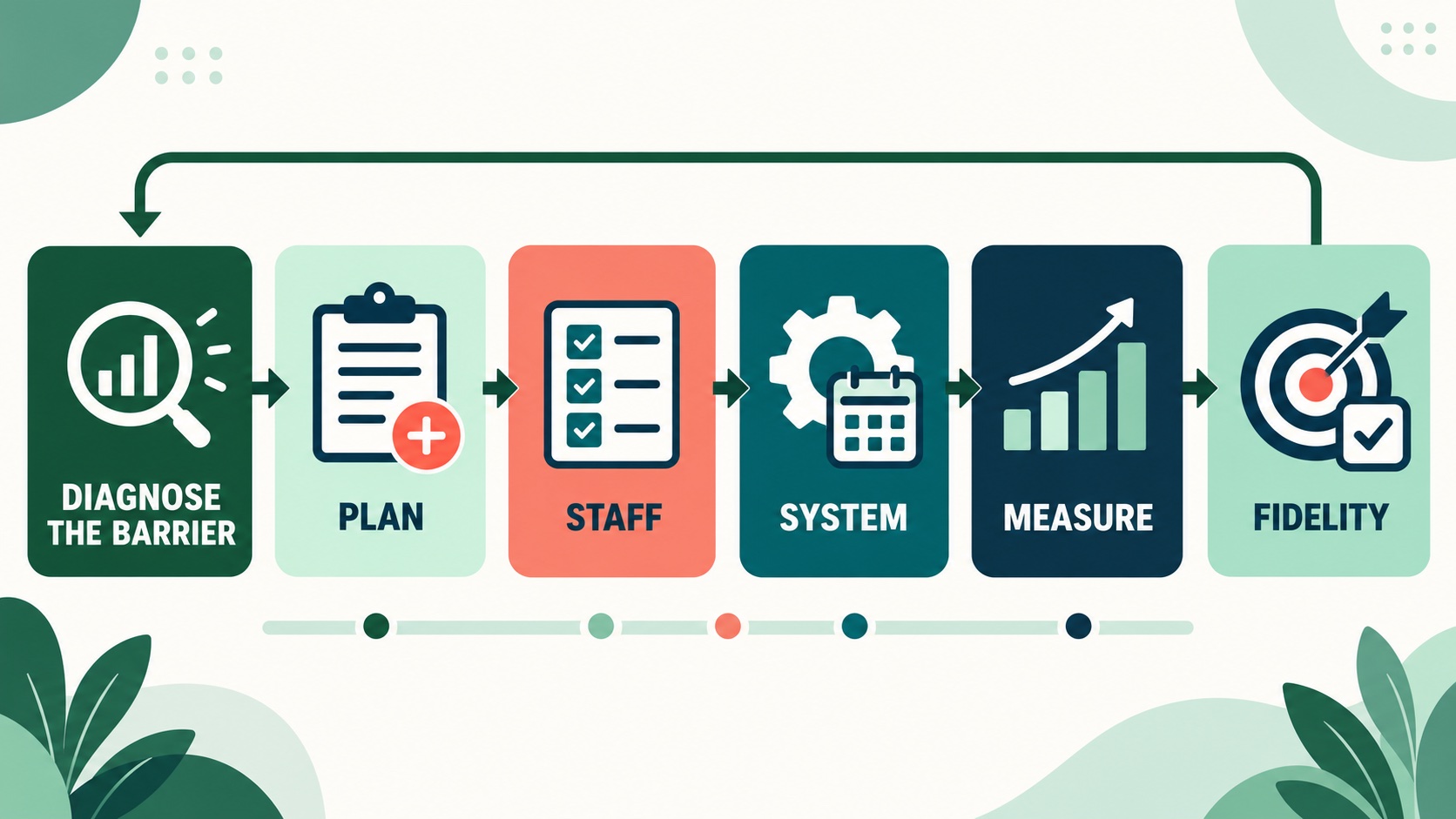
Improving implementation usually requires making the plan easier to perform and giving implementers active support. A plan should be introduced as a team process, not simply emailed to staff. The California PENT implementation guidance highlights team involvement, training, coaching, feedback, and treatment-integrity monitoring because these steps connect the written procedure to the real setting.
| If the barrier is… | Try first | Evidence to review |
|---|---|---|
| Staff do not know the steps | Use behavior skills training: instruction, modeling, rehearsal, and feedback. | A fidelity checklist completed during actual routines. |
| The routine makes the plan impractical | Reduce steps, prepare materials in advance, and place supports where the routine occurs. | Time, staffing, material, and opportunity data. |
| Adults respond differently | Create a shared one-page decision rule and practice the same examples. | Agreement checks and observations across implementers. |
| The replacement skill is not competing | Recheck the function, response effort, immediacy, and reinforcement value. | ABC patterns, replacement responses, and consequence data. |
Coaching should occur during the routines in which the plan is expected to work. A staff member may perform accurately in a quiet training room and still need support during arrival, transitions, group instruction, or a busy community activity. Feedback should identify the critical step, describe what was observed, and give the implementer an opportunity to rehearse the improved response.
Why are natural settings and buy-in important?
Natural settings contain variables that a clinic-style rehearsal may not capture. The student may have different communication partners, materials, schedules, reinforcers, noise levels, and response requirements. Generalization should therefore be planned rather than assumed. If a replacement response only works with one adult, one prompt, or one set of materials, the team has not yet demonstrated that it will transfer to the settings that matter.
Buy-in does not mean that every person must prefer the same terminology. It means implementers understand the purpose of the plan, can perform the critical steps, have a way to raise concerns, and see that the plan fits the student and routine. Involving implementers during development can reveal barriers before the plan is finalized. It can also improve the chance that the prevention strategy and reinforcement system will be practical enough to use.
- Use the language and materials that naturally occur in the setting.
- Practice with the people who will actually implement the plan.
- Plan for multiple settings, partners, materials, and routines.
- Collect feedback about feasibility without replacing objective fidelity data.
- Schedule review points so the plan can be adjusted before frustration accumulates.
How should a BCBA reason through the problem?
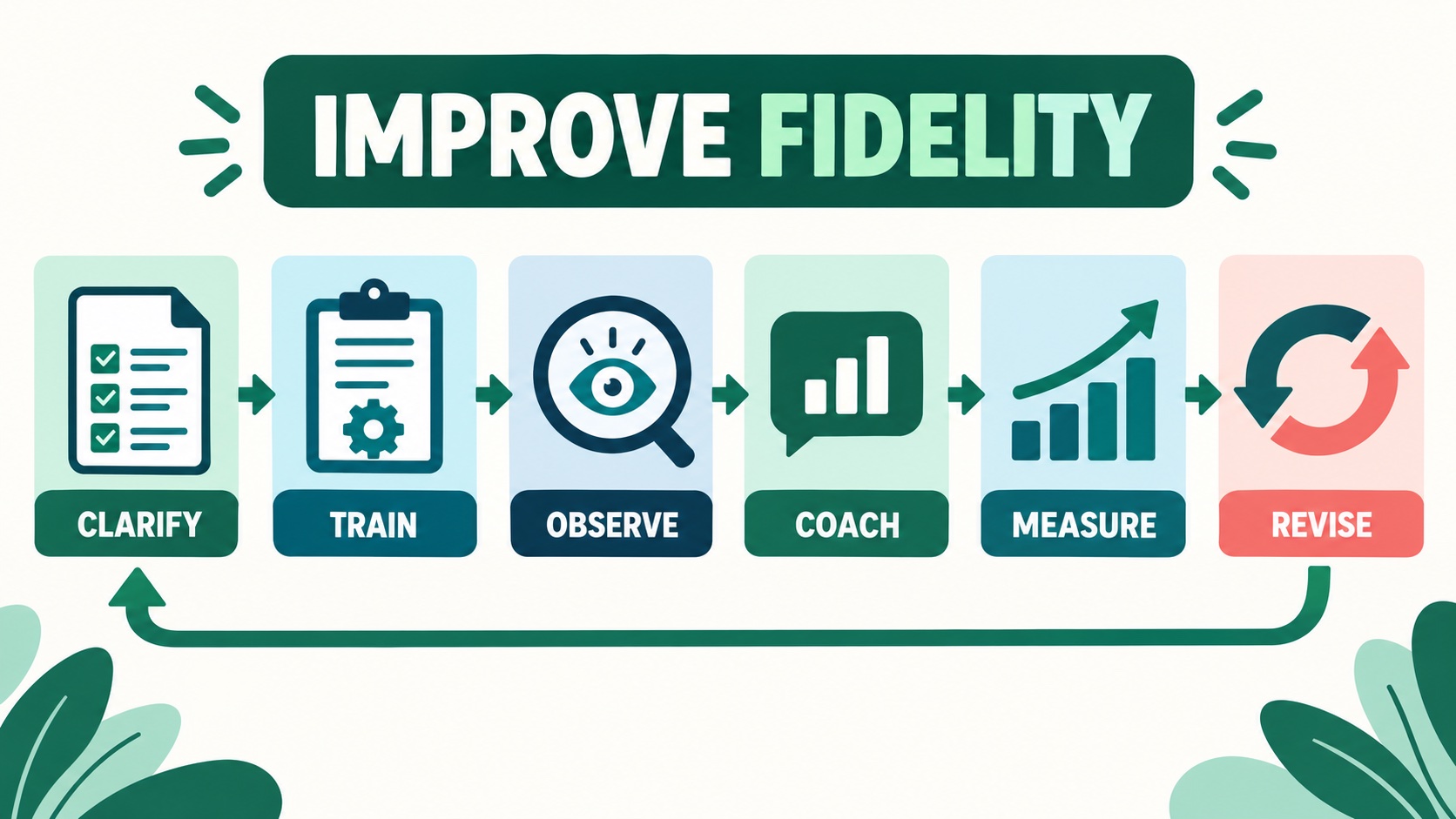
For current exam-domain framing, the BACB BCBA Test Content Outline is the authoritative reference for broad exam content; this article does not reproduce official questions. In a scenario, the safest sequence is usually to define the implementation problem, collect direct fidelity information, provide training or coaching, and then evaluate outcomes.
If the stem says the student is not improving but never tells you whether staff followed the plan, do not jump directly to a new intervention. If the stem says staff do not understand the procedures, the answer should address training, modeling, rehearsal, or feedback. If all staff implement the plan accurately but the behavior pattern does not change, then review the behavioral hypothesis, measurement, reinforcement, and treatment fit.
| Scenario clue | First reasoning move | Avoid |
|---|---|---|
| Staff use different procedures | Clarify, train, observe, and provide feedback. | Concluding the intervention is ineffective from outcome data alone. |
| The plan cannot fit the routine | Adapt materials and steps while preserving the function-based logic. | Expecting staff to add impossible steps without support. |
| High fidelity but no improvement | Reassess function, reinforcement, target definition, and measurement. | Blaming implementers without reviewing the plan. |
What mistakes should you avoid?
- Confusing outcome with fidelity: a poor outcome does not show that the plan was delivered as written.
- Using a document as training: reading a BIP is not the same as demonstrating each critical step.
- Making the plan longer instead of clearer: added complexity can increase implementation drift.
- Ignoring implementer context: time, materials, staffing, and routine demands affect feasibility.
- Assuming generalization: skills and supports may need deliberate programming across settings.
- Changing procedures without team review: modifications should be based on data and authorized decision-making.
BIP implementation barriers FAQ
Are BIPs difficult to implement because ABA does not work in natural settings?: No. Implementation difficulty is not evidence that ABA cannot work in natural settings. It is a prompt to examine function, plan fit, staff training, resources, fidelity, generalization, and measurement. A natural setting may require additional planning and support because more variables are present.
What is the most common implementation barrier?: There is no single barrier in every setting. Commonly reported problems include an intervention that does not address the cause of behavior, inconsistent implementation across staff, inadequate resources, ineffective or overly complex plans, and insufficient training or feedback. Direct observation is more useful than guessing which barrier is present.
Should a BCBA rewrite a BIP when staff do not follow it?: Not automatically. First determine whether the plan is clear, whether staff were trained, whether materials and time are available, and whether implementation can be observed reliably. Provide appropriate coaching and review fidelity. If the plan itself is not practical or no longer matches the function, then the team can consider a data-based revision.
How can a team tell whether the plan or implementation is the problem?: Collect both outcome data and implementation data. If fidelity is low, improve implementation before judging the intervention. If fidelity is high and the target behavior does not improve, review the functional hypothesis, replacement response, reinforcement, measurement, and contextual fit. This distinction is a high-value BCBA reasoning habit.
Quick review: define the barrier, observe fidelity, check the function and context, support the implementer, and then interpret outcome data. For additional scenario practice, use the free BCBA mock exam as a practice and feedback resource. It is not an official BACB exam and does not guarantee certification or a passing result.
Take the Free BCBA Mock Exam
When you are ready to apply the idea, use the free practice resource below for additional feedback. Take the Free BCBA Mock Exam



