

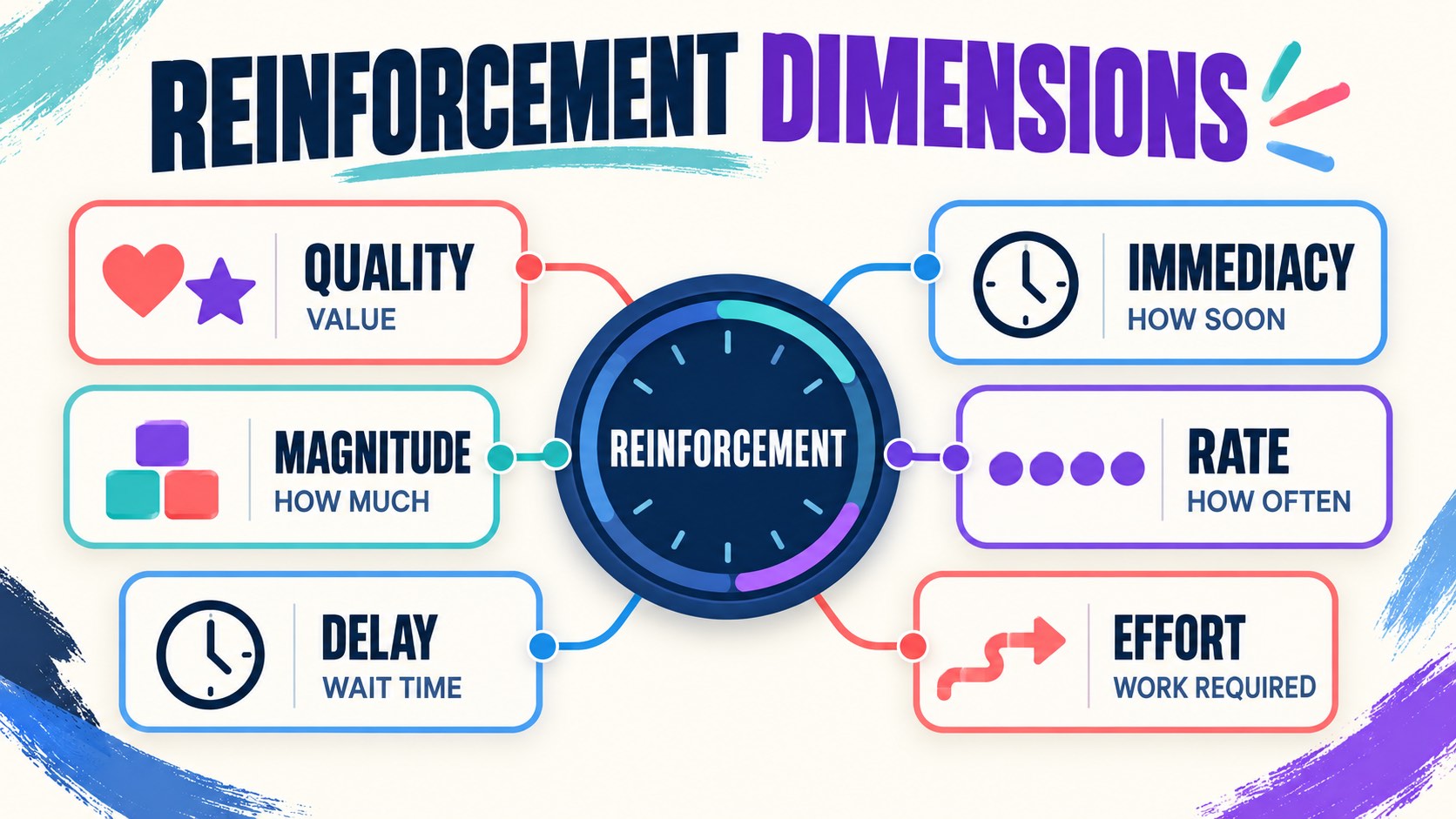
Short answer: In BCBA study language, dimensions of reinforcement ABA refers to measurable features of a consequence or reinforcement arrangement that can change how valuable, available, or effortful an option is. Common dimensions include quality, immediacy, magnitude, rate, delay, and response effort. They help a BCBA analyze why one response may be selected over another, but they do not predict behavior perfectly without data.
Table of Contents
- What are the dimensions of reinforcement in ABA?
- Which reinforcement dimensions should you recognize?
- How do you analyze a reinforcement-dimension scenario?
- Which dimension is changing in the example?
- How are these dimensions different from related ABA concepts?
- What does the evidence support?
- What are the BCBA exam traps?
- Dimensions of reinforcement ABA FAQ
- Take the Free BCBA Mock Exam
This topic is easy to confuse with the seven dimensions of ABA. Those are criteria for evaluating applied behavior analysis. Here, “dimensions” means parameters of reinforcement and the response conditions surrounding it. The distinction matters on the BCBA exam because the stem may ask which feature changed, not which procedure has a familiar label. Table of Contents
What are the dimensions of reinforcement in ABA?
A reinforcement dimension is a feature of the outcome or response arrangement that can be varied and measured. For example, two responses might both produce access to a preferred activity, but one produces a longer period of access, a faster start, a more preferred version, or a consequence that requires less work. Those differences are not automatically “the reinforcer”; they are parameters that may affect the reinforcer’s value or the allocation of responding.
The practical question is comparative: what does each available response produce, how soon does it produce it, and what does the learner have to do to contact it? This is why a dimension is not a promise that behavior will increase. A learner’s preferences, motivating operations, competing consequences, skill history, access needs, and the actual contingency still matter. The analyst should use the dimension to form a testable prediction, then inspect the data.
Which reinforcement dimensions should you recognize?
The most useful study set is quality, immediacy, magnitude, rate, delay, and response effort. Some texts group or name these variables differently, and “reinforcer dimensions” may also include duration, variety, or schedule arrangement. The label matters less than the operational question: what changed, and was the change contingent on the response?
- Quality: how preferred, valuable, or relevant the consequence is relative to another available consequence. Quality is individualized; an item is not high quality simply because an adult assumes it is.
- Immediacy: how quickly the consequence follows the response. A consequence that starts immediately may compete differently from one delivered after a long delay.
- Magnitude: the amount, size, duration, or intensity of the consequence delivered. Ten minutes of an activity and one minute of that activity differ in magnitude, although more is not always better.
- Rate or density: how often reinforcement is available or obtained over a period. Compare the programmed opportunity with the actual rate contacted by the learner.
- Delay: the time between the response and reinforcement. Delay is closely related to immediacy, but a stem may emphasize the waiting interval rather than the speed of delivery.
- Response effort: the work required to produce the response and contact the consequence. A response that produces a strong outcome may still be less likely if it is much harder than a competing response.
These dimensions can interact. A larger reinforcer delivered much later may compete poorly with a smaller reinforcer available immediately. A preferred activity may not function effectively when the learner must complete an unrealistic response requirement to access it. A high rate of reinforcement for one option can change allocation even when the nominal reinforcer is the same. On an exam, state the dimension first, then avoid claiming more than the facts support.
How do you analyze a reinforcement-dimension scenario?
Use a consistent sequence instead of jumping from a preferred item to a conclusion about behavior. The following checklist keeps the analysis functional:
- Name the responses. Identify the options the learner can actually emit, not just the activities an adult has planned.
- Map the consequence. Write what each response produces, including who delivers it and whether access is contingent.
- Compare the parameters. Check quality, immediacy, magnitude, rate, delay, and effort across the options.
- Look for a competing variable. Consider motivation, satiation, deprivation, skill, prompts, context, communication access, and other available consequences.
- Make a conditional prediction. Say which option may be more likely under the described arrangement, not what must happen in every setting.
- Identify the data needed. Choose a measure such as response allocation, latency, completed responses, choice percentage, or reinforcement obtained.
For instance, imagine that a learner can request help with a short card or engage in task refusal. The card produces a brief pause immediately, while refusal sometimes produces adult attention after several prompts. If card use remains low, do not conclude that the learner “does not like communication.” Compare the response effort, delay, prompt history, reliability of the consequence, and whether the pause actually matches the learner’s function. The dimension analysis points to variables to test; it does not replace assessment.
Which dimension is changing in the example?
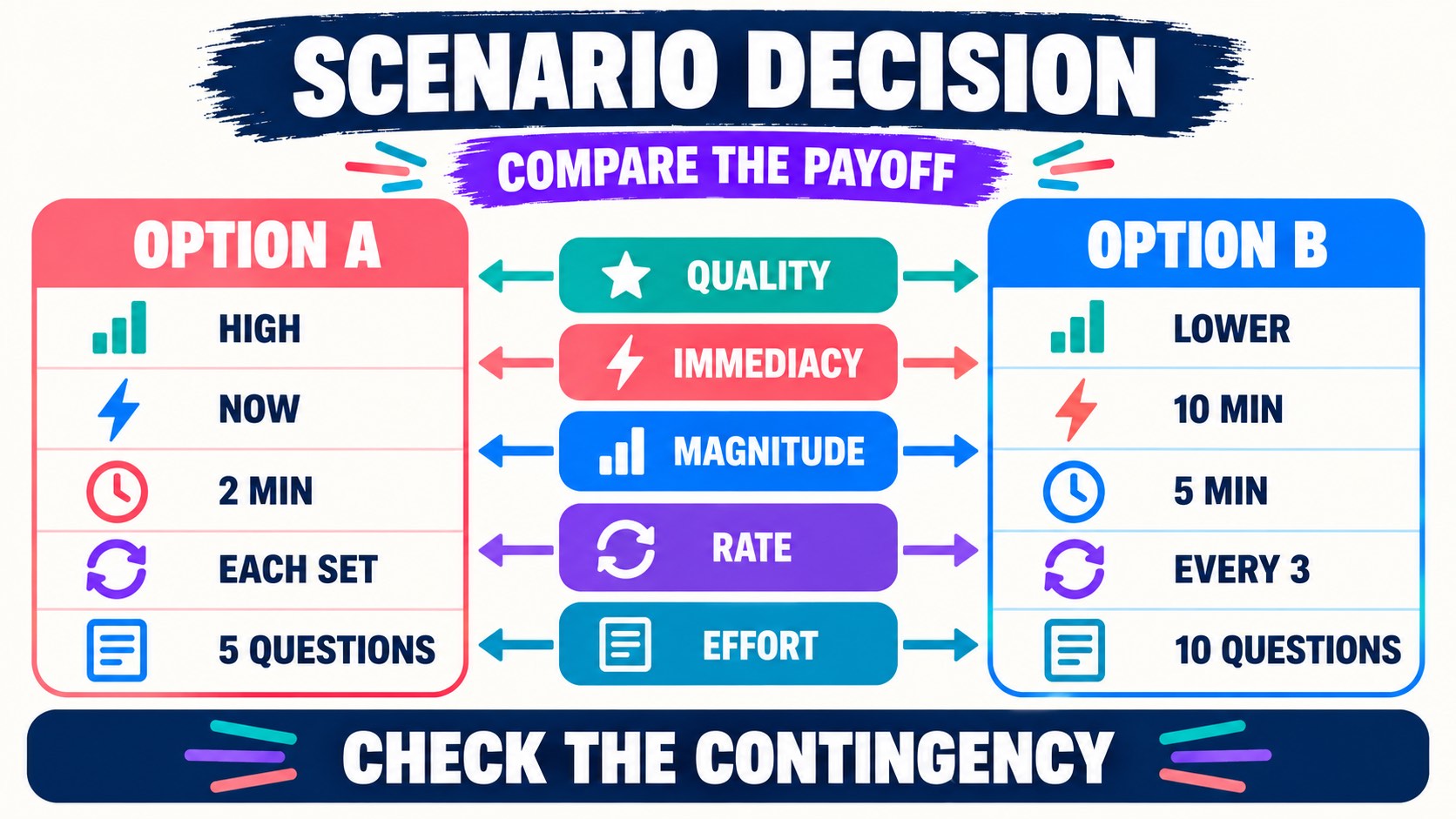
Consider two study options for a learner preparing for a short practice task. Option A is a five-question set followed by two minutes of a preferred video. Option B is a ten-question set followed by five minutes of the same video. If the video begins immediately after each completed set, the options differ in magnitude and response effort. If Option A gives access after every successful set while Option B gives access only after three sets, the reinforcement rate or density also changes. If the video is available only ten minutes later, delay changes.
| Dimension | What changes? | Stem clue | Useful measure |
|---|---|---|---|
| Quality | Preference or relevance of the outcome | Preferred activity versus less-preferred activity | Choice, approach, engagement, or allocation |
| Immediacy / delay | Time from response to consequence | Immediately, after a wait, or at a later transition | Latency, choice, or response allocation |
| Magnitude | Amount, duration, or intensity | One token versus five, or one minute versus ten | Response rate, choice, or breakpoint |
| Rate / density | How often reinforcement is obtained | More frequent opportunities or a richer schedule | Reinforcers per time, responses, or trial |
| Response effort | Work needed to contact the outcome | One step versus a long or difficult response | Independent completion, latency, or allocation |
How are these dimensions different from related ABA concepts?
Several nearby terms can appear in the same stem. Keep the level of analysis clear:
- Seven dimensions of ABA: applied, behavioral, analytic, technological, conceptually systematic, effective, and generality. These evaluate the character of applied behavior analysis; they are not the quality or magnitude of a reinforcer.
- Response dimensions: frequency, rate, duration, latency, and topography describe features of behavior being measured. Response effort can interact with reinforcement, but it is not the same as a response measure.
- Schedules of reinforcement: FR, VR, FI, VI, NCR, and other schedules describe the response–consequence rule or timing arrangement. A schedule can change reinforcement rate or predictability, but “magnitude” is not a schedule label.
- Preference assessment: a preference assessment identifies selections, rankings, or engagement. It does not by itself prove that an item will increase a target response; a reinforcer assessment tests the functional effect.
- Matching law: matching concerns relative response allocation in relation to relative reinforcement obtained. Dimensions such as quality, immediacy, rate, and effort may help explain that allocation, but they are not interchangeable with the law itself.
The same stimulus can have different effects across learners, tasks, or motivating conditions. Treat “more,” “faster,” or “preferred” as descriptive clues that require context. A sound answer identifies the parameter, states the likely functional implication, and checks what data would confirm it.
What does the evidence support?
Behavior-analytic research has examined how variables such as magnitude, quality, immediacy, rate, and effort influence preference and response allocation. The reinforcement-magnitude study treats magnitude as the amount, duration, or intensity of reinforcement and evaluates its relation to preference and reinforcer efficacy. Its value for study is the operational distinction; its results should not be turned into a universal dose rule for every learner.
The Vanderbilt IRIS explanation offers an accessible example of comparing quality, immediacy, magnitude, and effort when considering which behavior is more likely. The reinforcer-dimension sensitivity assessment further illustrates why an analyst may need to determine which parameter matters for an individual rather than assuming every person responds to the same feature.
For BCBA preparation, use the current BCBA Test Content Outline as an exam-scope boundary. It supports careful measurement, assessment, intervention, and data-based reasoning; it does not guarantee that this exact phrase or a particular scenario will appear on a test. The correct study habit is to translate the stem into observable variables and avoid unsupported certainty.
What are the BCBA exam traps?
- Confusing the seven dimensions of ABA with reinforcer dimensions: check whether the stem is evaluating an intervention or comparing consequences.
- Calling a preferred item a reinforcer without evidence: preference can guide a test, but the behavior must change in the relevant arrangement.
- Assuming a larger reinforcer always wins: immediacy, quality, effort, delay, and competing consequences can change the prediction.
- Ignoring response effort: the option with the best nominal outcome may be too difficult to contact efficiently.
- Treating delay and immediacy as unrelated variables: both describe timing; the stem may foreground either the fast delivery or the waiting interval.
- Confusing rate with magnitude: more reinforcers per hour is not the same as a larger reinforcer on each delivery.
- Calling a schedule a dimension: FR or VI describes a contingency arrangement; it may influence rate, predictability, or pause patterns but is not a synonym for quality.
- Making a clinical recommendation from one parameter: a BCBA must consider function, safety, assent or consent requirements, social validity, and ongoing data.
Quick review: name the available response, identify the consequence, compare quality, immediacy, magnitude, rate, delay, and effort, then state the data needed to test the prediction. If you are ready to practice reading these distinctions in context, try the free BCBA mock exam. It is a study resource and does not claim to reproduce official BACB questions.
Dimensions of reinforcement ABA FAQ
Are dimensions of reinforcement the same as the seven dimensions of ABA? No. Reinforcer dimensions describe features such as quality, immediacy, magnitude, rate, delay, and effort. The seven dimensions of ABA describe criteria for applied behavior analysis.
Which dimension is most important? There is no universal winner. The relevant parameter depends on the learner, response options, motivating conditions, task, and data. A scenario may be testing the contrast between two parameters rather than asking for one best dimension.
Is response effort a dimension of reinforcement? It is often discussed alongside reinforcer dimensions because the effort required to contact an outcome affects choice and response allocation. Read the stem carefully: effort describes the response requirement, while quality, magnitude, and immediacy describe features of the consequence or its delivery.
How can I remember the concept for the BCBA exam? Ask, “What does each option pay, how soon, how much, how often, and at what cost?” Then separate the prediction from the evidence. The answer should be based on the stated contingency and the measure that would test it.
Take the Free BCBA Mock Exam
When you are ready to apply the idea, use the free practice resource below for additional feedback. Take the Free BCBA Mock Exam



