
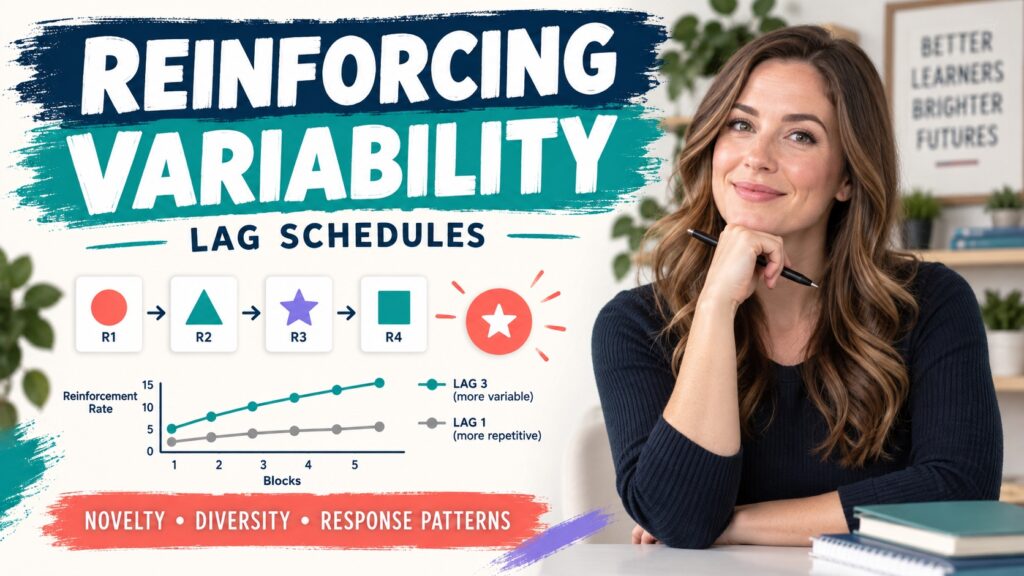
Short answer: Differential reinforcement of variability is a reinforcement arrangement in which the consequence depends on a defined amount or pattern of variation in responding. Instead of reinforcing one fixed response form, the contingency can favor a response that differs from recent responses, meets a lag criterion, or expands a defined repertoire. The key is not that behavior looks unpredictable; the key is that variability is the response property contacting reinforcement.
Table of Contents
- What does differential reinforcement of variability mean?
- How does a lag schedule reinforce variability?
- What exactly can vary?
- How is it different from DRA, DRO, and generalization?
- What are ABA examples of reinforced variability?
- How should you measure reinforced variability?
- What does the research support?
- What are the BCBA exam traps?
- Differential reinforcement of variability FAQ
- Take the Free BCBA Mock Exam
This BCBA study guide focuses on lag schedules, response diversity, measurement, and exam reasoning. It is narrower than a general response-variability overview: the question here is how a contingency can select variation. A real behavior plan still requires an individualized target, socially valid outcomes, safety review, and ongoing data analysis. Table of Contents
What does differential reinforcement of variability mean?
Differential reinforcement of variability targets a property of responding rather than one single topography. The learner may earn reinforcement for producing a different sequence, a new response form, a wider range of examples, or a response that differs from a recent sample. The analyst must define “different” before the contingency begins. Without that definition, “be creative” or “try something new” is an instruction, not a measurable behavioral criterion.
In operant terms, a response can vary along several dimensions: topography, sequence, location, force, duration, words used, materials selected, or the order of actions. A lag schedule is one common way to arrange the contingency. It compares the current response with one or more prior responses and delivers reinforcement only when the current response meets the programmed difference rule.
Do not confuse this topic with graph variability. A graph can show unstable session values, while differential reinforcement of variability describes a contingency that selects variation in the response itself. The existing response variability ABA overview is useful for the broader distinction; this page concentrates on how the reinforcement criterion is constructed.
How does a lag schedule reinforce variability?
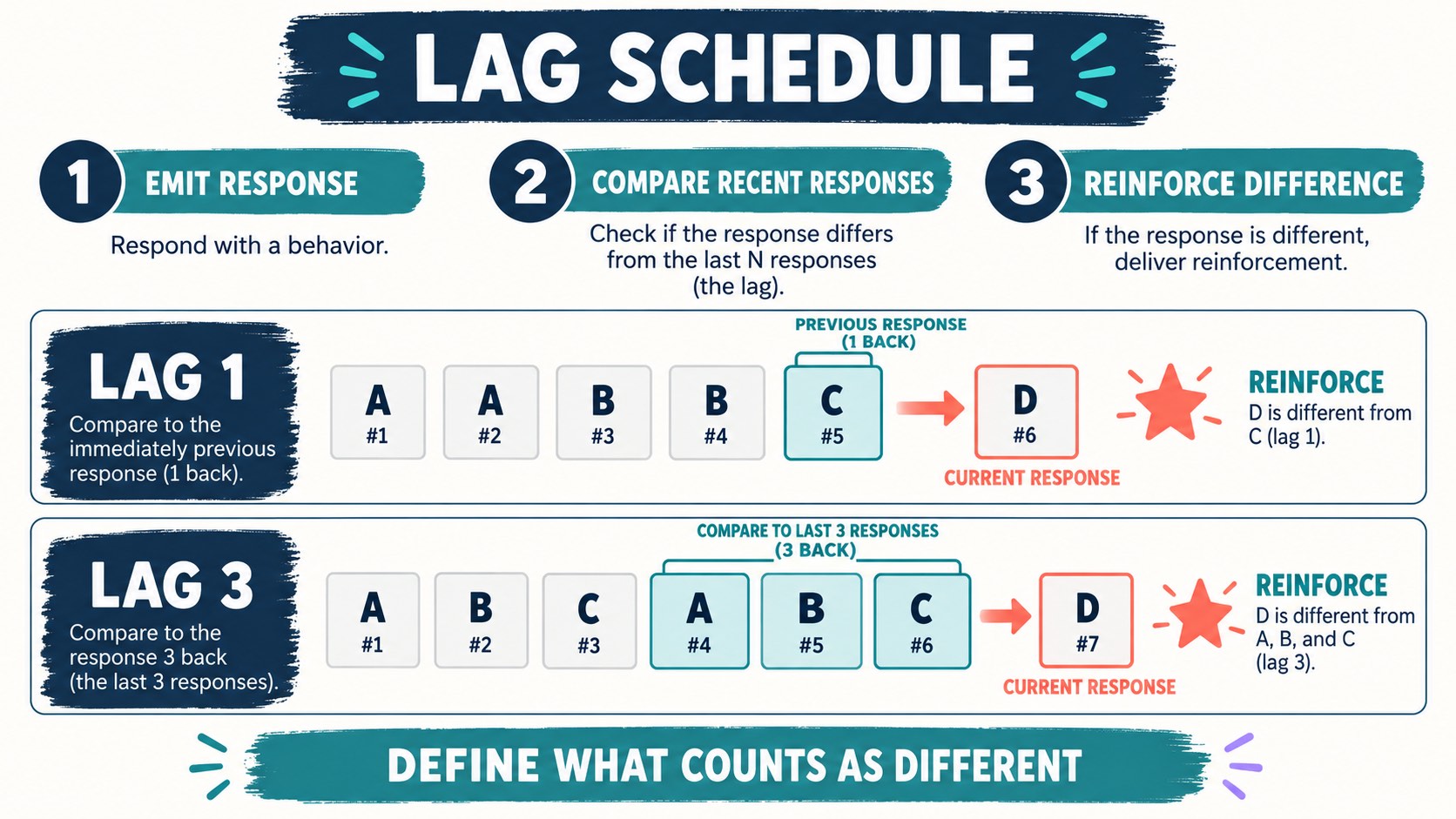
“Lag” means that the current response is compared with earlier responses. In a Lag 1 arrangement, reinforcement is available when the current response differs from the immediately preceding response. In a Lag 2 arrangement, the current response may need to differ from the previous two responses. As the lag requirement increases, the comparison set becomes larger and the variation criterion becomes more demanding.
The word “different” still needs an operational rule. A Lag 1 verbal-response program might define difference as a different word sequence. A play program might define it as a new construction pattern. A writing program might define it as a new sentence structure. The same label can describe very different response dimensions, so the scoring rule belongs in the plan and in the data sheet.
- Define the response unit. Decide whether the unit is a single response, a sequence, a completed product, or a response pattern.
- Define the comparison window. Specify how many prior responses are used to judge difference.
- Define the difference rule. State which feature must change and which features may remain the same.
- Deliver reinforcement only when the criterion is met. A correct but repeated response may not contact reinforcement in a variability contingency.
- Record both opportunities and successes. Otherwise, a high percentage can hide a very small number of opportunities.
A yoke or control condition can help a researcher compare the effects of a variability contingency with a similar amount of reinforcement that is not dependent on variation. For a BCBA exam question, however, the first task is simpler: identify whether reinforcement depends on a response being different, not merely whether the response changes during the session.
What exactly can vary?
A strong answer names the response dimension. Common possibilities include:
- Topography: different physical forms of an acceptable response.
- Sequence: a different order of actions within a routine or chain.
- Stimulus selection: different appropriate materials, examples, or choices.
- Verbal form: different words, phrases, or sentence arrangements that meet the communication goal.
- Product feature: a new color, shape, pattern, or arrangement within a defined task.
- Response allocation: a different combination or distribution of previously taught actions.
The dimension must be bounded by the goal. Reinforcing every possible difference can accidentally select inefficient, unsafe, or socially invalid behavior. A learner who is practicing functional communication may need varied forms that remain understandable and effective; a learner who is practicing flexible play may need variety within safe materials and task limits.
How is it different from DRA, DRO, and generalization?
Several procedures can produce behavior that looks different, but their contingencies are not interchangeable. Use the reinforced event as the deciding clue.
| Concept | What contacts reinforcement? | Exam clue |
|---|---|---|
| Variability reinforcement | A response that meets a defined difference or diversity criterion | Novel, different from recent responses, Lag n, or response diversity |
| DRA | One specified alternative response | Reinforce asking, requesting, or another named replacement |
| DRO | Absence of the target for a stated interval or check | No target behavior, regardless of which other response occurs |
| Generalization | Correct behavior across changed people, settings, stimuli, or examples | The same skill transfers; novelty itself is not the criterion |
For example, reinforcing a learner for using a break card is DRA, even if the card is used in many different ways. Reinforcing any communication response that differs from the last response is a variability contingency, provided that difference is the programmed criterion. Reinforcing the absence of screaming for two minutes is DRO, even if the learner happens to use many different appropriate responses during that time.
What are ABA examples of reinforced variability?
Consider the goal and the measurement rule together. In a play example, a learner might build a block structure, then earn reinforcement for a new arrangement that differs from the last few structures along a defined feature. In a verbal example, a learner might answer a familiar question with a new appropriate description instead of repeating the same phrase. In a social example, a learner might practice several acceptable ways to initiate a game, with the variability criterion limited to forms that are understandable and safe.
A response-diversity program should not reward novelty at the expense of function. If the learner is requesting a break, a wildly different form that is not understood may not be a useful outcome. If the learner is practicing conversation, variation should remain relevant to the question. If the learner is learning a safety routine, consistency may be more important than variability. The correct procedure depends on the response dimension and the social goal. When reading a scenario, ask:
- Was the learner taught one replacement, or are multiple acceptable forms eligible?
- Is the current response compared with recent responses?
- Does reinforcement depend on novelty, diversity, or simply correctness?
- Would a repeated response fail the criterion even if it is correct?
- Is the program protecting function, efficiency, communication, and safety?
How should you measure reinforced variability?
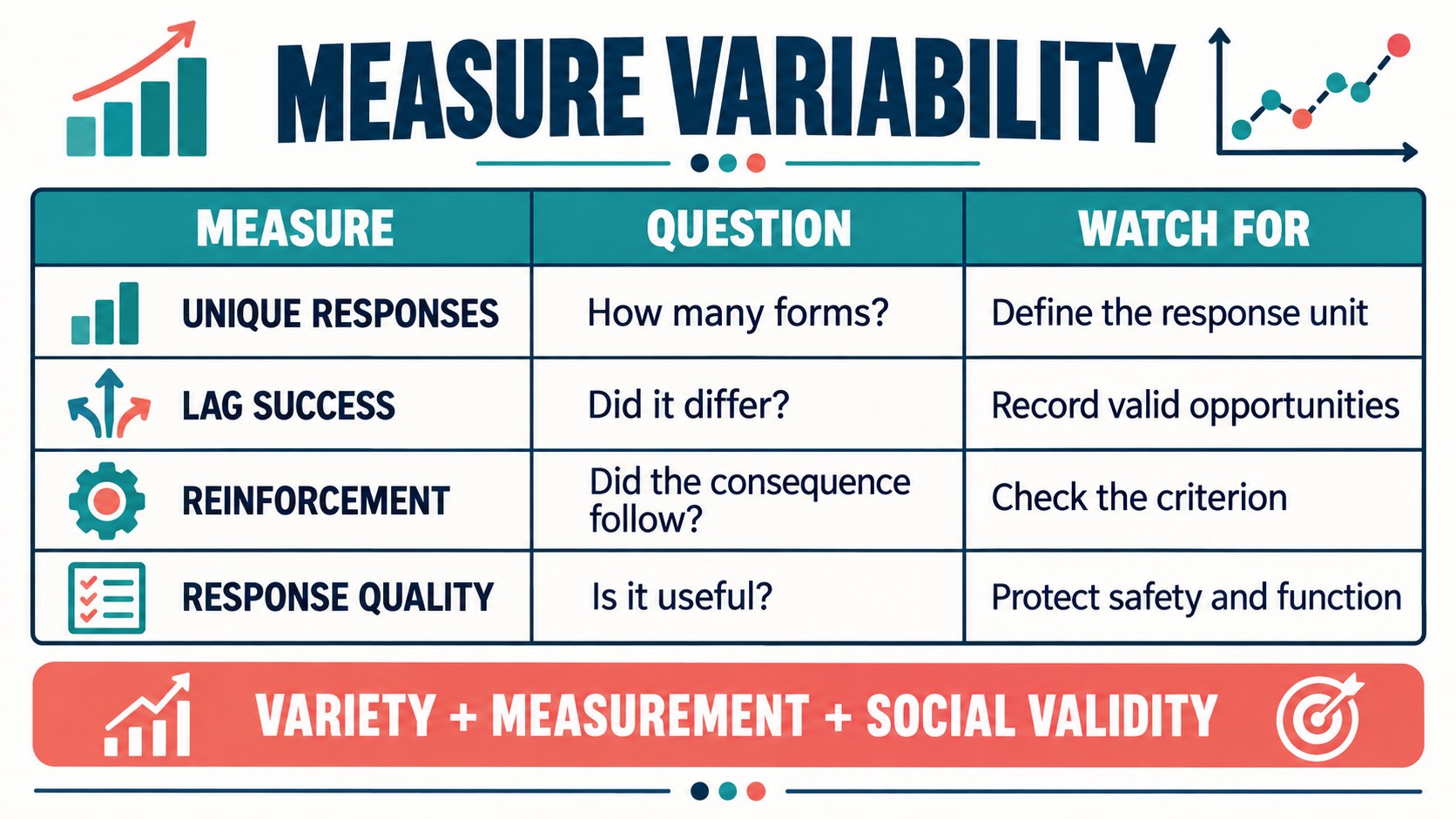
Measure the response property that the contingency is supposed to change. A simple form can record the response unit, the comparison set, whether the criterion was met, the reinforcer delivered, and the reason for a failed opportunity. If the program uses Lag n, the observer should be able to reconstruct which earlier responses were used for comparison.
| Measure | Question it answers | Caution |
|---|---|---|
| Unique responses | How many defined forms occurred? | Set the response unit before counting. |
| Variability-criterion percentage | How many opportunities met the Lag or novelty rule? | Report the number of valid opportunities. |
| Reinforcement delivery | Did the consequence follow qualifying variation? | A delivered reinforcer does not prove the criterion was scored correctly. |
| Response quality or function | Are varied responses still acceptable and useful? | Novelty must not replace social validity or safety review. |
Keep exposure and opportunity counts visible. Suppose five of six opportunities meet a variability criterion, but only six responses were requested; that percentage means something different from five of six successes across a 60-trial session. Also record repeated responses, invalid opportunities, prompts, and changes to the comparison window. Otherwise, a rising diversity score may reflect more opportunities or looser scoring rather than a real contingency effect.
What does the research support?
Experimental behavior-analytic research has shown that variability can come under reinforcement control, but the results are tied to specific response units, contingencies, and participants. For example, the Miller and Neuringer study examined reinforcement for varying response sequences in adolescents with autism and control participants. The finding supports the possibility that variation can be selected by reinforcement; it does not establish one universal Lag requirement for every applied setting.
The broader literature also discusses how variability is measured and how novelty criteria can be confused with random responding. The review on reinforcement and induction of operant variability is useful for the experimental distinction. The study on increasing response diversity in children with autism illustrates why applied examples need a defined response class and socially meaningful outcomes.
For exam preparation, use research as a boundary: reinforcement can select a response property, but the analyst still has to define, measure, and evaluate that property. The current BCBA Test Content Outline supports this measurement-first approach. It does not turn every research procedure into a ready-made clinical protocol.
What are the BCBA exam traps?
- “Different” is not enough: the stem must show that variation is the reinforced criterion.
- Lag is not a time interval: Lag n usually refers to comparison with prior responses, not a DRO-style absence interval.
- Novel does not mean random: a response can be new while remaining controlled, functional, and measurable.
- Correct but repeated may fail: under a variability contingency, correctness alone may not earn the consequence.
- DRA names one alternative: multiple eligible forms and a difference criterion point toward variability reinforcement instead.
- Graph variability is a data pattern: scattered points do not prove that response variability was reinforced.
- Generalization is transfer: changing the setting is not the same as requiring a novel response.
- Safety and social validity remain relevant: a higher diversity score is not automatically a better outcome.
Differential reinforcement of variability FAQ
Is a Lag schedule the same as DRA? No. DRA reinforces one specified alternative response. A Lag schedule reinforces a response that meets a comparison-based difference criterion, potentially allowing many acceptable forms. Does every new response contact reinforcement? Only if it meets the programmed definition of difference and the response is otherwise eligible. A new unsafe, irrelevant, or poorly defined response should not automatically earn reinforcement.
Can differential reinforcement of variability reduce repetition? It can be arranged to increase response diversity or reduce repetitive responding, but the result depends on the defined contingency, the reinforcer, the response unit, and the learner. Measure both variation and socially important outcomes.
What should I remember for the BCBA exam? Find the behavior property contacting reinforcement. If the clue is “different from recent responses,” think variability reinforcement or a lag criterion. If the clue is one named replacement, think DRA. If the clue is no target for a time period, think DRO.
Quick review: define the response unit, define what counts as different, specify the comparison window, record valid opportunities, measure qualifying variation and response quality, and interpret the result within the social and safety context. For more BCBA-style practice, try the free BCBA mock exam. It is a study resource and does not claim to reproduce official exam questions.
Take the Free BCBA Mock Exam
When you are ready to apply the idea, use the free practice resource below for additional feedback. Take the Free BCBA Mock Exam



