
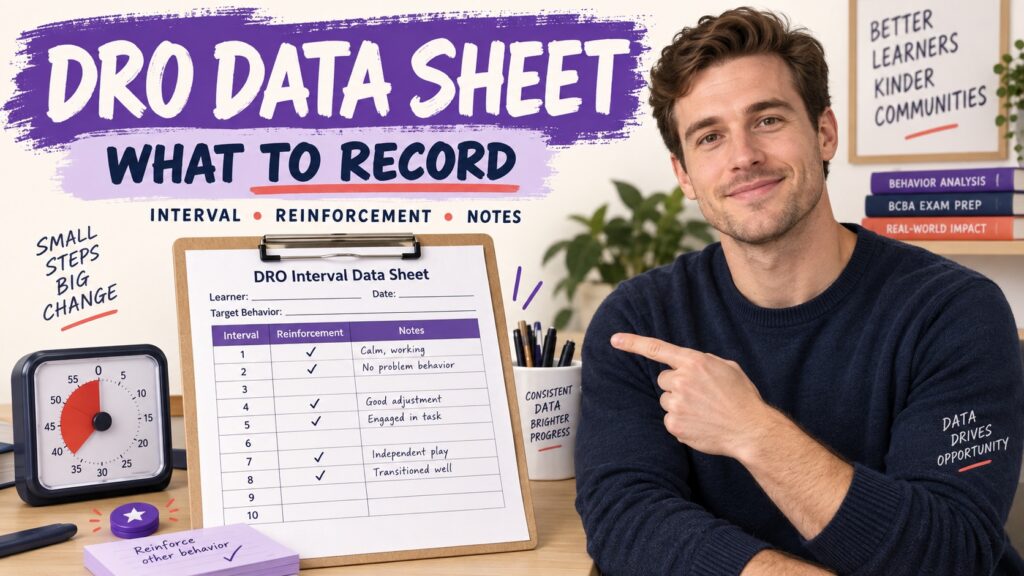
Short answer: A differential reinforcement of other behavior data sheet records whether a target behavior was absent during each programmed interval and whether the learner earned the planned reinforcer. A useful sheet makes the rule visible: what behavior is being monitored, how long each interval lasts, what counts as a successful interval, what happens after an occurrence, and how the observer records reinforcement and notes.
Table of Contents
- What should a differential reinforcement of other behavior data sheet show?
- How do you build the sheet before observation?
- How do you score each DRO interval?
- What does a completed DRO data sheet look like?
- How do you summarize DRO data?
- What are common data-sheet errors?
- How does a DRO data sheet appear in BCBA exam questions?
- DRO data sheet FAQ
- Take the Free BCBA Mock Exam
This is a practical BCBA exam study guide for designing and reading a DRO data sheet. It focuses on measurement logic rather than presenting a universal treatment protocol. The exact target definition, interval, reinforcer, safety plan, and review schedule must be individualized by a qualified behavior analyst and matched to the learner and setting. Table of Contents
What should a differential reinforcement of other behavior data sheet show?
A differential reinforcement of other behavior data sheet is a recording tool for a DRO contingency. In a DRO arrangement, reinforcement is available when the defined target behavior does not occur for a specified interval or at a specified check. The “other behavior” label does not mean that the observer must list every behavior the learner performs. It means that the contingency is based on the absence of the selected target, not on one required replacement response. The sheet should make five elements easy to find:
- Target behavior: an observable, measurable definition, including the start and stop rules when needed.
- Observation rule: the interval length and whether the procedure is whole-interval, momentary, fixed-interval, or resetting.
- Scoring rule: the mark that means the target was absent, present, or not scored.
- Consequence record: whether the programmed reinforcer was delivered, withheld, or delayed.
- Context and integrity notes: setting events, missing observations, timer problems, changes in staff, and whether the written procedure was followed.
That distinction matters because a sheet can look tidy while measuring the wrong dimension. A frequency tally is not automatically a DRO measure. A “yes” column is not meaningful unless the form states what “yes” means. Before using a template, write the contingency in one sentence: “If the target is absent for ___, then ___ is delivered.”
How do you build the sheet before observation?
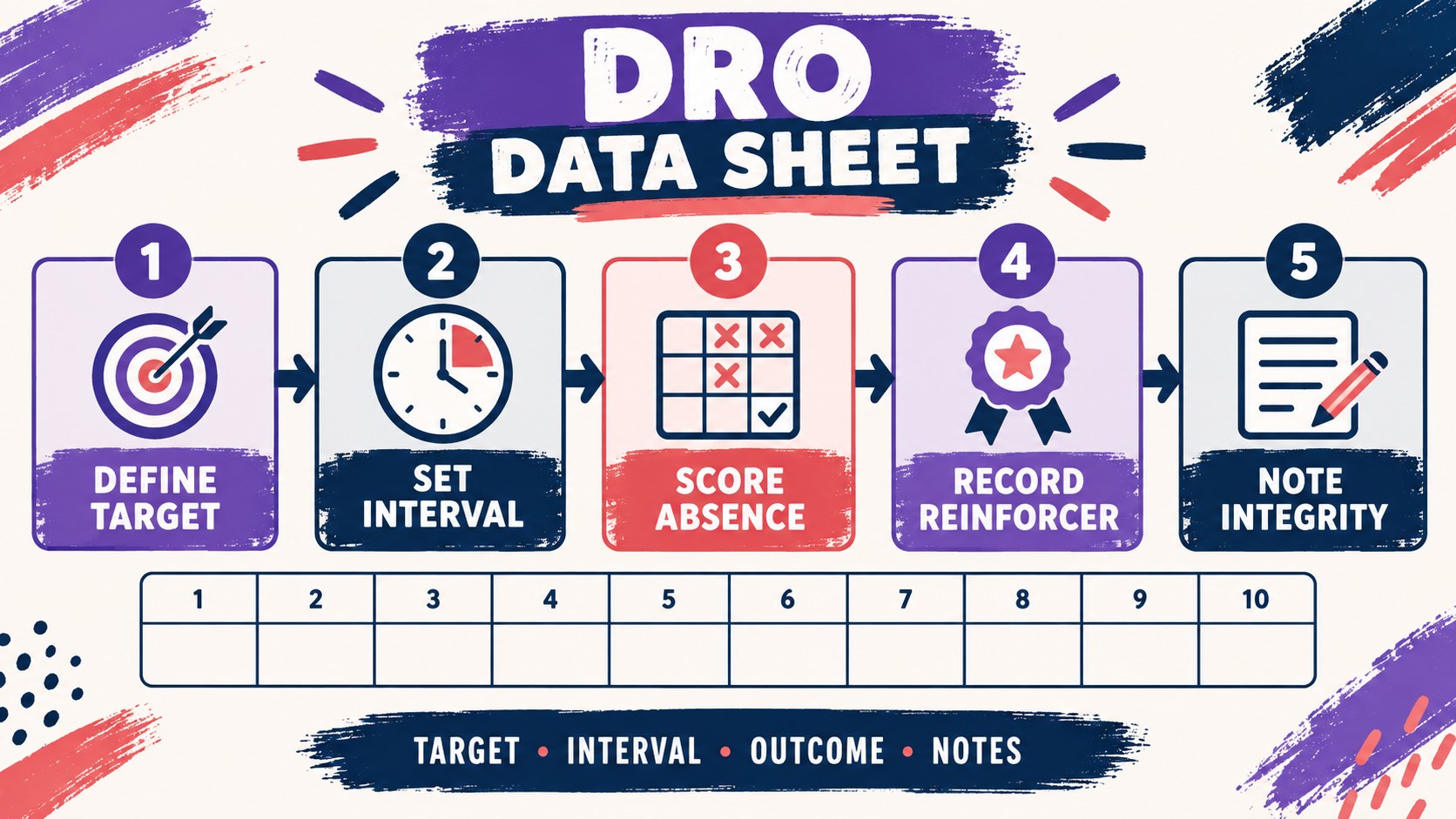
Start with the measurement question, not with a favorite template. The current BCBA Test Content Outline includes operational definitions, discontinuous measurement, representative data, validity, reliability, graphing, and procedural integrity. A DRO sheet should support those decisions instead of hiding them behind a generic checklist. For a basic interval-based form, place the following fields at the top:
- Learner or case identifier, date, observer, setting, and session start and end time.
- Operational definition of the target behavior and the behavior’s measurement unit.
- DRO type, interval length, starting criterion, and whether an occurrence resets the timer.
- Reinforcer or reinforcer category, delivery rule, and the person responsible for delivery.
- Directions for an unclear interval, interrupted session, or missing data point.
Then create one row for each planned interval. The exact fields can change with the design, but this table shows a useful minimum:
| Field | What it answers | Example entry |
|---|---|---|
| Interval | When was the observation checked? | 1:00–2:00 |
| Target absent? | Was the DRO criterion met? | Yes / No / NC |
| Reinforcer delivered? | Did the consequence follow the rule? | Yes, token |
| Reset or occurrence | Did an occurrence change the next interval? | Reset at 1:35 |
| Notes | What affects interpretation or integrity? | Fire drill; interval paused |
Use “NC” or another pre-defined code for not collected rather than silently treating missing data as a successful interval. If the form is digital, keep the same definitions and make the allowed responses explicit. A digital form is not more valid simply because it calculates a percentage automatically.
How do you score each DRO interval?
The scoring rule depends on the chosen DRO format. For whole-interval DRO, the target must be absent throughout the entire interval for that interval to count as successful. For momentary DRO, the observer checks whether the target is absent at the specified moment, usually at the end of the interval. A target could occur earlier in a momentary interval and still be absent at the check moment, so the two formats do not mean the same thing.
For a fixed-interval or resetting arrangement, follow the written timer rule exactly. A target occurrence might cause the current interval to fail, restart the interval, or simply prevent reinforcement at the scheduled check. The sheet must state which rule is in effect; otherwise, two observers can record different outcomes while both believe they followed the plan. Use this sequence during observation:
- Start the timer or identify the next scheduled check.
- Observe the behavior using the operational definition, not a general impression of being calm or busy.
- Record the required mark immediately after the interval or check.
- Deliver or withhold the programmed consequence according to the stated criterion.
- Record a reset, interruption, or unusual event before moving to the next row.
Research comparing discontinuous measurement procedures shows why the rule matters. Interval methods can be practical but can also introduce measurement error; the interval length and scoring method affect how closely the record represents behavior. For study purposes, remember that “target absent at the check” is a momentary rule, while “target absent for the entire interval” is a whole-interval rule.
What does a completed DRO data sheet look like?
Imagine a study example with a clearly defined target of leaving the assigned area, a 10-minute session, and one-minute whole-interval DRO. A successful interval is one in which leaving the area did not occur at any point. “Y” means the absence criterion was met; “N” means the target occurred; “NC” means the interval was not observable. The example is for learning how to read the form, not a recommendation for a real case.
| Interval | Target absent all interval? | Reinforcer | Note |
|---|---|---|---|
| 1 | Y | Delivered | No occurrence |
| 2 | N | Withheld | Left area at 1:42 |
| 3 | Y | Delivered | No occurrence |
| 4 | Y | Delivered | Prompt delivered separately |
| 5 | NC | Not scored | Fire drill |
| 6 | Y | Delivered | No occurrence |
The correct interpretation is not “five out of six intervals were successful.” The denominator for the success percentage should exclude the unscored interval: five scored intervals, four successful intervals, or 80%. If the plan uses a resetting timer, interval 3 might not begin at the same clock time as it would in a fixed-interval plan. The sheet must preserve that distinction.
How do you summarize DRO data?
A useful summary connects the row-level marks to a clearly named measure. Common summaries include:
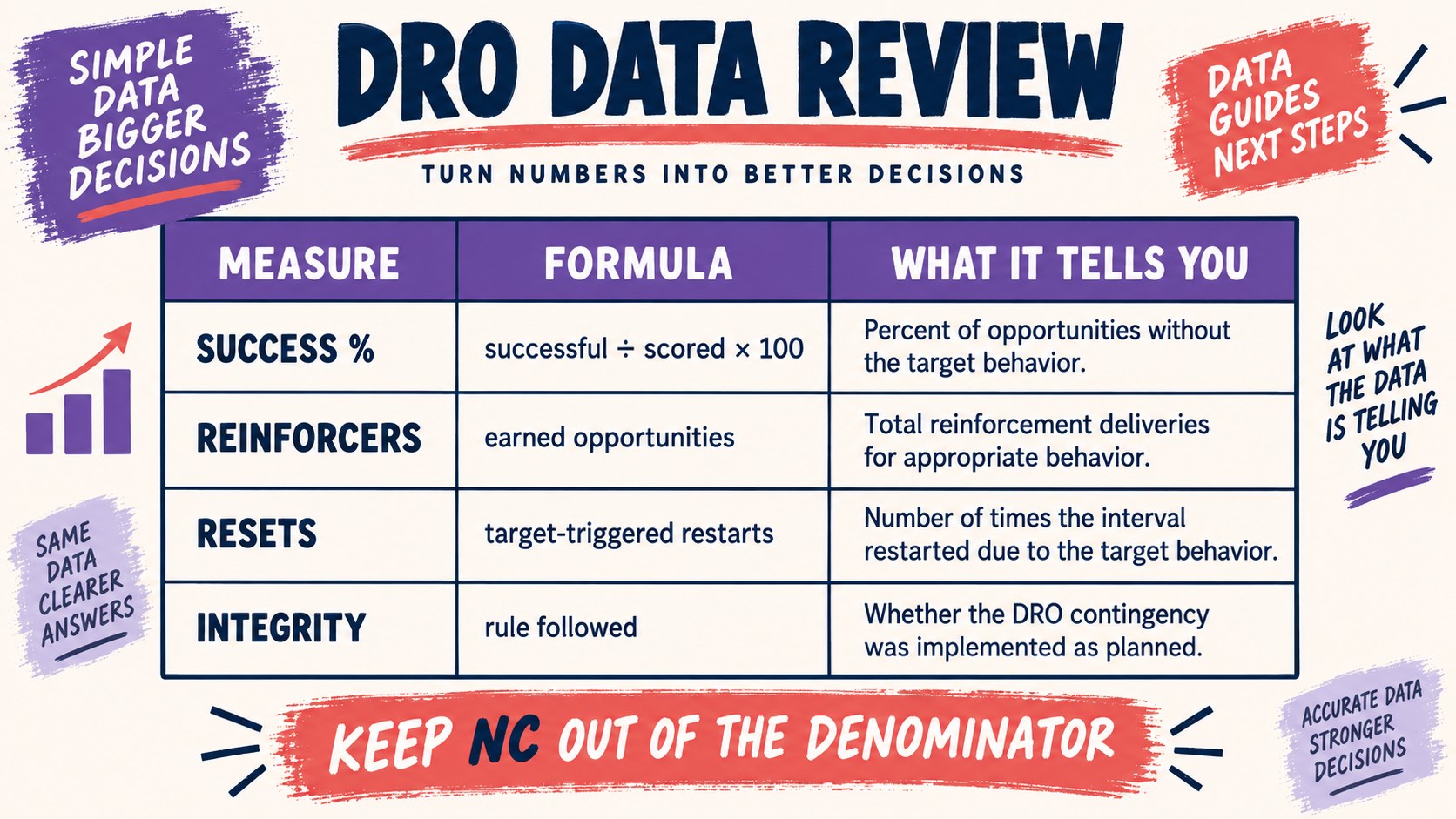
- Percentage of successful scored intervals: successful intervals divided by scored intervals, multiplied by 100.
- Number of target occurrences: the count recorded under the operational definition during the session.
- Reinforcement delivery: the number or percentage of opportunities in which the consequence followed the written rule.
- Reset count: the number of target occurrences that restarted the programmed interval when a resetting rule is used.
- Procedural integrity: whether the observer started the timer, scored the interval, and delivered the consequence as specified.
Do not treat a higher percentage of successful intervals as proof that the intervention caused improvement by itself. Review the operational definition, baseline, trend, variability, opportunities to respond, and any changes in the environment. Also check whether the absence of the target is being accompanied by appropriate skill acquisition. A DRO arrangement can document target absence while still requiring a separate plan to teach communication, tolerance, or another replacement skill.
When graphing, label the measure precisely. “DRO success” could mean percent of intervals, number of earned reinforcers, or a rate calculated from event data. Put the unit on the axis and keep unscored intervals visible in the session notes. This makes the graph easier to interpret and easier to audit.
What are common data-sheet errors?
Most errors come from a mismatch between the written contingency and the form. Watch for these traps:
- Using vague behavior labels: “aggression was bad” cannot tell an observer what to score.
- Leaving out the DRO type: whole-interval and momentary scoring produce different records.
- Counting missing data as success: “not observed” is not the same as “target absent.”
- Recording the reinforcer without recording the criterion: a token delivered does not prove the absence rule was met.
- Confusing DRO with DRA: DRO is organized around target absence; DRA is organized around a specified alternative response.
- Confusing DRL with DRO: DRL can reinforce the target at a lower rate, while DRO requires the target to be absent under its stated rule.
- Using a template without integrity checks: the sheet should show whether the procedure was implemented as written.
How does a DRO data sheet appear in BCBA exam questions?
On an exam, the sheet may be described rather than shown. Look for the measurement clue before choosing the acronym. “The observer checks at the end of each interval” suggests a momentary rule. “The behavior must not occur at any point during the interval” suggests a whole-interval rule. “The timer restarts whenever the behavior occurs” suggests a resetting arrangement. The item may ask for the measurement procedure, the intervention, the best data display, or the interpretation of a missing mark. A reliable answer routine is:
- Find the operational definition and the dimension being measured.
- Find the exact event that produces reinforcement.
- Identify whether the target is absent, reduced in rate, or replaced by a named response.
- Check whether the interval is whole, momentary, fixed, or resetting.
- Reject any answer that silently changes the denominator or treats missing data as success.
Peer-reviewed comparisons of whole-interval and momentary DRO arrangements show that the measurement and reinforcement rules are not interchangeable. Use the Repp, Barton, and Brulle comparison as a study reference for how the two procedures were defined, and the Miller and Jones comparison for an applied example. Those studies inform exam reasoning, but they do not prescribe one universal data sheet for every learner.
DRO data sheet FAQ
Is a DRO data sheet the same as an ABC data sheet? No. An ABC form records antecedent, behavior, and consequence events. A DRO form primarily records whether a target was absent under a time-based criterion and whether reinforcement followed. A case may use both forms for different questions.
What should a plus sign mean? Define it at the top of the form. For example, “+ = target absent for the entire interval; reinforcer may be delivered.” Do not assume that another observer uses the same symbol.
Can one form be used for whole-interval and momentary DRO? It can be redesigned for both, but the directions, scoring column, and interpretation must clearly change. A single unlabeled yes/no column is not enough.
Does a successful interval prove that the learner learned a replacement skill? No. It shows that the target met the stated absence criterion for that interval. Skill acquisition and generalization require their own definitions, teaching arrangements, and measures.
What is the best next step for BCBA exam practice? Practice translating a short vignette into a contingency, a measurement rule, and a denominator before selecting an answer. You can use the free BCBA mock exam for additional practice and feedback. It is a study resource, not a promise about any official exam item.
Quick review: Define the target, state the interval rule, mark successful and unscored intervals separately, record reinforcement and resets, audit procedural integrity, and label the final measure precisely. That is what turns a blank template into a defensible differential reinforcement of other behavior data sheet.
Take the Free BCBA Mock Exam
When you are ready to apply the idea, use the free practice resource below for additional feedback. Take the Free BCBA Mock Exam



