
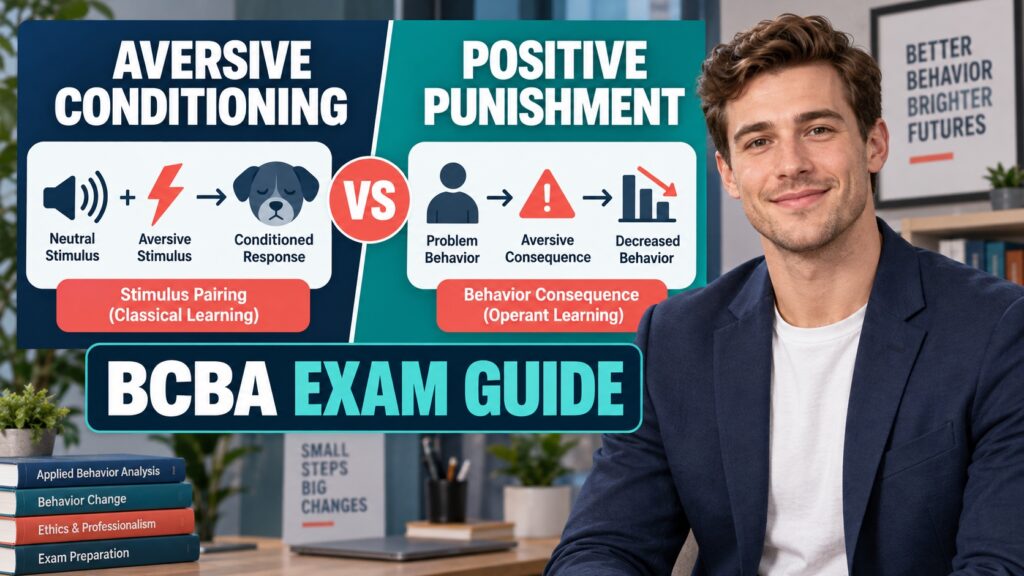
Short answer: Aversive conditioning vs positive punishment is mainly a comparison between two different behavior-change arrangements. Aversive conditioning usually describes a respondent or classical-conditioning process in which a stimulus acquires aversive properties through pairing. Positive punishment is an operant contingency in which a stimulus is presented after a behavior and the behavior decreases in the future. Both discussions can involve an aversive stimulus, but the learning relation is not the same.
Table of Contents
- What is the difference between aversive conditioning and positive punishment?
- How do the two concepts compare at a glance?
- How does aversive conditioning work?
- How does positive punishment work?
- What question should you ask first?
- How does the BCBA exam test the distinction?
- What ethical boundary matters?
- What common mistakes should you avoid?
- Aversive conditioning vs positive punishment FAQ
- Take the Free BCBA Mock Exam
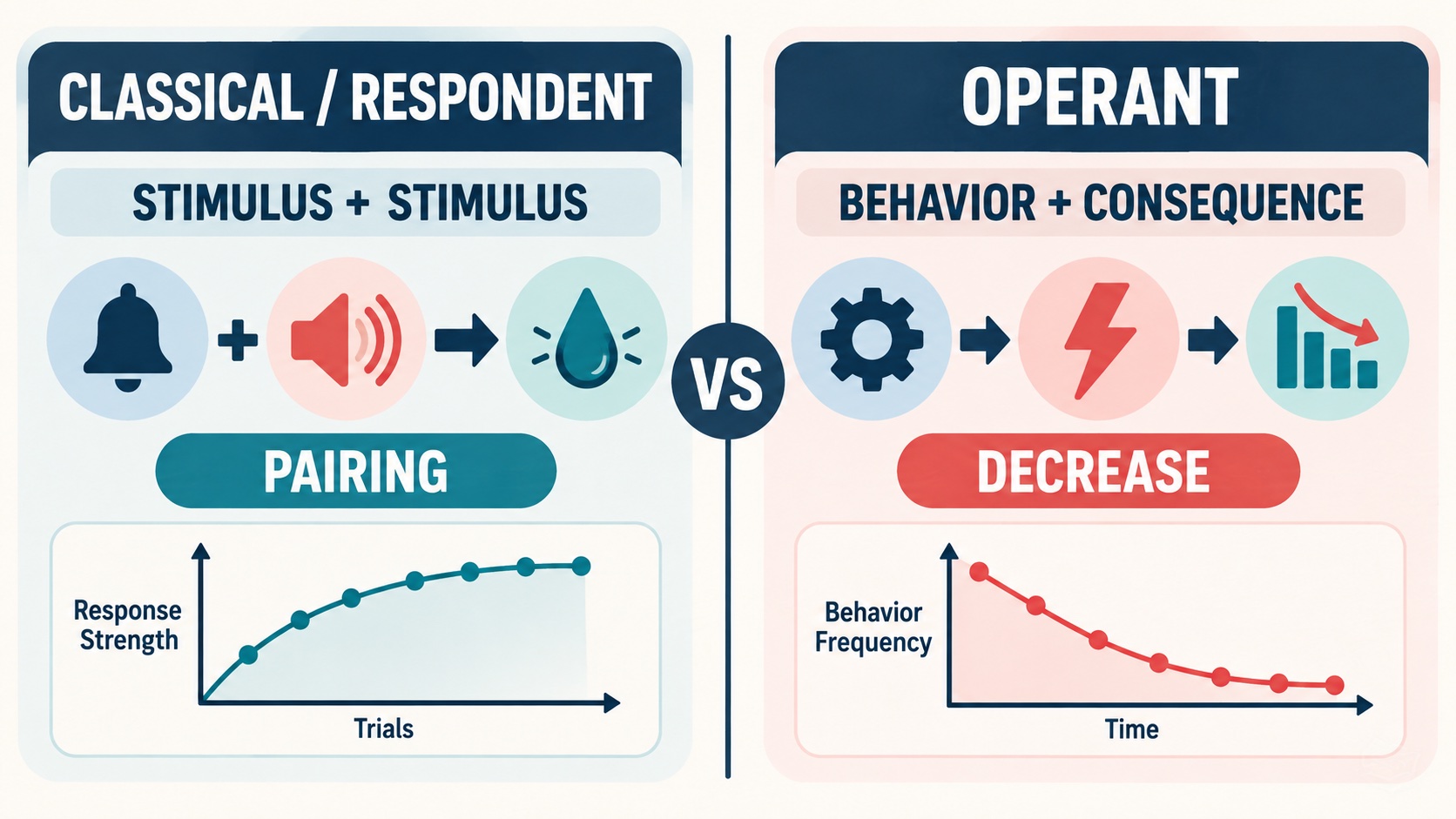
The fastest BCBA exam distinction is to ask what is being related. In aversive conditioning, the important relation is typically stimulus–stimulus: a previously neutral cue is paired with an aversive event and may later elicit a conditioned response. In positive punishment, the important relation is behavior–consequence: a consequence is added after an emitted behavior and that behavior becomes less likely. Do not classify a scenario only because the event sounds unpleasant.
“Positive” means that a stimulus is presented or added, not that the event is pleasant. “Punishment” means that the future frequency of the behavior decreases; an unpleasant event does not become a punisher merely because someone calls it aversive. This article is a study guide for identifying learning relations. It is not a recommendation to use aversive procedures or an individualized clinical protocol.
The conceptual distinction is supported by behavior-analysis literature discussing aversive stimuli, respondent conditioning, reinforcement, and punishment. For example, a review in Behavior Analysis in Practice explains that an aversive stimulus can participate in different functional relations, while an open psychology text explains the added-stimulus definition of positive punishment. Always read the contingency and the measured behavioral effect before selecting an answer. Table of Contents
What is the difference between aversive conditioning and positive punishment?
Aversive conditioning is commonly used for a respondent-conditioning arrangement in which a neutral or previously preferred stimulus is paired with an aversive unconditioned stimulus. After repeated or meaningful pairings, the formerly neutral cue may evoke an aversive or defensive response. The central unit is a relation between stimuli, and the response is typically described as elicited.
Positive punishment is an operant contingency. A behavior occurs, a stimulus is presented contingent on that behavior, and the future frequency of that behavior decreases. The central unit is a relation between a behavior and its consequence, and the behavior is an emitted response. The word “positive” describes presentation; it does not mean good, kind, or effective.
- Learning arrangement: stimulus–stimulus pairing versus behavior–consequence contingency.
- Response relation: an elicited respondent response versus an emitted operant behavior.
- Timing: pairing may occur across stimuli; punishment follows a defined behavior.
- Defining outcome: acquisition of a conditioned response versus a decrease in future behavior.
- Exam clue: look for “paired with” in the first pattern and “after the behavior, decreases” in the second.
How do the two concepts compare at a glance?
| Feature | Aversive conditioning | Positive punishment |
|---|---|---|
| Typical conditioning system | Respondent or classical conditioning | Operant conditioning |
| Core relation | A stimulus is paired with an aversive event | A consequence is added after a behavior |
| Response description | Often an elicited conditioned response | An emitted behavior changes in future frequency |
| What makes the label apply? | The pairing produces a learned stimulus function or conditioned response | The added consequence is followed by a measurable decrease in the behavior |
| Common trap | Calling every unpleasant event punishment | Assuming “positive” means desirable or that presentation alone proves punishment |
The table is a classification aid, not a claim that every textbook uses identical wording. “Aversive conditioning” can be used broadly in psychology and behavior therapy, so the scenario’s details control the answer. If the question describes a stimulus being paired with another stimulus to produce a later elicited response, respondent conditioning is the strongest clue. If it describes a behavior followed by an added event and a later decrease, positive punishment is the stronger classification.
How does aversive conditioning work?
In a basic respondent example, an initially neutral cue is repeatedly presented with an aversive unconditioned stimulus. The unconditioned stimulus already evokes a response without learning. After pairing, the previously neutral cue may function as a conditioned stimulus and evoke a conditioned aversive response. The important change is in the stimulus function created by the pairing.
Imagine a tone that is repeatedly paired with an unpleasant air puff in a laboratory demonstration. The tone may later evoke blinking or withdrawal even when the air puff is absent. The learner’s response is not being weakened because it was followed by a consequence; instead, the tone has acquired a new relation through pairing. The exact response and procedure would need careful ethical and scientific review in any applied setting. For an exam question, look for these features:
- A neutral or conditioned stimulus is paired with an aversive unconditioned stimulus.
- The question emphasizes elicitation, reflexive responding, fear, or a conditioned emotional response.
- The change is explained by stimulus pairing rather than by a consequence contingent on an operant.
- The same stimulus may later evoke a response even when the original aversive event is not presented.
How does positive punishment work?
Positive punishment requires an operant behavior, a consequence that is presented after that behavior, and a decrease in the future frequency of the behavior. The consequence can be called a positive punisher only if the behavior decreases under the relevant conditions. A stimulus may be described as unpleasant, but its label is functional and measured rather than assumed.
Consider a hypothetical scenario in which a person repeatedly violates a clearly stated rule and a response-contingent fee is added. If the fee is actually followed by a lower future rate of the rule violation, the contingency may meet the definition of positive punishment: an event was added after the behavior and the behavior decreased. If the behavior does not decrease, the event did not function as a punisher for that person and context, even if the fee was intended to punish.
Positive punishment is also different from negative reinforcement. Negative reinforcement removes an aversive stimulus after a behavior and strengthens that behavior. Positive punishment presents a consequence after a behavior and weakens that behavior. The emotional tone of the event does not decide the classification; the direction of behavior change and the stimulus operation do.
What question should you ask first?
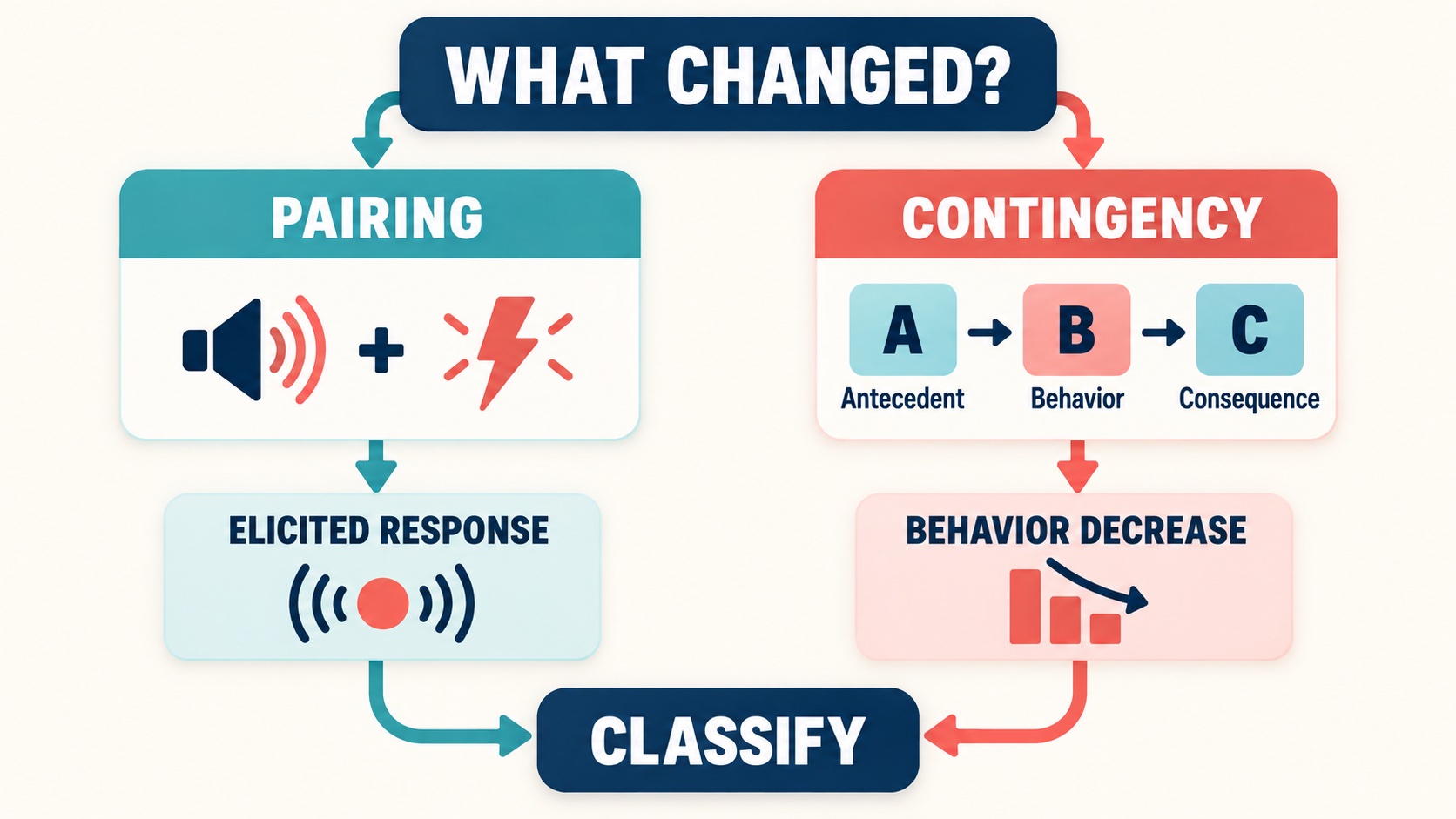
Use a fixed sequence instead of reacting to words such as “aversive,” “bad,” or “unpleasant.” These words describe how an event may be experienced, but they do not identify the conditioning process by themselves.
- What happened first? Identify the stimulus, behavior, and consequence in the vignette.
- Was there a pairing? If one stimulus was paired with another to change what it elicits, consider respondent conditioning.
- Was the event contingent on behavior? If the added event followed an emitted response, consider an operant contingency.
- What happened later? Look for a conditioned response, or for an increase/decrease in future behavior.
- What does “positive” modify? It indicates presentation or addition, not pleasantness.
- What evidence is provided? Do not call an event a punisher without the required decrease in behavior.
Here is a compact worked comparison. A tone is paired with an aversive event, and the tone later evokes withdrawal: the defining relation is stimulus–stimulus pairing. A student talks out, a response-cost-free added correction follows, and talking out decreases: if the added event is contingent and the behavior decreases, the operant relation is positive punishment. The surface word “aversive” may appear in both scenarios, but the unit of analysis changes.
How does the BCBA exam test the distinction?
Exam items often place familiar terms in an everyday story. The safest strategy is to translate the story into an ABC or stimulus-pairing diagram before choosing a label. Ask whether the stem is about a respondent response being elicited, an operant behavior changing because of a consequence, or a stimulus acquiring a new function.
| If the stem says… | Start with… | Then verify… |
|---|---|---|
| A cue was paired with an aversive event and later elicits a response. | Respondent/classical conditioning. | The response is tied to the conditioned stimulus, not a behavior-consequence decrease. |
| A stimulus was added after behavior and the behavior later decreased. | Positive punishment. | The event was contingent and the future frequency actually fell. |
| A stimulus was removed after behavior and the behavior increased. | Negative reinforcement. | The removed event was aversive and the response was strengthened. |
Current BACB materials should be used for the examination framework, but an exam outline does not turn every internet definition into official BACB wording. Use the current BCBA outline for scope and task-list context, then apply the behavioral relations described in the question.
What ethical boundary matters?
A comparison article should not turn a technical definition into a recommendation to use aversive or punishment-based methods. In applied practice, decisions require assessment, competence, informed consent where applicable, supervision, risk review, documentation, and attention to less intrusive effective alternatives. A label such as “positive punishment” describes a functional contingency; it does not by itself justify using the procedure.
- Do not infer that an aversive event is safe, effective, or ethically acceptable from its name.
- Do not select punishment merely because a behavior is inconvenient or socially disliked.
- Do not assume a stimulus will function as a punisher without data on future behavior.
- Do not confuse a respondent conditioning example with a consequence-based reduction procedure.
- Do not present a study guide as individualized clinical advice.
What common mistakes should you avoid?
- “Aversive means punishment.” Aversiveness describes a stimulus property or relation; punishment requires a behavior decrease after a consequence.
- “Positive means good.” In the technical term, positive means added or presented.
- “Any pairing is punishment.” Pairing two stimuli is a respondent clue, not automatically an operant contingency.
- “A decreased response proves punishment.” You must identify the preceding contingent consequence and the relevant comparison.
- “Intent defines function.” What someone intended to be a punisher may not function as one.
- “The most unpleasant answer is correct.” Exam classification depends on the relation and measured effect, not emotional intensity.
Aversive conditioning vs positive punishment FAQ
Are aversive conditioning and positive punishment the same?: No. Aversive conditioning usually highlights stimulus pairing and a conditioned respondent relation. Positive punishment is an operant contingency in which an event is presented after behavior and the behavior decreases in the future.
Can the same aversive stimulus appear in both examples?: Yes. The same physical event can participate in different functional relations. The classification depends on whether it is paired with another stimulus, delivered contingent on behavior, and followed by the relevant change in responding.
Does an unpleasant consequence automatically count as positive punishment?: No. It must be presented after an operant behavior and produce a decrease in that behavior under the relevant conditions. “Positive” means presented, not pleasant, and “punishment” is defined by the effect on future behavior.
What is the quickest exam shortcut?: Look for the relation: stimulus paired with stimulus and later elicits suggests respondent conditioning; behavior followed by an added event and later decreases suggests positive punishment. Then verify the full contingency before committing.
Quick review: do not classify an example by whether it feels good or bad. Identify the learning system, the timing, the contingency, the response type, and the measured behavioral effect. For additional scenario practice, use the free BCBA mock exam as a practice and feedback resource. It is not an official BACB exam and does not guarantee certification or a passing result.
Take the Free BCBA Mock Exam
When you are ready to apply the idea, use the free practice resource below for additional feedback. Take the Free BCBA Mock Exam



