
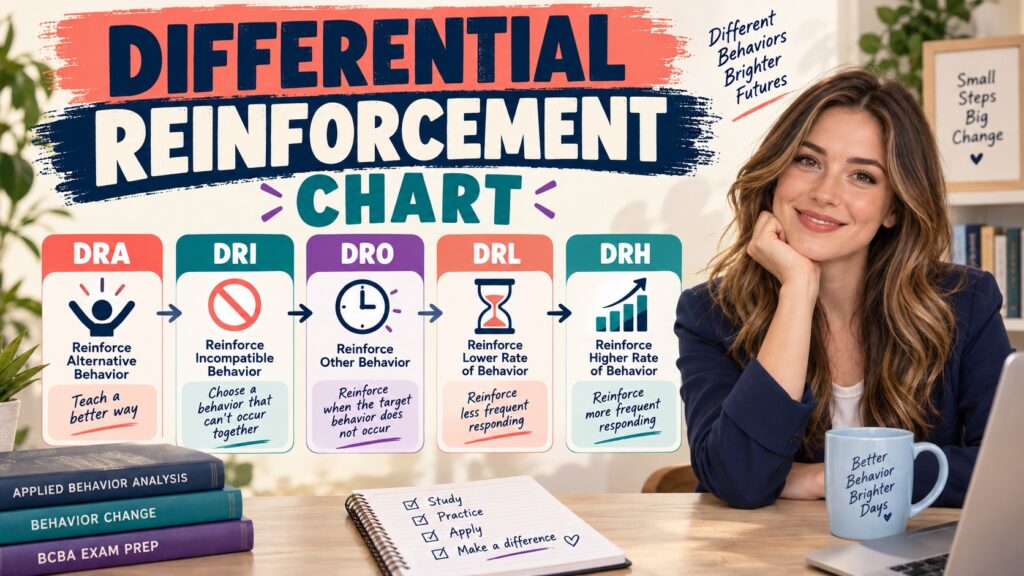
Short answer: A differential reinforcement chart helps you identify what earns reinforcement and what change is expected. Reinforce a specific alternative response and you are usually looking at DRA; reinforce an incompatible response and it is DRI; reinforce the absence of the target and it is DRO; reinforce a lower rate and it is DRL; reinforce a higher rate and it is DRH. The reliable way to use the chart is to read the contingency, not to memorize the acronym alone.
Table of Contents
- What is a differential reinforcement chart?
- How do you read the chart?
- What does each differential reinforcement procedure reinforce?
- DRA, DRI, DRO, DRL, and DRH comparison
- How do you choose the right row in a BCBA scenario?
- What does research say about differential reinforcement choices?
- What can the chart not decide?
- What are common exam traps?
- Differential reinforcement chart FAQ
- Take the Free BCBA Mock Exam
This quick-reference guide is designed for BCBA exam study and behavior-analysis reasoning. It keeps the five commonly tested procedures in one visual framework, then shows where the framework stops. A chart can organize a decision, but it cannot choose a socially significant target, establish a function, select a reinforcer, or replace individualized assessment and data review. Table of Contents
What is a differential reinforcement chart?
A differential reinforcement chart is a visual map of procedures that reinforce one response, pattern, or absence while arranging a different consequence for another response. The word differential reinforcement chart describes the study format; it is not a seventh differential-reinforcement procedure.
The chart’s organizing question is simple: What exactly must happen for reinforcement to be delivered? If the answer is “a named replacement response,” look toward DRA. If the answer is “a response that cannot occur with the target,” look toward DRI. If the answer is “the target did not occur during the interval,” look toward DRO. If the answer is a rate criterion, decide whether the criterion is lower or higher than baseline or than the programmed goal.
Differential reinforcement is broader than a collection of acronyms. Each procedure requires an observable definition, a measurable criterion, a consequence, and a rule for what happens when the criterion is not met. A chart makes the differences visible, but the written contingency remains the final test.
How do you read the chart?
Read a case from the consequence backward. Do not begin with the problem behavior label or with the first acronym that sounds familiar. Ask four questions:
- What response or condition contacts reinforcement? Is it a replacement response, an incompatible response, no target response, or a rate criterion?
- What happens to the target response? Is it placed on extinction, merely reduced, or still acceptable at a lower rate?
- Is the criterion about form, function, absence, or rate? A response can look different but serve the same function; a rate procedure can still reinforce the target response.
- What does the scenario ask you to name? The procedure, the consequence, the goal, and the data rule are related but not interchangeable.
For example, “reinforce asking for a break instead of hitting” points to an alternative response and usually DRA. “Reinforce hands in pockets while hitting cannot occur” points to an incompatible response and DRI. “Deliver a token when hitting has not occurred for five minutes” points to DRO. “Reinforce no more than two interruptions in ten minutes” points to DRL. “Reinforce at least five appropriate comments during discussion” points to DRH.
What does each differential reinforcement procedure reinforce?
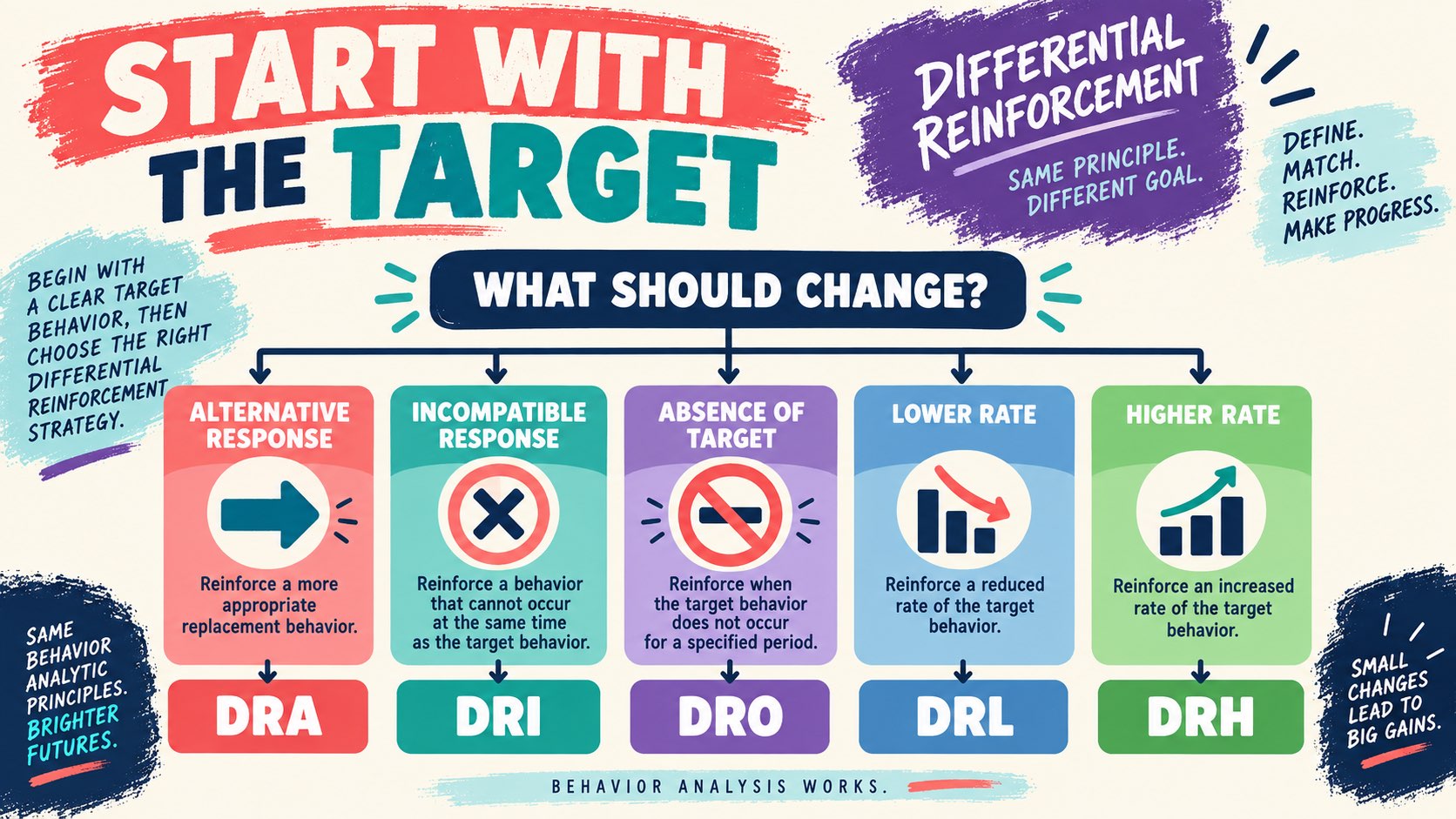
The five rows below are a compact study set. A real plan may use additional terms, such as differential reinforcement of diminishing rates or paced responding, but the same logic still applies: identify the exact response dimension and the criterion for reinforcement.
DRA: Differential Reinforcement of Alternative Behavior: DRA reinforces a specified alternative response while the target response is not reinforced under the arrangement. The alternative should be meaningful and, when the target behavior is maintained by social consequences, often functionally related to that consequence. Functional communication training is a common example: a learner’s appropriate request contacts the relevant reinforcer while the problem response no longer produces that same outcome under the plan.
The key word is alternative, not merely “good.” A response can be socially appropriate yet fail to address the function or compete with the target. On a question, identify the response that is explicitly taught and reinforced. If the scenario says only that the target did not occur, it is not automatically DRA.
DRI: Differential Reinforcement of Incompatible Behavior: DRI reinforces a response that cannot occur at the same time as the target response. The incompatibility is a physical or response-level relation, not just a preference for one behavior over another. Reinforcing hands folded on the desk as an incompatible response to hitting is different from reinforcing a verbal request that could occur before or after hitting.
DRI can be understood as a particularly constrained alternative-response arrangement, but an exam item may ask for the most specific label. If the defining clue is that the two responses cannot happen together, choose DRI rather than the broader DRA label.
DRO: Differential Reinforcement of Other Behavior: DRO delivers reinforcement when the target behavior is absent according to a stated interval or observation rule. The procedure does not require one particular replacement response. The learner could engage in many other behaviors and still meet the absence criterion, which is why a DRO plan should be examined carefully for safety, skill-building, and the behavior that is actually being strengthened.
Questions often distinguish DRO from DRA by changing one sentence: “reinforce any behavior except screaming” suggests DRO, while “reinforce using the break card” suggests DRA. Whole-interval, momentary, and other DRO formats change how absence is measured; they do not turn DRO into a replacement-response procedure.
DRL: Differential Reinforcement of Low Rates: DRL reinforces a lower rate of the target response. The target is not necessarily eliminated and may be acceptable when it occurs below a defined criterion. For example, a learner may receive reinforcement for asking no more than two relevant questions during a short activity when the goal is to reduce excessive but otherwise appropriate questions.
Do not choose DRL simply because the behavior is undesirable. The scenario must contain a lower-rate rule or a reduction criterion. If the goal is complete absence, look toward DRO; if the goal is a replacement response, look toward DRA or DRI.
DRH: Differential Reinforcement of High Rates: DRH reinforces a higher rate of the target response. The target behavior is desirable, but it is occurring too infrequently or below a performance criterion. A case might reinforce completing at least five independent responses during a teaching period. The question is not whether the response is “good” in the abstract; it is whether reinforcement depends on reaching a higher-rate standard.
DRH is the mirror image of DRL at the level of the rate criterion, but it is not interchangeable with DRA. DRA changes which response contacts reinforcement. DRH changes how often the named response must occur.
DRA, DRI, DRO, DRL, and DRH comparison
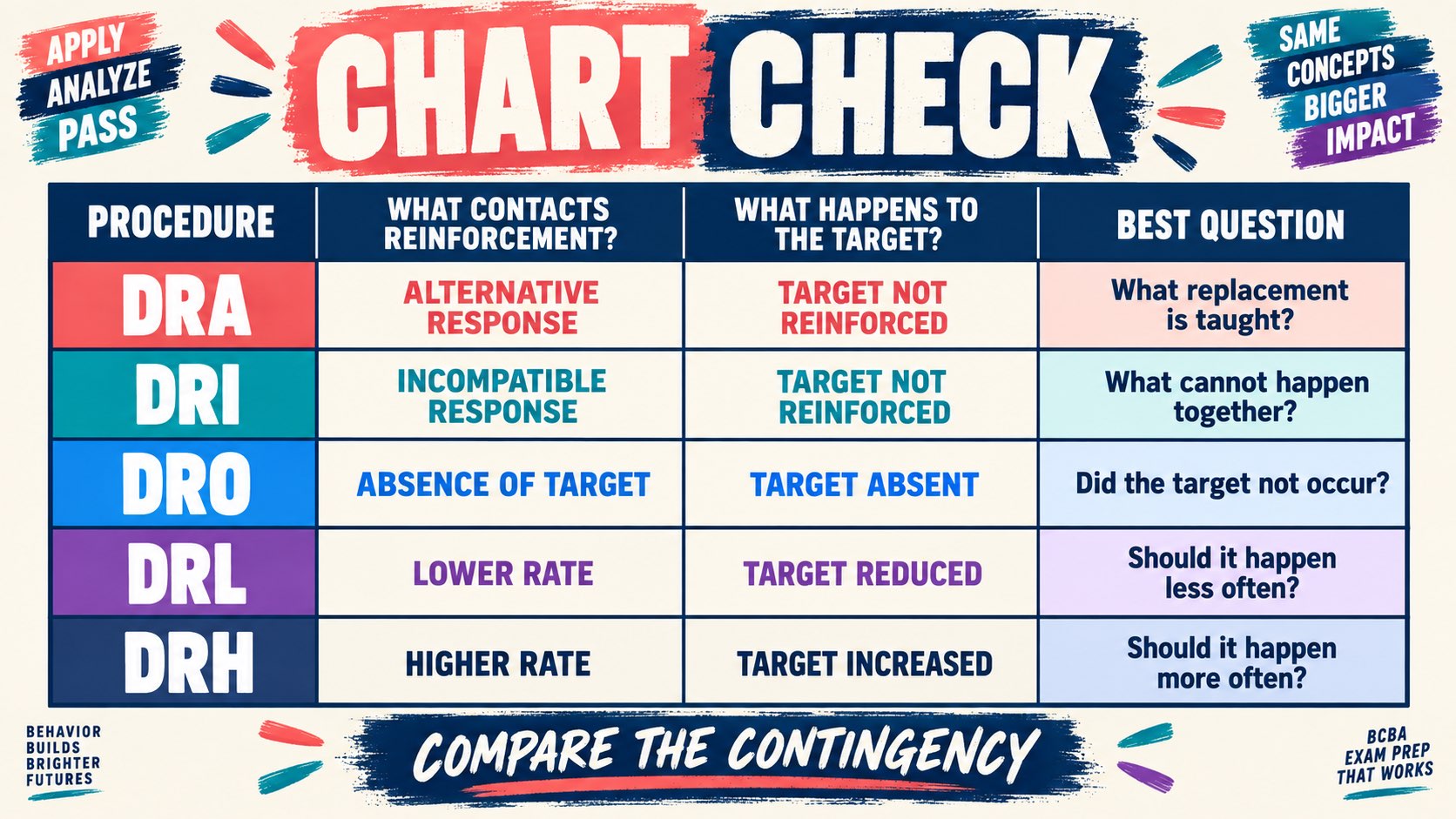
Use the following chart as a written version of the visual decision aid. Every cell has a border so the rows can be scanned on desktop or mobile. The “best question” column is a memory cue, not a substitute for an operational definition.
| Procedure | What contacts reinforcement? | What happens to the target? | Best question |
|---|---|---|---|
| DRA | A specified alternative response | Usually placed on extinction or not reinforced under the plan | What replacement is taught? |
| DRI | A response incompatible with the target | Cannot occur at the same time as the reinforced response | What cannot happen together? |
| DRO | The absence of the target during a defined rule | The target must not occur for the criterion to be met | Did the target not occur? |
| DRL | A response rate below a stated criterion | The target may occur, but less often | Should it happen less often? |
| DRH | A response rate above a stated criterion | The target is desired at a higher rate | Should it happen more often? |
How do you choose the right row in a BCBA scenario?
Convert the vignette into a one-line contingency before naming the procedure. Write: When ______ happens, reinforcement is delivered, and the target ______. Then fill in the blanks with observable language.
- Define the target. Do not rely on labels such as “noncompliance” or “inappropriate behavior.” Identify what the learner does and how it is measured.
- Underline the reinforced event. Is it a replacement, an incompatible response, the absence of the target, or a rate?
- Check the criterion. Look for words such as alternative, cannot occur, no occurrence, fewer, lower, more, or higher.
- Separate procedure from function. A procedure may be selected after a functional assessment, but the acronym itself does not prove the function.
- Check the measurement rule. Interval type, session rate, opportunities, and latency can change how the criterion is evaluated.
Try this mini-example: “During independent work, the student earns a token for starting the task within 10 seconds instead of leaving the table.” The reinforced event is a specified alternative response, so DRA is the best label if leaving the table is not reinforced. Change the sentence to “the student earns a token when leaving has not occurred for five minutes,” and the absence criterion makes it DRO. Change it to “the student earns a token for no more than one leave in 20 minutes,” and the lower-rate criterion makes it DRL.
What does research say about differential reinforcement choices?
Research does not support a universal ranking in which one differential-reinforcement procedure is always best. The right comparison depends on the target, maintaining variables, competing reinforcement, learner history, measurement, and implementation context. A controlled comparison of DRA and DRO for automatically reinforced behavior reported better outcomes for DRA in that study, but a single study does not turn DRA into the correct answer for every case.
Studies of DRL also show why the criterion matters. DRL is designed to reduce the rate of a response without necessarily eliminating it, so a question about decreasing frequency is conceptually different from one about teaching a functionally equivalent replacement. In practice, a team must also consider whether the arrangement is feasible, whether the reinforcer remains effective, and whether undesired behavior contacts reinforcement elsewhere.
- Evidence is conditional. Match research findings to the procedure, population, behavior, and setting actually described.
- Function still matters. A chart can classify the contingency; assessment helps determine whether it addresses the variables maintaining behavior.
- Data close the loop. Review target behavior, replacement behavior, rate, generalization, and side effects before changing the criterion.
For the current exam boundary, consult the BACB BCBA Test Content Outline. For a broader overview of the procedure family, see the site’s differential reinforcement BCBA guide; this chart page is intentionally narrower and organized as a selection aid.
What can the chart not decide?
A visual chart cannot decide whether a behavior is socially significant, whether a reinforcer is actually reinforcing, whether extinction is ethical or feasible, or whether a response is functionally equivalent. It also cannot replace an operational definition, baseline, treatment-integrity measure, or plan for generalization and maintenance.
Do not use the chart to jump from “problem behavior” to “DRO.” A DRO may reinforce the absence of one behavior without teaching a useful alternative. Do not jump from “replacement behavior” to “DRI.” The replacement must actually be incompatible with the target if DRI is the most specific label. And do not use DRL when the goal is complete elimination or when the target is supposed to increase.
What are common exam traps?
- DRA versus DRI: DRI is defined by incompatibility; DRA is the broader alternative-response category.
- DRA versus DRO: DRA names what the learner should do; DRO names the absence of what the learner should not do.
- DRO versus DRL: DRO requires no target response under the stated rule; DRL allows the target below a rate criterion.
- DRL versus DRH: Both use rate criteria, but one reinforces lower rates and the other reinforces higher rates.
- Procedure versus outcome: A behavior decreasing after an intervention does not, by itself, identify which differential-reinforcement procedure was used.
Differential reinforcement chart FAQ
Is DRI a type of DRA?
DRI can be treated as a more specific alternative-response arrangement because the reinforced response is incompatible with the target. On an exam, select DRI when the impossibility of simultaneous responding is the defining clue.
Does DRO reinforce any good behavior?
Not necessarily. DRO is defined by the absence of the target during a stated measurement rule. Other behavior may occur, but the procedure does not automatically specify a socially useful replacement. Is DRL used to eliminate behavior?
No. DRL reinforces responding below a criterion, so the target may still occur. If the criterion requires no target occurrences, the case is closer to DRO. Are these the only differential-reinforcement procedures?
No. Study materials may include DRD, DRP, or other rate and pattern variations. The five-row chart is a common core for quick classification, not an exhaustive taxonomy.
Next step: Use the chart to classify the contingency before looking at the answer choices. Then practice with our free BCBA mock exam, focusing on what contacts reinforcement, what happens to the target, and which measurement rule is stated. Research for further study: Hedquist and Roscoe’s comparison of DRA and DRO; research on signals in DRL procedures; and a comparison of differential-reinforcement arrangements for stereotyped behavior.
Take the Free BCBA Mock Exam
When you are ready to apply the idea, use the free practice resource below for additional feedback. Take the Free BCBA Mock Exam



