

Short answer: Behavior Intervention Implementation (BII) usually refers to the direct implementation of a student’s behavior support or behavior intervention plan, often in a school-based setting. A BII may carry out teaching and behavior-support procedures, collect agreed-upon data, help the student access classroom routines, and communicate implementation observations to the supervising team. The exact job title and service model can vary by district or provider, so behavior intervention implementation BII should be read as a role or service description—not as a universal BACB credential.
Table of Contents
- What is Behavior Intervention Implementation (BII)?
- What does a BII do?
- How does a BII fit with the BCBA, BID, teacher, and RBT?
- What data does a BII collect?
- How is implementation fidelity checked?
- What is outside the BII role?
- How should you reason through a BII question on the BCBA exam?
- What common mistakes should you avoid?
- Behavior Intervention Implementation BII FAQ
- Take the Free BCBA Mock Exam
The key boundary is implementation. A BII generally works from an established plan and follows the procedures that a qualified supervisor or behavior team has designed. That does not mean the BII independently diagnoses, conducts a functional analysis, changes a treatment plan, or makes a certification decision. For BCBA exam preparation, identify who designed the intervention, who is authorized to modify it, what the implementer records, and how the team checks treatment integrity.
School-based descriptions from Los Angeles Unified School District and California’s Positive Environments, Network of Trainers describe implementation as carrying out behavior supports consistently and with fidelity. Provider descriptions such as IBIC also connect BII work with classroom participation, data collection, and implementation of a behavior support or intervention plan. These sources support the general role distinction, but local contracts and regulations still control a specific service. Table of Contents
What is Behavior Intervention Implementation (BII)?
Behavior Intervention Implementation is the process of putting an existing behavior intervention or support plan into practice. In some school systems, BII also names the service provider who works directly with the student. The implementer may support classroom participation, prompt a replacement skill, follow a reinforcement procedure, help the learner use a communication response, and record observable outcomes.
“Implementation” is different from “development.” Development involves assessment, selecting goals and procedures, writing the plan, and deciding how progress will be evaluated. Implementation involves arranging the planned antecedents, presenting the instructional opportunity, responding according to the protocol, delivering the planned consequence, and recording what happened. A BII can offer useful observations about feasibility or learner response, but the person who receives those observations must follow the program’s supervision and decision-making structure.
- Plan: the written behavior support, intervention, or treatment plan.
- Implementer: the person who carries out the observable steps in the plan.
- Target behavior: an operationally defined response that can be measured.
- Replacement skill: a more effective response taught for the relevant context.
- Fidelity: the degree to which the planned steps are implemented as written.
A BII role is therefore best understood through the actual task and supervision arrangement, not through the acronym alone. One provider may use BII for a classroom-based behavioral interventionist; another may use different terminology for a similar implementation function. Always check the local scope, training requirements, documentation rules, and supervisor relationship.
What does a BII do?
A BII’s daily work is usually concrete and observable. The implementer may enter the classroom, review the active steps of the plan, support the student during routines, and collect data that lets the supervising team evaluate whether the intervention is working. The role is not simply “being near the student.” It is implementing specified procedures while protecting dignity, safety, instructional access, and data quality.
| Implementation activity | Observable example | What the team learns |
|---|---|---|
| Prepare the context | Checks materials, schedule, antecedent supports, and the learner’s access to the activity. | Whether the planned opportunity can occur as designed. |
| Prompt the replacement skill | Uses the prompt level and response procedure specified in the plan. | Whether the learner responds with the planned support. |
| Deliver the consequence | Provides the programmed reinforcement or corrective response according to the protocol. | Whether the consequence is available, timely, and linked to the target response. |
| Record data | Scores frequency, duration, latency, opportunities, prompt level, or fidelity items as defined. | Whether the intervention and learner response are changing over time. |
Implementation should also preserve the student’s access to instruction and relationships. A BII may need to coordinate timing with a teacher, reduce unnecessary attention, use the least disruptive planned support, and document barriers rather than improvising a new intervention in the moment. If the plan cannot be implemented safely or feasibly, the observation should be communicated through the established supervision channel.
How does a BII fit with the BCBA, BID, teacher, and RBT?
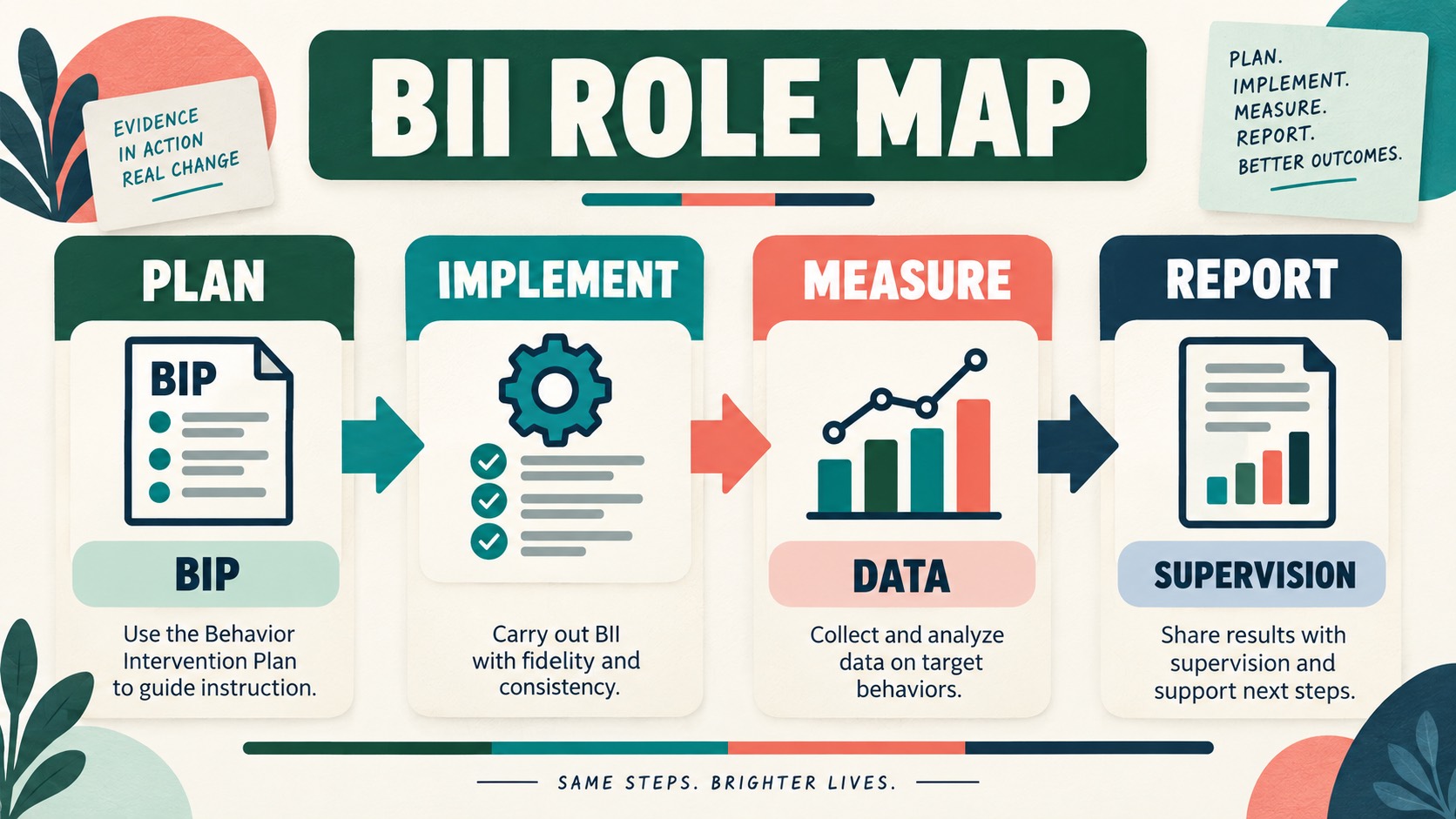
Many exam questions become easier when you separate the person who designs or evaluates a plan from the person who implements it. Titles differ across organizations, so focus on the described function and the supervision relationship.
| Role or label | Primary function in the scenario | Exam boundary to remember |
|---|---|---|
| BCBA or qualified supervisor | Assesses, designs, supervises, evaluates, and revises behavior-analytic services within the applicable scope. | Do not assign independent plan modification to an implementer merely because the implementer sees the learner daily. |
| BID or behavior developer | In some school-service models, helps develop the behavior plan, directs implementation, and coordinates data review. | The acronym is local; infer responsibility from the scenario and written authorization. |
| BII | Carries out specified intervention or support procedures, assists participation, and records agreed-upon observations. | Implementation data can inform the team; it does not automatically authorize a new assessment or treatment change. |
| Teacher or classroom team | Provides instruction and classroom context and may implement agreed-upon supports. | Collaboration is essential; a BII should not isolate the learner from ordinary instruction without a justified plan. |
| RBT or other technician | May implement behavior-analytic services under the applicable supervision and credential rules. | BII and RBT are not interchangeable labels; identify the credential, setting, and authorized duties described. |
What data does a BII collect?
The correct measurement depends on the operational definition and the question the team is trying to answer. A BII should use the data system specified by the supervising team rather than choosing a convenient measure that changes the meaning of the target.
- Frequency: how many times the defined response occurs.
- Rate: responses divided by a relevant unit of time.
- Duration: how long the behavior lasts.
- Latency: the time between the instruction or cue and response onset.
- Opportunity-based accuracy: correct responses divided by planned opportunities.
- Prompt level: the amount or type of assistance required.
- Treatment-integrity score: the percentage of planned implementation steps completed.
Data notes should be objective and specific. “Had a bad day” is not a measurement. “Completed four of five transition steps with a gestural prompt and one verbal reminder” gives the team something it can interpret. Contextual notes can be useful when they are separated from the direct measure: absence of materials, schedule change, peer interruption, or a safety event may explain why a planned opportunity did not occur.
How is implementation fidelity checked?
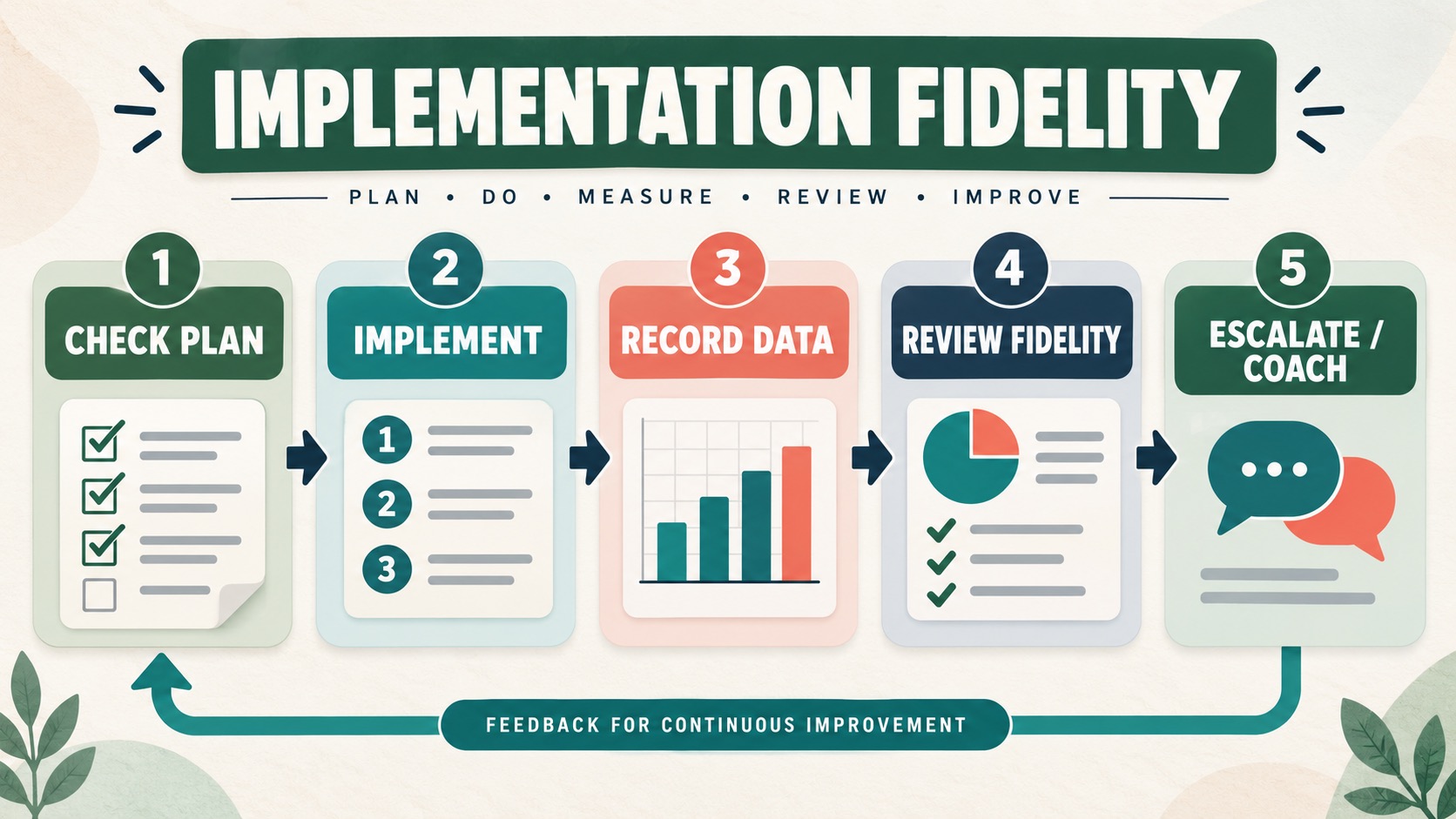
Implementation fidelity asks whether the intervention was delivered as designed. A learner’s outcome and the implementer’s fidelity are related but not identical. A poor outcome after a correctly implemented plan calls for one type of review; a poor outcome after inconsistent implementation calls for another. The team should not conclude that an intervention is ineffective before checking whether it was actually delivered.
A simple fidelity review can compare a checklist of observable steps with the session record. For example, a supervisor might score whether the implementer delivered the instruction, waited the planned interval, used the stated prompt, reinforced the defined response, recorded the opportunity, and followed the transition or safety step. The checklist should be clear enough that two observers can score it with reasonable agreement.
- Define each implementation step in observable language.
- Train the implementer with instruction, modeling, rehearsal, and feedback when appropriate.
- Observe or review a representative sample of sessions.
- Calculate and discuss fidelity rather than relying on impressions.
- Provide supportive feedback and retraining when a step is missed.
- Escalate safety, ethics, feasibility, or scope concerns through supervision.
What is outside the BII role?
The answer depends on the service model, but a BII should not be assumed to have authority that the prompt does not grant. A careful BCBA exam response respects both competence and supervision.
- Independently diagnosing a condition or conducting an assessment outside the assigned role.
- Changing the function-based intervention because a single session was difficult.
- Inventing a consequence, restraint, punishment procedure, or crisis response that is not authorized.
- Withholding instruction or preferred activities as an unplanned punishment.
- Reporting subjective labels instead of observable behavior and context.
- Sharing confidential student information outside the approved team or documentation process.
- Promising an outcome, certification, or treatment result to a family.
Recognizing a problem is part of responsible implementation. If a plan appears unsafe, impossible to carry out, or inconsistent with the student’s current needs, the BII should document the observable concern and contact the designated supervisor. “Follow the plan” does not mean ignoring an immediate safety issue; it means using the approved escalation path rather than making an undocumented clinical change.
How should you reason through a BII question on the BCBA exam?
On a scenario question, first identify the verb. Is the person implementing, measuring, training, assessing, designing, or revising? Then identify the plan and the supervision relationship. A question that asks what the BII should do next is often testing procedural fidelity, objective data collection, communication, or scope—not asking you to select a new intervention from scratch.
- Locate the plan: What written procedure or goal is active?
- Define the response: What exactly should the learner or implementer do?
- Check the implementer’s task: Which step is authorized and observable?
- Choose the data: What measure answers the stated question?
- Check fidelity and safety: Was the plan implemented as written and safely?
- Use the supervision channel: What should be reported, reviewed, or escalated?
For example, if a BII reports that a replacement communication response decreased after a classroom schedule changed, the best next step is not automatically to abandon the plan. Review the operational definition, opportunities, prompt level, reinforcement availability, implementation fidelity, and contextual change, then communicate the data to the supervising team. The team can decide whether a plan revision is warranted.
What common mistakes should you avoid?
- Treating BII as a universal credential: local service labels do not replace credential and scope rules.
- Confusing implementation with development: carrying out a plan is not the same as authoring or revising it.
- Measuring only the problem behavior: track replacement skills, opportunities, prompts, and fidelity when the plan calls for them.
- Ignoring classroom context: an intervention must be evaluated in the setting where it is expected to work.
- Using “fidelity” as a vague compliment: define the steps and score them.
- Making a clinical change in the moment: record the barrier and follow the supervision or safety procedure.
Behavior Intervention Implementation BII FAQ
Is a BII the same as a BCBA?: No. BII is commonly used for an implementation service or role, while BCBA identifies a professional certification with its own eligibility, examination, and practice requirements. A scenario must state the person’s credential and authorized function before you assign responsibility.
Does a BII write the behavior intervention plan?: Usually, the BII implements an existing plan and reports observations. Plan development and revision belong to the qualified professional or team authorized by the service model. A BII may contribute information, but contribution is not the same as independent authorship.
What is the difference between BII and BID?: In some school-service models, BII means Behavior Intervention Implementation and BID means Behavior Intervention Development. The first emphasizes carrying out services; the second emphasizes development, direction, or supervision. Because labels are local, use the responsibilities described in the question rather than memorizing acronyms alone.
What should a BII do when the plan is not working?: Record objective data, check whether the planned steps were implemented with fidelity, note relevant context, and contact the designated supervisor. Do not independently replace the intervention based on one difficult session.
Quick review: BII means implementation, not automatic independent clinical authority. The strongest answer connects the plan to observable steps, accurate data, treatment fidelity, student access, and the correct supervision path. For more scenario practice, use the free BCBA mock exam as a practice and feedback resource. It is not an official BACB exam and does not guarantee certification or a passing result.
Take the Free BCBA Mock Exam
When you are ready to apply the idea, use the free practice resource below for additional feedback. Take the Free BCBA Mock Exam



