
A practical BCBA decision guide for choosing DTT, NET, BST, and related teaching procedures by task—not by label. When people search for ABA teaching methods, they are usually asking two questions at once: what methods exist, and which one fits the learner, skill, setting, and teaching team in front of them? The most useful answer is not a giant list. It is a decision rule.
Table of Contents
- What are the main ABA teaching methods?
- How do you choose among ABA teaching methods?
- When is discrete trial training (DTT) a good fit?
- When is natural environment teaching (NET) a good fit?
- When is behavior skills training (BST) a good fit?
- ABA teaching methods comparison: DTT vs NET vs BST
- Where do prompting, shaping, chaining, and precision teaching fit?
- A five-step ABA teaching-method selection workflow
- Common mistakes when studying ABA teaching methods
- What does the BCBA exam test about teaching methods?
- Turn ABA teaching methods into exam practice
- ABA teaching methods FAQ
- The bottom line
- Sources to study and recheck
- Quick Review Checklist
- Take the Free BCBA Mock Exam
Discrete trial training (DTT), natural environment teaching (NET), and behavior skills training (BST) are different arrangements, not competing labels that a BCBA must choose once and use forever. A strong plan can combine them while keeping the target response, prompt plan, reinforcement, measurement, and generalization strategy observable.
This guide gives you a BCBA-friendly way to compare ABA teaching methods, recognize when a method is a poor fit, and explain your choice on an exam vignette. For a focused explanation of one procedure, use the site’s related method guides after you identify the decision you need to make.
What are the main ABA teaching methods?
The main methods learners usually mean by this query are DTT, NET, and BST. DTT organizes repeated, clearly defined teaching trials. NET embeds teaching opportunities in meaningful activities and motivation. BST teaches another person to perform a skill through instruction, modeling, rehearsal, and feedback. Other procedures—such as prompting, shaping, chaining, errorless teaching, and precision teaching—are often components or specialized tools inside a broader teaching plan.
That distinction matters. A prompt is not automatically a complete teaching method, and a naturalistic setting does not remove the need for an operational definition or data. The BACB describes behavior analysis as an approach grounded in behavior and its consequences, and the current BCBA test content outline expects candidates to distinguish teaching procedures, prompting, reinforcement, and data-based decisions. Use the method label as a starting description, then identify the contingency and the performance standard.
| Question | Why it matters | Example answer |
|---|---|---|
| What skill is being taught? | The response and mastery rule determine what counts as progress. | “Requests a break independently in four of five opportunities.” |
| Where and with whom must it occur? | The setting and implementer affect generalization and treatment integrity. | “During a classroom transition with the trained aide.” |
| What data question comes first? | A method should make the important change visible. | “Is performance independent, prompted, and maintained?” |
How do you choose among ABA teaching methods?
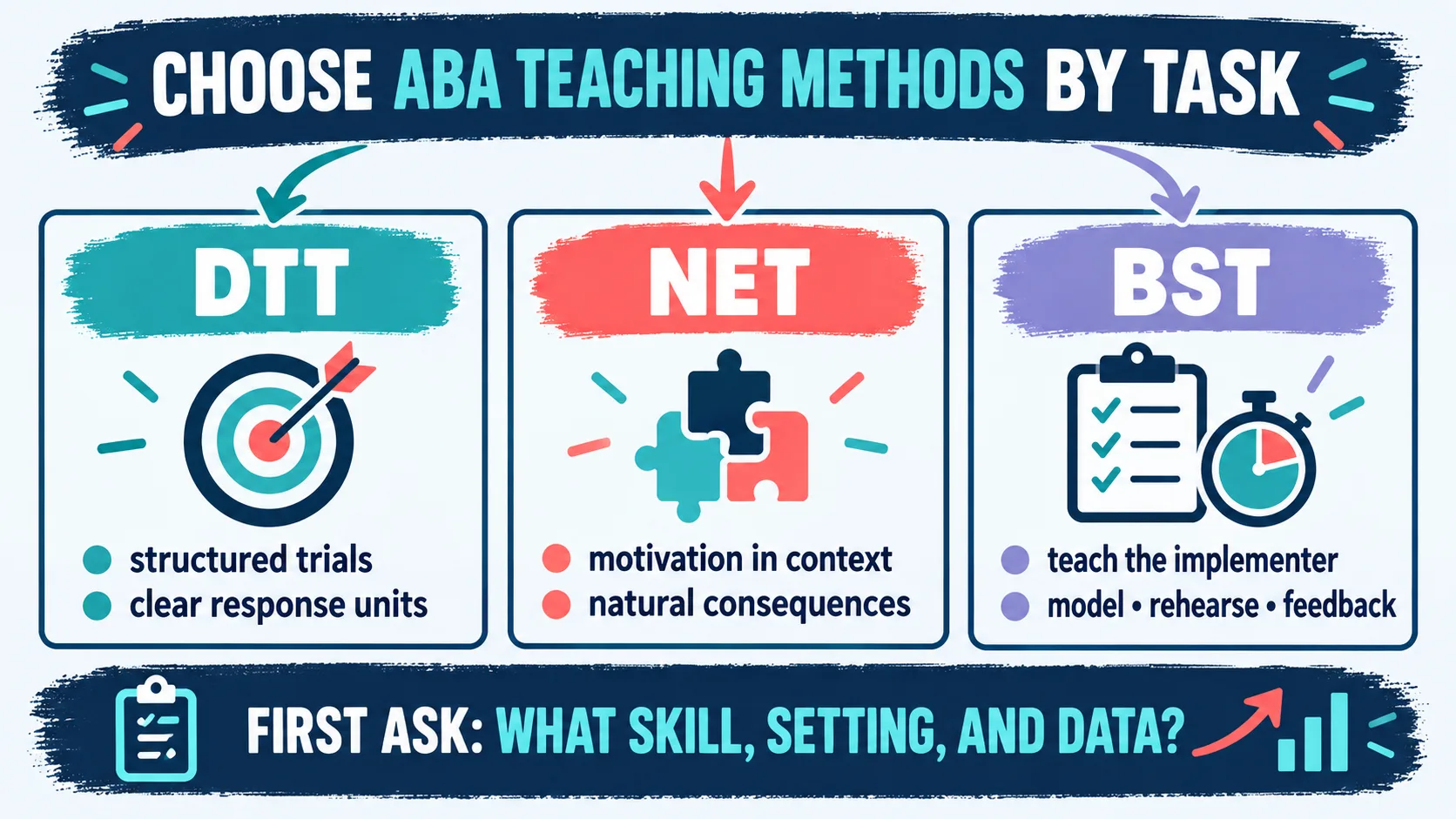
Begin with the teaching problem, not with the method you remember most easily. If the learner needs a clean response unit and the team needs repeated practice with precise scoring, DTT may be a useful starting arrangement. If the target depends on motivation, communication, or flexible responding in everyday activities, NET may provide a better context. If the main problem is that an adult cannot implement the plan reliably, BST may be the most direct first step.
These are decision tendencies, not universal prescriptions. A BCBA still checks assent and dignity, the learner’s history, response effort, reinforcer value, safety, cultural context, and whether the procedure is within the implementer’s competence. The same learner may use DTT for a new discrimination, NET for generalization, and BST to train the caregiver or technician who will support both.
When is discrete trial training (DTT) a good fit?
DTT is a structured arrangement in which a teaching trial has identifiable parts, often including an antecedent or instruction, the learner’s response, and a consequence. The BCBA can define the opportunity, deliver a prompt when planned, reinforce the target response, and record the result. This structure can make early acquisition, discrimination training, and trial-level data easier to inspect.
DTT is especially useful when the team needs to answer questions such as: Did the learner respond independently? Which stimulus was presented? Was the prompt delivered according to the plan? How many opportunities were correct? A clean trial format is not the same as drilling without purpose. Mix exemplars, vary materials, plan prompt fading, and test whether the response transfers beyond the teaching table.
Do not treat DTT as appropriate for every target simply because it is easy to count. If a skill only occurs in a routine, an artificial trial may miss the variables that maintain it. Use the structure when it helps the learner and the data answer the teaching question.
When is natural environment teaching (NET) a good fit?
NET arranges teaching opportunities inside meaningful activities, materials, routines, or interactions. The BCBA may capture an opportunity that naturally occurs or contrive a reasonable opportunity that preserves relevance. Motivation, choice, natural consequences, and generalization are central considerations. For example, a request for an item can be taught when the item is relevant, rather than only after a decontextualized instruction.
NET still needs a measurable target. Record what the learner did, what prompt was used, whether the natural consequence followed, and how the skill changes across people, materials, and settings. “The learner participated more” is not enough unless participation has an observable definition. A natural activity can also contain too few opportunities, so the team may need to plan when and how to sample performance.
When is behavior skills training (BST) a good fit?
BST is designed to teach a person how to perform a skill. The core sequence is instruction, modeling, rehearsal, and feedback. It can be useful when a technician, caregiver, teacher, or other implementer needs to carry out a procedure with fidelity. The relevant outcome is not that the trainer explained the plan; it is that the implementer can perform the defined steps under the conditions that matter.
A BST plan should specify what the implementer must do, how performance will be observed, what feedback is immediate and useful, and what criterion indicates competency. If the learner’s progress stalls, the BCBA should distinguish learner variables from implementation variables. A well-designed learner program can look ineffective when the person delivering it skips the prompt, changes the consequence, or records data inconsistently.
BST is not a synonym for supervision, and an explanation alone is not proof of competency. Rehearsal and observation make the procedure testable; the team should also plan maintenance, generalization, and a repair loop when fidelity falls below criterion.
ABA teaching methods comparison: DTT vs NET vs BST
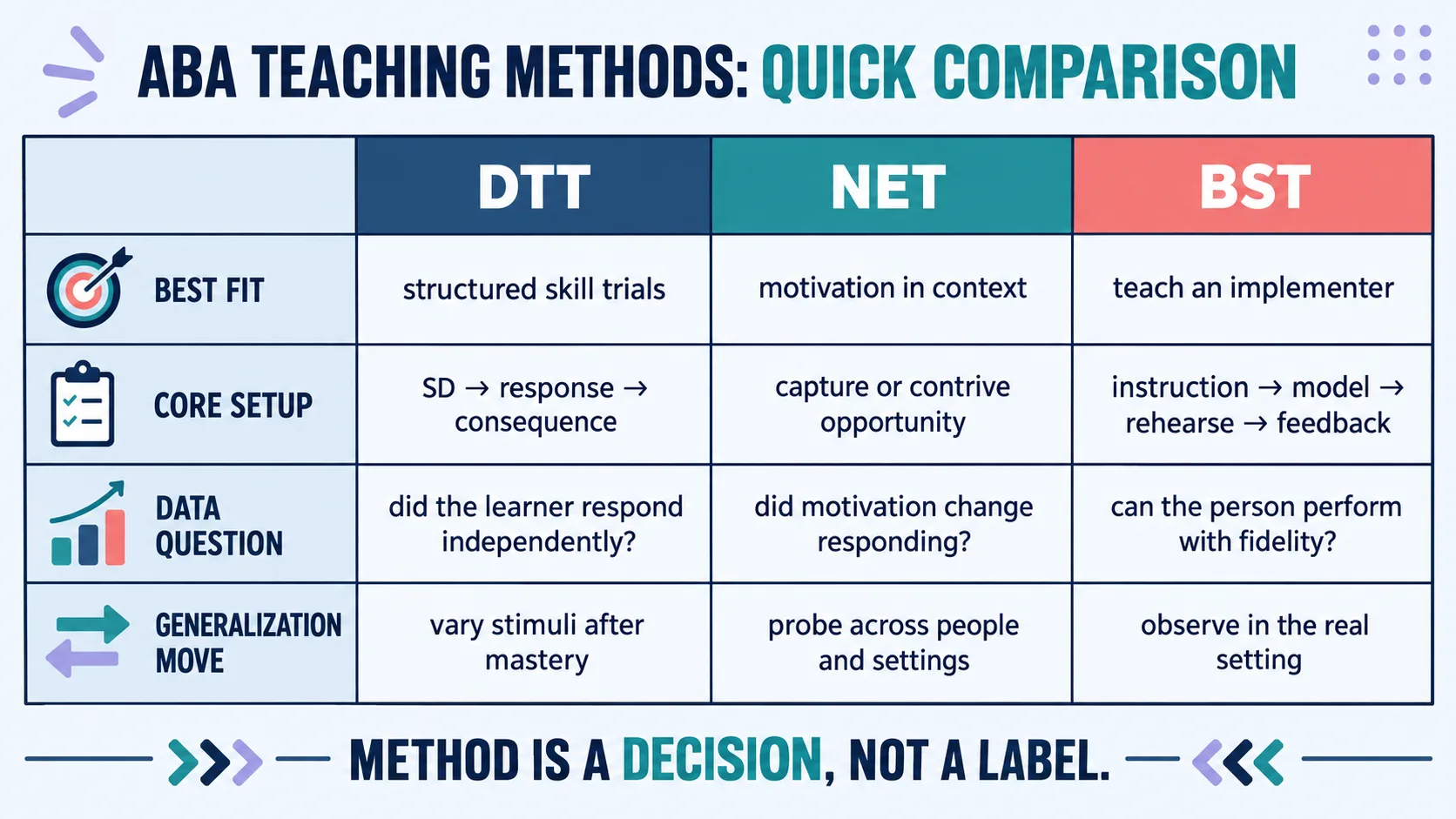
The table above is a study shortcut, not a replacement for assessment. Ask what the target and data require, then select the arrangement that makes the next decision visible.
| Method | Best initial question | Watch for |
|---|---|---|
| DTT | Can the learner acquire a defined response across repeated opportunities? | Prompt dependence, narrow stimulus control, and weak generalization. |
| NET | Will motivation and natural consequences support the response in context? | Too few opportunities, vague targets, or reinforcement that is not actually natural. |
| BST | Can the implementer perform the plan accurately and consistently? | Training that stops after explanation, without rehearsal or fidelity data. |
Where do prompting, shaping, chaining, and precision teaching fit?
These terms answer different questions. Prompting adds assistance and fading transfers control to the intended stimulus. Shaping reinforces successive approximations. Chaining teaches and links task-analysis steps. Errorless teaching reduces errors while still planning transfer. Precision teaching emphasizes frequent measurement and fluency decisions. They can be combined with DTT or NET. Keep the hierarchy clear: target, arrangement, teaching procedure, prompt plan, consequence, data, and generalization.
A five-step ABA teaching-method selection workflow
- Define the response. State what the learner or implementer will do, under which conditions, and what does not count.
- Identify the context. Decide whether acquisition, communication, daily living, implementer performance, or generalization is the immediate problem.
- Choose the arrangement. Use structured repeated trials, meaningful natural opportunities, implementer training, or a deliberate combination.
- Preselect the data. Define independent versus prompted responding, fidelity, latency, rate, duration, or another measure before teaching begins.
- Probe and adjust. Check maintenance, generalization, social validity, and treatment integrity. If the data are weak, change the next variable you can justify—not the label alone.
This workflow protects against changing methods before checking whether the target, prompt, reinforcer, or measurement system was defined clearly. A different label cannot repair an unobservable goal or inconsistent consequence.
Common mistakes when studying ABA teaching methods
Mistake 1: treating DTT and NET as opposites. They can serve different phases of the same program. Mistake 2: selecting the most natural-looking procedure without data. Natural context still needs an operational target and measurement. Mistake 3: calling instruction BST. BST requires instruction, modeling, rehearsal, and feedback; an explanation alone is not the full sequence. Mistake 4: counting prompted responses as independent. Record the response level that matters. Mistake 5: skipping generalization. Acquisition in one arrangement does not prove performance with new people, materials, or settings.
What does the BCBA exam test about teaching methods?
Exam questions often present a target, an antecedent, a prompt, a consequence, and a data pattern, then ask for the best next step. Do not answer from a method’s reputation. Identify the missing variable: Is the learner failing to acquire the response? Is the prompt preventing independence? Is the reinforcer not contacting the target? Is the implementer missing a step? Is the skill not generalizing?
When two answers appear reasonable, prefer the option that is observable, functionally related to the problem, ethically defensible, and measurable. Explain why: “BST is first because the implementer lacks fidelity,” or “NET fits because communication depends on motivation in a routine.”
Turn ABA teaching methods into exam practice
After reviewing the method map, practice classifying short vignettes. For each one, write the target, setting, first data question, method or combination, and the condition that would make you change course. If your answer only names DTT, NET, or BST without a reason, it is not finished.
Use the Free BCBA Mock Exam to test whether you can identify the teaching problem before choosing a procedure. It is a study tool, not an official BACB result. Review each rationale and label the error: target definition, method fit, prompt dependence, data choice, fidelity, or generalization.
ABA teaching methods FAQ
What is the most common ABA teaching method?: DTT and NET are commonly discussed teaching arrangements, but “most common” does not mean “best for every target.” The method should fit the response, context, motivation, implementer, and data question. Is NET better than DTT?: Neither is universally better. DTT can make acquisition and trial-level scoring clear; NET can support motivation and generalization in meaningful activities. A program may use both.
Is BST a learner teaching method?: BST is primarily a way to teach a person to perform a defined skill or procedure. It is often used with caregivers, technicians, teachers, and other implementers, then evaluated with competency and fidelity data. Can prompting be used in DTT and NET?: Yes. Prompting can be embedded in either arrangement, but the plan should specify the prompt, timing, fading strategy, and how independent responding will be measured.
How should I remember ABA teaching methods for the BCBA exam?: Remember the decision questions: structured trials for a defined response, natural opportunities for context and motivation, and instruction-model-rehearse-feedback for implementer performance. Then return to the full vignette and the data.
The bottom line
ABA teaching methods are tools for arranging learning, not labels to memorize in isolation. Start with the target and context, choose DTT, NET, BST, or a justified combination, make prompts and consequences explicit, and measure the response that matters. The strongest BCBA exam answer is the one that connects method choice to an observable problem and a data-based next step.
Sources to study and recheck
- BACB: Behavior Analysis in Education
- BACB: Behavioral Treatment of Autism and Other Developmental Disabilities
- BACB BCBA Test Content Outline, 6th edition
- BACB: About Behavior Analysis
- Response prompting and fading methods: a review
- PBIS: Functional Behavior Assessment resource
For targeted review, use our aba teaching methods practice questions to apply the concept in exam-style scenarios.
Quick Review Checklist
Use this final checklist to turn aba teaching methods into exam-ready reasoning. The goal is not to memorize a label in isolation; it is to identify the relevant evidence and explain why the best answer fits the scenario. Key ideas to review:
- State the central definition or decision point for aba teaching methods in your own words.
- Identify the detail that makes aba teaching methods different from its closest related ABA term.
- Separate the observable facts in a scenario from assumptions that are not supported by the facts.
- Write one example and one nonexample so you can recognize the concept in a new setting.
Exam application checks:
- Ask what the question is actually requesting before comparing the answer choices.
- Mark the antecedent, response, consequence, or other evidence that supports the selected answer.
- Look for a distractor that describes a related process but does not answer the specific question.
Final self-check:
- Explain how you would verify the interpretation with clear observations or data.
- Change one detail in the scenario and decide whether your answer should change.
- Give a one-sentence rationale that a supervisor or study partner could evaluate.
Take the Free BCBA Mock Exam
A useful next step is to apply this idea in a fresh set of BCBA-style practice questions and review the feedback. Take the Free BCBA Mock Exam



