
Short answer: “Celia’s mock exam BCBA” usually refers to a third-party BCBA exam-preparation resource associated with Celia’s Mocks, not to an official BACB examination or BACB-endorsed score report. If you searched for celia’s mock exam bcba, use the provider’s current page to verify access and version, then use the mock as a practice baseline: take it once under realistic conditions, review every missed or guessed item, tag the underlying concept, and build the next study session from the pattern.
Table of Contents
- What “celia’s mock exam bcba” Refers To
- What the Public Resource Page Says
- Check the Mock Against the BACB Blueprint
- Treat a Mock Score as Diagnostic Evidence
- Evaluate Question Quality and Explanations
- Use a Four-Step Score-to-Study Workflow
- Use a Third-Party Mock Safely
- Celia’s Mock Versus Official BACB Materials
- Who Should Use It
- Common Mistakes With a Celia’s Mock Exam BCBA Search
- Frequently Asked Questions
- Sources
A mock exam can help you practice retrieval, pacing, question reading, and applied reasoning. It cannot prove that you will pass the BCBA exam, establish a passing-score conversion, or replace the current BACB handbook and Test Content Outline. The public Celia’s Mocks page describes the resource as an immersive preparation tool created by Dr. Celia Heyman and says it is designed to reflect the depth and style of the exam. Treat those as provider descriptions, not as independent BACB validation.
This guide is independent and does not imply an affiliation with Celia’s Mocks, ABA Education Center, or the BACB. It does not reproduce questions, answer keys, or paid materials. When a product page, access arrangement, or exam rule changes, the current provider and BACB sources control.
What “celia’s mock exam bcba” Refers To
The exact phrase is a named-resource search, so the first job is identification. “Celia’s Mocks” is presented publicly through ABA Education Center as a BCBA preparation resource associated with Dr. Celia Heyman, Ph.D., BCBA-D. The public page describes practice intended to build critical thinking and application, and it provides a link to view the current resource. That description can help a candidate find the right page, but it does not answer whether the current version matches the candidate’s exam date, delivery format, access terms, or study needs. Before starting, verify four details from the current source:
- Identity: confirm that the page is the current Celia’s Mocks or provider page, not an old repost, scraped file, or unauthorized shared copy.
- Version: check whether the resource names the current BACB Test Content Outline or another edition, and note the date you accessed it.
- Format: determine whether it is a PDF, video, timed digital set, or another format, and whether the answer explanations are included.
- Terms: review current access, payment, sharing, and copyright conditions before downloading or distributing anything.
What the Public Resource Page Says
The provider page describes Celia’s Mocks as a preparation tool for aspiring BCBAs and highlights accuracy, comprehensiveness, realistic practice, and confidence building. It also identifies the creator’s professional background and links the resource to broader Cooper, Heron, and Heward chapter-review materials. Those statements explain the intended use and positioning of the product. They are not the same as a BACB endorsement, a psychometric validation study, or a guarantee that the mock predicts an individual result.
| What you can learn from a product page | What you still need to check |
|---|---|
| Who presents the resource and what preparation purpose it claims to serve. | Whether the current version covers the blueprint you are using and when it was updated. |
| Whether the page describes explanations, application, or an immersive practice experience. | Whether explanations are available for every item and whether they explain distractors. |
| How to reach the current provider or resource entry point. | Access terms, permitted sharing, refund or support details, and the absence of BACB affiliation. |
That distinction is important for a branded query. A neutral study article can help a reader evaluate and use a third-party resource; it should not present the resource as the official BCBA exam, copy its protected content, or make an unsupported quality ranking.
Check the Mock Against the BACB Blueprint
Use the current BACB source as the authority for what the certification exam covers. The BACB BCBA page directs candidates to the current BCBA Handbook and transition guidance, while the BACB Test Content Outline defines the content areas and task language. A third-party mock is useful only when its vocabulary, scenarios, and distribution are sufficiently relevant to the blueprint you are studying. Do not ask only whether the mock “feels hard.” Compare it by content coverage and decision quality.
- Coverage: map the questions or explanations to the current content areas and notice what is absent.
- Application: look for scenarios that require selecting the best behavior-analytic action, not only recognizing a definition.
- Precision: check whether the stem supplies enough facts to support one best answer and whether the rationale distinguishes close distractors.
- Transfer: ask whether you can explain the concept in a new scenario without remembering the original item.
A high-quality review process is more valuable than a superficial claim that a mock “mirrors” the exam. No third-party resource can guarantee that its wording, difficulty, or score distribution will match the live exam on your test date.
Treat a Mock Score as Diagnostic Evidence
A score is one observation under one set of conditions. It can show how you performed on that particular set, but it is not a BACB passing threshold and should not be converted into a predicted pass or fail outcome. The result may be affected by prior exposure, guessing, timing, fatigue, test anxiety, item familiarity, and the quality of the mock itself.
| Use the result to ask | Do not conclude |
|---|---|
| Which concepts did I miss, guess, or change at the last second? | This percentage equals my probability of passing the BACB exam. |
| Were errors concentrated in one content area, reasoning step, or wording pattern? | A single easy or difficult mock proves that I am ready or unready. |
| Did timing, fatigue, or rushing change the quality of my decisions? | A third-party score is an official BACB result. |
| What should I review and retest after the analysis? | Repeating the same mock until the score rises proves mastery. |
Keep a separate record for incorrect answers, correct answers reached by guessing, and answers changed under time pressure. Those three categories point to different interventions: content review, retrieval practice, or decision and pacing practice. A raw percentage hides that distinction.
Evaluate Question Quality and Explanations
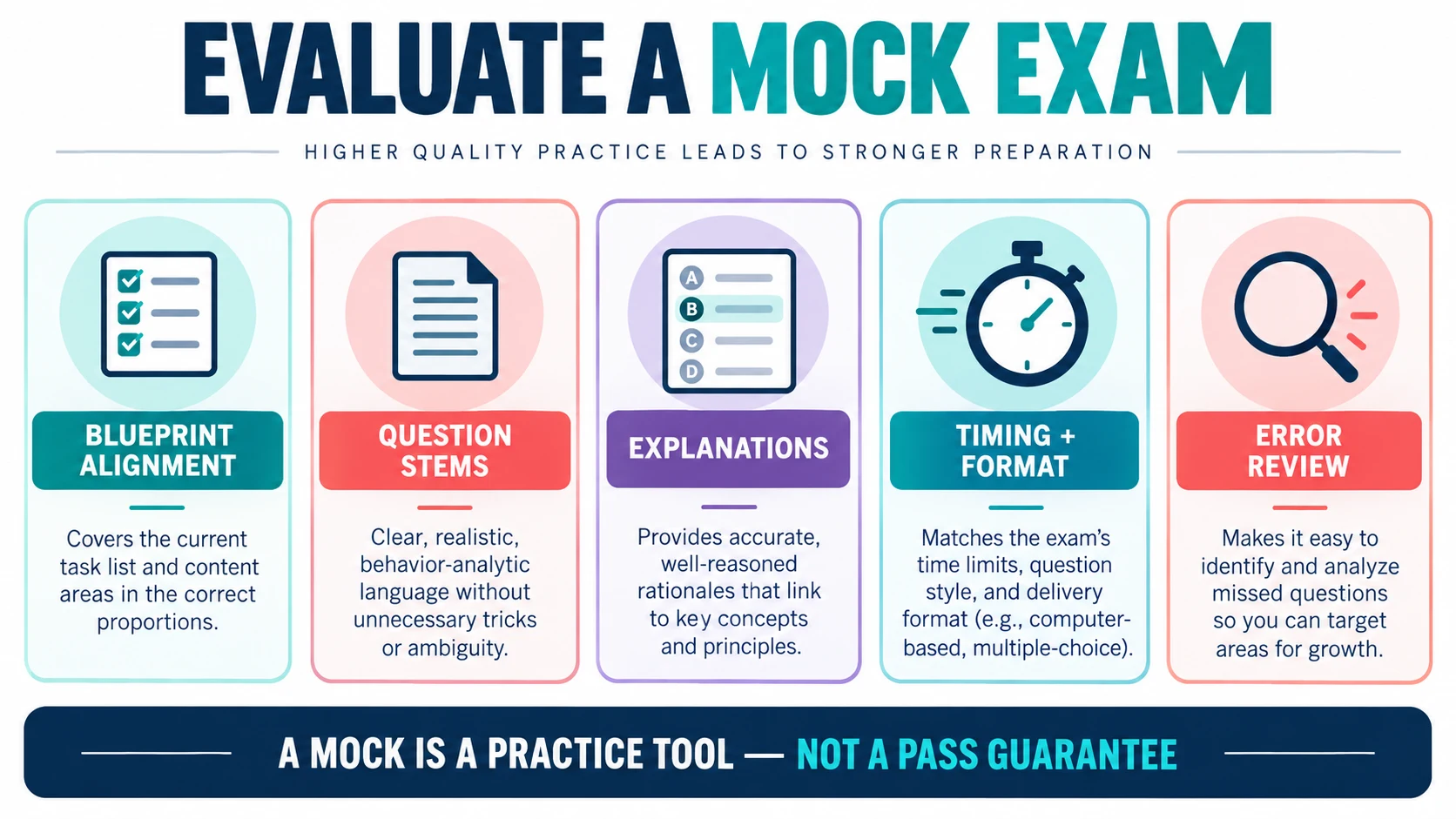
Before treating a third-party mock as a main study source, inspect a small sample of items and explanations. You are looking for evidence that the material helps you reason, not merely memorize a letter.
- Blueprint alignment: the item can be connected to a current task or content area without forcing the match.
- Clear stem: the facts are sufficient to determine what the question is asking and why one option is best.
- Useful distractors: wrong options represent plausible confusions, not obviously silly answers or unexplained wording tricks.
- Full rationale: the explanation states why the correct answer fits and why the closest alternatives do not.
- Behavior-analytic precision: terms such as measurement, function, ethics, supervision, and intervention are used consistently.
- Actionable feedback: the resource helps you decide what to review next rather than leaving you with a score alone.
If an item seems ambiguous, do not immediately assume that your content knowledge is the problem. Write down the missing fact, compare the answer choices to the stem, and check an authoritative text. One poorly written item should become a review note, not a new rule you memorize.
Use a Four-Step Score-to-Study Workflow
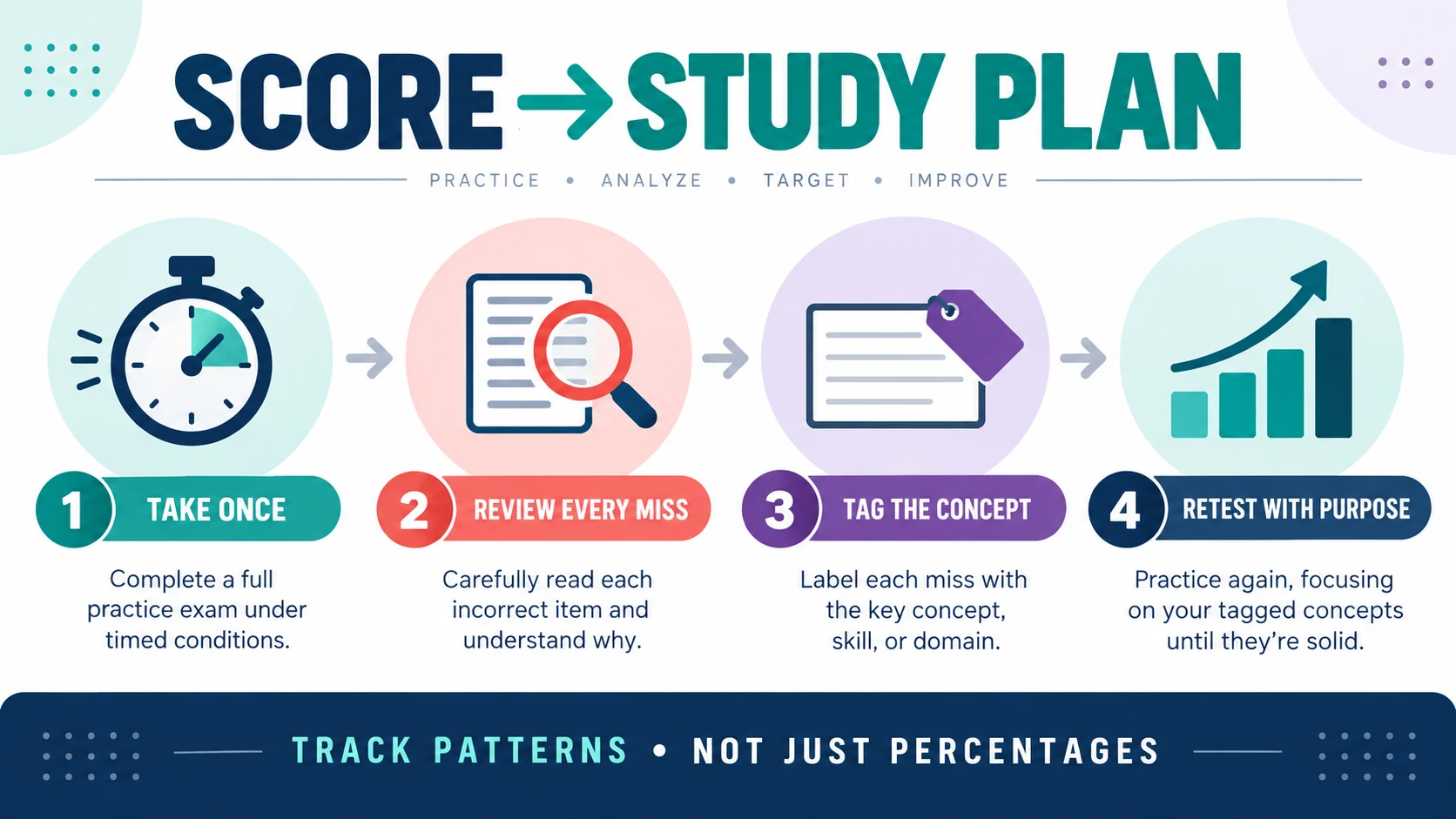
Use the mock once as a baseline before repeating it. The goal is to turn a practice session into a study plan.
- Take once under timed conditions: use the format and time plan you intend to practice, without notes or answer checking.
- Review every miss and guess: write the concept, the evidence in the stem, your answer, the correct answer, and the reason the distractor was attractive.
- Tag the pattern: label each item by content area, definition confusion, application error, reading error, pacing issue, or uncertainty.
- Retest with purpose: study the tagged concepts from authoritative materials, then use a fresh set or a later attempt to test transfer.
When you repeat an item, do not count recognition of the old answer as proof of mastery. Explain the rule without looking, create a new example, and decide how the answer would change if one fact in the scenario changed. That is closer to the reasoning a live exam item demands.
Use a Third-Party Mock Safely
Named resources create practical and intellectual-property risks. Use the current provider page or a legitimately obtained copy. Do not rely on a file that has been reposted without permission, and do not upload questions or answer keys into a public study folder. Keeping a private error log in your own words is safer and more useful than copying the entire item.
Keep three claims separate: what the provider says about the resource, what you personally observed while studying, and what the BACB officially requires. For example, “the provider describes the questions as realistic” is a source-based statement; “I found the explanations useful for measurement review” is a personal study observation; “the BACB handbook or outline requires…” is an official-rule statement. Do not turn the first two into the third.
Also verify the access route before entering payment information or personal data. A search result, social post, or shared drive is not automatically the current provider. If the brand page does not answer a question about version, access, or support, contact the provider directly instead of guessing.
Celia’s Mock Versus Official BACB Materials
Use the third-party mock for practice and the BACB materials for authority. They serve different jobs.
| Resource | Best use | Authority boundary |
|---|---|---|
| Celia’s Mocks | Practice retrieval, application, pacing, and error analysis. | Third-party study resource; provider claims are not BACB endorsement. |
| BACB Handbook and Test Content Outline | Verify current certification process, scope, and content language. | Official source for BACB requirements and exam framework. |
| Personal error log | Convert missed and guessed items into targeted review. | Your study evidence; not a psychometric readiness report. |
Who Should Use It
Celia’s mock can be useful for a BCBA candidate who already has core content to review and wants a structured practice set, especially when the candidate will analyze explanations instead of chasing a single score. It may be less useful as a first exposure if the candidate is still learning basic definitions, or as the only source if the candidate needs the current BACB rules, a comprehensive content map, or supervised feedback.
Use it alongside an authoritative content source, a concept notebook, and a realistic pacing plan. If a supervisor, faculty member, or study partner helps you review, ask them to challenge the rationale and the distractors rather than simply confirm the selected letter.
Common Mistakes With a Celia’s Mock Exam BCBA Search
- Confusing the brand with BACB: the resource is third-party and should not be presented as an official exam.
- Buying or downloading an old copy: verify the current provider page, version, and permitted access.
- Using the score as a pass predictor: treat it as one diagnostic observation, not a conversion to readiness.
- Repeating without analyzing: a higher score after memorizing answers may not show transfer.
- Ignoring explanations: the rationale and distractor analysis are often more useful than the percentage.
- Copying protected material: keep your own notes and follow the provider’s sharing terms.
- Using one resource only: compare practice feedback with the official BACB blueprint and handbook.
Frequently Asked Questions
Is Celia’s mock exam an official BACB exam?: No. It is a third-party study resource associated publicly with Celia’s Mocks and ABA Education Center. Use the official BACB handbook and Test Content Outline for certification requirements and exam authority.
Does a score on Celia’s mock predict whether I will pass?: No reliable pass conversion should be assumed from a third-party score. Use the result to identify missed, guessed, and time-pressured concepts, then verify those concepts with authoritative materials and retest transfer.
Should I take the mock more than once?: You can retest after studying, but do not treat recognition of repeated items as proof of mastery. Keep the first attempt as a baseline, review the reasoning, and use fresh or varied practice when possible.
What should I use with a third-party BCBA mock?: Use the current BACB BCBA Handbook and Test Content Outline, a structured error log, concept review, and a study schedule that includes timing and application practice. A second practice source can help you check whether a skill transfers beyond one resource’s wording.
Bottom line: the safest way to use a Celia’s mock exam BCBA resource is to verify the current source, keep its third-party status clear, practice under realistic conditions, analyze every miss and guess, and treat the result as diagnostic evidence rather than a pass guarantee. For a separate practice checkpoint, try our celia’s mock exam bcba study comparison and Take the Free BCBA Mock Exam. It is not affiliated with or endorsed by Celia’s Mocks or the BACB.
Sources
- ABA Education Center: Celia’s Mocks, public provider description and creator information.
- BACB Board Certified Behavior Analyst page, current handbook and transition-resource entry point.
- BACB BCBA Test Content Outline, official exam content framework.
- BCBA 6th Edition Quick Study Guide, an additional independent study-planning resource.



