

Data collection is an important part of ABA because it turns a description of behavior into information that a team can inspect, discuss, and use. Without a defined observation and a record of what happened, a decision can quietly become a guess based on memory, frustration, or one unusually easy or difficult session.
Table of Contents
- Why Data Collection Is an Important Part of ABA
- What Data Collection Adds to ABA Assessment
- Follow the Define-to-Decide Loop
- Match the Measure to the Question
- Record Context Without Losing the Signal
- Check Data Quality Before You Change the Plan
- Use Data for Progress, Fidelity, and Generalization
- Avoid Overclaiming What the Data Prove
- BCBA Exam Traps and Practical Questions
- Frequently Asked Questions
- Sources for Further Study
- Take the Free BCBA Mock Exam
Data do not make a treatment effective by themselves. They help a BCBA and the people supporting a learner ask better questions: What was observed? Under what conditions? Is the measure sensitive to meaningful change? Was the plan implemented as intended? What should be maintained, adapted, or reviewed in supervision?
This guide explains the why behind ABA data collection, then maps the process from an operational definition to a decision. It is educational information, not an individualized treatment protocol, payer instruction, or substitute for current BACB, state, organizational, privacy, and supervision requirements. The existing ABA data-collection reference remains a read-only resource; this new page focuses on the decision logic behind the practice.
Why Data Collection Is an Important Part of ABA
Data collection is important in ABA because it creates a repeatable record for baseline, measurement, progress monitoring, treatment decisions, and accountability. It lets a team compare observations over time instead of relying only on impressions. A useful record can show whether a behavior changed, whether a skill is emerging, whether the context changed, or whether the measure itself needs improvement. That answer has five practical parts:
- Define: describe the target response in observable terms so different observers know what counts.
- Measure: choose a dimension that matches the question, such as frequency, duration, latency, percentage, or a permanent product.
- Compare: look at patterns across sessions, settings, people, and relevant conditions instead of treating one observation as the whole story.
- Decide: use the record to maintain, adapt, intensify, fade, or further assess a plan within professional scope and supervision.
- Protect: keep the learner’s welfare, consent, dignity, privacy, and access needs visible when data are collected or shared.
Data collection should fit the real routine. A complicated form that is rarely completed may be less useful than a short, clearly defined measure that can be collected consistently. The right question is not “How much data can we collect?” It is “What information is necessary for this decision, and how can we obtain it responsibly?”
What Data Collection Adds to ABA Assessment
Assessment is broader than data collection. An assessment may include interviews, record review, direct observation, skill probes, preference information, and other sources. Data collection is one way of obtaining and organizing observations inside that larger process. Graphing is also different: a graph displays data, but a polished graph cannot repair an unclear definition or missing observations.
| Component | Question it answers | If skipped |
|---|---|---|
| Operational definition | What observable response is being counted or described? | Observers may record different events under the same label. |
| Measurement plan | Which dimension best fits the clinical or learning question? | The number may be precise but answer the wrong question. |
| Assessment context | When, where, with whom, and after what events did it occur? | A pattern may be mistaken for a stable trait when it is context-specific. |
| Decision rule | What pattern would lead the team to review or adjust the plan? | Teams may react to a single high or low point without a shared standard. |
This is why “collect data” is not a complete instruction. The team must also define the target, select the measure, identify the observation window, explain who records what, and decide how quality will be reviewed. Those choices determine what the resulting number can and cannot tell you.
Follow the Define-to-Decide Loop
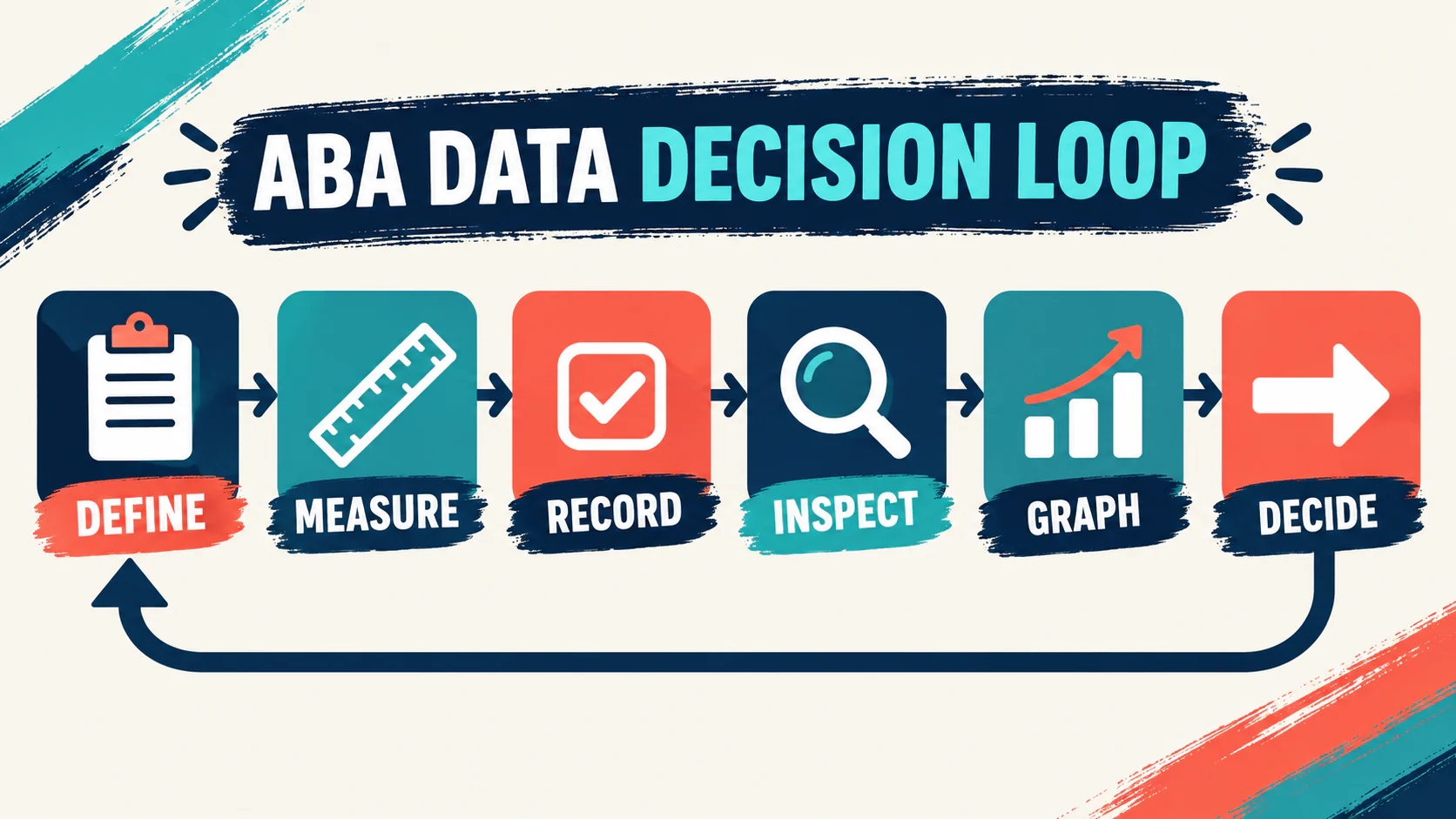
A practical ABA data workflow can be remembered as define, measure, record, inspect, graph, and decide. The steps are connected, but they are not interchangeable.
- Define the response: use observable examples and nonexamples. Avoid relying only on labels such as “noncompliance,” “aggression,” or “engaged.”
- Choose the dimension: select frequency, rate, duration, latency, interval data, percentage, trial-by-trial performance, or another method based on the behavior and decision.
- Record the observation: note the agreed time window and relevant context. If something prevented observation, mark missing data instead of silently filling the gap.
- Inspect the record: look for definition drift, unusual observer conditions, skipped opportunities, equipment problems, or a change in the routine.
- Graph or summarize: display the pattern in a format that makes level, trend, variability, and important context easier to see.
- Decide and document: connect the observed pattern to the next professional action, the rationale, and the point at which the team will review again.
| Step | Evidence to keep visible | Decision risk |
|---|---|---|
| Define | Examples, nonexamples, onset, offset, and observation unit. | Different observers count different responses. |
| Measure | The selected dimension, opportunity count, and observation window. | A changing opportunity count looks like behavior change. |
| Record | Actual observations, missingness, context, and support changes. | Memory or selective recording replaces direct evidence. |
| Decide | Pattern, decision rule, clinical rationale, and review date. | A single data point drives an unnecessary plan change. |
Match the Measure to the Question
There is no universally best ABA data-collection method. The measure must fit the response, the environment, the observer, and the decision. For example, duration may be meaningful for a long episode, while latency may better describe how quickly a learner begins a task. Frequency alone can mislead when session lengths or opportunities vary.
| Question | Possible measure | Important caution |
|---|---|---|
| How often did the response occur? | Frequency or rate | Compare observation time and opportunity count. |
| How long did the episode last? | Duration | Define onset and offset consistently. |
| How quickly did the learner respond? | Latency | Specify the instruction, start point, and response criterion. |
| How many opportunities were completed? | Percentage or trial-by-trial data | Keep the denominator and prompt level visible. |
| What happened before and after? | ABC narrative or structured recording | A sequence describes a pattern; it does not prove function by itself. |
Record Context Without Losing the Signal
Context makes behavior data more interpretable. Relevant context may include the task, setting, people present, schedule, materials, sleep or health information that the family chooses to share, prompts, reinforcement changes, and whether the observation was interrupted. The goal is not to document every detail of a person’s life. The goal is to preserve the variables needed to interpret the specific measure and protect the learner’s privacy.
ABC notes are a common example. A record can describe an antecedent, an observable behavior, and an immediate consequence. It can help a team generate a hypothesis for further assessment. It should not be written as if the consequence is automatically the cause, and it should not convert an observer’s interpretation into a fact. Use objective language, separate observation from interpretation, and escalate safety concerns through the appropriate clinical process.
Check Data Quality Before You Change the Plan
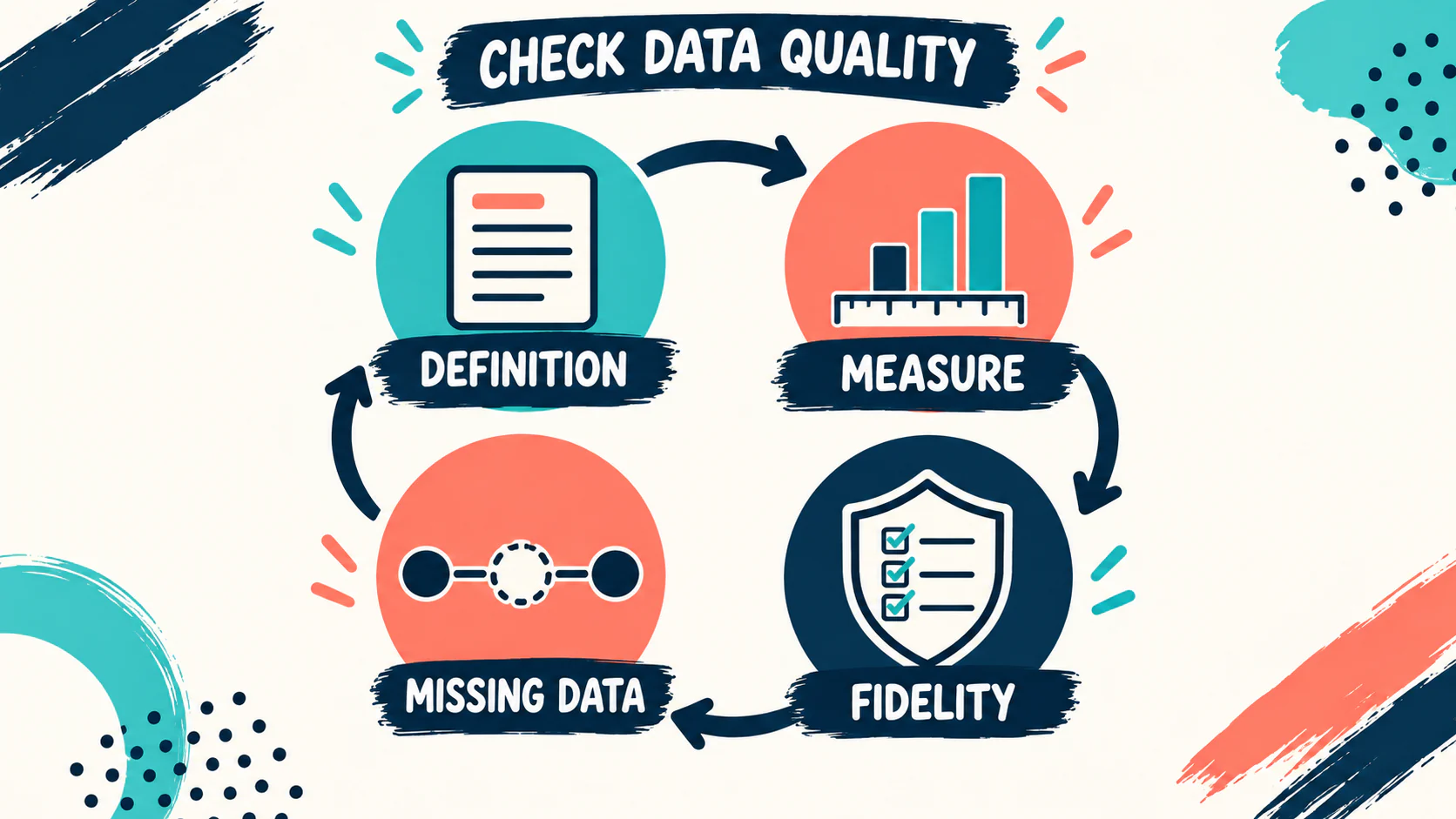
Before changing an intervention because a graph moved, check whether the data deserve that level of confidence. Data quality is not just a math issue. It includes the definition, the training and conditions of the observer, the recording system, the amount of missing data, and whether the intervention was implemented as planned.
- Definition check: Can a trained observer identify the same response from the written description?
- Measurement check: Does the chosen dimension represent the question, or is it merely convenient?
- Observer check: When appropriate, has agreement or another reliability check been planned and interpreted in context?
- Implementation check: Was the support delivered as intended, with the expected materials, prompts, timing, and opportunities?
- Missing-data check: Are gaps, interruptions, and unusual sessions visible rather than silently treated as zero?
| Review finding | What it may mean | Prudent next question |
|---|---|---|
| Definition drift | The target changed while the label stayed the same. | Do we need to retrain, clarify, or separate responses? |
| Large missing-data pattern | The observed sample may not represent the routine. | What barrier caused the gap, and what smaller measure is feasible? |
| Support changed | A data shift may reflect a prompt, schedule, person, or material change. | Is the change a treatment effect, a context effect, or both? |
| Implementation was inconsistent | Outcome data cannot be interpreted as a clean test of the plan. | Should the team support fidelity before judging the outcome? |
Use Data for Progress, Fidelity, and Generalization
Once quality is understood, data can support several decisions. Progress data show whether a defined skill or behavior is changing. Fidelity data show whether the intervention components were delivered as planned. Generalization data show whether a skill transfers across people, materials, settings, or routines. These are related questions, but one graph should not be forced to answer all three.
Use data to make the next conversation more specific. Instead of saying “the plan is not working,” a team might say, “the rate decreased during structured sessions, but the home observation window is too inconsistent to judge transfer.” Instead of saying “the learner is ready for fading,” the team might identify the current prompt level, independent-response pattern, and settings that still need support.
For families and direct-care staff, the data system should be understandable and feasible. Explain what is recorded, why it matters, who can see it, how errors are corrected, and how to report a concern. A person who contributes an observation should not be blamed for a pattern that requires professional interpretation.
Avoid Overclaiming What the Data Prove
Data can support a hypothesis, document a pattern, and inform a decision. They do not automatically prove that one intervention caused an outcome. Causal confidence depends on the design, the stability of the baseline, the consistency of implementation, the quality and amount of observation, alternative explanations, and the context in which the change occurred.
This distinction matters in ABA exam questions and in real practice. If behavior changes after several things changed at once, write what was observed and what remains uncertain. If the data are sparse, say that the sample is limited. If implementation was inconsistent, address that barrier before presenting the outcome as a clean test. Accurate uncertainty is more useful than false precision.
BCBA Exam Traps and Practical Questions
Common BCBA exam traps include treating a label as an operational definition, choosing frequency when opportunity count or observation time changed, confusing a graph with an assessment, ignoring missing data, and assuming that a post-intervention improvement proves causation. Another common mistake is asking a caregiver or technician to make a clinical change without the supervision and scope needed for that decision. Use these questions when reviewing an ABA data system:
- What exact response or skill is being measured, and what are the examples and nonexamples?
- Does the measurement dimension match the decision we need to make?
- Are session length, opportunities, prompts, materials, and missing observations visible?
- What evidence tells us the data are sufficiently trustworthy for this decision?
- What would make us maintain, adapt, pause, or further assess the plan?
- How are privacy, consent, dignity, accessibility, and professional responsibility protected?
If you are preparing for the BCBA exam, the Free BCBA Mock Exam can help you practice measurement selection, graph interpretation, data-based decision making, and ethical boundaries. It is a study diagnostic, not a substitute for supervision or a guarantee of certification.
Frequently Asked Questions
Why is data collection an important part of ABA?: It creates a repeatable record that can support baseline, progress monitoring, treatment review, fidelity checks, generalization planning, and professional accountability. It reduces reliance on memory while still requiring clinical judgment and context.
Does collecting more ABA data always make a program better?: No. Data should be sufficient for the decision and feasible for the people collecting it. A shorter, well-defined measure may be more useful than a burdensome form that produces inconsistent or missing records.
What is the best ABA data-collection method?: There is no single best method for every target. Frequency, rate, duration, latency, percentage, interval systems, trial-by-trial recording, permanent products, and ABC notes each answer different questions. Match the measure to the response, context, and decision.
Can ABA data prove that an intervention caused behavior change?: Not by themselves. The strength of a causal conclusion depends on the design, data quality, implementation, alternative explanations, and pattern across conditions. A responsible record states both what the data show and what remains uncertain.
Sources for Further Study
For current professional boundaries and credential context, review the BACB Ethics Codes, BCBA Handbook, and BCBA resource hub. For research context, read the open-access discussion of data-collection integrity in applied behavior analysis. You can also compare the ABA data collection guide. Recheck current local, organizational, payer, privacy, and supervision requirements before applying any data system. For targeted review, use our data collection is an important part of aba practice questions to apply the concept in exam-style scenarios.
Take the Free BCBA Mock Exam
When you are ready to apply the idea, use the free practice resource below for additional feedback. Take the Free BCBA Mock Exam



