
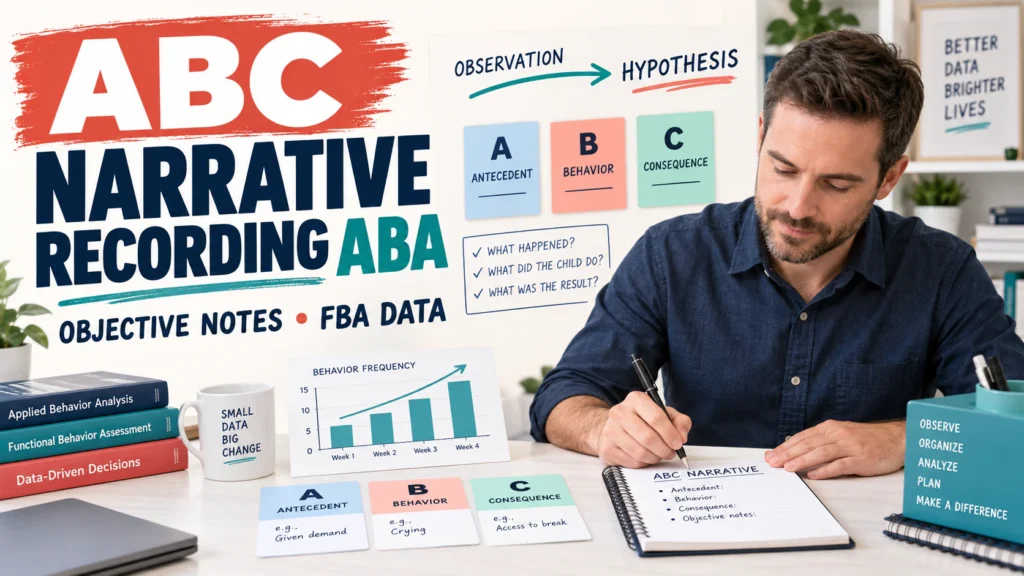
ABC narrative recording ABA is a descriptive way to write what happened before an observable behavior, what the behavior looked or sounded like, and what happened immediately afterward. The record can help a BCBA identify patterns and build a functional hypothesis, but one narrative observation does not prove that a consequence caused the behavior.
Table of Contents
- ABC Narrative Recording ABA: The Short Answer
- Write the A, B, and C as Observable Notes
- Rewrite Subjective Notes Into Observable Language
- Choose Narrative ABC or Structured ABC Coding
- Use ABC Notes to Build a Hypothesis, Not a Causal Claim
- BCBA Exam Traps and Study Use
- Frequently Asked Questions
- Sources for Further Study
- Quick Review Checklist
- Take the Free BCBA Mock Exam
This guide focuses on writing objective narrative notes and choosing between narrative ABC and more structured ABC coding. The existing ABC recording reference, FBA data-collection guide, and anecdotal-assessment guide remain read-only references. This new URL does not replace or change them. Use fictional, de-identified examples for study. In real practice, follow current privacy, consent, supervision, documentation, and assessment requirements. Do not place names, addresses, school details, or other identifying information in a public worksheet.
ABC Narrative Recording ABA: The Short Answer
An ABC narrative note is a brief, chronological account of an event:
- Antecedent: relevant events or conditions immediately before the response, including a demand, transition, interaction, material, or change in the routine.
- Behavior: the observable response, written with a clear definition rather than a mental-state label.
- Consequence: what immediately followed, including what other people did, what changed in the environment, and what the learner gained, avoided, or experienced.
Add setting events or context when they are relevant, but keep them separate from the immediate A-B-C sequence. “Tired,” “wanted attention,” and “was frustrated” may be hypotheses or contextual reports; they are not automatically observable behavior or a proven function. Write what was seen, heard, reported, or measured, and label an interpretation as an interpretation.
Write the A, B, and C as Observable Notes
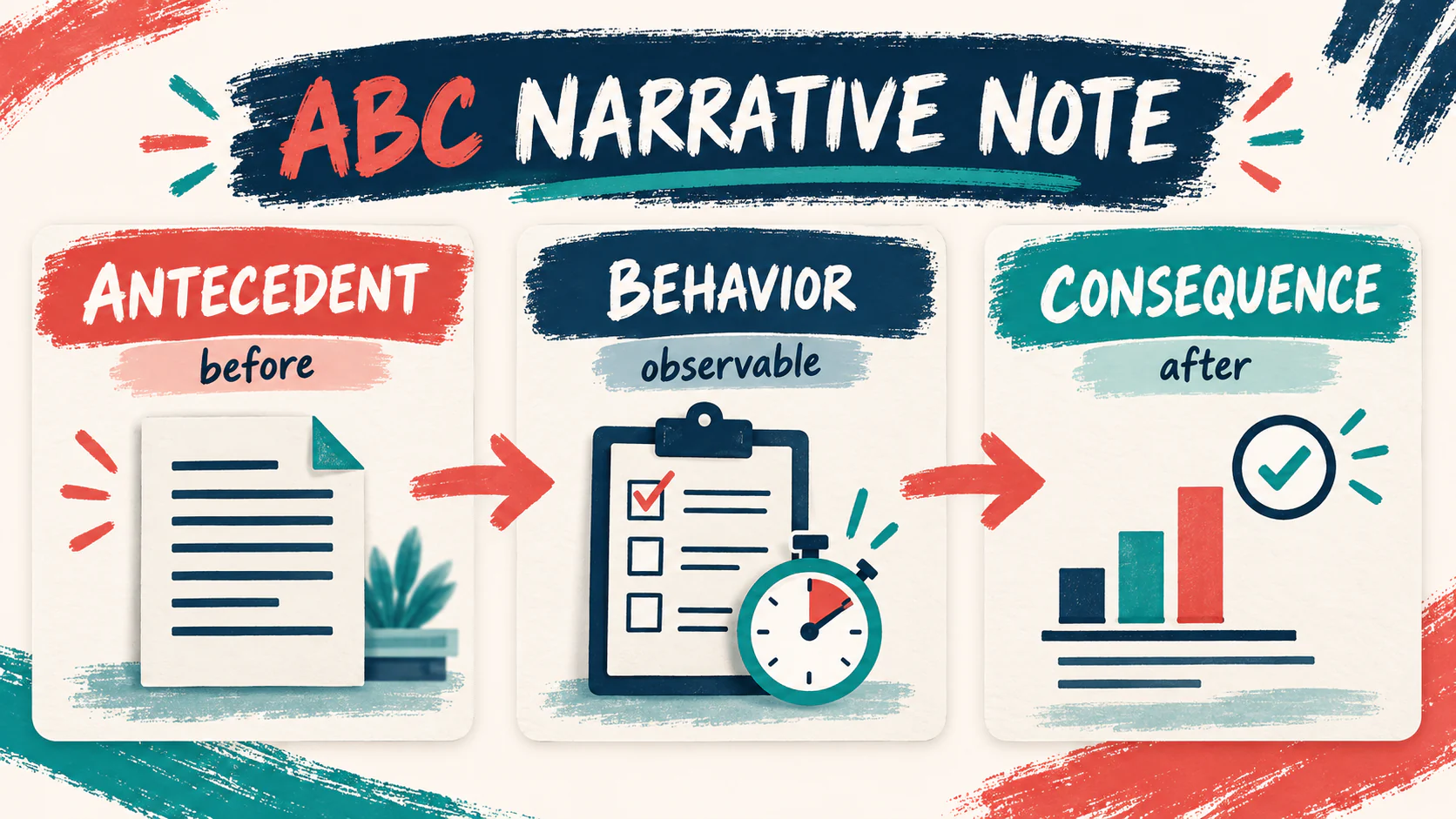
Use the three-part map as a writing check. A good note lets another trained reader reconstruct the event without needing to guess what the observer meant.
| Part | Write | Example of useful detail |
|---|---|---|
| Antecedent | The event or condition immediately before the behavior, in sequence and neutral language. | “At 9:10, the instructor placed the worksheet on the desk and said, ‘Start problem one.’” |
| Behavior | Topography, duration, intensity or count when relevant, and a start or stop rule. | “The learner pushed the worksheet to the floor and moved 2 meters away from the desk.” |
| Consequence | What happened immediately afterward, including changes in task, attention, access, or location. | “The instructor picked up the worksheet, repeated the direction, and delayed the next instruction for about 20 seconds.” |
| Context | Relevant setting event or variation, clearly labeled as context rather than function. | “This occurred during the first academic block after a schedule change.” |
Keep the note chronological. If the consequence includes multiple events, record the sequence instead of compressing it into “staff handled it.” If the observer did not see what happened, write “unknown” or identify the report source. Missing data are more honest and useful than invented precision.
Rewrite Subjective Notes Into Observable Language
Objective writing does not mean removing all context or making a note cold. It means separating observation from interpretation so the team can evaluate both.
| Subjective wording | Observable rewrite | Interpretation boundary |
|---|---|---|
| “The learner was frustrated.” | “The learner sighed, said ‘no,’ pushed the pencil away, and looked toward the door.” | Frustration may be a report or hypothesis; the listed actions are the observation. |
| “Staff gave attention.” | “The technician moved within 1 meter, said ‘Are you okay?’ and touched the learner’s shoulder.” | Specify the form, timing, and duration of the social consequence. |
| “The learner escaped the task.” | “The worksheet was removed for 2 minutes after the learner left the table.” | Escape is a possible outcome or hypothesis; removal is what was observed. |
| “The behavior escalated.” | “Across 90 seconds, volume increased from conversational speech to shouting; no contact occurred.” | Describe the dimension that changed and the boundary of the response. |
When a caregiver, teacher, or learner provides important information, identify it as an interview or report rather than presenting it as direct observation. Both sources can matter, but they answer different questions and have different limits.
Choose Narrative ABC or Structured ABC Coding
Narrative recording is flexible and preserves sequence and detail. Structured ABC coding uses predefined categories or codes, which can make comparison across observations easier. The best choice depends on the question, setting, observer training, response class, and how much detail is needed.
| If the question is… | A useful starting point may be… | Check before deciding |
|---|---|---|
| “What is happening in this unfamiliar routine?” | Narrative ABC to preserve sequence and generate possible variables. | Observer training, privacy, and a consistent note format. |
| “How often does each coded antecedent occur across 20 observations?” | Structured ABC categories or a combined coding system. | Whether categories are mutually clear and reliably scored. |
| “Does this intervention cause the behavior change?” | A design and measurement system that can address a functional relation. | Narrative or descriptive ABC alone cannot answer the causal question. |
Use ABC Notes to Build a Hypothesis, Not a Causal Claim
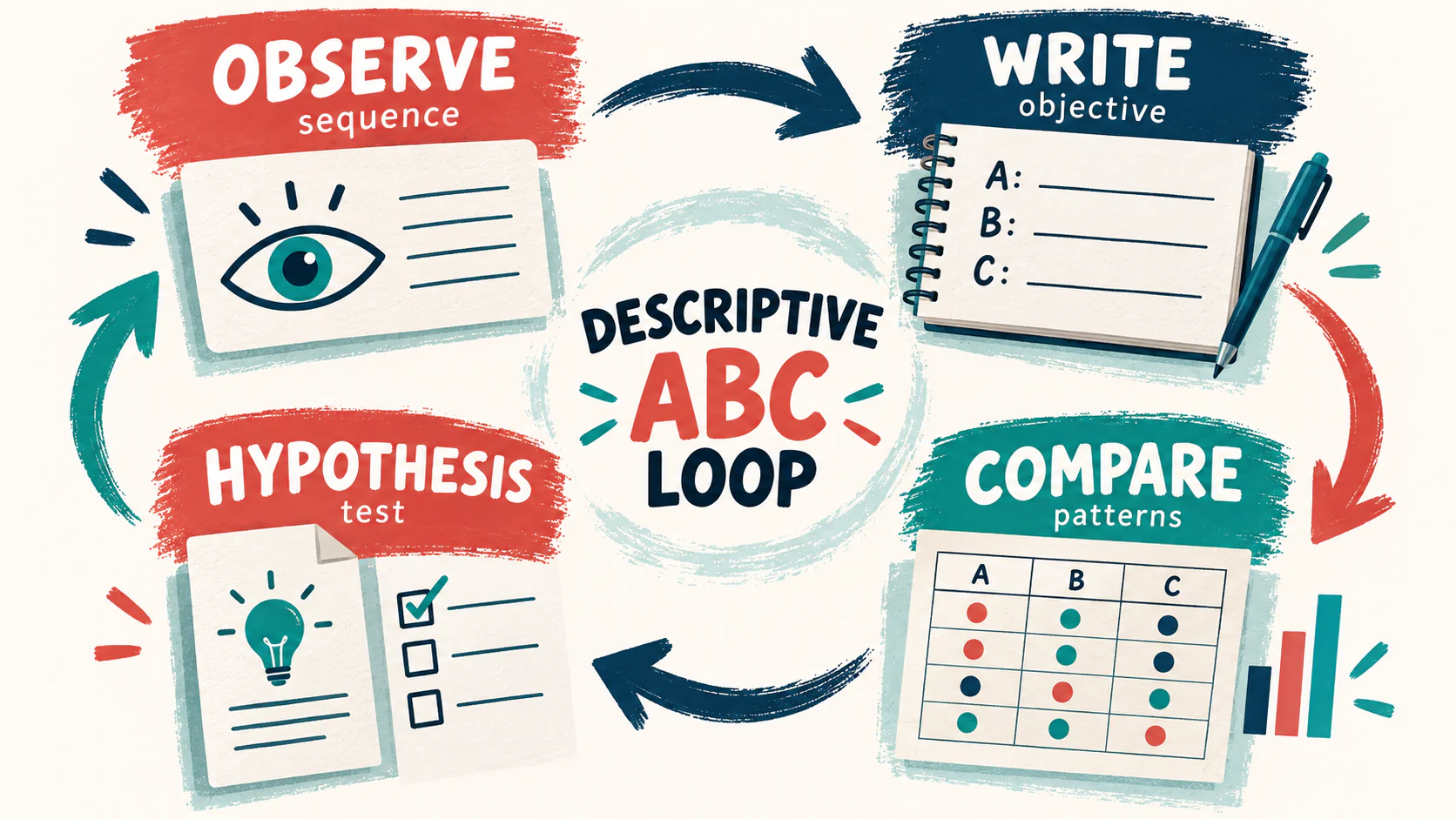
Use repeated observations to compare patterns. If a demand is frequently followed by leaving the area and the demand is then delayed, the pattern may support an escape-related hypothesis. It is still a hypothesis: the observer should consider competing variables, verify definitions, gather more data, and use an appropriate assessment process before making a clinical decision.
- Observe: collect several notes across relevant times, people, and routines when appropriate.
- Write: keep A, B, C, context, and interpretation separate.
- Compare: look for repeated relations rather than a memorable single event.
- Hypothesize: state the possible function and the evidence that supports and limits it.
Descriptive data can be a valuable part of an FBA, but it is not automatically a functional analysis. Do not write “the behavior is maintained by attention” simply because attention followed one event. The data should guide the next assessment or intervention conversation, not replace it.
BCBA Exam Traps and Study Use
For BCBA exam questions, watch for these distinctions:
- An antecedent is not the same as a setting event, and a consequence is not the same as a presumed function.
- “Noncompliance,” “attention-seeking,” and “anxious” are not complete observable behavior definitions.
- A narrative ABC record is descriptive; it does not by itself demonstrate a functional relation.
- Structured coding can improve comparison only when the categories are clear and observers can use them reliably.
- Objective language does not require ignoring caregiver or teacher reports; it requires labeling their source.
Use the Free BCBA Mock Exam to practice identifying whether a scenario asks for measurement, descriptive assessment, functional analysis, or an ethics and documentation boundary. It is a study diagnostic, not an official BACB exam or a substitute for supervision.
Frequently Asked Questions
What is ABC narrative recording in ABA?: It is a descriptive narrative of relevant events before a behavior, the observable behavior itself, and what immediately followed. It is used to document patterns and develop hypotheses, not to prove a function from one event. What does ABC stand for?: ABC commonly stands for antecedent, behavior, and consequence. A complete note may also include setting events, context, measurement details, source of information, and the observer’s clearly labeled interpretation.
Can ABC data prove the function of behavior?: No. Narrative or descriptive ABC data can support a hypothesis and help identify variables for further assessment. A causal conclusion requires an assessment approach and design appropriate to the clinical question.
How do I make an ABC note objective?: Describe what was seen or heard, use operational definitions, keep the sequence and timing clear, identify the information source, and separate observations from words such as “frustrated,” “manipulative,” or “wanted attention.”
Sources for Further Study
For current professional and documentation boundaries, review the BACB Ethics Codes, BCBA Handbook, and BCBA resource hub. For evidence context, see the PubMed research record and compare a secondary ABC data-sheet reference. Recheck current policy, supervision, consent, privacy, and assessment requirements before using a real recording system.
Quick Review Checklist
Use this final checklist to turn abc narrative recording aba into exam-ready reasoning. The goal is not to memorize a label in isolation; it is to identify the relevant evidence and explain why the best answer fits the scenario. Key ideas to review:
- State the central definition or decision point for abc narrative recording aba in your own words.
- Identify the detail that makes abc narrative recording aba different from its closest related ABA term.
- Separate the observable facts in a scenario from assumptions that are not supported by the facts.
- Write one example and one nonexample so you can recognize the concept in a new setting.
Exam application checks:
- Ask what the question is actually requesting before comparing the answer choices.
- Mark the antecedent, response, consequence, or other evidence that supports the selected answer.
- Look for a distractor that describes a related process but does not answer the specific question.
Final self-check:
- Explain how you would verify the interpretation with clear observations or data.
- Change one detail in the scenario and decide whether your answer should change.
- Give a one-sentence rationale that a supervisor or study partner could evaluate.
Take the Free BCBA Mock Exam
When you are ready to apply the idea, use the free practice resource below for additional feedback. Take the Free BCBA Mock Exam



