

Contrived opportunities ABA are teaching or assessment opportunities a behavior analyst deliberately arranges so a target response is more likely to become relevant. The arrangement may involve placing a needed item in view but out of reach, pausing at a predictable point in a routine, setting up a communication need, or creating a safe practice condition for a skill that may not occur often on its own.
Table of Contents
- What Contrived Opportunities ABA Means
- Captured Versus Contrived Opportunities
- How to Arrange a Contrived Opportunity Step by Step
- Prompting, Reinforcement, and Ethical Limits
- Contrived Opportunity vs. NET and DTT
- What to Record and How to Decide Next Steps
- Common Errors on Practice and in Sessions
- BCBA Exam Takeaways
- Frequently Asked Questions
- Take the Free BCBA Mock Exam
- Practice the Distinction on a Free BCBA Mock Exam
- References
The key is not to make the situation artificial for its own sake. The key is to arrange one meaningful condition, define the response before the opportunity begins, and record what happened before adding a prompt or teaching sequence. A contrived opportunity should make the learning target observable while protecting the learner’s dignity, choice, safety, and access to appropriate reinforcement.
What Contrived Opportunities ABA Means
A contrived opportunity is an intentionally arranged chance for a learner to use a target skill. The analyst changes a relevant antecedent or part of the environment so that the response can occur and be measured. For example, a preferred container can be closed while the learner has access to the activity, creating a reasonable opportunity to request help or a missing item. The analyst is not waiting for the exact situation to appear by chance; the analyst is arranging a safe, purposeful version of it.
In behavior-analytic language, “contrived” does not automatically mean deceptive, coercive, or low quality. It means prearranged. The quality of the opportunity depends on the function of the arrangement, the learner’s experience, the response definition, and what happens after the response. A contrived opportunity for a mand should make the relevant item or information valuable without creating unnecessary distress. A contrived opportunity for a social skill should create a realistic reason to respond rather than demand a performance that has no connection to the context.
This distinction matters for BCBA study because the current BCBA Test Content Outline includes motivating operations, verbal behavior, stimulus control, prompting, reinforcement, and generalization. Identify what was arranged and what the arrangement was intended to evoke.
Captured Versus Contrived Opportunities
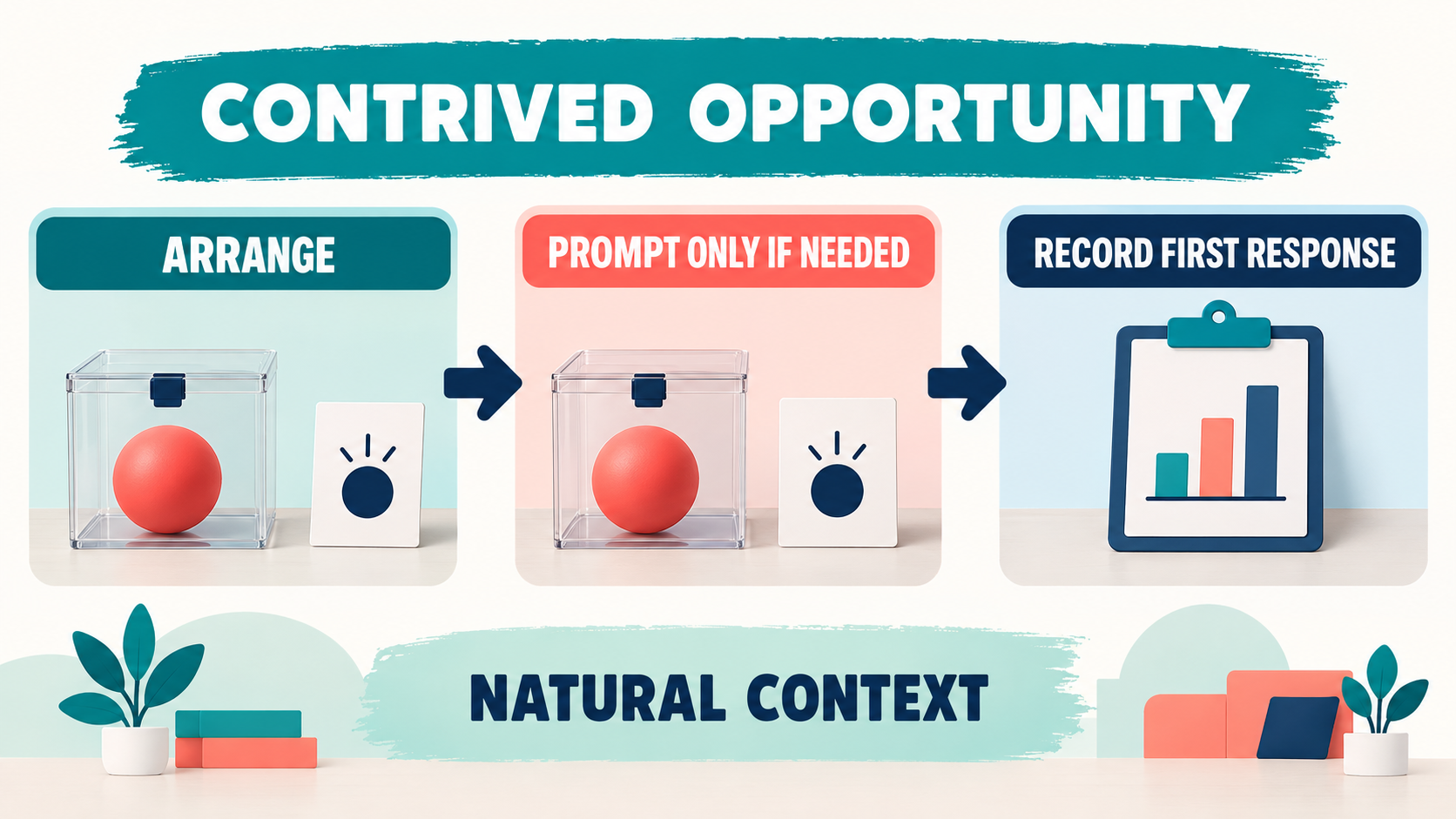
A captured opportunity uses a relevant event that occurs naturally. A learner reaches toward a closed container, looks toward a desired item, or encounters a genuine pause in a routine. The practitioner recognizes that the moment can support the target response and teaches within it. A contrived opportunity is arranged in advance or deliberately created because the natural event may be too rare, too inconsistent, or too difficult to measure reliably.
Both approaches can be useful. Captured teaching may feel more natural and can reveal whether the skill occurs during ordinary activities. Contrived teaching can increase opportunity density and make the antecedent and response easier to define. They should not be treated as interchangeable data points, however. The record should identify whether the opportunity was naturally occurring or arranged, especially when the team is evaluating generalization.
| Opportunity type | What happens | Main interpretation |
|---|---|---|
| Captured | A meaningful event occurs during the routine and the practitioner teaches within it. | The skill occurred in a naturally available context. |
| Contrived | A relevant item, pause, missing step, or practice condition is intentionally arranged. | The response occurred under the planned arrangement; transfer still needs to be checked. |
| Unplanned or unclear | The antecedent, response window, or teaching purpose is not specified. | The result is difficult to interpret and should not be labeled as independent mastery. |
How to Arrange a Contrived Opportunity Step by Step
Start with the response and the reason it matters, not with a clever setup. If the goal is functional communication, the arrangement should create a real reason to communicate. If the goal is tolerating a change, the planned change should be small enough to be safe and meaningful. If the goal is a social response, the opportunity should resemble the setting in which the learner will use the skill.
- Define the target response. State exactly what counts, including the response form, the relevant stimulus, the response window, and whether an approximation is acceptable.
- Choose one relevant condition to arrange. Examples include an item being visible but unavailable, a missing step in a familiar routine, a choice between two materials, or a planned pause that invites a request for continuation.
- Check the learner’s history and preferences. Confirm that the material is appropriate, the skill is in the learner’s repertoire or instructional plan, and the arrangement does not rely on avoidable distress.
- Present the opportunity consistently. Use the programmed instruction, materials, and response window. Avoid changing the item, wording, distance, and prompt level all at once.
- Allow the independent response opportunity. Wait for the pre-defined interval before adding a prompt. If safety requires an immediate response, follow the approved safety procedure and document what happened.
- Deliver the programmed consequence. Reinforce the target response with the relevant natural or programmed consequence, then apply the teaching or error-correction sequence as written.
- Plan the next test of transfer. After the arranged condition is useful, vary one dimension at a time: person, setting, material, wording, time, or the natural availability of the opportunity.
For example, a learner is working on requesting assistance during an art routine. Instead of repeatedly saying “Ask for help,” the analyst gives the learner a familiar container that is difficult to open independently, keeps the activity available, and waits for the defined request. The analyst records whether the request occurs without a prompt. If the learner requests help, the consequence should be assistance with the task—not an unrelated reward that teaches a different relation.
Prompting, Reinforcement, and Ethical Limits
The first opportunity and the teaching opportunity are not always the same event. If the purpose is to measure independent responding, record the response before prompting. If the purpose is instruction, use the approved prompt hierarchy after the response window and record the prompt level. A prompted correct response may show that the learner can perform with support, but it should not be silently scored as independent.
Reinforcement should be connected to the response and the learner’s goal. In a communication example, the requested item or assistance may be the most natural consequence. In a practice arrangement, a brief programmed reinforcer may be appropriate when the natural consequence cannot be delivered immediately. The data should make the distinction visible so the team can evaluate whether the arranged contingency is producing useful behavior outside the practice setup.
There are ethical limits to arranging an opportunity. The current BACB Ethics Code for Behavior Analysts emphasizes benefit, dignity, respect, integrity, competence, and protection from harm. Do not withhold essential care or create unnecessary frustration. Consider assent when relevant, use the least intrusive arrangement that answers the teaching question, and modify it when risk matters more than the data.
Contrived Opportunity vs. NET and DTT
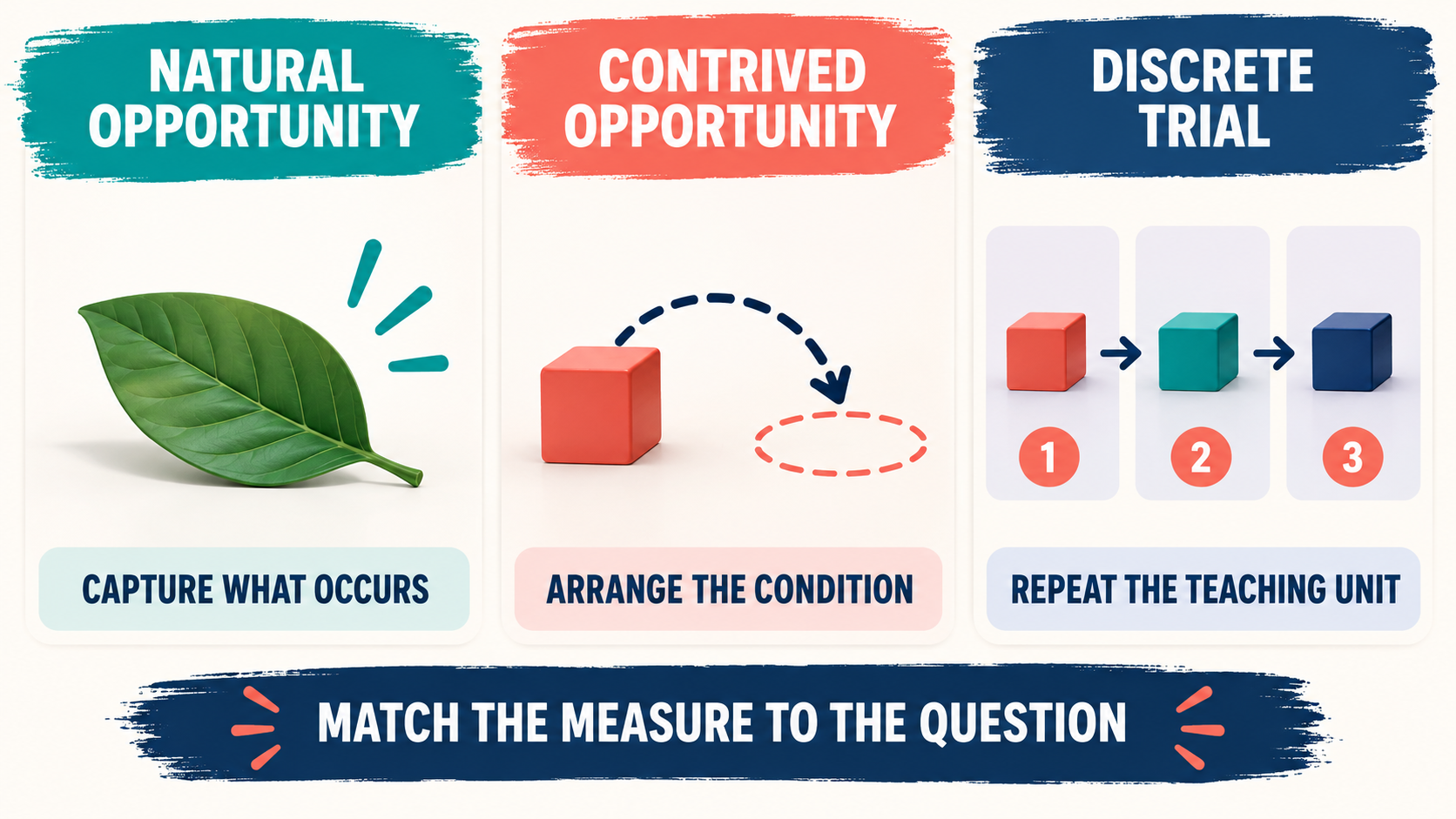
Contrived opportunities can occur inside natural environment teaching, but the terms are not synonyms. Natural Environment Training describes a broader teaching arrangement that uses meaningful activities and naturally relevant consequences. A contrived opportunity describes the deliberate creation of one opportunity within that or another context. Discrete-trial teaching is also broader than the word “contrived”; it typically organizes repeated teaching units with defined antecedents, responses, consequences, and prompting.
| Arrangement | Primary question | What to watch for |
|---|---|---|
| Natural opportunity | Does the target response occur when the relevant event naturally appears? | The event may be less frequent or less standardized. |
| Contrived opportunity | Can the team arrange a relevant condition to evoke and measure the target? | The result may not generalize unless the arrangement is faded or varied. |
| Discrete trial | How does the learner respond across repeated teaching units? | The team must distinguish trial-by-trial performance from a single arranged opportunity. |
A common exam trap is to see a preferred item arranged in the environment and immediately choose “natural environment teaching.” If the item was intentionally placed to create a request, the specific opportunity is contrived. If the larger session uses child-led activities and natural consequences, the session may also be NET; name the level the question asks about.
What to Record and How to Decide Next Steps
A useful record should allow another trained person to reconstruct the opportunity without guessing. Include the target, the arranged condition, the instruction or cue, the response window, the learner’s response, prompt level, consequence, and any relevant change. Also label whether the opportunity was captured or contrived. If the skill is communication, note whether the item or information was actually available after the response. If the skill is tolerance, record the duration and the exact change that was introduced.
- Independent: the target response occurred within the defined window without the planned prompt.
- Prompted: the target occurred after a specified prompt; record the prompt level separately.
- Incorrect or no response: apply the programmed correction or next step rather than improvising a new criterion.
- Not interpretable: mark interruptions, unclear instructions, unexpected access, or safety changes instead of forcing a score.
Use the data to answer the original programming question. If independent responding is low, review the target, arrangement, response definition, and instructional sequence. If responding is high only under the arranged condition, plan a captured opportunity or generalization check. A contrived opportunity is not proof that the skill will occur everywhere.
Common Errors on Practice and in Sessions
- Calling every setup “natural.” If the practitioner deliberately changes access, materials, or timing to evoke a response, label that part as arranged.
- Changing too many variables. If the item, instruction, person, and setting all change, the data cannot show which variable mattered.
- Prompting before observing. This removes the independent opportunity and makes the score answer a different question.
- Using frustration as the intervention. A contrived opportunity should create relevance, not unnecessary distress or deprivation.
- Failing to fade the arrangement. Practice may stay dependent on a hidden item, an adult pause, or a special setup unless the team plans transfer.
- Confusing an opportunity with mastery. One successful request or one correct response is evidence from one condition, not a complete generalization assessment.
- Recording the consequence vaguely. “Reinforced” is less useful than documenting whether the learner received the requested item, help, continuation, or another programmed consequence.
BCBA Exam Takeaways
For a multiple-choice question, identify the event the practitioner arranged and then match it to the target response. A preferred item placed out of reach may establish a reason to request. A missing step in a familiar routine may create an opportunity to ask for help. A planned pause may evoke a continuation request. The answer should still account for the response definition, prompt level, consequence, safety, and generalization plan.
- Captured means the relevant opportunity was already occurring; contrived means the practitioner arranged it.
- Contrived does not mean unethical; the arrangement must be purposeful, safe, respectful, and clinically relevant.
- A prompted response and an independent response answer different measurement questions.
- NET is a broader teaching context; a contrived opportunity can occur within NET.
- Generalization and maintenance require their own checks rather than assumptions from one arranged setup.
- When a question includes a motivating operation, stimulus control, or verbal operant, identify the controlling variables instead of relying on the label “contrived.”
Frequently Asked Questions
Is a contrived opportunity the same as a contrived motivating operation?: Not exactly. A contrived opportunity is the arranged situation in which a response can occur. A motivating operation is an environmental variable that changes the value of a consequence and the momentary likelihood of behavior related to that consequence. An arranged situation may include a motivating operation, but the terms describe different parts of the analysis.
Is contrived teaching only used for mand training?: No. It is often discussed in communication and mand training because access, missing items, and information can create clear reasons to respond. The same logic can support practice for help-seeking, tolerance, social interaction, discrimination, or other targets when the arrangement is relevant and approved in the program.
How do I know whether to use a captured or contrived opportunity?: Use a captured opportunity when the natural event occurs often enough to observe and measure. Use a contrived opportunity when the team needs a safe, purposeful way to increase opportunity density or teach a response that is otherwise too rare to practice. In either case, plan how the skill will be checked in the natural environment.
Take the Free BCBA Mock Exam
If you want a low-pressure way to check your recall, use the free practice resource below. Take the Free BCBA Mock Exam
Practice the Distinction on a Free BCBA Mock Exam
Once you can separate captured events, arranged opportunities, discrete trials, prompting, and generalization, practice identifying the controlling variables in short scenarios. The free BCBA mock exam is a study resource for practicing those distinctions. It is not a BACB product, does not guarantee an exam result, and does not replace current official materials or supervision.
References
- Behavior Analyst Certification Board: BCBA Test Content Outline, 6th ed.
- Behavior Analyst Certification Board: Ethics Code for Behavior Analysts
- A Clinical Tutorial on Methods to Capture and Contrive Establishing Operations to Teach Mands
- Teaching Children With Autism Spectrum Disorder to Mand for Information Using “Which?”
- Effects of Behavioral Skills Training With Video Modeling and In Situ Training on Workplace Conversational Skills



