
A cold probe data sheet ABA teams use records a learner’s first response to a target before teaching, prompting, or corrective feedback changes the opportunity. The purpose is not to collect less data just because the sheet is short. The purpose is to capture a clean snapshot of what the learner can do under a defined condition at that moment.
Table of Contents
- What a Cold Probe Data Sheet Is For
- Cold Probe Definition and Scope
- Build a Cold Probe Data Sheet ABA Workflow
- How to Score the First Response
- Cold Probe vs. Other ABA Measures
- Common Cold Probe Data-Integrity Errors
- BCBA Exam Takeaways
- Frequently Asked Questions
- Take the Free BCBA Mock Exam
- References
The practical answer is: list the target, define the opportunity, record the independent response, mark the score consistently, and note any condition that could change interpretation. A cold probe is only useful when the probe is genuinely comparable from one session to the next. The form itself is not a BACB-mandated document; the supervisor and treatment team must define the program, response criteria, and decision rules.
What a Cold Probe Data Sheet Is For
A cold probe data sheet is a compact record for a first, unprompted opportunity. It is commonly used with skill-acquisition targets such as labeling, listener responding, imitation, manding, academic responses, or other programs in which the team wants to know whether a response occurs before direct teaching begins. A probe can also be used to check whether a skill remains available after it has been taught, but that is a different decision context and should be labeled clearly.
Think of the sheet as a measurement tool, not a lesson plan. It should tell another trained person exactly what target was presented, what counted as correct, what response occurred, and what condition surrounded that response. It should not force a therapist to guess whether “almost correct,” “prompted,” or “no response” means the same thing across programs.
Cold Probe Definition and Scope
In a cold probe, the team presents a defined target before the learner receives teaching or assistance for that opportunity. The probe may be the first trial of a session or another pre-specified opportunity. The important feature is the learning history immediately before the measurement: the response is sampled without the prompt or correction sequence that would normally support acquisition.
That does not mean the environment must be completely uncontrolled. The team should keep the relevant instruction, materials, response window, and scoring rules stable enough to compare observations. If a learner is tested with a different picture, a different instruction, or an unusually distracting arrangement, the sheet should record that difference instead of treating the result as a pure change in skill.
Cold probe data can answer a narrow question: “What happened on this defined opportunity before teaching support?” It cannot, by itself, prove mastery, explain why a response was missed, or replace a broader assessment. It also should not be treated as a universal procedure required by the BACB. The current BACB Task Lists provide the professional study context for measurement and behavior-analytic decision making, while the actual probe procedure must follow the learner’s program and supervisor-approved definitions.
Build a Cold Probe Data Sheet ABA Workflow
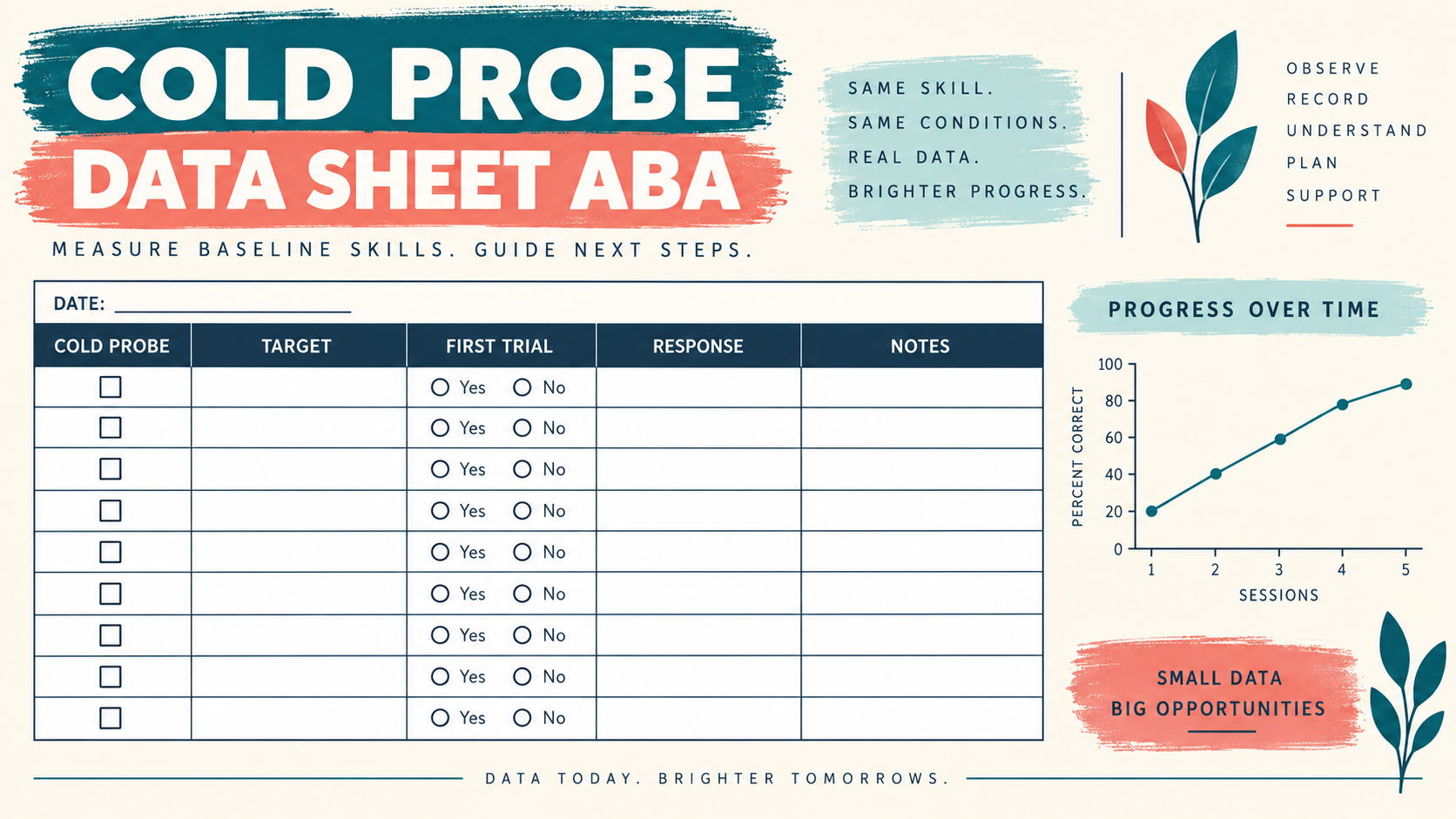
A useful cold probe data sheet can be one page, but it still needs enough context to make each mark interpretable. Start with the learner identifier permitted by your documentation rules, the date, the observer, and the program or skill area. Then define the unit of measurement. If the program has five targets, the sheet should make it obvious whether the score is recorded once per target or once for the whole program. Use the following fields as a practical design checklist. They are not a required BACB form layout; they are the minimum information needed to protect the meaning of the data.
- Target: name the skill or stimulus item in observable language.
- Opportunity: record the instruction, material, or task that was presented.
- Date and session: identify when and under which session conditions the probe occurred.
- First-trial indicator: show that the row represents the pre-teaching opportunity.
- Response: record the learner’s actual response, not an interpretation of intent.
- Independent score: mark correct, incorrect, or another program-defined outcome.
- Prompt status: mark whether a prompt occurred; a prompted response should not be silently counted as independent.
- Notes: capture a material change, interruption, unusual latency, or other relevant condition.
- Decision field: note whether the team will teach, probe a new target, repeat the assessment, or review the program definition.
A simple row might read: “Label spoon; spoken instruction; first opportunity; vocal response ‘spoon’; independent correct.” If the learner needed a model, the response may still be useful, but the sheet should show that the response was prompted. That distinction is often the difference between an honest baseline snapshot and an inflated independence score.
How to Score the First Response
Before collecting data, define what counts as correct. For a verbal label, the program may require the specified word within a response window. For a motor imitation target, it may require the defined movement sequence. For a listener response, it may require selecting the correct item without a prompt. The sheet should not invent a new criterion during the probe. Use this sequence to keep scoring consistent:
- Present the programmed instruction and material.
- Wait for the defined response window without adding an unplanned prompt.
- Record the response as correct, incorrect, no response, or another pre-defined category.
- Mark whether the response was independent or prompted.
- Write a short note if the opportunity differed from the planned condition.
- Only after the probe is recorded, follow the teaching or error-correction procedure.
If the program summarizes several opportunities as a percentage, use the program’s stated denominator. For example, if four of five target opportunities were correct and independent, the descriptive percentage is 4 ÷ 5 × 100 = 80%. That number describes those five opportunities; it does not automatically establish mastery. A supervisor may require repeated probes, a different criterion, generalization checks, or maintenance data before making a programming decision.
| Probe result | What to record | What it supports |
|---|---|---|
| Correct, no prompt | Independent correct response | Evidence that the target occurred under the defined probe condition |
| Correct after a prompt | Prompted correct; identify prompt level | Information about supported performance, not independent baseline |
| No response or incorrect | Program-defined error or no response | A reason to follow the approved teaching, assessment, or review plan |
Cold Probe vs. Other ABA Measures
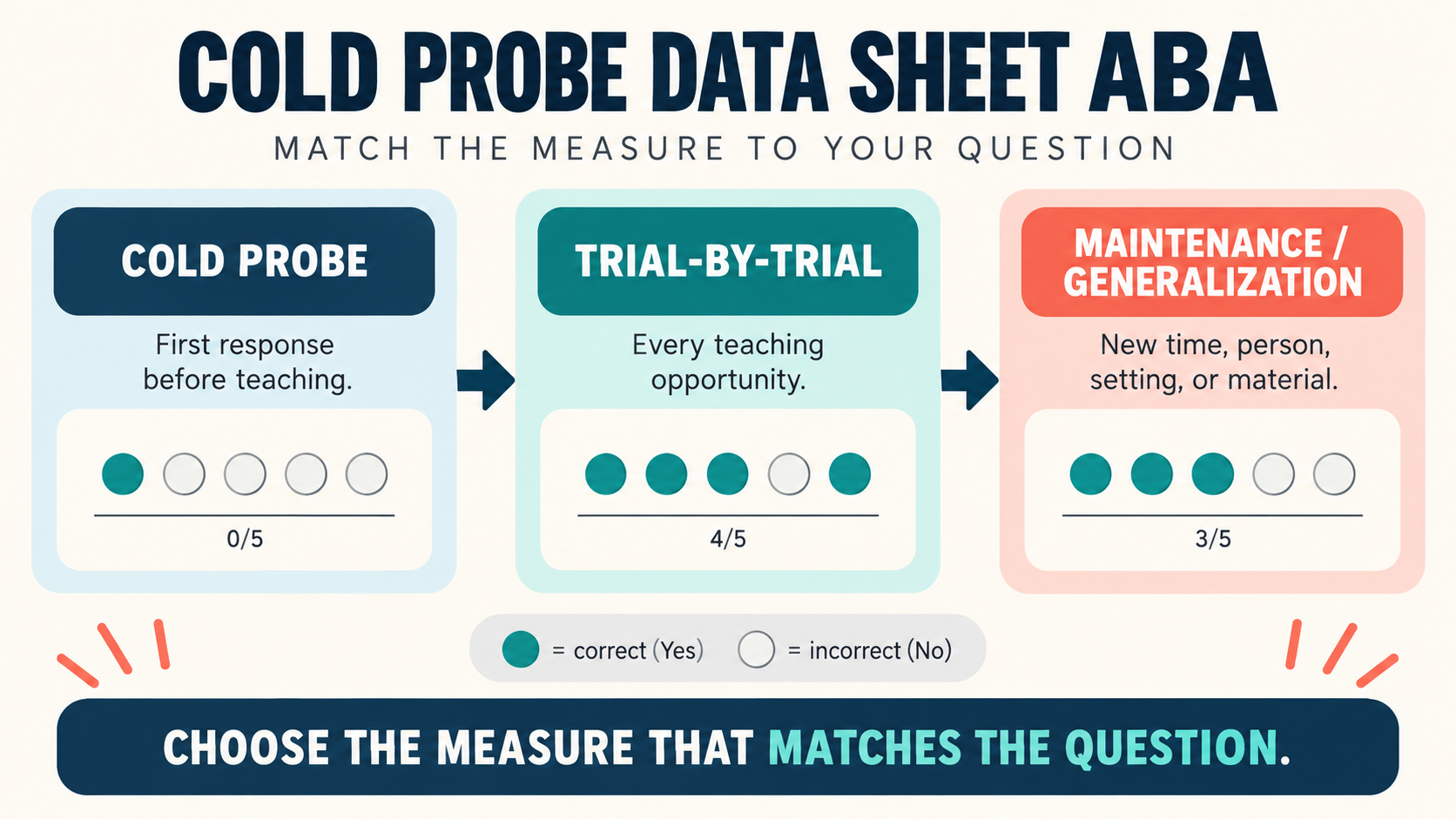
The best sheet depends on the question. A cold probe is useful when the team wants a quick sample of first-trial performance. A trial-by-trial sheet is better when each teaching opportunity matters and the team needs to see how prompting, reinforcement, errors, or response patterns change across the session. A maintenance or generalization probe is designed to ask whether the skill persists or transfers under a new condition.
Do not use “cold probe” as a substitute for every type of probe. If the team wants to know whether a skill occurs with a new person, setting, material, or instruction, name that dimension. A learner can score well on a familiar cold probe and still need generalization programming. Conversely, a low first-trial score may reflect a changed stimulus, unclear instruction, fatigue, or an untested response form rather than a broad loss of skill.
| Measure | Primary question | Common mistake |
|---|---|---|
| Cold probe | What happens before teaching support? | Counting a prompted response as independent |
| Trial-by-trial | How does performance change across teaching opportunities? | Recording only the first trial and calling it session performance |
| Maintenance or generalization probe | Does the skill persist or transfer? | Changing several dimensions without recording which one changed |
Common Cold Probe Data-Integrity Errors
Most problems are not caused by the grid design. They come from quietly changing the procedure. Use this review list before relying on the score:
- Teaching before measuring: prompting or correcting the target before the first-trial mark changes the measurement.
- Unclear response definitions: “close enough” creates different scores between observers.
- Moving materials: a new picture, item, distance, or instruction may test generalization instead of the original target.
- Mixing data types: putting a prompted teaching response in the same column as an independent cold-probe response hides the learning history.
- Assuming a percentage is mastery: a small sample describes those opportunities; the criterion must come from the program.
- Leaving out exceptions: illness, interruption, unusual latency, or a recording error should be documented rather than erased.
- Using the sheet without a decision rule: data collection should connect to a defined next step, not become paperwork with no programming consequence.
For quality assurance, have another trained observer review a sample of rows when feasible. The question is not whether both people like the sheet. The question is whether they can apply the operational definition and record the same outcome from the same opportunity. When the agreement is weak, repair the definition or training before interpreting a trend.
BCBA Exam Takeaways
For BCBA exam questions, keep the measurement logic separate from the name of the form. First identify what the question asks: baseline, acquisition, maintenance, generalization, prompting, or treatment progress. Then identify the response dimension and the relevant condition. A cold probe is not automatically the best answer just because it uses fewer trials.
- “Before teaching” points toward a first-trial or baseline-style probe.
- “Every opportunity” points toward trial-by-trial measurement.
- “New person, setting, material, or time” points toward generalization or maintenance.
- “Independent versus prompted” is a scoring distinction, not a decorative note.
- “4 out of 5” is a descriptive percentage unless a program criterion gives it a decision meaning.
- The form should make the antecedent, response, prompt condition, and scoring rule visible.
If you are reviewing measurement concepts, use the ABA data-collection methods guide for the broader cluster, then use the free BCBA mock exam to practice choosing a measure from a scenario. Practice questions can strengthen discrimination among measures, but they do not replace a supervisor-approved program definition or current BACB materials.
Frequently Asked Questions
Is a cold probe the same as baseline?: Not automatically. A cold probe can provide baseline-like information when it is collected before instruction under a defined condition, but “baseline” describes the phase and purpose of a measurement plan. The team should use the terminology that matches its program and design.
Should a prompted correct response count as correct?: Record it according to the program’s scoring system, but do not silently treat it as independent. A prompted correct response and an unprompted correct response answer different questions. If the sheet has only one score column, add a prompt-status field or revise the form before collecting a series of data points.
How many trials should a cold probe include?: There is no universal number for every skill. The supervisor and program should specify the number of targets or opportunities needed to answer the measurement question. A small, stable sample may be practical, but it should not be presented as a universal mastery rule.
Can I download a cold probe data sheet and use it unchanged?: A template can be a starting point, but review every field against the learner’s operational definitions, response window, prompt hierarchy, materials, and decision rules. A visually attractive form that cannot distinguish independent from prompted performance is not a complete measurement system. For targeted review, use our cold probe data sheet aba practice questions to apply the concept in exam-style scenarios.
Take the Free BCBA Mock Exam
Once you can separate first-trial measurement, teaching data, and maintenance or generalization checks, test the distinction in fresh scenarios. The free BCBA mock exam is a practice resource for reviewing measurement decisions; it is not a BACB product, does not guarantee an exam result, and does not replace current official guidance.
References
- Behavior Analyst Certification Board: Task Lists
- Behavior Analyst Certification Board: BCBA Handbook
- PaTTAN: Data Collection
- Peer-reviewed applied study using cold-probe data



