
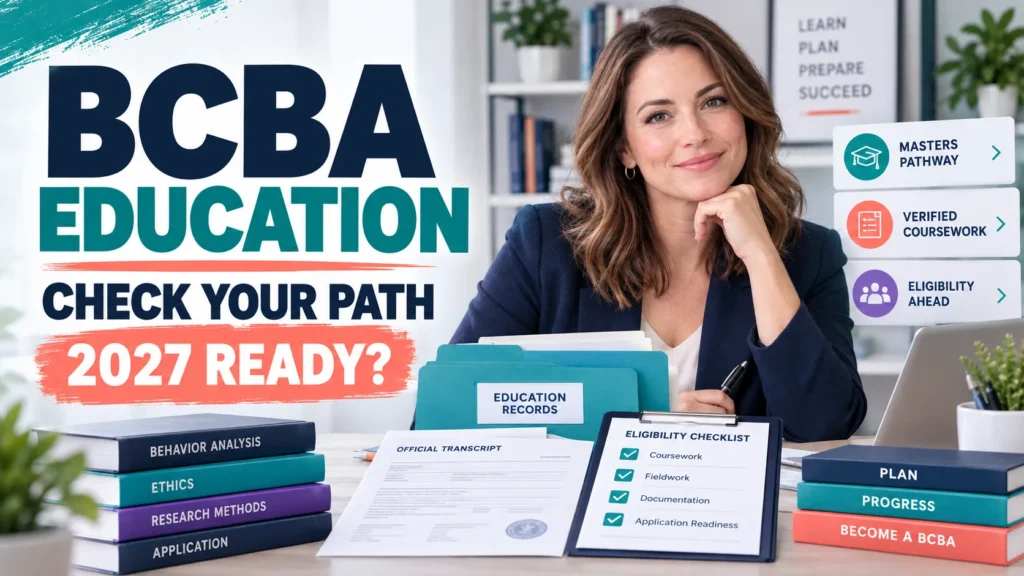
A practical evidence-audit checklist for matching your degree, coursework, transcript, fieldwork records, and application timing to the BCBA pathway you plan to use. Board certified behavior analyst education is more than choosing a graduate program. Before you apply, you need an evidence chain: the degree must fit the applicable pathway, the coursework must be documented, the transcript must support the coursework claim, and your fieldwork and application records must be ready for the same requirement year. A degree title by itself does not answer all of those questions.
Table of Contents
- Board Certified Behavior Analyst Education: What Must Be Verified
- Start With Your Application Date
- Audit the Degree and Program Evidence
- Audit Coursework and Transcript Evidence
- Add Fieldwork and Application Documents
- Common Education Audit Mistakes
- Frequently Asked Questions
- Quick Review Checklist
- Take the Free BCBA Mock Exam
This guide is designed as a pre-application audit, not as a personal eligibility determination. Start with the current BACB 2027 requirements overview, then verify the handbook, forms, and dates that apply to your situation. If your application timing is close to the 2027 transition, treat the official transition document as the controlling reference and ask your program or supervisor to review anything uncertain.
Board Certified Behavior Analyst Education: What Must Be Verified
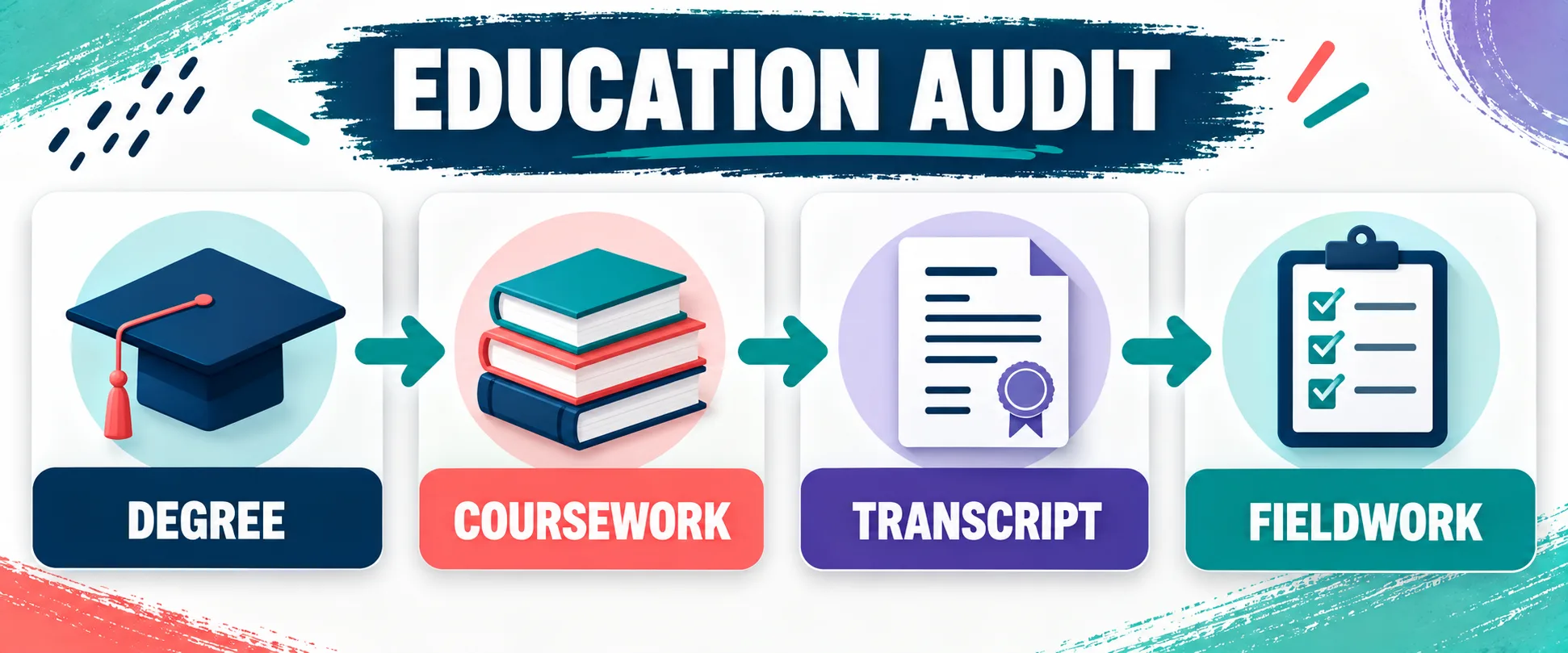
The cleanest way to review your education is to treat it as a sequence of linked records. First identify the pathway. Then identify the institution or program evidence that supports it. Next match the coursework to the transcript and the applicable requirement year. Finally, separate education evidence from fieldwork and application evidence so that a missing item does not disappear inside a broad checklist.
| Evidence area | What to verify | Why it matters |
|---|---|---|
| Pathway | Which BACB pathway and requirement year apply to your planned application? | The pathway determines which degree, coursework, and documentation rules you must follow. |
| Degree | Degree level, conferral record, institution, and any recognition or accreditation evidence. | A program’s marketing language is not a substitute for the official eligibility standard. |
| Coursework | Course titles, content, graduate-level credit, dates, grades, and the person who can attest to the record. | The transcript must support the coursework claim rather than merely list a related degree. |
| Fieldwork and application | Supervision records, forms, signatures, payment, and the application date. | Education can be complete while the application evidence is still incomplete. |
Use this table as a routing tool. If you are still deciding what to study, begin with the degree and program. If you already graduated, begin with the transcript and coursework evidence. If your records span different years, begin with the application-date question before assuming that an older checklist is current.
Start With Your Application Date
The 2027 BCBA transition makes timing part of the education audit. The BACB’s transition guidance distinguishes applications completed under the current requirements from applications submitted under the 2027 requirements. Do not choose a pathway only because an older article, forum post, or program webpage uses familiar language.
| Timing question | Audit action | Avoid this assumption |
|---|---|---|
| Applying before the transition | Read the current handbook and confirm what “complete application” means, including required documents and payment. | Finishing a class or opening an application automatically locks in the older rules. |
| Applying on or after January 1, 2027 | Use the 2027 pathway, coursework, fieldwork, and application documents that the BACB identifies for that date. | A current program webpage is guaranteed to reflect every 2027 documentation change. |
| Records cross requirement years | Save the official transition PDF, compare the conversion rules, and ask the program contact which record supports each requirement. | A course with a familiar name automatically satisfies a later content or hour rule. |
The practical rule is simple: write your intended application date at the top of your audit sheet, then use the official documents for that date. The BACB can review a formal application, but an informal webpage or a practice article cannot promise that a particular person is eligible. When a date or document is unclear, pause and obtain a current answer from the program, supervisor, or BACB process that applies to your case.
Audit the Degree and Program Evidence
A degree audit starts with the actual record, not the name of the major. Save the institution name, degree name, conferral date, transcript, and any accreditation or recognition evidence relevant to the pathway. An online format is not automatically the problem or the solution; the issue is whether the program and record satisfy the official pathway requirements.
For the 2027 requirements, the BACB describes defined pathways and changes to how applicants demonstrate eligibility. Pathway 1 and Pathway 2 do not mean “any master’s degree” and “any ABA electives.” They are routes with their own evidence expectations. Use the official 2027 BCBA requirements document to identify the route, then ask your university which office or contact can verify the record. At this stage, ask three questions:
- What exact degree record will show that the required degree was conferred?
- Does the program identify the applicable BACB pathway and requirement year?
- Who can answer a transcript or coursework question after graduation?
If the answers are vague, do not fill the gap with a different school’s checklist. Keep the issue open until you have a current official source or a written response from the responsible program contact.
Audit Coursework and Transcript Evidence
Coursework is where many education audits become unreliable. A degree may be behavior-analytic, but the eligibility record still has to show the applicable content, level, credit, timing, and grade information. The current BCBA Handbook explains the record and application boundaries; the 2027 transition document explains how the new framework affects applicants moving between requirement years.
Compare your transcript against the program’s course list rather than copying course names into a spreadsheet without evidence. Look for graduate-level designation, academic credit, the course date, the final grade, and the person or office responsible for a Pathway 2 attestation when that pathway applies. If a course was transferred, repeated, renamed, or completed outside the primary program, flag it for review.
| Transcript item | What to inspect | Question for the program |
|---|---|---|
| Course identity | Course number, title, syllabus or content description, and term completed. | Which current requirement area does this course support? |
| Level and credit | Graduate-level status, academic credit, credit value, and institution. | Does the record meet the pathway’s level and credit rules? |
| Grade | Final grade and whether a pass, transfer, or substitution needs an explanation. | Is this grade accepted for the applicable requirement year? |
| Attestation | Program contact, current attestation process, and supporting records. | Who is authorized to verify the coursework record? |
For 2027 planning, also check whether your program is using a changed course structure or a conversion rule. The transition guide reports a 315-hour coursework framework for the 2027 pathway; do not infer that a single old course list automatically converts to it. Record the source, date, and program response beside each item so you can distinguish verified evidence from an assumption.
Add Fieldwork and Application Documents
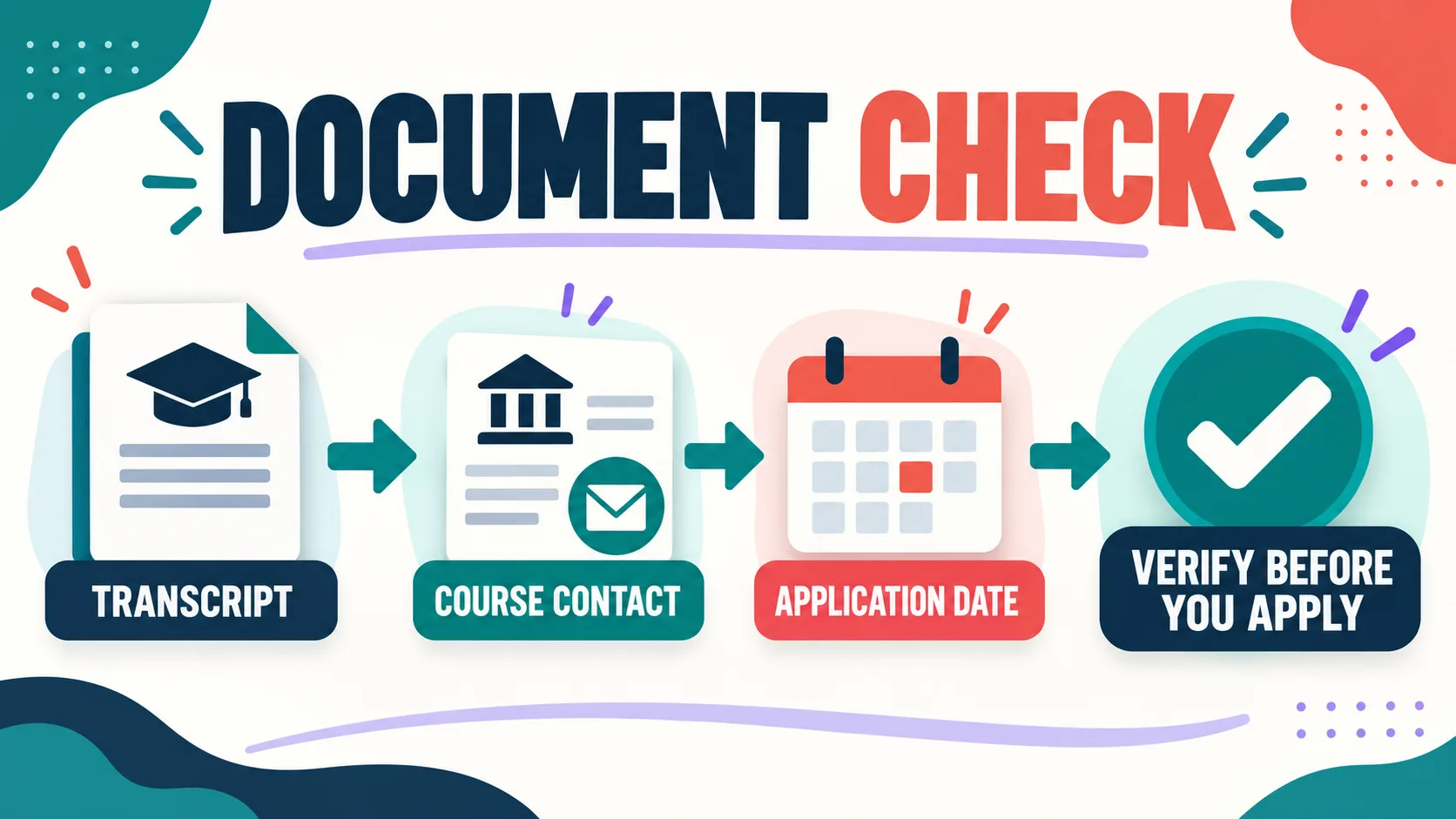
Education is only one part of the application file. Fieldwork supervision records, monthly documentation, signatures, and the application itself belong in a separate evidence column. Keeping them separate prevents a completed transcript audit from creating false confidence that the entire application is ready.
Use the BACB’s current forms and application-processing updates when you check signatures, document versions, and submission instructions. Your fieldwork supervisor should be able to explain which records support your fieldwork pathway and which dates matter. If you are changing requirement years, save both the transition guidance and the form version that matches your plan. A final pre-application check should answer:
- Can I identify the pathway and requirement year in one sentence?
- Can I point from each education claim to a degree record, transcript entry, or program attestation?
- Are fieldwork, supervision, and application documents tracked separately?
- Have I checked the current official form and application instructions immediately before submitting?
Once the documentation is organized, use the BCBA prerequisites and eligibility pathways guide for the broader roadmap, then test your exam-readiness knowledge with the Free BCBA Mock Exam. A practice result can reveal study gaps, but it cannot replace official eligibility review.
Common Education Audit Mistakes
Mistake 1: treating the degree title as the whole answer. A degree name is one record. Coursework, transcript, pathway, and timing complete the evidence chain. Mistake 2: using a pre-2027 checklist without checking the date. Requirement transitions can change both the route and the documents. Put the intended application date at the top of the audit. Mistake 3: counting course names instead of verifying content and credit. A familiar title does not prove that the course satisfies the applicable rule. Save the transcript and the program’s current explanation. Mistake 4: mixing fieldwork with education evidence. A strong transcript cannot repair incomplete supervision records, and a complete fieldwork file cannot prove an education requirement. Mistake 5: asking a general forum to decide personal eligibility. Use public resources to organize questions. Use the official process, program contact, supervisor, or BACB guidance for the decision that applies to your record.
Frequently Asked Questions
What degree do I need for BCBA education?: The answer depends on the BACB pathway and requirement year that apply to your application. Start with the official 2027 requirements or current handbook, then verify the degree record, program evidence, and related coursework. Do not rely on a degree title alone.
Is a master’s in ABA automatically enough?: No single program label should be treated as an automatic eligibility decision. Audit the degree, pathway, coursework, transcript, dates, grades, and any required attestation or program contact. The institution’s marketing page is not the same as an official review of your application.
How should I prepare for the 2027 BCBA education changes?: Write down your intended application date, read the BACB transition guidance, and ask your program which pathway and document set support that date. If your coursework spans requirement years, keep a written conversion or verification record instead of assuming that old and new lists are interchangeable.
Do fieldwork hours count as education evidence?: Fieldwork is a separate evidence area. Track supervision, monthly records, forms, and signatures independently from your degree and coursework audit. Both parts may be needed, but one does not replace the other.
What is the fastest way to check whether my BCBA education file is organized?: Use four folders or columns: degree and program, coursework and transcript, fieldwork and supervision, and application and timing. Every claim should point to a record or an official source. Anything that cannot be traced should remain an open question before you apply.
Bottom line: Strong board certified behavior analyst education planning is an evidence audit. Confirm the pathway and date, verify the degree, reconcile coursework with the transcript, separate fieldwork documents, and use current BACB sources before submitting an application.
Quick Review Checklist
Use this final checklist to turn board certified behavior analyst education into exam-ready reasoning. The goal is not to memorize a label in isolation; it is to identify the relevant evidence and explain why the best answer fits the scenario. Key ideas to review:
- State the central definition or decision point for board certified behavior analyst education in your own words.
- Identify the detail that makes board certified behavior analyst education different from its closest related ABA term.
- Separate the observable facts in a scenario from assumptions that are not supported by the facts.
- Write one example and one nonexample so you can recognize the concept in a new setting.
Exam application checks:
- Ask what the question is actually requesting before comparing the answer choices.
- Mark the antecedent, response, consequence, or other evidence that supports the selected answer.
- Look for a distractor that describes a related process but does not answer the specific question.
Final self-check:
- Explain how you would verify the interpretation with clear observations or data.
- Change one detail in the scenario and decide whether your answer should change.
- Give a one-sentence rationale that a supervisor or study partner could evaluate.
Take the Free BCBA Mock Exam
When you are ready to apply the idea, use the free practice resource below for additional feedback. Take the Free BCBA Mock Exam



