
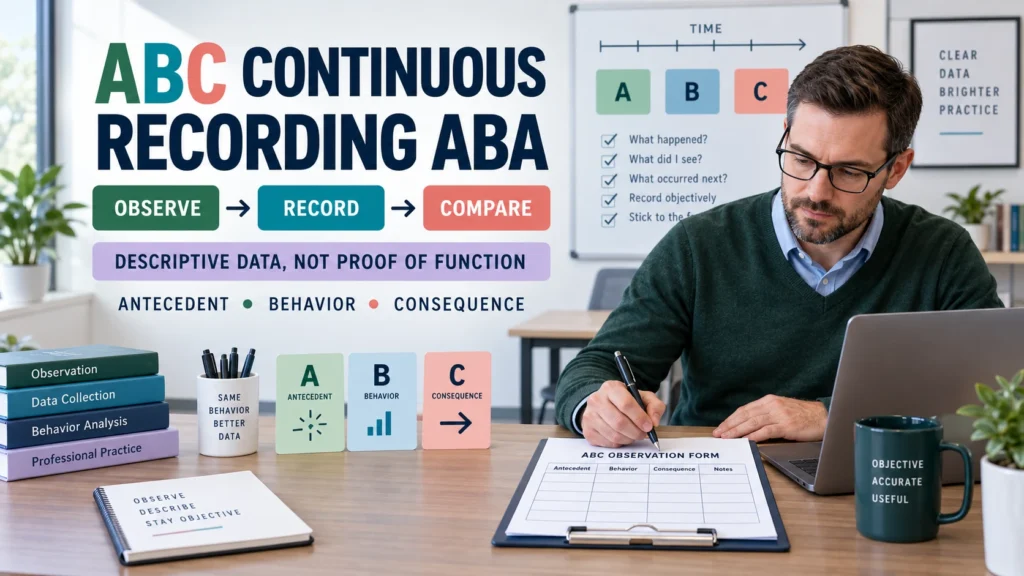
Short answer: abc continuous recording aba is a direct, descriptive way to record each observable target episode and the surrounding antecedent and consequence events during a defined observation window. The observer writes what happened before, what the behavior looked like, and what happened immediately after each episode. The result can reveal patterns for a hypothesis, but it does not prove the behavior’s function.
Table of Contents
- What ABC Continuous Recording ABA Means
- ABC Continuous Recording vs. Continuous Measurement
- ABC Continuous Recording vs. ABC Narrative Recording
- Choose the Observation Window and Definition
- Record Antecedent, Behavior, and Consequence in Order
- Work Through an ABC Continuous Recording Example
- Keep Descriptive Data Separate From Function
- Check Observer Accuracy and Missing Entries
- Know When Continuous Recording Is Not Practical
- Use ABC Data in a Broader Assessment
- Common Recording Mistakes
- Frequently Asked Questions
- Sources
The word continuous describes the observation and recording opportunity: the observer stays engaged throughout the specified window and records qualifying events rather than checking only selected intervals. ABC continuous recording is therefore different from a general ABC narrative note, a partial-interval sample, or a simple count that leaves out the surrounding context.
This guide is for study and measurement planning. The operational definition, recording form, observation length, privacy safeguards, and assessment decisions should come from the responsible behavior analyst and current service plan. For exam alignment, compare the method with the current BACB BCBA Test Content Outline, including the distinction between continuous and discontinuous measurement and the design of descriptive assessments.
What ABC Continuous Recording ABA Means
ABC stands for antecedent, behavior, and consequence. In an ABC continuous record, the observer captures a sequence for each defined episode during the observation period:
- Antecedent: the observable event or condition immediately before the response, such as an instruction, transition, denied item, peer interaction, or change in materials.
- Behavior: the response as defined by its observable form, not a label such as “noncompliance” or “attention seeking.”
- Consequence: what happened immediately after the response, including changes in tasks, materials, adult behavior, peer behavior, or access to an item.
The record is descriptive because it reports events as they occurred in a natural setting. It is not an experimental manipulation. The observer does not arrange a test condition simply by writing down what happened, and a repeated sequence is not proof that the consequence maintained the behavior.
| Field | Record | Do not replace it with |
|---|---|---|
| Antecedent | What was observable immediately before the response. | “The learner was triggered” or another inferred state. |
| Behavior | The response that meets the operational definition. | A function label such as escape, tangible, or attention. |
| Consequence | What changed or followed immediately after the response. | “The behavior was reinforced” before an assessment supports that conclusion. |
ABC Continuous Recording vs. Continuous Measurement
Continuous measurement and ABC continuous recording overlap, but they answer different questions. Continuous measurement is a family of procedures that captures every detectable occurrence or a relevant response dimension throughout an observation. Frequency, rate, duration, latency, and interresponse time can all be continuous measures when the observer records them according to the defined procedure.
ABC continuous recording adds environmental context to each target episode. It may include a count of episodes, but its primary value is the ordered description of what occurred before, during, and after each event. A practitioner may use both: an event count to summarize occurrence and an ABC record to examine the contexts surrounding selected episodes.
The current BACB outline asks candidates to distinguish continuous from discontinuous measurement and to select a method that accounts for the critical dimension of behavior and environmental constraints. “Continuous” is not automatically the best choice. The method must be feasible for the observer and sensitive to the question being asked.
ABC Continuous Recording vs. ABC Narrative Recording
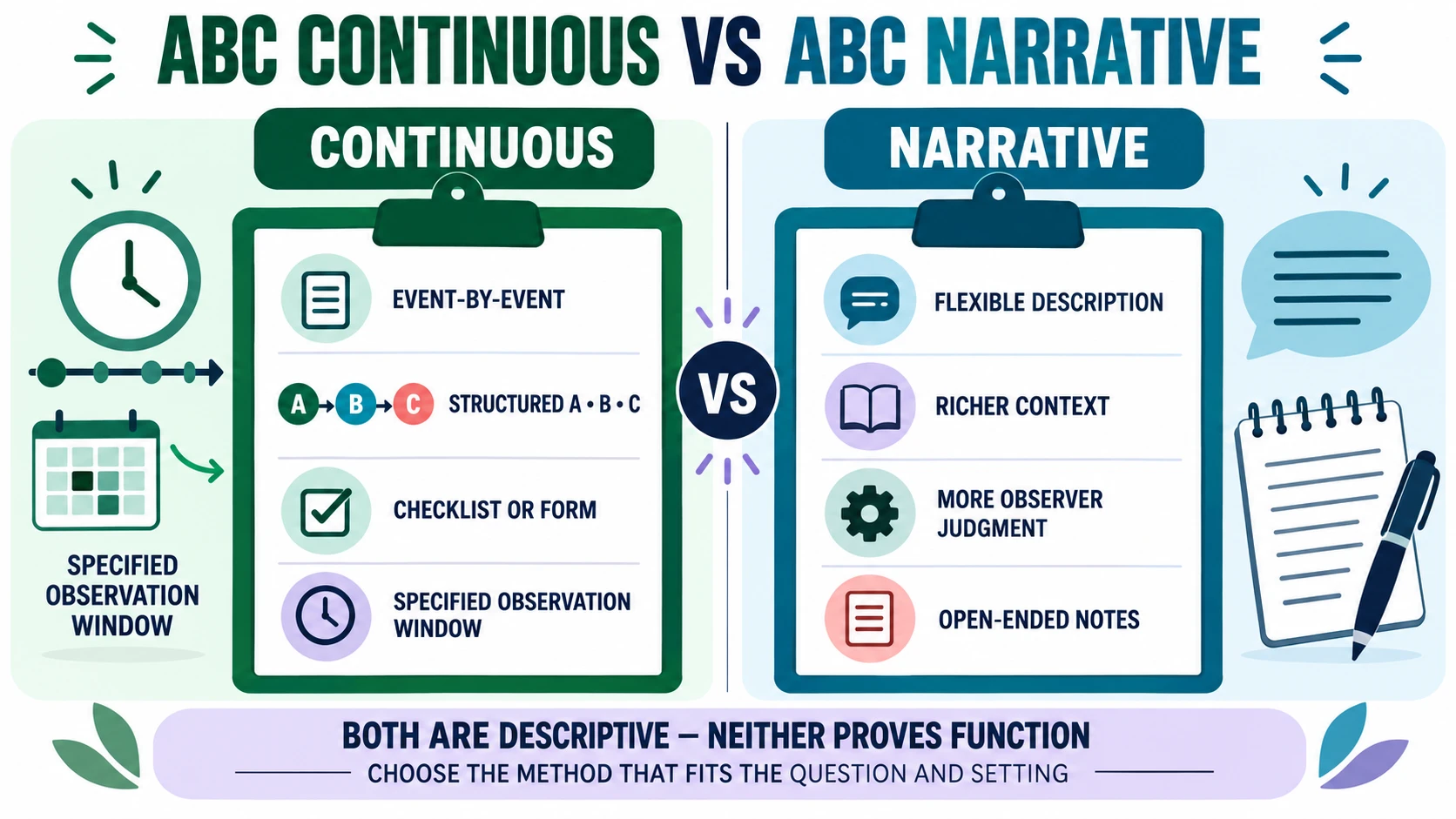
Both methods describe antecedent-behavior-consequence sequences, but their structure differs. ABC continuous recording generally uses a defined observation window and a structured, event-by-event form. ABC narrative recording is more open-ended: the observer writes a brief description of each episode in natural language and may capture richer context, but the entries can vary more across observers.
| Question | ABC continuous recording | ABC narrative recording |
|---|---|---|
| Structure | Structured A-B-C fields or a coded checklist for each episode. | Open-ended notes in the observer’s words. |
| Strength | Makes event-by-event comparison and consistent coding easier. | Can preserve context that a narrow form would omit. |
| Risk | The observer may miss events when the setting is busy or behavior is high-rate. | Different observers may write different levels of detail or inference. |
| Best fit | A defined question where event sequence and consistent categories matter. | Early exploration when broad contextual detail is important. |
Do not choose a method because its name sounds more precise. Choose it because the observer can use it reliably, the form matches the operational definition, and the resulting data support the decision without overstating what was observed.
Choose the Observation Window and Definition
Before collecting data, specify when observation begins and ends, where it occurs, who is observing, and what counts as an episode. A continuous record without boundaries can quietly turn into selective note-taking. The observation window should be long enough to encounter the relevant context but practical enough for the observer to record accurately.
- Operational definition: describe the response in observable, countable terms and include start and stop boundaries when needed.
- Observation window: name the date, setting, activity, start time, end time, and any planned interruptions.
- Recording rule: state whether one episode ends before another can begin and how repeated topographies are handled.
- Context fields: include only the setting events needed for the assessment question; avoid collecting unnecessary private information.
- Observer role: identify whether the observer is participating in service delivery or observing independently, because that can affect what can be recorded.
If the definition is unclear, fix the definition before arguing about the data. Two observers can disagree honestly when the form does not say whether a brief pause ends an episode or whether multiple responses within one burst count separately.
Record Antecedent, Behavior, and Consequence in Order
Use the same sequence for every entry. First write the event before the response, then the observable response, then the immediate outcome. Keep the wording concrete and time-linked. If the observer is unsure, record the uncertainty or mark the field as not observed rather than filling it with a function label.
For example, “The instructor placed a worksheet on the table and said, ‘Complete the first three problems’” is an antecedent. “The learner pushed the worksheet onto the floor with both hands” is a behavior if it matches the definition. “The instructor picked up the worksheet, paused the demand, and offered a break” is the immediate consequence. The entry does not need to say that the behavior was caused by escape or that the break reinforced it.
When several events occur close together, preserve the order and note the relevant timing. If the consequence is not visible, write “not observed” and continue according to the form. A blank field can look like missing data; an explicit limitation tells the analyst what the record can and cannot support.
Work Through an ABC Continuous Recording Example
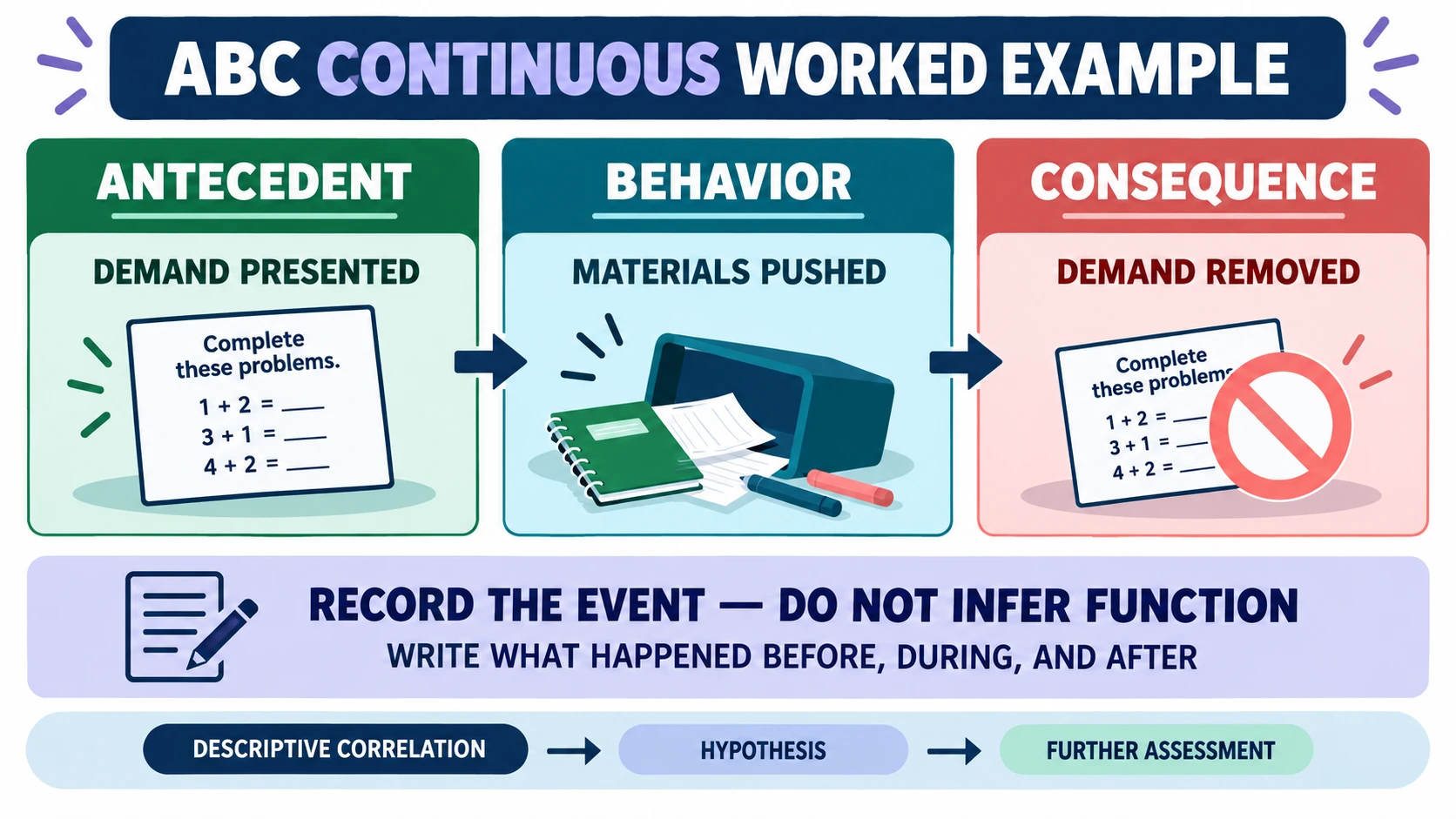
Imagine a defined target response of pushing instructional materials at least 10 centimeters away with one or both hands. During a math activity, the instructor presents a worksheet and gives a clear direction. The learner pushes the materials away. The instructor removes the worksheet and offers a brief break. A single entry would record those three observable components in order.
If the same sequence occurs again after the worksheet is represented, the record may show a recurring correlation between the demand context, material pushing, and the adult response. That pattern can help the behavior analyst decide what information to gather next. It is not permission to conclude that the behavior has an escape function or to change the plan without assessment and clinical direction.
A useful review asks: Did the antecedent occur in the same form each time? Was the target behavior defined consistently? Did the consequence actually follow the response? Were there other events between the response and the outcome? Were episodes omitted because the observer was implementing instruction, helping another person, or recording a different measure?
Keep Descriptive Data Separate From Function
ABC data can suggest a hypothesis because it organizes repeated environmental sequences. It does not demonstrate experimental control. A consequence that follows a behavior may be a response to the behavior, a coincidental event, or part of a larger interaction. A functional analysis or another assessment process is the place to evaluate function under arranged conditions when that is clinically appropriate.
Use cautious language in the record: “In 4 of 6 observed episodes, the instruction was followed by material pushing, and the task was paused within 10 seconds.” Avoid: “The learner pushed to escape.” The first statement reports the sample. The second claims an explanation that the sample alone cannot establish.
This boundary matters for treatment decisions, communication, and ethics. Descriptive records should not be used to justify a new consequence, diagnosis, or restrictive procedure without the qualified professional’s review and the required assessment process.
Check Observer Accuracy and Missing Entries
Accuracy is not just neat handwriting or a complete-looking form. The observer needs to detect the defined response, identify the relevant context, record events in the right order, and distinguish observation from interpretation. Use training, modeling, practice, and direct feedback before relying on the record for a consequential decision.
- Compare definitions: have observers explain what counts and what does not count before collecting.
- Practice with examples: use video or role-play when permitted and compare entries after the same event sequence.
- Check for omissions: note periods when the observer was unable to watch or record continuously.
- Review agreement: when clinically appropriate, arrange an independent observer or an approved reliability check; do not pretend agreement exists when observers recorded different opportunities.
- Audit the form: check that timestamps, A-B-C fields, setting, and observer information are complete and secure.
A high number of entries is not automatically better data. If the observer cannot attend to the learner and record each event, the team should discuss a different method or a different observation arrangement rather than labeling incomplete notes as continuous.
Know When Continuous Recording Is Not Practical
Continuous observation can be demanding when the target is frequent, the setting has multiple people, the observer is also teaching, or several behaviors compete for attention. In those conditions, missed events can create a false impression of low occurrence or a distorted A-B-C pattern.
Discontinuous methods such as partial-interval recording, whole-interval recording, or momentary time sampling reduce the recording burden by sampling time, but they answer a different question and can introduce measurement error. A rate, duration, latency, permanent-product, or structured sampling method may be more appropriate depending on the critical dimension and environmental constraints. The current method should be selected by the responsible analyst, not chosen only because it is familiar.
| Situation | Question to ask | Possible response |
|---|---|---|
| Low-rate, discrete response | Can the observer detect every episode and its surrounding context? | ABC continuous recording may be feasible if the definition is clear. |
| High-rate or overlapping behavior | Will the observer miss events or merge episodes? | Consider a different measure or a structured sample with known limits. |
| Observer is implementing | Can the person deliver the procedure and record without sacrificing either? | Add an observer, shorten the window, or change the collection plan. |
Use ABC Data in a Broader Assessment
ABC continuous recording is one source of descriptive information. Combine it, when appropriate, with interviews, record review, direct measurement, preference or skill assessments, and the client’s and family’s priorities. Keep track of which source supports which conclusion. A pattern in ABC data should lead to a focused question, not a shortcut around assessment.
For BCBA exam preparation, connect this topic to operational definitions, direct versus indirect measurement, continuous versus discontinuous procedures, descriptive assessment, measurement validity, and the limits of correlational evidence. A question may use the same A-B-C labels while testing whether you can distinguish observation from experimental analysis.
Common Recording Mistakes
- Using function labels: writing “escape” in the consequence field instead of describing what the adult or environment did.
- Skipping the behavior definition: treating “tantrum” or “aggression” as self-explanatory.
- Recording only the most dramatic episode: calling a selective sample continuous.
- Changing the plan while observing: arranging a new consequence and then treating the record as naturalistic data.
- Confusing correlation with causation: treating a repeated sequence as proof of function.
- Ignoring missing opportunities: presenting a busy session’s partial notes as a complete record.
- Mixing methods: using interval samples, event counts, and ABC narratives without labeling which method produced each result.
- Sharing identifiable details: placing names, images, or unnecessary clinical information in study examples or unsecured files.
Frequently Asked Questions
What does continuous mean in ABC continuous recording?: It means the observer has a defined observation window and records qualifying episodes as they occur throughout that window, rather than checking only selected intervals. The exact recording rule still depends on the operational definition and form.
Does ABC continuous recording prove a behavior’s function?: No. It is descriptive and can reveal correlations that help form a hypothesis. It does not provide experimental control by itself, so function claims require the appropriate assessment process and qualified clinical review.
Is ABC continuous recording the same as ABC narrative recording?: No. Both describe antecedents, behaviors, and consequences, but continuous recording is usually more structured and event-by-event, while narrative recording is more open-ended and may preserve broader context.
What should I do if I cannot record every event?: Document the limitation honestly and consult the responsible analyst about changing the observer arrangement, shortening the window, or selecting a method that fits the behavior and setting. Do not call incomplete notes continuous without qualification.
Bottom line: abc continuous recording aba means observing a defined window, recording each qualifying A-B-C sequence, and interpreting the result as descriptive evidence—not proof of function. For a separate measurement study checkpoint, try our abc continuous recording aba study companion and Take the Free BCBA Mock Exam. It is a practice resource, not an official BACB product.
Sources
- BACB BCBA Test Content Outline (6th ed.)
- Procedures and Accuracy of Discontinuous Measurement of Problem Behavior in Common Practice of Applied Behavior Analysis
- ABC Continuous Recording glossary overview
- Two Variations of ABC Data, Explained



